Updates: Recent Science Fiction Acquisitions No. CLV (Herbert + Tucker + Saberhagen + England Swings SF anthology)

A person with the initials K.W.G ditched their entire SF collection at my local Half Price Books.  So many books that the store made a new SF anthology section that did not exist a few months ago and the “vintage” SF books made up more than half the non-vintage SF section.  I spent too much money.  One of many future SF Acquisitions posts featuring books from the mysterious K. W. G….

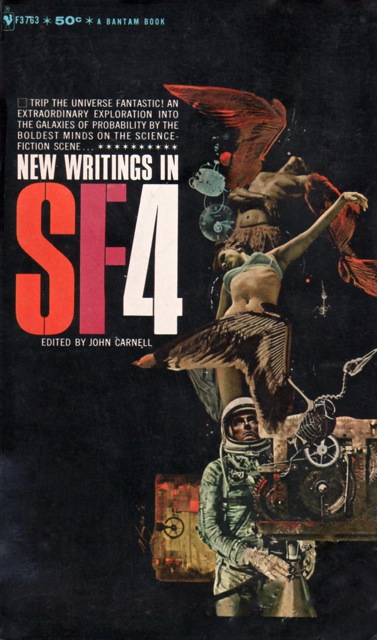
A famous anthology important for showcasing UK authors in America!  I’ve included the lengthy description of the collection by Ace and their position vis-à-vis New Wave SF.  I find it humorous that the publisher has to defend their position!

An often praised 1950s post-apocalyptical novel by Wilson Tucker….  My 1969 edition was “rewritten” by the author–unfortunately, I have already started reading it (not sure how much it will tell me about  its position in 1950s SF if it were rewritten in the 60s).  Perhaps someone knows how much was changed?  Admiral Ironbombs wrote a worthwhile review here.

Fred Saberhagen’s best known work.

And one of the few Frank Herbert novels I have not read…

Thoughts and comments are always welcome.

1. England Swings SF: Stories of Speculative Fiction, ed. Judith Merril (1968)

NGLNDSWNGS1970

(Ron Walotsky’s cover for the 1970 edition) Continue reading

Book Review: The Eclipse of Dawn, Gordon Eklund (1971)

THCLPSFDWN1971

(Diane and Leo Dillon’s cover for the 1971 edition)

3.25/5 (Vaguely Good)

“I hadn’t even voted in the last election.  I knew nothing about it, except Robert Colonby, how he wanted to make America strong again, how he said we ought to exert ourselves” (15).

Gordon Eklund’s first novel Eclipse of Dawn (1971) tells of a future dystopic America (the year 1988) chaffing under foreign quarantine and suffering from a major race war which results in African-Americans creating an autonomous political entity in the American South.  The effects of limited nuclear war spawns a poisonous urban environment and microclimates across the state of California. A return to “Victorian morality” presents but a facade of “purity laid across a morass of fear and guilt” (94).

Robert F. Colonby sets out from his residence amidst the bombed-out remains of Disneyland, where he dines on exotic cuts of meat and “wines dated back to the glory days” Continue reading

Updates: Recent Science Fiction Acquisitions No. CLIII (Wolfe + Lichtenberg + Brown + Davidson)

One of the least known works on David Pringle’s The 100 Best Novels between 1949-1984 list and soon to be published as a Gollancz Masterwork…  For reference here’s a link to the list. Hopefully the Gollancz publication will bring the price down! (paperbacks go for ~30$ online).

A collection from a prolific 50s/60s primarily short-fiction SF author who died too young (at 41 due to lymphoma)….

Another Avram Davidson novel…

And a suspicious work by Jacqueline Lichtenberg described as for “admirers of the Early Heinlein”—of which I am obviously not.  But, then again, the way presses marketed new women authors took on strange guises in the period.  It might not feel like Heinlein in the slightest!

Two gorgeous covers by Richard Powers!

As always, thoughts and comments are welcome.

1. A Handful of Time, Rosel George Brown (1963)

Screen Shot 2016-07-08 at 10.56.16 AM

(Richard Powers’ cover for the 1963 edition) Continue reading

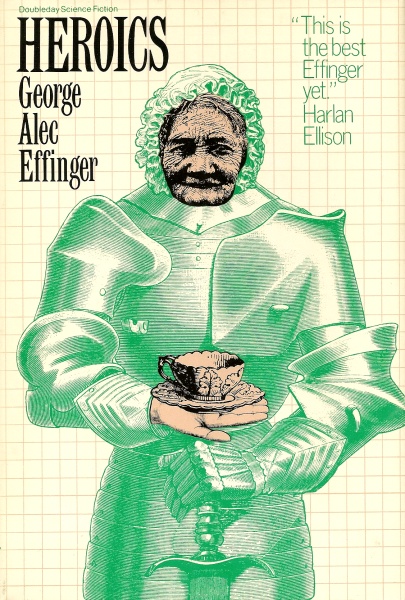
Book Review: Heroics, George Alec Effinger (1979)

HEROICS1979

(Gary Friedman’s cover for the 1979 edition)

4.25/5 (Good)

George Alec Effinger’s What Entropy Means to Me (1972), a complex and intense homage to the act of literary creation, ranks among my favorite SF novels.  Heroics (1979), a deconstruction of myth and heroic quest,  treads similar ground but in a more light-hearted manner.  The sheer intensity elevates the former while the latter’s sincere examination of old age and loneliness still strikes with elegiac power.  Both are highly recommended but What Entropy Means to Me or his short story collection Irrational Numbers (1976) might be the place to Continue reading

Short Book Reviews: Theodore Sturgeon’s Venus Plus X (1960), Christopher Priest’s The Affirmation (1981), and Barry N. Malzberg’s Screen (1968)

Cycle: read a book, place it in the review pile, the immediacy of the novel fades slightly or the novel fights every moment of the review writing process (–> Priest’s masterpiece The Affirmation), never review it, feel bad that I never reviewed the novel, read less in order to catch up…

Result: less reading and more pouting.

Remedy: In order to catch up, here are short/less intensive reviews with links to in-depth analysis (if it exists).  Part I + II (books by Budrys, Strete, White, Bishop, etc).

1. Venus Plus X, Theodore Sturgeon (1960)

VNSPLSX1960

(Victor Kalin’s cover for the 1960 edition) Continue reading

Updates: Recent Science Fiction Acquisitions No. CLII (Silverberg + Reed + Robinson + Reamy)

More Kit Reed! I enjoyed both her first short story collection Mister Da Vi (1967) and first SF novel Armed Camps (1969).  I was impressed enough to track down another—and as she has informed me via twitter “rare”—collection.  Rare enough that she does not even own a copy!

Fresh off Tom Reamy’s dark and wonderful Blind Voices (1978), I thought it would be best to explore some of his early short fiction.

There’s nothing wrong with another Robert Silverberg collection from his heyday (late 60s-70s), although, I have read at least two of the thirteen stories in the collection already.

Frank M. Robinson in the early 90s jumped back on the SF scene with the well-received generation ship novel The Dark Beyond the Stars (1991).  More involved with editing over the decades, he published in the 70s a series of famous thrillers with Thomas N. Scortia.  I found a copy of his first novel, The Power (1956), although, the presence of telepathy (my least favorite SF theme?) makes me less than enthused.

Three of the four following books came via Mike at Potpourri of Science Fiction Literature and Tongues of Speculation—he visited Uncle Hugo’s in Minneapolis and sent me 10 (!!) books I had on my “to acquire” list.

Thoughts and comments are welcome (as always!).

1. Unfamiliar Territory, Robert Silverberg (1973)

NFMLRTRRTR1978

(Paul Alexander’s cover for the 1978 edition) Continue reading

Book Review: Blind Voices, Tom Reamy (1978)

BLNDVCS1978

(David Plourde’s cover for the 1978 edition)

4.25/5 (Very Good)

Tom Reamy’s Blind Voices (1978) was nominated for the Nebula, Hugo, and BFSA awards and came in second in Locus voting for best novel in 1979.  Posthumously released, Reamy died of a heart attack while writing in the fall of 1977 at 42.  His take on small town America transformed by the arrival of a traveling circus and its array of wonders will stay with you for years to come.  The science fiction elements (revealed more than halfway through the novel) interlace and add to the elegiac and constrained fantasy feel.  The specter of sexuality and violence Continue reading

Adventures in Science Fiction Cover Art: The Brothers Quay and SF covers

SCNNRDRKLM1977

(Cover by the Brothers Quay for the 1977 edition of A Scanner Darkly (1977), Philip K. Dick)

While looking through the cover catalogue to celebrate Octavia E. Butler’s birthday on twitter (@SFRuminations), I found that her first novel Patternmaster (1976) was graced with a cover by Stephen and Timothy Quay—as in, the famous stop-motion (and more recently, live action) film directors know collectively as Brothers Quay!  If you’ve never seen their work, check out The Street of the Crocodiles (1986).

Brothers Quay—along with Guy Maddin, Jan Švankmajer, Wojciech Has, Juraj Herz (for The Cremator, 1969) among others—have long been among my cinematic cornerstones, and to discover that they created SF covers certainly made my day!  I have included a series of stills from their films below—creepy, gorgeous, incredibly well-crafted, (the adjectives could continue for pages).   Continue reading

Updates: Recent Science Fiction Acquisitions No. CLI (Wilhelm + Oliver + Coney + Anthology)

Prepare for a glut of “Recent Science Fiction Acquisition” posts!

From my recent travels and a gift from a friend (@SFPotpourri)….

Michael G. Coney is an odd bird.  If you’re curious what I might mean, check out my reviews of Friends Come in Boxes (1973) and Hello Summer, Goodbye (variant title: Rax) (1975).  In short, I had to procure a short story collection!

Chad Oliver, an early proponent of anthropological SF, intrigues yet frustrates—I need to read more than The Shores of Another Sea (1971) to come to a firm conclusion about his fiction.

And Kate Wilhelm, my views are firmly established — in the spring of last year I put together a Kate Wilhelm guest post series.  Check it out!  I’ve posted reviews for the following: her early collection (for fans of 50s SF only) The Mile-Long Spaceship (1963), her spectacular collection with numerous award-winning stories (for fans of experimental SF) The Downstairs Room and Other Speculative Fiction (1968), her solid SF + psychological horror novel Margaret and I (1971), and her even better novel Juniper Time (1979).

And New Dimensions IV (1974), an anthology edited by Silverberg—with a story from one of the unsung SF greats, David R. Bunch.  I have discussed but not reviewed his collection Moderan (1972).  I placed it on my top 10 SF works (pre-1980) for inclusion in the Gollancz Masterwork series list.  And, has anyone read Felix C. Gotschalk?  It contains two stories by this unknown (at least to me) author.  An overall fantastic lineup (Malzberg, Lafferty, Dozois, Bunch, etc.)….

Thoughts? comments?

[does anyone know the artist for the Silverberg edited anthology?]

1. Monitor Found in Orbit, Michael G. Coney (1974)

MNTRNRBTBE1974

(Kelly Freas’ cover for the 1974 edition) Continue reading