Short Book Reviews: Clifford D. Simak’s They Walked Like Men (1962) and Jacques Sternberg’s Sexualis ’95 (1965, trans. 1967)

Note: My read but “waiting to be reviewed pile” is growing. Short rumination/tangents are a way to get through the stack before my memory and will fades. My website partially serves as a record of what I have read and a memory apparatus for future projects. Stay tuned for more detailed and analytical reviews.


1. They Walked Like Men, Clifford D. Simak (1962)
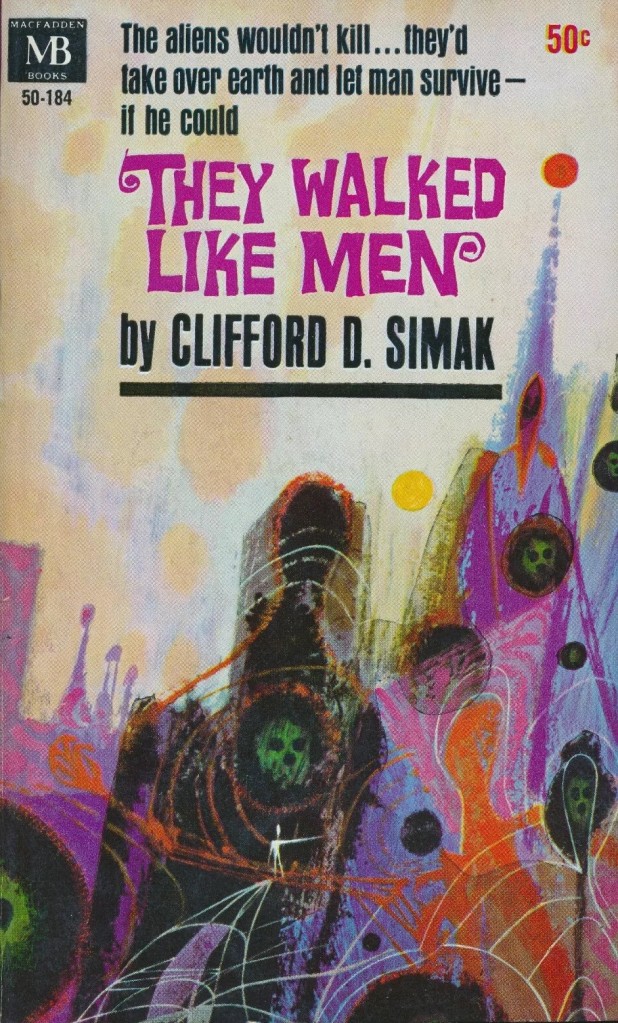
3/5 (Average)

In a confrontation with maleficent alien land prospectors in Clifford D. Simak’s They Walked Like Men (1962), the main character ruminates that “it was almost if [we] were acting out an old morality play, with the basic sins of mankind enlarged a millionfold to prove a point by exaggeration” (113). Simak’s moment of meta-commentary on his own narrative and tonal choices gives shape to odd conjuration of juvenile comedy and apocalyptic extrapolation of capitalism unleased.

Continue reading
What pre-1985 science fiction are you reading? + Update No. XII

What pre-1985 science fiction are you reading or planning to read this month?

Here’s April’s installment of this column.

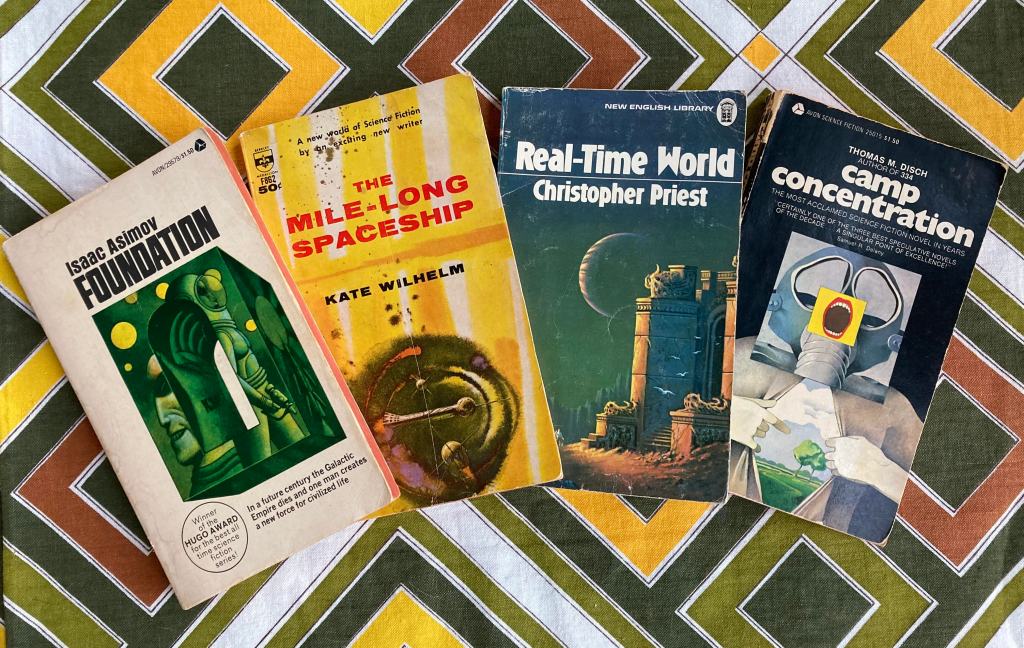
First, a bit about Isaac Asimov’s Foundation (1951) from M. Keith Booker’s Monsters, Mushroom Clouds, and the Cold War: American Science Fiction and the Roots of Postmodernism, 1946-1964 (2001), my current history of science fiction read:

Continue reading

Short Story Reviews: Clifford D. Simak’s “Masquerade” (1941) and “Tools” (1942)

Today I’ve selected two early Clifford D. Simak “apprentice” stories–“Masquerade” (1941) and “Tools” (1942)–deeply critical of the American business ethic.1 Collectively they posit a future in which colonization goes hand-in-hand with the exploitation of resources, workers, and threatens the alien intelligences they encounter.2

Welcome to a future of capitalistic vastation!


3/5 (Average)

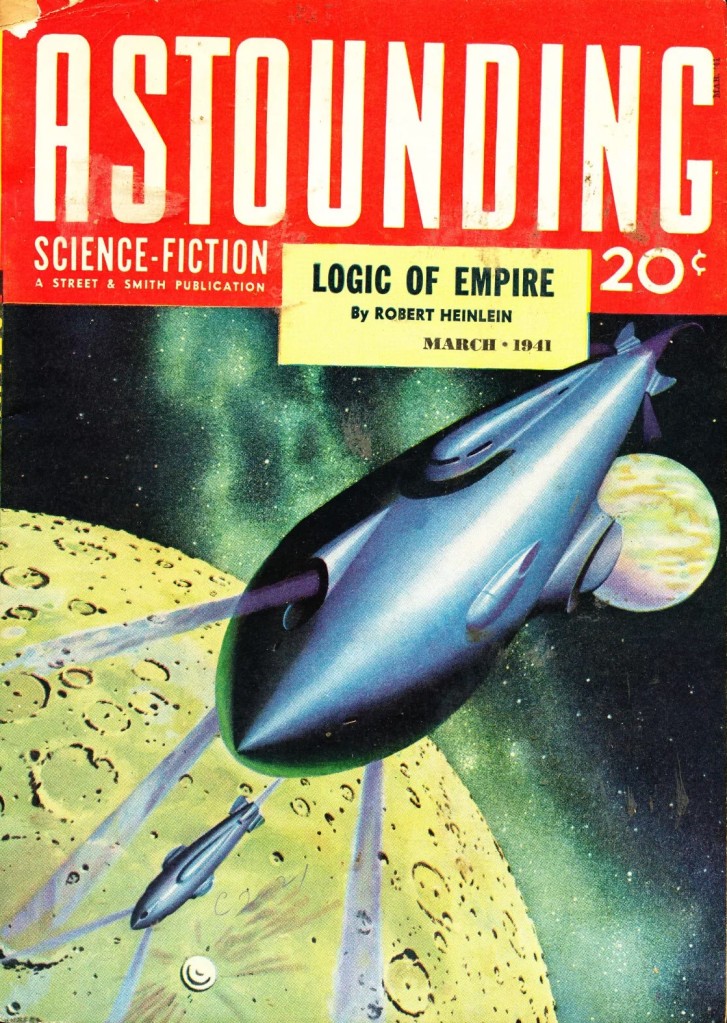
“Masquerade” first appeared in Astounding, ed. John W. Campbell, Jr. (March 1941). You can read it online here.

In the surprisingly bleak “Masquerade” (1941), metamorphic aliens on Mercury’s radiation-blasted surface parrot human actions. Beneath their clownish behavior is a plot, a plot to takedown an Earth corporation. The story begins with a disquieting sequence in the bleak expanse outside a sunlight harvesting power station on the surface of Mercury: “the Roman candles, snatching their shapes from Creepy’s mind, had assumed the form of Terrestrial hillbillies and were cavorting the measures of a square dance” (57). The Candles, “kicking up the dust, shuffling and hopping and flapping their arms” (58), are the mysterious natives of Mercury. In classic Simak fashion, there’s a method to their apparent comic madness.3

Continue reading

Short Story Reviews: Robert Bloch’s “Daybroke” (1958) and “The Head” (1976)

After watching the first episode of the new Fallout (2024) adaptation a few nights ago (I like it!), I impulsively decided to push aside all my unfinished reviews and write about two more nuclear gloom tales. I selected two by Robert Bloch (1917-1994), best known as the author of Psycho (1959), whose SF output I’ve only recently started to explore. Both stories are slick satires that use the nuclear scenario to poke holes in the stories we weave about American exceptionalism and progress.

Let’s get to the nightmares!


3.25/5 (Above Average)

“Daybroke” first appeared in the only issue of Star, ed. Frederik Pohl (1958). You can read it online here.

Robert Bloch’s “Daybroke” attempts to convey an encyclopedic glimpse of post-apocalyptic destruction in order to satirize an America that allowed the usage of a nuclear weapon. Despite its appealing structure, the story lacks the prose necessary to sear and burn–the last sentence, well, that you’ll remember.

Continue reading

What pre-1985 science fiction are you reading? + Update No. XI

What pre-1985 science fiction are you reading or planning to read this month. Here’s March’s installment of this column.

Before we get to books and birthdays and writing plans…

Continue reading

Short Story Review: Vladimir Colin’s “The Contact” (1966, trans. 1970)

Today I’m joined again by Rachel S. Cordasco, the creator of the indispensable website and resource Speculative Fiction in Translation, for the second installment of our series exploring non-English language SF worlds. Last time we covered Kōbō Abe’s allegory of Marxist transformation, “The Flood” (1950, trans. 1989).

This time we journey east of the Iron Curtain to 1960s Romania with Vladimir Colin’s “The Contact.” It first appeared in his collection of short stories Viitorul al doilea (1966). We read it in Other Worlds, Other Seas: Science-Fiction Stories from Socialist Countries, ed. Darko Suvin (1970). The story was translated into English by the author. I cannot find a copy online. Reach out if you want to read it!

Make sure to check out Rachel’s website Speculative Fiction in Translation. Not only does she review the global phenomena of speculative fiction but gathers lists of translated fiction by language. Also check out her reference monograph Out of This World: Speculative Fiction in Translation from the Cold War to the New Millennium (2021).

Now let’s get to our reviews!

Continue reading

Updates: Recent Science Fiction Purchases No. CCCXXXII (Vernor Vinge, Brian Stableford, Joan Cox, and Pierre Boulle)

Which books/covers/authors in the post intrigue you? Which have you read? Disliked? Enjoyed?

1. The Witling, Vernor Vinge (1976)

From the back cover: “Witling: A pretender to wit. (Webster’s Dictionary)

In the eyes of the inhabitants of Giri the scientific explorers from outer space were witlings. In the context of that primitive-seeming planet, they were.

Because on Giri a peculiarity of evolution had given a special talent to all living things–and this talent had made unnecessary most of the inventions associated with intelligent life elsewhere. Roads and planes, engines and doors… these were the products of witlings, not of ‘normal’ people.

So when the little band from Earth’s exploration team fell into Giri hands, their problem was unprecedented. How to demonstrate that science is worthwhile and how to keep the medieval masters of Giri from realizing their potential for cosmic mischief.”

Continue reading

Short Story Review: Kōbō Abe’s “The Flood” (1950, trans. 1989)

Today I’m joined by Rachel S. Cordasco, the creator of the indispensable website and resource Speculative Fiction in Translation, for something a bit different!

We will both offer our reviews of one of Kōbō Abe’s first published speculative short stories, “The Flood” (1950). Over the next few months, we’ll post reviews of speculative fiction in translation from Romania, Chile, Austria, Poland, France, and the Netherlands. Depending on the story and our thoughts, I might also include our responses to each other’s review.

Also if you haven’t checked out Rachel’s website, you must. Not only does she review the global phenomena of speculative fiction but gathers lists of translated fiction by language. Also check out her reference monograph Out of This World: Speculative Fiction in Translation from the Cold War to the New Millennium (2021). In 2016, she contributed to my site reviews of three French SF stories in translation.

We read Kōbō Abe’s “The Flood” (1950) in The Best Japanese Science Fiction Stories, ed. John L. Apostolou and Martin H. Greenberg (1989). Translated by Lane Dunlop. You can read it online here.

Now let’s get to our reviews!

Continue reading

What pre-1985 science fiction are you reading? + Update No. X

What pre-1985 science fiction are you reading or planning to read this month? Here’s February’s installment of this column.

Before we get to books and birthdays and writing plans…

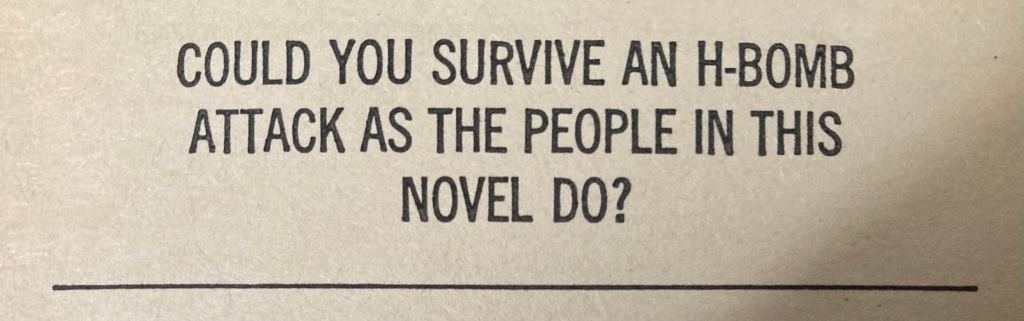
Do you have the inner strength to survive the panic of a nuclear attack? Take a test in the August 21st 1953 issue of Collier’s and find out! Sample question: “HOW DO YOU FEEL WHEN: […] You are alone in an automatic elevator when it stalls between floors?” Possible answers: “I’m not bothered,” “I become tense,” “It jars me badly,” and “I blow up.”

Continue reading