Updates: Recent Science Fiction Acquisitions N. XXXIX (Priest + Brunner + Crowley + Wallace + Duncan)

Ah, what a delightful group! A few from my father, a few from Marx books which I hadn’t posted yet….  Priest and Crowley’s novels involve fascinating worldscapes — a world winched across the horizon, a world at the top of a pillar…  Both are considered among the better stylists in science fiction and fantasy.

And, my 22nd (?) Brunner novel!  The Stone That Never Came Down (1973) — from his glory period of the late 60s-early 70s (this period produced Stand on Zanzibar, The Sheep Look Up, Shockwave Rider, The Jagged Orbit).

And two more impulsive finds — Ian Wallace’s Croyd (1967) — a reader claimed it was one of the best sci-fi novels of the 60s, and thus due to my intense curiosity, I had to find a copy.  And Dark Dominion (1954), I know little about David Duncan — he wrote only three sci-fi novels in the 50s.  His work is described by SF encyclopedia as “quietly eloquent, inherently memorable, worth remarking upon.”

And the covers!

1. The Inverted World, Christopher Priest (1974)

(Jack Fargasso’s cover for the 1975 edition) Continue reading

Adventures in Science Fiction Cover Art: Spacewomen of the Future (fixing spaceships + fighting aliens + charging across barren landscapes)

(Don Sibley’s cover for the November 1950 issue of Galaxy)

When we conjure the image of a 40s/50s science fiction pulp heroine we often imagine a character who has to be rescued by men from aliens, shrieks and clings to any man nearby, and is always in a state of undress.  I’ve included one cover, for the sake of comparison, that I find to be an exemplar of this type of sexist (and racist) depiction below (Alex Schomburg’s cover for the January 1954 issue of Future Science Fiction): white woman wrapped in only a towel stalked by an evil alien obviously painted with African-American facial characteristics (heavy on the sexual predation vibe) — the reader is supposed to buy into the racial stereotypes and thus be titillated by the fear she must feel.

I’ve selected a wide range of mostly pulp magazine covers depicting spacewomen of the future (I’ve loosely decided that this means women in space, in spacesuits) that tend to buck the trend Continue reading

Book Review: Seed of Light, Edmund Cooper (1959)

(Uncredited cover for the 1959 edition — I suspect it might be David Davies)

3.25/5 (Average)

Edmund Cooper’s Seed of Light (1959) is less of a traditional narrative of the voyage of a generation ship as are its fellow generation ship novels of the 40s/50s. The best examples are Brian Aldiss’ Non-Stop (1958) and Robert Heinlein’s Orphans of the Sky (1941).  Seed of Light is more like a piece of pseudo-history interlaced with fragments of narrative of varying effectiveness.  The work is best described as a thematically-linked series of novellas tracking the future development of man in broad strokes à la Brian Aldiss’ Galaxies Like Grains of Sand (1960).  Unfortunately, Cooper’s original splicing of the generation ship theme onto a Future History template (made popular but Olaf Stapleton and Isaac Asimov among others) is extremely uneven.  Some portions are involving while others are plagued by laborious epoch-spanning pseudo-historical lectures.

Because each part is a separate novella (the last two are more closely Continue reading

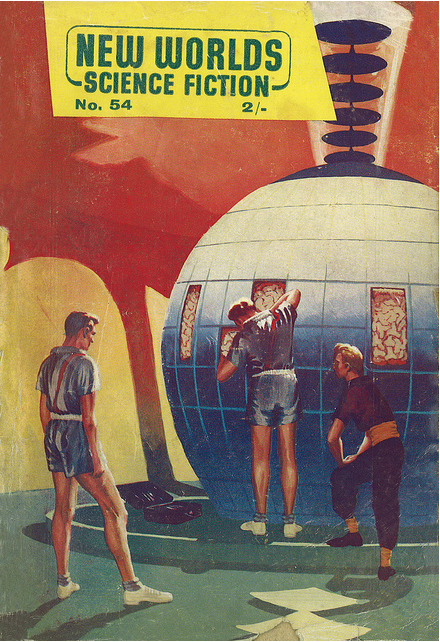
Adventures in Science Fiction Cover Art: Disembodied Brains, Part I

(Gerard Quinn’s cover for the December 1956 issue of New Worlds)

Disembodied brains — in large metal womb-like containers, floating in space or levitating in the air (you know, implying PSYCHIC POWER), pulsating in glass chambers, planets with brain-like undulations, pasted in the sky (GOD!, surprise) above the Garden of Eden replete with mechanical contrivances among the flowers and butterflies and naked people… The possibilities are endless, and more often than not, taken in rather absurd directions.

I’ve cobbled together a large variety of images from pulp magazines to covers from the late 70s.  My favorites include Valigrusky’s Continue reading

Book Review: The Long Winter, John Christopher (1962)

(Paul Lehr’s cover for the 1968 edition)

3.75/5 (Good)

Although known for his famous young adult Tripod Trilogy (The White Mountains, The City of Gold and Lead, The Pool of Fire), John Christopher produced a substantial corpus of science fiction works for older readers — most notably, the post-apocalyptical tale No Blade of Grass (1956).  The Long Winter (1961), one of Christopher’s lesser known works, is on the surface another post-apocalyptical novel (or sorts).  However, the post-apocalyptical elements are subsumed by a bitting satire on colonial and post-colonial British attitudes towards their colonies.  The publication date of 1962 is of vital importance in understanding the work.  Nigeria gained its independence from the British in 1960, Ghana in 1957, and South  Africa in 1961.

A large percentage of the reviews I’ve read complain that they Continue reading

Updates: Recent Science Fiction Acquisitions No. XXX (Christopher + Benford + Shaw + Frank + et al.)

My second batch of books from my youthful haunt (Austin, TX) is equally as varied and intriguing as the first.  I’m most interested in Pat Frank’s famous late 50s classic Alas, Babylon. Yes, a sci-fi fan like me should have read it a LONG time ago.  John Christopher’s The Long Winter (1962) should also prove a worthwhile read — an ice age hits Earth and the English main characters flee to Africa.  Shaw’s Orbitsville (1975) is the the vein of Larry Niven’s more famous Ringworld (1970) and Arthur C. Clarke’s classic Rendezvous with Rama (1972) — explorers encountering unusual alien worlds (in this case, a dyson sphere).

As always, a few stunning covers…  My favorite of the bunch is John Schoenherr’s cover for Mark Phillips’ Brain Twister (1962)…

Enjoy!  If you’ve read any of the novels few free to comment.  I’ve not read any of Benford, Frank, Mark Phillips (pseudonym for Laurence Janifer and Randall Garrett) or Platt’s works before.

1. In The Ocean of Night, Gregory Benford (1977)

(Larry Kresek’s cover for the 1977 edition) Continue reading

Updates: Recent Science Fiction Acquisitions No. XXVI (Malzberg + Wells + Gunn +Pohl)

A nice (varied) selection of finds….

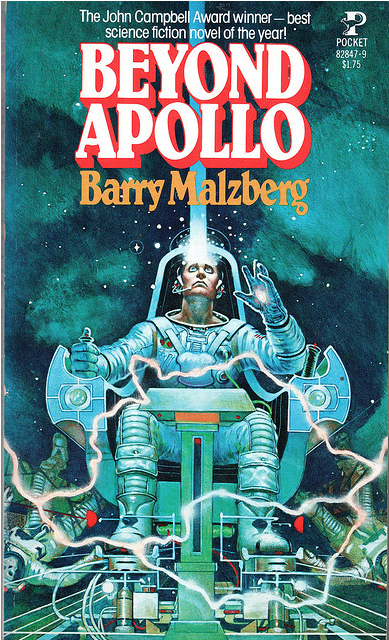
I’ve continued to be on the lookout for Malzberg’s novels and, due to the proliferation of comments by my readers about what is his best, I’ve acquiesced and picked up a copy of his acknowledged masterpiece, Beyond Apollo (1972).  I suspect it will be as good as In The Enclosure (1973).

If there is any area (besides sci-fi from the 21st century) that I haven’t read a good portion of the classics, it’s works from around the turn of the century.  I have read a large swathe of Verne’s works and from beginning of the 20th century  all of Edgar Rice Burroughs’ John Carter series — but, only a few of H. G. Wells’ oeuvre (The War of the Worlds and The Time Machine).  So, when I came across a 60s edition of The First Men in the Moon (1901) with a nostalgic looking cover I snatched it up!

The two short story collections are unknown commodities: Frederick Pohl’s In The Problem Pit (1976) and James Gunn’s Station in Space (1958).  I’ve never heard of Gunn and sort of dislike what I’ve read of Pohl so far.  Regardless, both works have intriguing covers!

Enjoy!

1. Beyond Apollo, Barry Malzberg (1972)

(Don Maitz’ cover for Continue reading

Updates: Recent Science Fiction Acquisitions N. XXIII (Farmer, Malzberg + et al.)

A while back I slogged through Philip José Farmer’s dismal To Your Scattered Bodies Go (1971) (the worst novel ever to win the Hugo Award?) and all the increasingly terrible sequels and made a solemn vow to wait a few years before I returned to his extensive oeuvre — so, against my better judgement I picked up a copy of  Traitor to the Living (1973).  I don’t have high hopes (but I love the cover!).  I hope my two dollars were well spent.

Malzberg is shaping into my “under read/unjustly forgotten author of the year” whom I’ll showcase.  Last year’s winner was the brilliant D. G. Compton (see INDEX for reviews).  Fresh off Conversations (1975) and In The Enclosure (1973) I picked up a copy of Guernica Night (1975).  I can’t wait!

Harold Mead’s The Bright Phoenix (1955) is yet another against the oppressive state à la Orwell’s 1984… But, I’ve found that the premise generally holds up despite frequent re-interpretations…

Greenfield’s Waters of Death (1967) should be avoided — at all cost.  I’ve already written a scathing review (rant).

1. Traitor to the Living (1973), Philip José Farmer (MY REVIEW)

(Hans Ulrich Osterwalder and Ute Continue reading

Updates: Recent Science Fiction Acquisitions N. XXI (Silverberg + Compton + Malzberg + Anderson)

A few more Christmas gift card purchases…

Dying Inside (1972) is often considered one of Silverberg’s best works and I can’t wait to read it (I will after my soon to be hellish weekend grading ~60 undergrad history papers).  Despite a painfully negative review on Amazon slamming Compton’s The Silent Multitude (1967) as a dull imitation of J. G. Ballard, it is high on my to read list — almost any experimental (allegorical) work exploring a crumbling city intrigues me.  Malzberg’s Conversations (1975) was a shot in the dark — it might be the least read of any of his novels — hence, my interest.

Pohl Anderson is almost always worth reading — even his middling short stories are fun.

Enjoy!

1. Dying Inside, Robert Silverberg (1972)

(Jerry Thorp’s cover for Continue reading