Updates: Recent Science Fiction Acquisitions N. XXII (Cooper + Wilhelm + Kornbluth + Merril)

I was so impressed with C. M. Kornbluth’s masterful collection The Explorers (1954) that I picked up a copy his 1958 collection A Mile Beyond the Moon (I own the hardback first edition but I prefer Powers’ cover below).  Also, recently inspired (again) to read more 1960s works by female authors I bought a collection of three novellas by Merril and a 1963 collection of shorts by Kate Wilhelm.  Wilhem and Merril aren’t always top-notch but worth a read (and in Wilhelm’s case, a second chance — I enjoyed Where Late the Sweet Birds Sang (1977) but I’m still not convinced it was Hugo/Nebula quality work).

Cooper’s Seed of Light (1958) is considered one of his more mature works — to the chagrin of some of his fans who prefer his more “pulpish” works — but my obsession with generation ships was my real motivation to add it to my collection.

One short story, a novel, and one of the novellas take place on generation ships!

A nice haul — a mixture of lesser known works by some famous figures.

Enjoy (the covers)!

1. Daughters of Earth (1968), Judith Merril (MY REVIEW)

(Robert Foster’s cover for Continue reading

Adventures in Science Fiction Cover Art: Rocket, Field, Figure Part I

(Rod Dunham’s cover for the 1953 edition of Planet of the Dreamers (1953), John D. MacDonald)

First (archetypal) incarnation: rocket, field, figure.  Second incarnation: rocket with extra fins, field with unusual terrain, human staring at alien figure (s).  Repeat with virtually infinite variation.

By far one of my favorite science fiction cover tropes, rocket/field/figure evokes covers spanning the entire history of science fiction.  Rod Dunham’s cover for the 1953 edition of John D. MacDonald’s Planet of the Dreamers (above) perfectly evokes the archetype in its pure unadulterated form.  Emswiller’s cover for the 1960 issue of The Magazine of Fantasy and Science Fiction (below) uses a more traditional perspective but manipulates the field with a Continue reading

Book Review: The Explorers, C. M. Kornbluth (1954)

(Richard Powers’ cover for the 1954 edition)

collated rating: 4/5 (Good)

I’ve stayed away from C. M. Kornbluth for far too long.  I read Kornbluth and Pohl’s The Space Merchants (1953) when I was quite young and was put off for some unexplainable reason.  What a shame!  This collection of short stories and novelettes contains some of the best short works I’ve ever read from the 50s (a few of Philip K. Dick’s early works are just as good).  As with The Space Merchants, Kornbluth exposes (in an often satirical manner) the dark underbelly of the usually glamourous 50s accounts of space travel, interplanetary trade, and the devastating social ramifications of technology on astronauts, new cultures, etc.  Kornbluth is equally adept at infusing his work with devastating commentary on American society.

This collection is brilliant throughout — only the annoying silly Continue reading

Book Review: The City Machine, Louis Trimble (1972)

THCTMCHNGH1972

(Kelly Freas’ cover for the 1972 edition)

3.75/5 (Good)

First, a snarky comment about Kelly Freas’ unfortunate cover art — I can’t help but giggle at the imposing sci-fi behemoth cityscape which accidentally wandered onto a Thomas Kinkade, “Painter of Light” (or, as I call him, “The Painter of Kitsch”) Christmas tableau.  Kelly Freas’ fuzzy light, happy-budget-hotel-color-scheme art seldom impresses me.  Perhaps I’m too harsh….

On the other less caustic hand, Louis Trimble’s The City Machine is a surprisingly intriguing blend of allegory and sci-fi tale.  In line with my previous Continue reading

Adventures in Science Fiction Cover Art: The Domed Cities of the Future Part I

(Uncredited cover for the 1965 edition of Beyond the Sealed World (1965), Rena M. Vale)

While browsing through my collection of cover images I’ve collated over the last few months for science fiction art post ideas, I came across the uncredited cover for Rena Vale’s Beyond the Sealed World (1965) and was transfixed!  The angle of the text, the mountain, the dark expanse of space, the little spaceship, the figures silhouetted against the night, and the surreal shape of the domed city connected to other distant domed cities… If anyone knows the artist (or has a good educated guess) please let me know!  The second edition cover (below) still has beautiful domed cities but the caveman, helmeted soldier, and white-clad (not for long, the dress is slipping) woman tableau ruins the feel.

Particularly noteworthy is Jack Gaughan’s elevated domed city cover Continue reading

Adventures in Science Fiction Cover Art: A Selection of Bleak Alien Landscapes

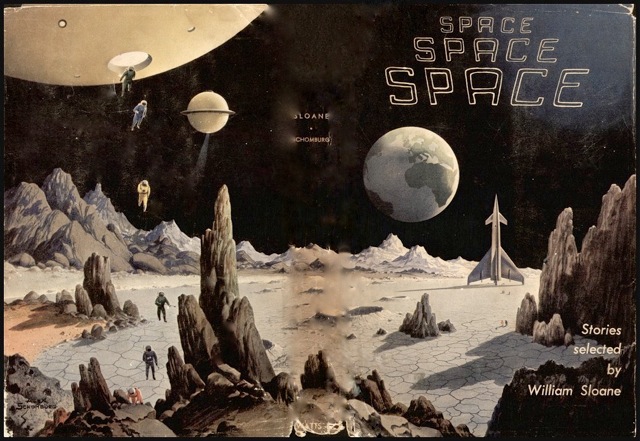
(Alex Schomburg’s cover for the 1953 edition of Space, Space, Space (1953), ed. William Sloane)

Our science fiction heroes are often confronted by bleak alien landscapes adorned with rocks, vast deserts, adverse atmospheres — commonly these vistas are traversed, colonized, tamed…  Spaceships touch down on virgin surfaces, the explorers tentatively step forward, aliens peer from the distance.  When settlements are built the alien vista remains an ever present source of fear and fascination.  The depiction of a convincingly bleak alien landscape (think Arrakis in Frank Herbert’s Dune) can be of paramount importance in conveying not only  otherworldliness but the backdrop for human drama and the challenges our heroes must overcome (by technology or other Continue reading

Book Review: The Alien Way, Gordon Dickson (1965)

3.75/5 (Good)

I was pleasantly surprised by Gordon R. Dickson’s intelligent and occasionally thought-provoking The Alien Way (1965).  Considering he’s famous for his military sf Dorsai! saga, the lack of epic space battles — i.e. inter-species conflict in the traditional manner — came as a shock.  There are a few instances of violence but they’re few and far between.

The ultimate message is a cautionary one — only when the pattern of human nature (its instincts, reactions, ets) is understood can non-violent contact be made with an alien species.   We react to protect our species just as animals react to protect their young.  Of course the aliens have to come to this realization Continue reading