Updates: Recent Science Fiction Acquisitions No. CXXXVIII (Matheson + Tenn + Priest)

Adored An Infinite Summer (1979), had to procure more Priest…

I want to give Matheson another chance—although some of the stories in Third From the Sun (1955) were worth reading…

William Tenn, great short story author—needed more! I had previously read both Of Men and Monsters (1968) and his collection The Human Angle (1956).

Thoughts?

1. The Shores of Space, Richard Matheson (1957)
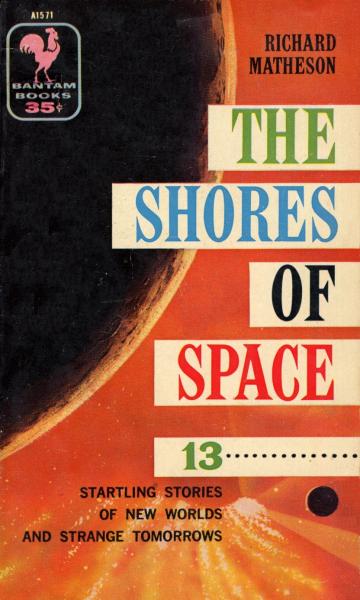
THSHRSFSPC631957

(Uncredited cover for the 1957 edition)

From the back cover: “Shocking— Startling — Incredible.  13 strange and unusual stories set against the background of new worlds and fantastic futures— Continue reading

Book Review: An Infinite Summer, Christopher Priest (1979)

NNFNTSMMR1981

(Don Puchatz’s cover for the 1981 edition)

4.75/5 (collated rating: Very Good)

With Christopher Priest’s second short story collection, An Infinite Summer (1979), he enters the pantheon of my favorite SF authors.  The thing is, I knew he would all along once I moved past the sour taste of his first novel Indoctrinaire (1970) and finally picked up one of his later endeavors.

Priest’s fiction appeals to my sensibilities: he is the consummate wordsmith; his worlds (especially the stories in the loose sequence of the Dream Archipelago) are evocative; the stories drip with a certain nostalgic longing and/or are populated with characters who cannot escape their memories; metafictional experimentation (a novel within a story, a novel that Priest himself would go on to write–perhaps with a different plot!) is rooted to the aims of each story (you cannot separate the two without Continue reading

Updates: Recent Science Fiction Acquisitions No. CXXXVI (Sheckley + Wilhelm + Pesek + Shaara)

Despite my incredible busyness my reading of SF has not slowed that heavily as I find it a relaxing activity before bed.  There is a chance (time permitting) that I will post (two paragraph?) mini-reviews of such gems as Disch’s Camp Concentration (1968) + Lafferty’s intriguing Past Master (1968) + Mann’s  Wulfsyarn (1990) et alii in the coming weeks in order to get caught up (I haven’t been in more than a year)…

That said, I am still working through my recent acquisition posts for a stack of books that have slowly come in over the last few months.  More psychological SF via Wilhelm, a Mars novel originally in German, a collection of 50s – 80s short SF by an unsung master (according to some), and Sheckley at his most bizarre…

Three of the following novels came via Carl at Stainless Steel Droppings on his book store trip…  Grateful as always for his book hunting skills on his travels and willingness to send me a large box (and paypal bill! — haha).

Thoughts?

1. The Earth is Near, Ludek Pesek (1970, English trans. 1973)

THRTHSNRSN1974

(Uncredited cover for the 1974 edition) Continue reading

Book Review: Scop, Barry N. Malzberg (1976)

SCPHBSVJZB1976

(Stephen Fabian’s cover for the 1976 edition)

3.5/5 (Good)

A TANTALIZING FRAGMENT/THE CONCEPTUAL CORE: “‘Don’t you understand what is going on here? [Scop] said, “Don’t you realize that we are living not in a present but in a dream of waste, an extension of all the terrors of the past; don’t you realize that we live awash in blood?” (105).

WHOSE BLOOD?/THE HISTORICAL JUNCTION: John F. Kennedy is assassinated on November 22nd, 1963 by Lee Harvey Oswald. Abraham Zapruder, a private citizen, films the death from the Grassy Knoll in Dealey Plaza, Dallas.  Jack Ruby kills Oswald, who was awaiting trial, on November 24th.  James Earl Ray assassinates Martin Luther Jing, Jr. on April 4th, 1968.  Robert F. Kennedy is assassinated by Sirhan Sirhan on June 5th, 1968.

Scop wants all three to never have Continue reading

Updates: Recent Science Fiction Acquisitions No. CXXXV (Delany + Wyndham + Budrys + McIntyre)

*preliminary note:  I am on something of a semi-hiatus—PhD writing and the like.  However, I have a Malzberg review of Scop (1976) nearly complete and might do a rundown of the SF I’ve been unable to review over the past few months in a more informal format (one paragraph reviews or something of that ilk)—Phillip Mann’s Wulfsyan (1990), M. John Harrison’s The Machine in Shaft Ten (1975), etc.

In my recent travels, I stopped in Nashville, Tennessee and picked up three of the four novels for under a dollar each.  McIntyre’s novel is the sole Hugo Award Winner for best Novel between the years 1953 to 1990 I’ve not read.  I should remedy that immediately as I’ve enjoyed her other work—for example, the novella “Screwtop” (1976).

Budrys’ novel actually sounds like I’d enjoy it despite my dislike of some of his work (and views)…. It certainly is my type of SF story concept-wise.  The last Delany novel missing from my collection and everyone loves Wyndham and immortality SF, right?

Thoughts?

1. Dreamsnake, Vonda N. McIntyre (1978)

DRMSNKA21978

(Stephen Alexander’s cover for the 1978 edition of Dreamsnake) Continue reading

Book Review: Garbage World, Charles Platt (serialized 1966)


NW_0168

(Keith Roberts’ cover for New Worlds SF, October 1966, ed. Michael Moorcock)

2/5 (Bad)

In 1980, 3,000 copies of Charles Platt’s SF novel The Gas (1968)—in which, the “eponymous gas, accidentally released over England, works as an irresistible aphrodisiac […]” and, according to John Clute at SF encyclopedia, contains “sex material” in “transgressively pornographic terms”—were seized by UK’s Director of Public Prosecutions in effect preventing a UK distribution [article].

Platt’s first novel, Garbage World (serialized 1966), feels like The Gas‘s SF juvenile little brother i.e. without the transgressive porn but all the intent to shock a 14 year old boy, although it’s never more than “the warmth of the mud mingled with the warmth of their lovemaking” (95).  So, what is this tidbit of effluvia all about?  First, the silliest part of the novel—the often scatalogical chapter titles: “Garbage Party” (21), “The Hole” ( 57), “The Yellow Rain” (81), “The Defecated Village” (100), “The Great Purgative Continue reading

Book Review: Walk to the End of the World, Suzy McKee Charnas (1974)

5/5 (Masterpiece)

“The men heard, and they rejoiced to find an enemy they could conquer at last.  One night, as planned, they pulled all the women from sleep, herded them together, and harangued them, saying, remember, you caused the Wasting” (3).

Suzy McKee Charnas’ Walk to the End of the World (1974) is the first of four novels in The Holdfast Chronicles sequence (1974-1999) that charts the slow forces of change in a post-apocalyptical future where women (“fems”) are chattel.  Kate Macdonald, in her wonderful review of Ammonite (1993) characterized Nicola Griffith’s novel as “instantly […] feminist: not stealth, or muted, or sub-conscious.”  Walk to the End of the World falls squarely, and powerfully into this category.  Told with intensity and vigor, Charnas brands the reader with her vision, a searing and festering landscape where white men have either exterminated the remaining “unmen” (the “Dirties”) or subjugated them (the “fems”) after a manmade cataclysm.  Complex societal institutions maintain control in a mostly illiterate world via appeals to collective memory, intensive drug facilitated indoctrination, and the deconstruction of the family unit in favor of exclusively homosocial relationships.

Continue reading

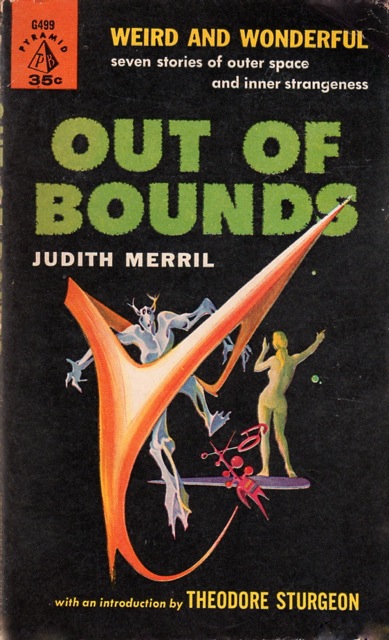
Book Review: Out of Bounds, Judith Merril (1960)

OTFBNDS1960

(Art Sussman’s cover for the 1960 edition)

3.25/5 (collated rating: Vaguely Good)

I have long been a fan of both Judith Merril’s fiction and edited volumes.   The eponymous novella in the collection Daughters of Earth (1968) is one of more delightful visions from the 1950s I have encountered. Merril reframes biblical patrilineal genealogy as matrilineal–i.e. humankind’s conquest of space is traced via the female descendants of an august progenitor.  The story is brilliant in part due to a remarkable metafictional twist, the story itself is compiled from historical documents to serve as an instructional template for future generations of women.  Despite substantial editorial control that forced Merril to include a rather hokey plot on two hokey planets, the story remains memorable for the well crafted feminist Continue reading

Guest Post: Margaret and I, Kate Wilhelm (1971)

 The fifth in my Kate Wilhelm’s SF Guest Post Series (original announcement and post list) comes via Max Cairnduff (twitter)—who reviews literature and occasionally SF over at Pechorin’s Journal.  In the past he has contributed to my Michael Bishop series. He is responsible for introducing me to one of my favorite works of all time, Anna Kavan’s phenomenal hallucination of a novel Ice (1967)—so check out his site.

Although he does not seem to have enjoyed Margaret and I (1971) as much as I did, his review does touch on the novel’s extreme psychological power and ingenious set-up.

Thank you so much for contributing!

~

MRGRTNDI1978

(Uncredited cover for the 1978 edition)

Nominated for the 1972 Nebula Award for Best Novel

The only Kate Wilhelm I’d read before Joachim invited me to take part in this Guest Post series was her novel Welcome, Chaos. I’ve not even read Where Late the Sweet Birds Sang (though I always thought I had, which ironically is probably what stopped me reading it).

Beyond those two titles I knew very little about her work. Joachim though knows his vintage SF, so when he invited me Continue reading