Guest Post: No Enemy But Time, Michael Bishop (1982)

NENMYTM1983

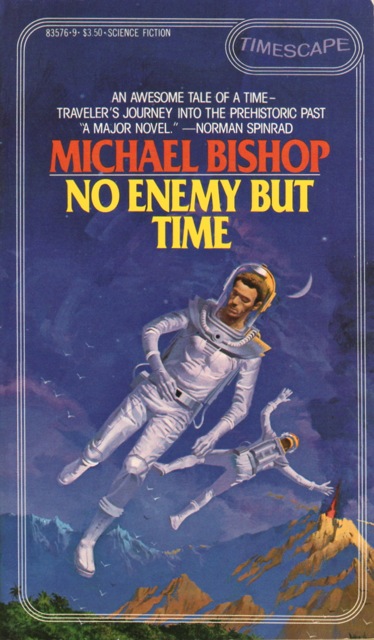
(Vincent Di Fate’s cover for the 1983 edition)

The third installment of my Guest Post Series on Michael Bishop’s SF was written by Megan (twitter: @couchtomoon) over at the relatively new but completely worthwhile SF review site From Couch to the Moon.  She’s already put together a substantial list of delightful reviews.  Megan selected Bishop’s single most famous and Nebula award-winning novel, No Enemy But Time (1982)—and sadly, one of few books of his still in print.  Along with Transfigurations (1979), it was republished and selected for the Gollancz Masterwork [list].
michael bishop,header,02

No Enemy But Time (1982) — Michael Bishop

Coming out of Bishop’s 1982 Nebula award winning novel, No Enemy But Time, is like coming out of a time travel trance: the experience is jarring, hazy, and unwelcome. Bishop sweeps the reader into his world—humanity’s distant past—and paints a primitive African landscape dappled with hippos, hyenas, and volcanoes, but lush Continue reading

Guest Post: “Death and Designation Among the Asadi,” Michael Bishop (1973)

michael bishop,header,02

The first installment in my Guest Post Series on The Science Fiction of Michael Bishop was written by Jesse over at the remarkable SF review site Speculiction… Not only is he incredibly prolific (and has a large back catalog of reviews to browse) but his reviews are also a joy to read.  If you are interested in both classic and contemporary SF, and the occasional post on Chinese poetry, make sure to check out his site.

Jesse has previously posted on his site about Bishop’s  “The Samurai in the Willows” (1976) and “Cri de Coeur” (1994).  Both reviews are worth reading.  

“Death and Designation Among the Asadi” (1973) is one of Michael Bishop’s more well known novellas that was nominated for both the Hugo and Nebula in 1974.  It was first published in the magazine Worlds of If January-February 1973, ed. Ejler Jakobsson.  If you are interested in finding a copy the story can be found in multiple later collections and forms the first part of his novel Transfigurations (1979) [listing here].

Enjoy!

~

“Death and Designation Among the Asadi,” Michael Bishop (1973)

The alien is perhaps the most recognized, if not the most used trope of Continue reading

Update: Guest Post Series Announcement, The Science Fiction of Michael Bishop

michael bishop,header,02

Collage of Bishop’s SF covers created by my father

“[Michael Bishop’s] early stories and novels display considerable intellectual complexity, and do not shirk the downbeat implications of their anthropological treatment of aliens and alienating milieux” — John Clute, SF Encyclopedia

Michael Bishop (b. 1945) [official website] is no stranger to critical success for both his novels and short SF: he has won the Nebula Award twice (“The Quickening” and No Enemy But Time) and picked up nine Hugo nominations and an additional thirteen Nebula Nominations.  Two of his more famous novels, No Enemy But Time (1982) and Transfigurations (1979), were selected for inclusion and republication in the Gollancz Masterwork List. Although Bishop has not published a novel since the Hugo-nominated Brittle Innings in 1994, he received a Nebula nomination for his novelette “Vinegar Peace, or, The Wrong-Way Used-Adult Orphanage” (2008) as recently as 2010!

With this in mind it is surprising that his extraordinary talent is not better known within the SF community.  John Clute in his article for SF Encyclopedia argues that “the earnest ardour and rigorousness of Bishop’s fiction has made Continue reading

Book Review: Juniper Time, Kate Wilhelm (1979)

(Bob Aulicino’s cover for the hideous 1979 edition)

3.5/5 (Good)

Nominated for the 1980 Nebula Award

“Everything that is, Robert had said, must be.  Every cycle must be completed, must lead to the next cycle.  He had talked about times when the desert had been drier than it now was, times when it had been lush and wet, and there had been no questions in his mind that this too must be” (170-171).

At the heart of Kate Wilhelm’s Nebula-nominated novel Juniper Time (1979) is the notion of historical cyclicality at both the macro- (earth cycles) and the micro- (human historical time) levels.  Wilhelm’s near-future mysteriously drought-stricken world is at an important juncture of two such cycles.  The macrocycle concerns devastating world-wide desertification, which is most likely caused by a natural cycle but the precise nature of which is unknown.  The microcycle concerns a shift in human populations in the drought stricken countries: mass migrations towards coasts as the springs and rivers of the hinterlands turn to mud.  In this world the farmer, in the past linked tightly to his fields, abandons his traditional position in American society and moves to a cluttered and violent state Continue reading

Book Review: Billenium, J. G. Ballard (1962)

(Richard Powers’ cover for the 1962 edition)

4.25/5 (collated rating: Very Good)

Billenium (1962), J. G. Ballard’s first collection of short stories, contains three masterpieces of the 50s/60s: “Billenium” (1961), “Build-Up” (variant title: The Concentration City) (1957), and “Chronopolis” (1960).  The first is a deadpan satire on overpopulation, the second a fantastic Borgesian depiction of an endless city that stretches (literally) in all directions, and the third a vision of a city that had enough and revolted against time.  I preferred these three ruminations, that unfolded in evocative and decaying urban spaces, to the three decadent and baroque stories—“Studio 5, The Stars” (1961), “Mobile” (variant title: “Venus Smiles”) (1957), and “Prima Belladonna” (1956)—from his famous Vermillion Sands sequence.  The remaining four are all readable.

As with J. G. Ballard’s first novel masterpiece, The Drowned World (1962), the sense of decay and malaise that permeate majority of the stories in Billenium is gorgeously Continue reading

Updates: Immortality Themed SF Novels/Short Stories Resource Posted


I while back I put out a call for SF novels/short works on immortality to add to a preliminary list I put together.  Due to my lack of knowledge of newer SF and uncanny ability to forget relevant previously read works I eagerly added your suggestions.  And Marta Randall’s Islands (1976) motivated me to finally post  it…

Here’s the LIST!

If you can think of any that I might be missing be sure to Continue reading

Book Review: Islands, Marta Randall (1976)

Screen shot 2014-02-02 at 9.35.15 AM

(Vincent Di Fate’s cover for the 1976 edition)

3.5/5 (Good)

Nominated for the 1977 Nebula Award for Best Novel

*Note: I read the 1980 Pocket edition which, according to Locus, was modified (to what extent I do not know) from the original 1976 first edition.

Marta Randall, the first female president of SFWA, is one of numerous female science fiction writers from the 70s that are seldom read today.  A while back Ian Sales alerted me to Randall’s work in his very positive review of A City in the North (1976) on SF Mistressworks.  Recently, while looking for unread works on my immortality-themed SF list (here), I came across the Nebula-nominated Islands (1976).

One of the more effective ways to write about the ennui Continue reading

Updates: Recent Science Fiction Acquisitions No. XCI (Ballard + MacLean + Aldiss + Watson)

One of the better groups of acquisitions in a while!  After Katherine MacLean’s masterpiece Missing Man (1975) I was very excited to come across a collection of her late 40s and 50s short stories.  Unfortunately, my edition — from 1973— had such an awful cover that I couldn’t put in on this post.  Instead, I put the first edition cover by Paul Lehr which is simply gorgeous….

Ballard collections are always welcome!  I have all of his short works in a single volume but the Powers cover is top-notch.

One of Ian Watson’s most famous novels…

And an unknown work by Brian Aldiss,  Enemies of the System (1978)…  Has anyone read it?  I suspect it will be the weakest book of the bunch.

1. The Diploids, Katherine MacLean (1962)

(Uncredited — but looks like Lehr — cover for the 1962 edition) Continue reading