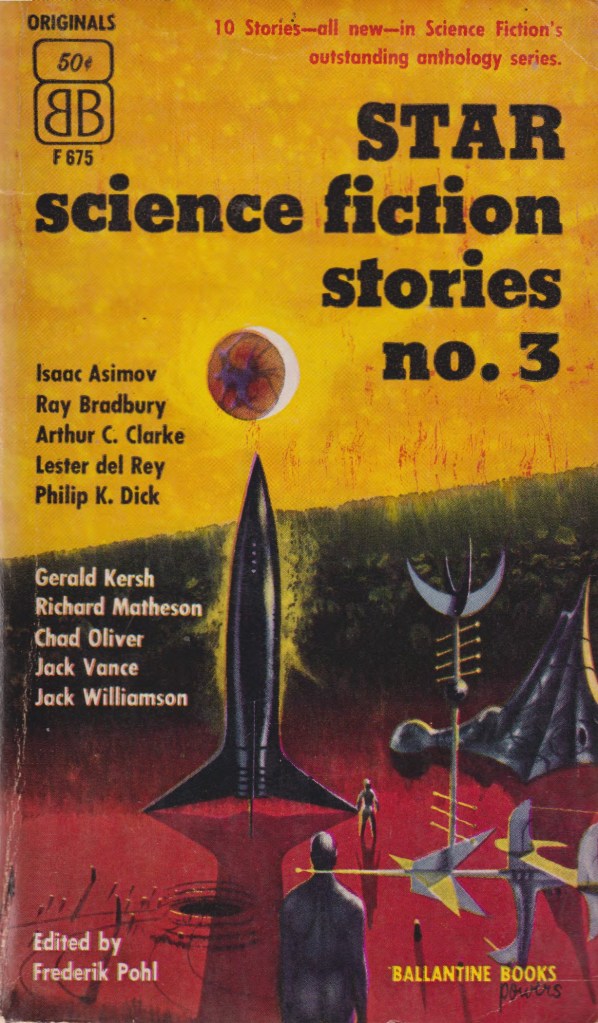
Ballantine Books’ illustrious science fictional program started with a bang–Star Science Fiction Stories. According to Mike Ashley’s Transformations: The Story of Science-Fiction Magazines from 1950 to 1970 Frederik Pohl’s anthology series of original (mostly) stories was “intended as both a showcase of Ballantine’s authors and a lure to new writers.” Paying better rates than magazines, the Star series foreshadowed the explosion of original anthologies that would provide a sustained challenge to the eminence held in the 50s by the magazine.
I’ve selected the third volume of the six-volume series.1 It contains an illustrative cross-section of 50s science fiction. Philip K. Dick’s “Foster, You’re Dead” (1955), Richard Matheson’s “Dance of the Dead” (1955), and Jack Williamson’s “Guinevere for Everybody” (1955) are not to be missed.
Here’s to a happy 2024! I hope you had a successful reading year. Maybe you pulled down some dusty tome that you’ve wanted to dive into for a decade. I’d like to imagine you finally picked up a book I raved about in years past that you acquired with great anticipation but never opened. Whether you are a lurker, occasional visitor, or a regular commenter, thank you for your continued support and wonderful conversation.
What were your favorite vintage SF reads–published pre-1985–of 2023? Let me know in the comments.
Continuing a trend, I read only a handful of novels this year. Instead, my obsessions focused on my science short story review initiatives (listed below), collections, and histories of the science fiction genre. Without further ado, here are my favorite novels and short stories I read in 2023 with bonus categories. I made sure to link my longer reviews where applicable if you want a deeper dive into the rich seam of science fictional gems.
Check out last year’s rundown if you haven’t already for more spectacular reads. I have archived all my annual rundowns on my article index page if you wanted to peruse earlier years.
My Top 5 Science Fiction Novels of 2023
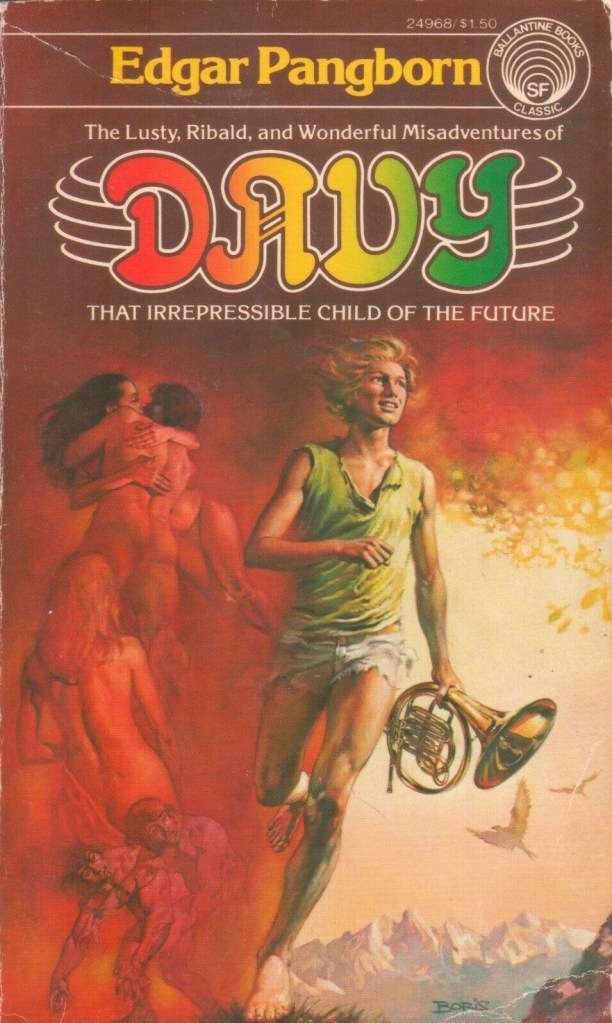
Boris Vallejo’s cover for the 1976 edition
1. Edgar Pangborn’s Davy(1964), 5/5 (Masterpiece): Nominated for the 1965 Hugo Award for Best Novel. Full review.
After Frederik Pohl (1919-2013) left his editorial position at Galaxy and If in 1969, he set his pen towards a productive vein of form in the 70s that would culminate in his Hugo and Nebula-winning Gateway (1977). The Gold at the Starbow’s End contains five short stories–including the first of his Heechee sequence–from this period. Two of the best stories, the titular “The Gold at the Starbow’s End” (1972) and “The Merchant of Venus” (1972), demonstrate Pohl’s characteristic blend of hyperbolic satire and delirious energy. There are no duds in this collection.
2022 was the single best year in the history of my site for visits and unique viewers!
As I mention year after year, I find reading and writing for the site—and participating in all the SF discussions generated over the year—a necessary and greatly appreciated salve. Whether you are a lurker, occasional visitor, or a regular commenter, thank you for your continued support.
Continuing a trend from 2021, I read only a handful of novels this year. Instead, I devoted my obsessive attention to various science short story review initiatives (listed below), anthologies, and histories of the science fiction genre. Without further ado, here are my favorite novels and short stories I read in 2022 with bonus categories. Descriptions are derived from my linked reviews.
Check out last year’s rundown if you haven’t already for more spectacular reads. I have archived all my annual rundowns on my article index page if you wanted to peruse earlier years.
My Top 5 Science Fiction Novels of 2022 [TITLES LINK TO FULL REVIEWS]
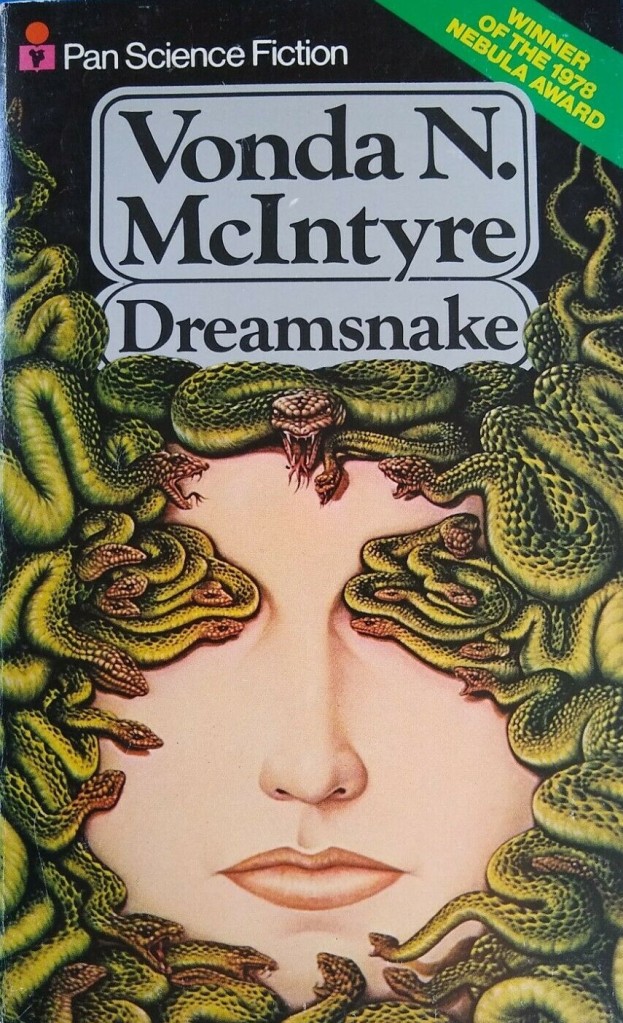
George Underwood’s cover for the 1979 edition
1. Vonda N. McIntyre’s Dreamsnake(1978), 4.75/5 (Near Masterpiece): Won the 1979 Hugo, Locus, and Nebula Award for Best Novel. Snake journeys across the post-apocalyptic wastes of a future Earth with three serpents healing the sick and caring for the dying. She is a member of the healers, who adopt orphans and rescue the oppressed and train them how to use the serpents. Mist and Sand are genetically modified vipers of terrestrial origin. But Grass comes from another alien world. Snake uses Mist and Sand’s venom to create vaccines, treat diseases, and cure tumors. Grass, the rare dreamsnake, with its alien DNA is the most important of them all–it provides therapeutic pleasure and dreams that facilitate conquering one’s fear and healing in the ill. In Snake’s voyages, she encounters prejudice and violence. A joyous sense of sexual freedom permeates the proceedings. A powerful and different take on a post-apocalyptic worldscape in every possible way.
Which books/covers/authors intrigue you? Which have you read? Disliked? Enjoyed?
1. Strange Ports of Call, ed. August Derleth (1948)
Uncredited cover for the 1958 edition
From the back cover: “‘Begotten of Imagination, on the body of Technology, there springs forth the wild child Science Fiction.’ –Clifton Fadiman
The above is one of the many attempts that have been made to describe a department of fiction which, in spite of some sniping critics, continues to increase its followers. Recently Bertrand Russell observed that science fiction consists of ‘intelligent anticipation–much more intelligent than the expectations of statesmen.’
Wallace Wood’s interior art for Frederik Pohl’s “The Wizards of Pung’s Corners” in Galaxy Magazine, ed. H. L. Gold (October 1958).
Today I’ve reviewed the twentieth story in my series on the science fictional media landscape of the future. Frederik Pohl satirizes a post-apocalyptic world where advertising gets right to work after the bomb!
Dember’s cover for Galaxy Magazine, ed. H. L. Gold (October 1958)
3/5 (Average)
Frederik Pohl’s “The Wizards of Pung’s Corners” first appeared in Galaxy Magazine, ed. H. L. Gold (October 1958). You can read it online here.
The year 1957 flashed subliminal messaging directly into the popular imagination. Vance Packard published The Hidden Persuaders (1957), that quickly became a best seller, and articlesincluding “The Growing Power of Admen” in the Atlantic [1]. In addition, research findings were released and publicized demonstrations occurred over the course of the year appeared to substantiate Packard’s primary claims. In September 1957 James Vicary, a pioneer in subliminal advertising, conducted his infamous “breakthrough media event” to gathered reporters [2]–he intermixed a nature documentary with the subliminal message “Drink Coca-Cola” 169 times! –that built on his earlier studies [3].
Which books/covers/authors intrigue you? Which have you read? Disliked? Enjoyed?
I planned to have a review up today. Unfortunately, August is always my least productive month writing as it marks the return to work after a much needed summer break. It’s been a rough few weeks! Stay tuned.
1. The Squares of the City, John Brunner (1965)
Murray Tinkelman’s cover for the 1978 edition
From the back cover: CHECHMATE IN PARADISE. Ciudad de Vados was a Latin-American showplace, a paradise…a flourishing supercity designed and run nearly to perfection.
Which books/covers/authors intrigue you? Which have you read? Disliked? Enjoyed?
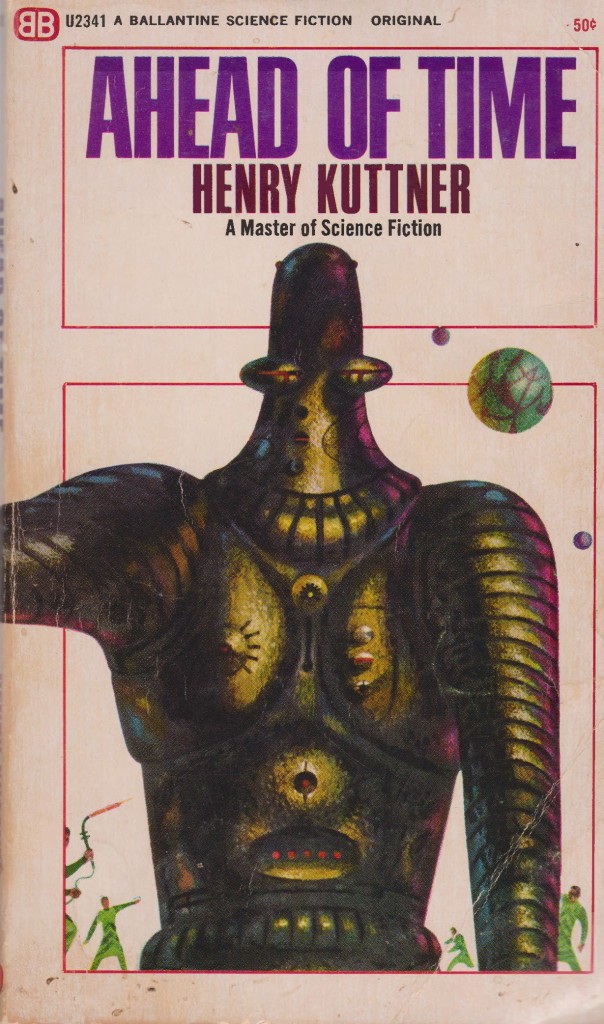
1. Ahead of Time, Henry Kuttner and C. L. Moore (1953)
Richard Powers’ cover for the 1st paperback edition
From the inside page: “A brain in a box fights a criminal plot
A visitor from the future turns out to be peculiar even for his society
An eternal hillbilly family survives the centuries and gets into political trouble
A sick electronic calculator catches a psychosis from its operator
…these are some of the highly original and vividly written stories you will find in this selection of a master’s work.
Science fiction and fantasy grow constantly in popularity. Writing of this quality and imagination is the reason. Henry Kuttner demonstrates again in his book why more and more readers are becoming devotees of that intriguing fiction which is not content to stay in the world as we see it and know it, which takes us to the farthest reaches of space and time, to the farthest reaches of the human mind.”
Which books/covers/authors intrigue you? Which have you read? Disliked? Enjoyed?
1. Planet of the Damned, Harry Harrison (serialized 1961)
Uncredited cover for the 1962 edition
From the back cover: “Brion Brandd of the Galactic CRF had a problem. It was the planet Dis. Brion’s assignment was to salvage it.
Dis was a harsh, inhospitable, dangerous place and the Disans made it worse. They might have been a human once–but they were something else now.
The Disans had only one desire–kill! Kill everything, themselves, their planet, the universe if they could–
BRION HAD MINUTES TO STOP THEM–IF HE COULD FIND OUT HOW!”
Initial Thoughts: Smells like a variation of Harrison’s Deathworld (1960), which I never managed to review, from a year earlier. Which isn’t a good sign… Planet of the Damned was a finalist for the 1962 Hugo for Best Novel. It lost to Robert A. Heinlein’s Stranger in a Strange Land (1961).







 Science Fiction and Other Suspect Ruminations