Over the years, I’ve slowly made my way through a substantial portion of William Tenn’s output: I’ve reviewed his only SF novel Of Men and Monsters(1968), two short story collections–The Human Angle(1956) and Of All Possible Worlds (1955), and three additional short stories “Bernie the Faust” (1963), “Eastward Ho!” (1958), and “Generation of Noah” (1951). I’ve found him an effective satirist with a penchant for often self-defeating twist endings. At his best, Tenn challenges grand narratives of American progress and exceptionalism, 50s consumerist culture and gender roles, and renders an absurdist spin on Cold War conflict. I imagine his reluctance to write novels relegates his often brilliant ouvre to the fringes of contemporary interest in 50s SF.
What pre-1985 science fiction are you reading or planning to read next month? Here’s the August installment of this column.
The Power of the List. I adore lists. I’ve compiled lists of science fiction stories on my site about generation ship stories, immortality (abandoned), overpopulation (abandoned), and sports and games (abandoned). I religiously update my SF Novel and Short Story Review index and the Best SF Novels I’ve reviewed index. In your exploration of genre, I imagine you’ve encountered a “Best Of” list that horrified you — they tend to generate controversy, argument, and all sorts of impulsive takes. Lists can be dangerous. Lists can suggest canon. Lists exclude. Lists can be incomplete. Lists can motivate. Ian Sales, a long-time critic, author, and visitor to my site, created the SF Mistressworks (unfortunately, also abandoned) website in response to an egregious list that demonstrate utter ignorance about the wonderful SF written by women.
Photo of Chukwunonso Ezeiyoke’s Nigerian Speculative Fiction: The Evolution (2025)
Over the last few years, I have highlighted a smattering of the vast range of spectacular scholarship on science fiction in my reviews and Exploration Log series that intrigue me.1 Today I have an interview with Chukwunonso Ezeiyoke about his brand new book Nigerian Speculative Fiction: The Evolution (2025), the first ever monograph on Nigerian speculative fiction (science fiction, fantasy, and horror) (SF). Due to the focus of my site and research interests, I focused my questions primarily on the historical portions of his book.
You can buy a copy directly from Routledge here or on Amazon. As academic works aren’t the cheapest, can also request your library procure a copy.
Let’s get to the interview and the fascinating world of Nigerian SF!
What pre-1985 science fiction are you reading or planning to read next month? Here’s the April installment of this column.
As readers of the site know, I am obsessed with the machinations of Cold War nuclear logic—historical and science fictional. In Ira Chernus’ brilliant Apocalypse Management: Eisenhower and the Discourse of National Insecurity (2008), he dives into the Manichean ideoscape that dominated Eisenhower’s thinking. In short, he posits that Eisenhower interpreted the Soviet threat as an apocalyptic struggle in which the traditional outcome, eliminating the treat, is impossible. Instead the best hope is “to contain and manage it forever” (2)–hence “apocalypse management.” This “new linguistic paradigm” profoundly influenced their policymaking process and dominated American public discourse.
According to Chernus, Eisenhower was obsessed with Americans practicing voluntary self-control in their consumption in order shoulder the taxes needed to fund the perpetual struggle. With this paradigm, Eisenhower’s gestures towards peace–for example his “The Chance for Peace” (April 16th, 1953) speech–were acts of calibrated psychological warfare designed to put the burden of action on the Soviets and score points with the American public and American allies. The United States, on the other hand, could wage the conflict with perpetual, safe, and managed inaction in which peace is never the ultimate objective.
Note: My read but “waiting to be reviewed pile” is growing. Short rumination/tangents/impressions are a way to get through the stack before my memory and will fades. My website partially serves as a record of what I have read and a memory apparatus for future projects. Stay tuned for more detailed and analytical reviews.
1. Margo Bennett’s The Long Way Back (1954)
Uncredited cover for the 1955 edition
3.25/5 (Above Average)
I’m always on the lookout for lesser-known SF works by female authors. And Margot Bennett’s The Long Way Back (1954) certainly fits the bill. Bennett (1912-1980), a Scottish-born screenwriter and author of primarily crime and thriller novels, lead a fascinating life before her writing career. During the Spanish Civil War, she volunteered for Spanish Medical Aid, and was shot in both legs. Afterwards, she continued to participate in various left-wing political causes such as the Campaign for Nuclear Disarmament.
The Long Way Back manifests, with satirical strokes, her critical stance on nuclear war and British colonialism. In a future collectivized Africa ruled by a calculating machine that grades the population, Grame, a “mechanical-repetitive worker” (7), dreams of a career in physics. Instead, the machine shuffles him off on an ill-fated expedition to the ruined remains of Britain post “Big Bang” (nuclear blast). On the way he falls in love with the leader of the expedition, Valya, who serves as a virginal Bride of the State (24). After their sea plane lands, they are beset by a bizarre range of mutations–ferocious dogs, micro-horses, etc. Eventually they discover a tribe of hairless white survivors holed up in primitive caves. Grame teaches the brightest arithmetic. Valya sets about measuring and applying pseudo-scientific theories to understand white society, religion, and conception of the world i.e. parroting all the pseudo-science and racist theories posed by British explorers of Africa. As they attempt to find a lost city, Hep, the third surviving member of the expedition, imagines the potential exploitation and colonization Africa might implement—“Yellow America” is on the rise and resources will be needed. History threatens to re-cycle through the horrors of the past in more ways than one.
Over the last few years, I have attempted to incorporate a smattering of the vast range of spectacular scholarship on science fiction into my reviews and highlight works with my Exploration Log series that speak to me.1 Today I have an interview with Jordan S. Carroll about his brand-new book, Speculative Whiteness: Science Fiction and the Alt-Right (2024). In the book, he examines the ways the alt-right uses classic science fiction imagery and authors to mainstream fascism and advocate for the overthrow of the state.
You can buy an inexpensive physical copy ($10) directly from the University of Minnesota Press website or an eBook version ($3.79) on Amazon.
Thank you so much for agreeing to this interview. First, can you introduce yourself and research interests?
Here’s to a happy reading in 2025! I hope you had a successful reading year. Whether you are a lurker, occasional visitor, a regular commenter, a follower on Bluesky or Mastodon, thank you for your continued support. It’s hard to express how important (and encouraging) the discussions that occur in the comments, social media, and via email are to me. This was the third year running of record-breaking numbers of viewers and views in the 13-year history of my site. What were your favorite vintage SF reads–published pre-1985–of 2024? Let me know in the comments.
Here’s to a happy 2024! I hope you had a successful reading year. Maybe you pulled down some dusty tome that you’ve wanted to dive into for a decade. I’d like to imagine you finally picked up a book I raved about in years past that you acquired with great anticipation but never opened. Whether you are a lurker, occasional visitor, or a regular commenter, thank you for your continued support and wonderful conversation.
What were your favorite vintage SF reads–published pre-1985–of 2023? Let me know in the comments.
Continuing a trend, I read only a handful of novels this year. Instead, my obsessions focused on my science short story review initiatives (listed below), collections, and histories of the science fiction genre. Without further ado, here are my favorite novels and short stories I read in 2023 with bonus categories. I made sure to link my longer reviews where applicable if you want a deeper dive into the rich seam of science fictional gems.
Check out last year’s rundown if you haven’t already for more spectacular reads. I have archived all my annual rundowns on my article index page if you wanted to peruse earlier years.
My Top 5 Science Fiction Novels of 2023
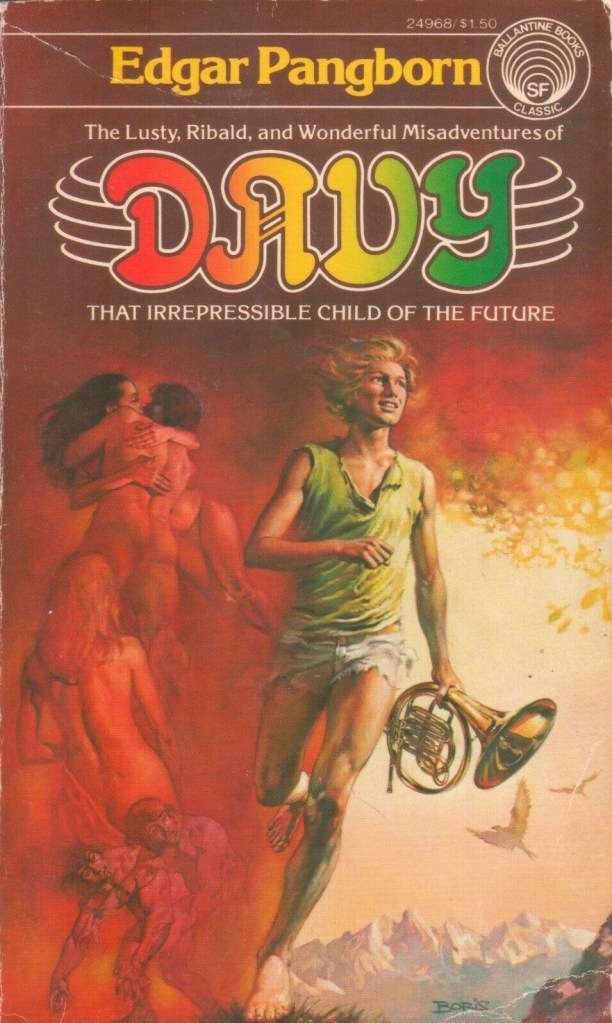
Boris Vallejo’s cover for the 1976 edition
1. Edgar Pangborn’s Davy(1964), 5/5 (Masterpiece): Nominated for the 1965 Hugo Award for Best Novel. Full review.
Chan Davis (1926-2022) was a fascinating figure. He was a communist activist, fanzine editor, mathematician, and political prisoner. He was fired from the University of Michigan in 1954 and imprisoned for six months in 1960 on charges of contempt of Congress leveled by HUAC. The Hugo Book Club recently posted a fantastic interview, from which I derived the bibliographic blurb above, with Steve Batterson, the author of The Prosecution of Professor Chandler Davis: McCarthyism, Communism, and the Myth of Academic Freedom(2023) that I plan on purchasing soon.
Today I have selected three of Chan Davis’ thirteen published SF short stories. The connecting theme? 1940s speculations on nuclear war in the immediate post-Hiroshima world. All three appeared in Astounding Science Fiction under the tutelage of John W. Campbell, Jr.
William Timmins’ cover for Astounding Science Fiction, ed. John W. Campbell, Jr. (May 1946)
3/5 (Average)
“The Nightmare” first appeared in Astounding Science Fiction, ed. John W. Campbell, Jr. (May 1946). You can read it online here.
A few months before the atomic bomb attack on Hiroshima (August 6th, 1945), a group of scientists at the University of Chicago published The Franck Report (June 11th, 1945). James Franck and his colleagues argued that “within ten years other countries may have nuclear bombs, each of which, weighing less than a ton, could destroy an urban area of more than ten square miles.” They point out the great disadvantage of the United States with its “agglomeration of population and industry in comparatively few metropolitan districts” in comparison to countries with a population and “industry […] scattered over large areas.” In the months after Hiroshima, Chan Davis published his first SF story “The Nightmare” with The Franck Report warning firmly in mind [1].





 Science Fiction and Other Suspect Ruminations