Short Story Reviews: Chan Davis’ “The Nightmare” (1946), “To Still the Drums” (1946), and “The Aristocrat” (1949)

Chan Davis (1926-2022) was a fascinating figure. He was a communist activist, fanzine editor, mathematician, and political prisoner. He was fired from the University of Michigan in 1954 and imprisoned for six months in 1960 on charges of contempt of Congress leveled by HUAC. The Unofficial Hugo Book Club recently posted a fantastic interview, from which I derived the bibliographic blurb above, with Steve Batterson, the author of The Prosecution of Professor Chandler Davis: McCarthyism, Communism, and the Myth of Academic Freedom (2023) that I plan on purchasing soon.

Today I have selected three of Chan Davis’ thirteen published SF short stories. The connecting theme? 1940s speculations on nuclear war in the immediate post-Hiroshima world. All three appeared in Astounding Science Fiction under the tutelage of John W. Campbell, Jr.


3/5 (Average)

“The Nightmare” first appeared in Astounding Science Fiction, ed. John W. Campbell, Jr. (May 1946). You can read it online here.

A few months before the atomic bomb attack on Hiroshima (August 6th, 1945), a group of scientists at the University of Chicago published The Franck Report (June 11th, 1945). James Franck and his colleagues argued that “within ten years other countries may have nuclear bombs, each of which, weighing less than a ton, could destroy an urban area of more than ten square miles.” They point out the great disadvantage of the United States with its “agglomeration of population and industry in comparatively few metropolitan districts” in comparison to countries with a population and “industry […] scattered over large areas.” In the months after Hiroshima, Chan Davis published his first SF story “The Nightmare” with The Franck Report warning firmly in mind [1].

Continue reading

Updates: Recent Science Fiction Purchases No. CCLXXII (James Tiptree, Jr., Allen F. Wold, Nova Anthology, and non-fiction on Drugs, Esoterica, and Visionary Experience in the Seventies)

As always, which books/covers/authors intrigue you? Which have you read? Disliked? Enjoyed?

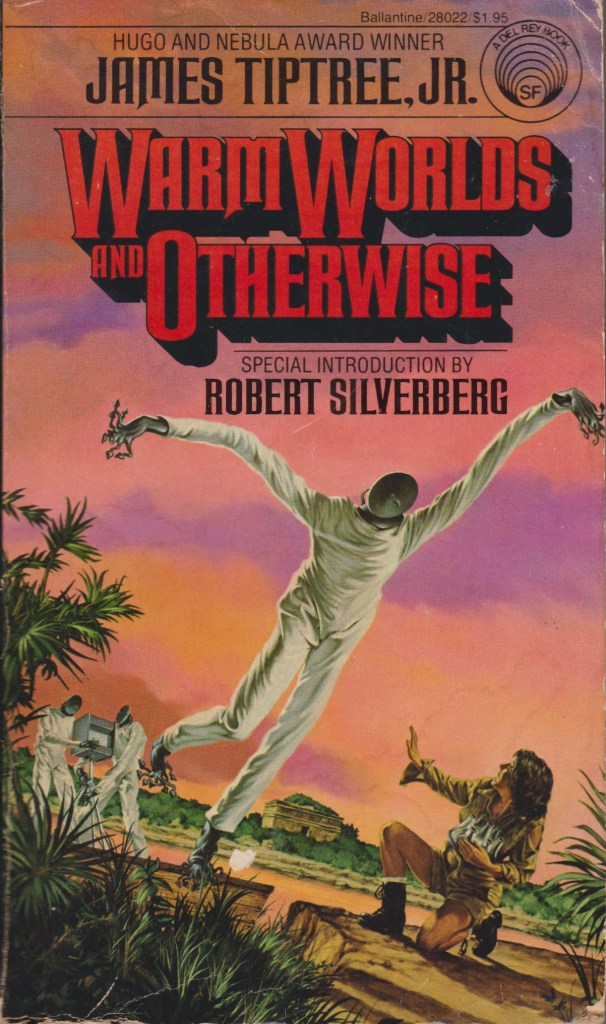
1. Warm Worlds and Otherwise, James Tiptree, Jr. (1975)

From the back cover: “A DOZEN FABULOUS TALES OF INNER VISIONS AND OUTER SPACE…

LOVE IS THE PLAN, THE PLAN IS DEATH (Nebula-Award Winner—Best Short Story 1973)

Courtship rites can easily run amok, especially when that’s what’s supposed to happen… especially when the creatures are color-coded for passion as well as for death!

THE GIRL WHO WAS PLUGGED IN

Continue reading

Updates: My 2018 in Review (Best SF Novels, Best SF Short Fiction, and Bonus Catagories)

Post-academia depression hits hard…. While completing my PhD (defended in the summer of 2017), reading SF and writing about SF was the way I kept sane. After multiple mostly unsuccessful years on the academic market, I have changed gears career-wise (although I’m still affiliated with a university and teaching college-level history courses but without the research component) and it has been a liberating experience. My history obsessions remain, even stronger in many ways, and academic monographs on all the topics that I wanted to read about but never could—Hellenistic successor states to Alexander, Early Islam, Late Antique and Medieval Persia, etc.–have dominated my time and pocketbook 2018 (don’t ask how much I’ve spent). I have included a “Best Academic History Reads of 2018” section for the curious.

At the beginning of November, I was moments from announcing that I was on hiatus for the foreseeable future. However, I have fallen back in love with SF and writing about SF and the new year beckons!

All of this is to say, I read little SF this year–until last month. However, there were a handful of stand-out SF novels and short stories that I managed to squeeze in.

And please list your favorite vintage (or non-vintage) SF reads of the year. I look forward to reading your comments.

Enjoy!

…and read lots of good books in 2019. I will.

Best SF Novels Continue reading

Book Review: Scop, Barry N. Malzberg (1976)

SCPHBSVJZB1976

(Stephen Fabian’s cover for the 1976 edition)

3.5/5 (Good)

A TANTALIZING FRAGMENT/THE CONCEPTUAL CORE: “‘Don’t you understand what is going on here? [Scop] said, “Don’t you realize that we are living not in a present but in a dream of waste, an extension of all the terrors of the past; don’t you realize that we live awash in blood?” (105).

WHOSE BLOOD?/THE HISTORICAL JUNCTION: John F. Kennedy is assassinated on November 22nd, 1963 by Lee Harvey Oswald. Abraham Zapruder, a private citizen, films the death from the Grassy Knoll in Dealey Plaza, Dallas.  Jack Ruby kills Oswald, who was awaiting trial, on November 24th.  James Earl Ray assassinates Martin Luther Jing, Jr. on April 4th, 1968.  Robert F. Kennedy is assassinated by Sirhan Sirhan on June 5th, 1968.

Scop wants all three to never have Continue reading