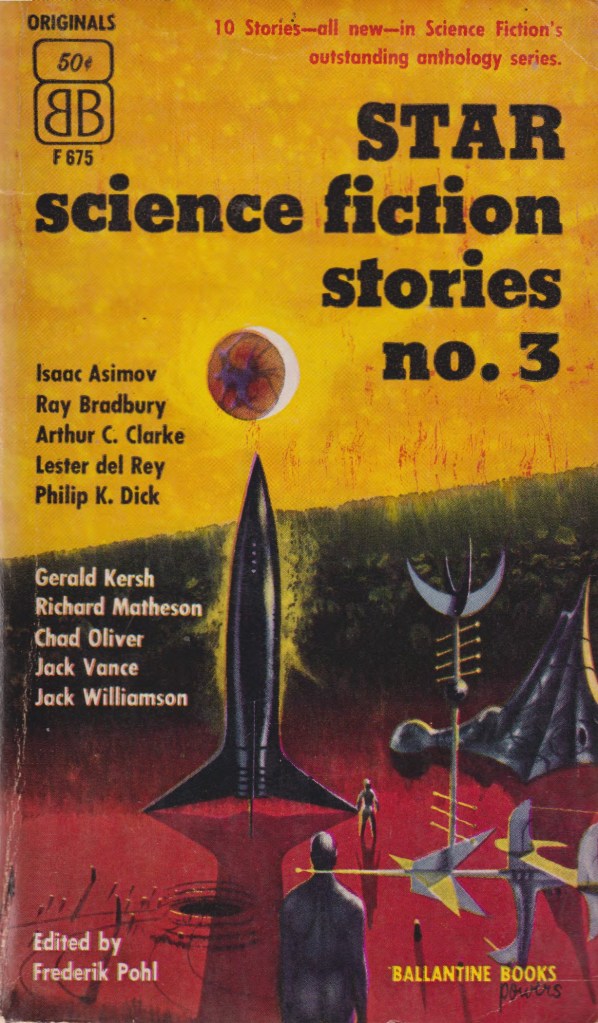
Book Review: Star Science Fiction Stories No. 3, ed. Frederik Pohl (1955)

3.5/5 (collated rating: Good)

Ballantine Books’ illustrious science fictional program started with a bang–Star Science Fiction Stories. According to Mike Ashley’s Transformations: The Story of Science-Fiction Magazines from 1950 to 1970 Frederik Pohl’s anthology series of original (mostly) stories was “intended as both a showcase of Ballantine’s authors and a lure to new writers.” Paying better rates than magazines, the Star series foreshadowed the explosion of original anthologies that would provide a sustained challenge to the eminence held in the 50s by the magazine.

I’ve selected the third volume of the six-volume series.1 It contains an illustrative cross-section of 50s science fiction. Philip K. Dick’s “Foster, You’re Dead” (1955), Richard Matheson’s “Dance of the Dead” (1955), and Jack Williamson’s “Guinevere for Everybody” (1955) are not to be missed.

Continue reading

What pre-1985 science fiction are you reading? + Update No. XVIII

What pre-1985 science fiction are you reading or planning to read this month? Here’s the November installment of this column.

Last week I wrote a post about Clifford D. Simak’s delightfully inclusive 1971 speech at the height of the New Wave in which he celebrated science fiction as a “forum of ideas” open to all voices. While reviewing the various snarky comments leveled at the movement by “classic authors” like Asimov, a faint memory of James Blish’s own anti-New Wave sentiments tickled my memory. I randomly opened up a book on my desk to figure out a fascinating SF tidbit to start this post, and voilà, the James Blish story.

Jacqueline Foertsch’s Reckoning Day: Race, Place, and the Atom Bomb in Postwar America (2013) contains a sustained analysis of Samuel R. Delany’s various post-apocalyptic novels. She includes a discussion of the response to Delany’s Nebula-winning The Einstein Intersection (1967). At the 1968 Nebula Awards Banquet, moments after Delany received his prize for Einstein (and where moments later he’d collected another award for “Aye, and Gomorrah”), Blish lambasted the New Wave. Blish complained about the “loosening of the genre’s parameters” and the “re-christening of the genre” as “speculative fiction” (98). I find all of this hilarious as Blish himself wrote fantasy novels like Black Easter (1968) (that would also nab a 1969 Nebula nomination) and far earlier oblique proto-New Wave speculative fictions like “Testament of Andros” (1953). I wonder if Blish aimed such vitriol at a figure like Simak, who took the loosening of the genre’s parameters to extremes during the New Wave–i.e. novels like The Goblin Reservation (1968), Destiny Doll (1971), and Out of Their Minds (1970). Unfortunately, I don’t think it’s surprising that Blish took especial issue with one of the few black SFF authors of the day.

And let me know what pre-1985 science fiction you’ve been reading!

Continue reading

Updates: Recent Science Fiction and Fantasy Purchases No. CCXCII (Jack Vance, Craig Strete, Cherry Wilder, Giorgio De Maria)

Which books/covers/authors intrigue you? Which have you read? Disliked? Enjoyed?

1. The Brave Free Men, Jack Vance (magazine 1972)

From the back cover: “The Faceless Man was a prisoner in his own palace and his power over the people of Durdane was in the hands of another–the hands of Gestel Etzwane, a youth whose thirst for vengeance against the dreaded Roguskhoi would slacken only in oceans of their blood.

But to destroy the Roguskhoi, Gastel would have to unite a world that survived by its separateness. To do this was more than dangerous, but Gestel had little choice. He would return to the people control of their lives–and send them to fight to their death…”

Continue reading

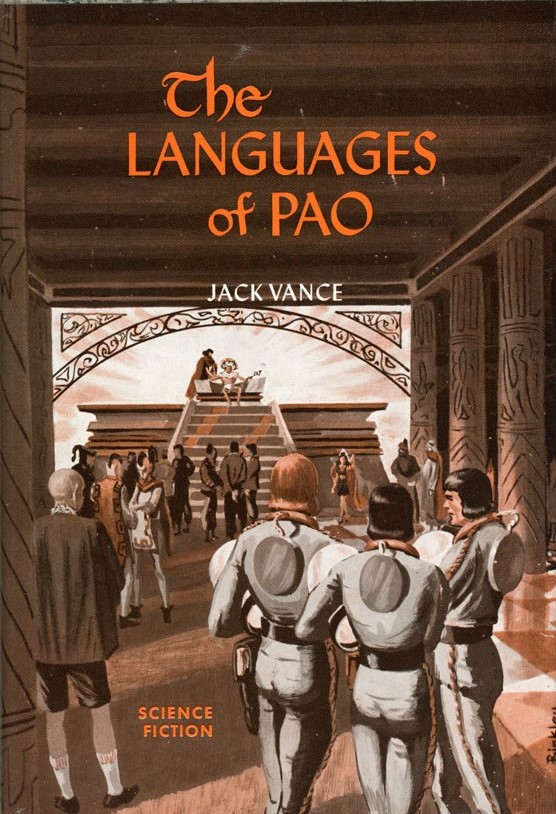
Short Book Reviews: Jack Vance’s The Languages of Pao (1958), Kit Reed’s Fort Privilege (1985), and John Shirley’s Transmaniacon (1979)

Note: My read but “waiting to be reviewed pile” is growing. Short rumination/tangents are a way to get through the stack before my memory and will fades. Stay tuned for more detailed and analytical reviews.


1. The Languages of Pao, Jack Vance (1958)

3.25/5 (Vaguely Good)

Since I started my site in 2011, I’ve soured a bit on Jack Vance’s brand of planetary adventure in richly realized and exotic worlds. I doubt I’d currently rate novels like Showboat World (1975) or The Blue World (1966) as highly as I did back then. One of more appealing elements of having a single project for so long is my ability to track my evolving views on genre. That said, I’d classify Wyst: Alastor 1716 (1978) and The Languages of Pao (1958) amongst his most conceptually ambitious novels I’ve read so far and worth tracking down. For a full list consult my index. Note: I read but never reviewed Dying Earth (1950).

Continue reading

Updates: Recent Science Fiction Purchases No. CCLXVI (Pamela Sargent, Warren Miller, Robert Thurston, and a Themed Anthology on Deep Space)

As always, which books/covers/authors intrigue you? Which have you read? Disliked? Enjoyed?

Preliminary Note: I’ve made two big changes to the site. My revamped review index now contains every single short story and novel I’ve reviewed on the site listed by author. In the past, you had to sift through the anthologies to find short stories. Hopefully this is easier to navigate [you better say yes — it took me more than eight hours — hah]. Let me know if it is a useful change.

I’ve also updated the site template to make it easier to navigate on a mobile device. I still like my old template but this seems functionally identical and visually similar.

Now to the science fiction!


1. Deep Space, ed. Robert Silverberg (1973)

John Berkey’s cover for the 1976 edition

From the back cover: “Beyond the rim of the solar system, past the orbit of Pluto, far into uncharted space, a man in a life hutch is held prisoner by a deranged robot. A galactic agent learns that there is a cosmic reason for his distasteful, dangerous job. A man discovers he is the only human being not controlled by an analogue—an invisible guardian. And the planet Centaurus holds Continue reading

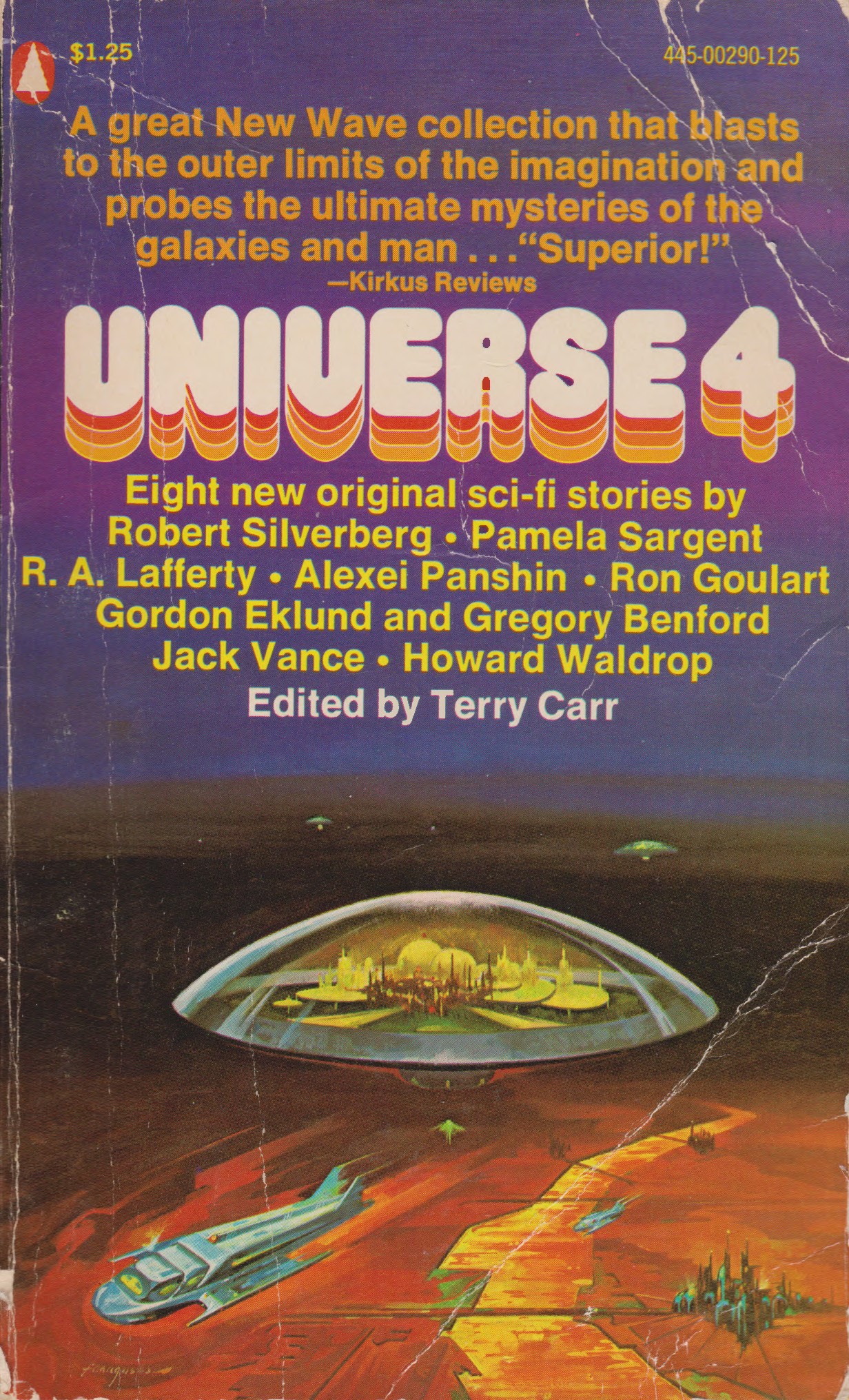
Book Review: Universe 4, ed. Terry Carr (1974) (Robert Silverberg, Pamela Sargent, Jack Vance, R. A. Lafferty, Alexei Panshin, Ron Goulart, et al.)

Jack Faragasso’s cover for the 1975 edition

3.25/5 (collated rating: Vaguely Good)

Terry Carr’s original anthology Universe 4 (1974) contains a cross-section of early 70s science fiction–from oblique New Wave allegories to “hard SF” first contact stories with unusual aliens.

Despite clocking in last in the installments I’ve read so far– behind Universe 2 (1972), Universe 1 (1971), and Universe 10 (1980)—the best stories, R. A. Lafferty’s rumination on memory and nostalgia, Pamela Sargent’s bleak account of urban Continue reading

Updates: Recent Science Fiction Acquisitions No. CCXXIII (Jack Vance, Alexei Panshin, Brian Aldiss, Frederick Turner)

On a recent trip to Chicago I spent far too much on vintage SF at Bucket O’ Blood Books and Records (twitter).If you’re in the city and love old SF paperbacks, stop by! I’ll certainly be back. Here are the first four books from that haul.

1. Jack Vance is an author I always tend to buy but never enjoy as much as I think I should–see my recent review of Emphyrio (1969). Thoughts on this one?

2. I have yet to read anything by Alexei Panshin—at least I now have a copy of his masterpiece, Rite of Passage (1968) (nominated for the 1969 Hugo + won that year’s Nebula).

3. A lesser-known 70s comedic novel from Brian W. Aldiss…

4. And finally, the one I’m most excited about. Evolved humans are thrust into conflict on a terraformed, but dying, Mars. With a fun Powers cover to boot! The rest of Frederick Turner’s SF output appears to be the epic poem variety according to SF Encyclopedia.

Let me know what books/covers intrigue you. Which have you read? Enjoyed?

1. The Anome, Jack Vance (magazine, 1971)

(Paul Lehr’s cover for the  1973 edition) Continue reading

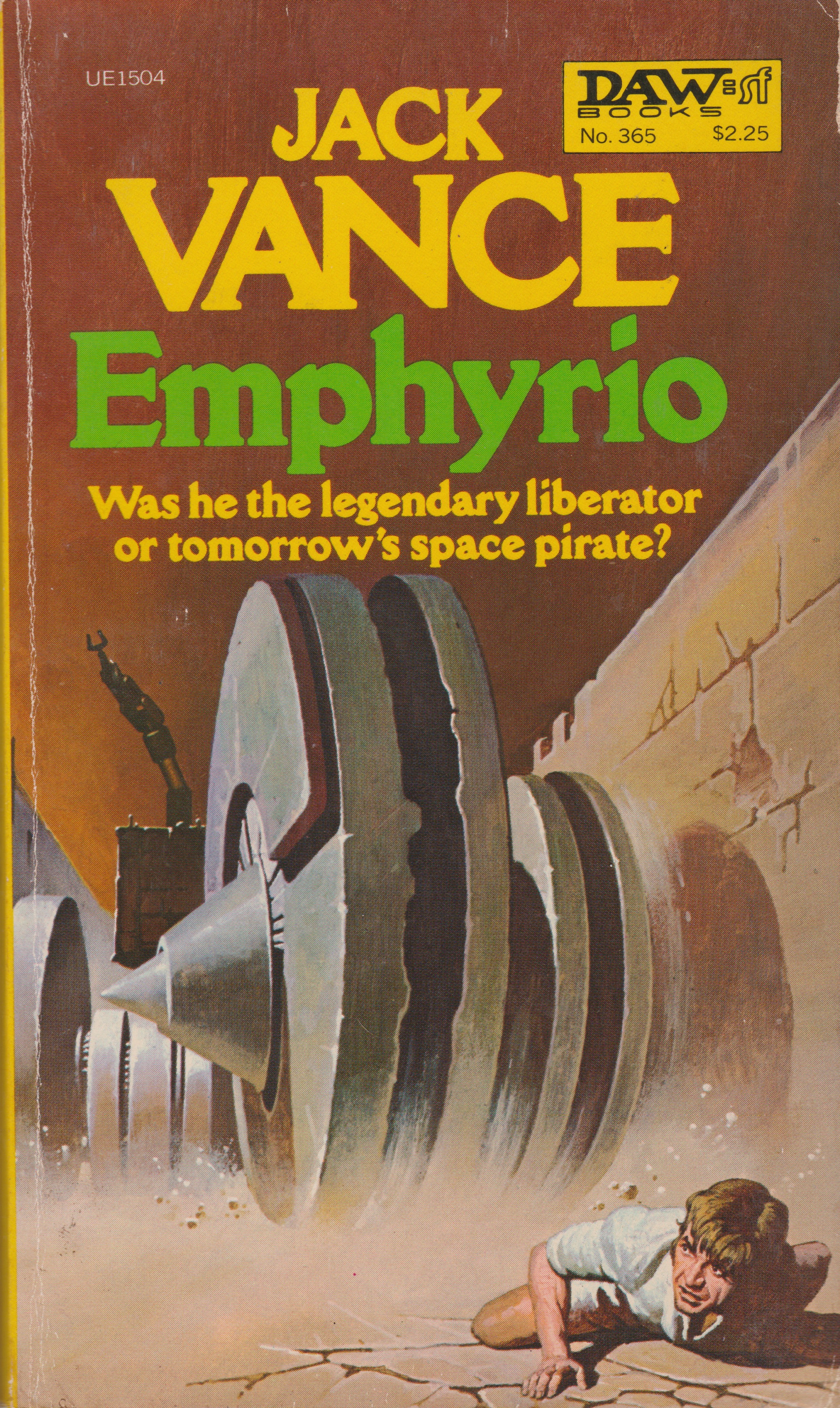
Book Review: Emphyrio, Jack Vance (1969)


(Gino D’Achille’s cover for the 1979 edition)

3.5/5 (Good)

Jack Vance’s Emphyrio (1969) is a story about how a story can create change and heighten our own yearning for escape. Although a pulp coming-of-age adventure at heart, Vance reigns in his baroque descriptive tendencies to spin a narrative that tries (successfully) to say something meaningful about the impact of storytelling.
Continue reading

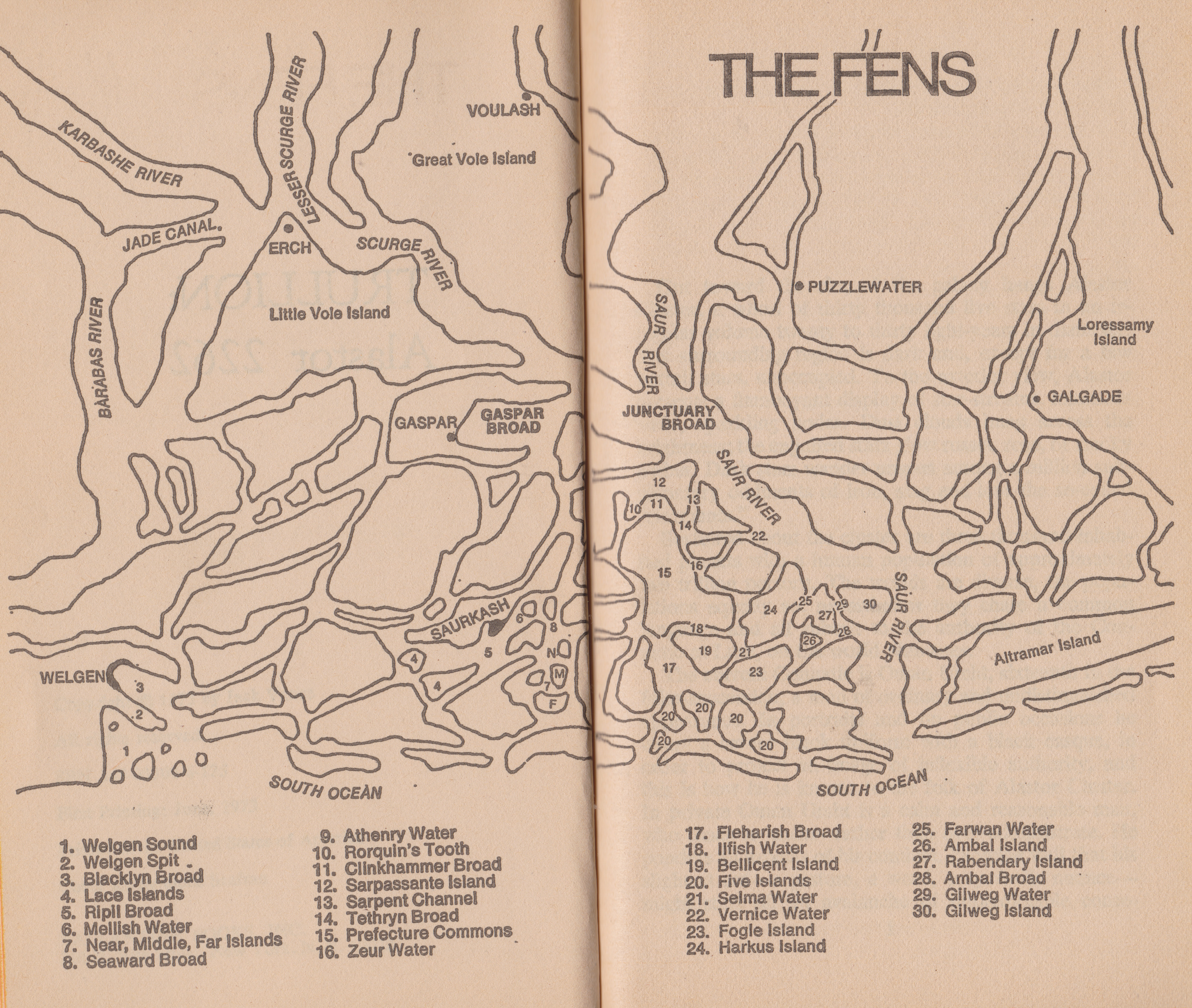
Adventures in Science Fiction Interior Art: Monday Maps and Diagrams (Science Fiction) — Jack Vance’s Trullion: Alastor 2262 (1973)

Monday Maps and Diagrams 11/26/18

In my informal Monday Maps and Diagrams series I will showcase scans of SF maps and diagrams from my personal collection. As a kid I was primarily a fantasy reader and I judged books on the quality of their maps. When my reading interests shifted to science fiction, for years I still excitedly peeked at the first few pages… there could be a map!

Let’s start off with a simple yet effective map via Jack Vance. Islands, and rivers, and swamps….

The Map:

Citation: Map from the 1973 Ballantine edition of Jack Vance‘s Trullion: Alastor 2262 (1973) [click to enlarge]. Continue reading