What pre-1985 science fiction are you reading? + Update No. XXV

What pre-1985 science fiction are you reading or planning to read next month? Here’s the July installment of this column.

One of my favorite forms of SF scholarship is careful identification of a intellectual genealogy–tracing what an author read and engaged in dialogue with. Authors are readers. They also can’t escape references and textual traces of what they’ve consumed (or, of course, engagement with the world in which they lived).

I’ve read two interesting examples recently. The first, Carol McGuirk’s “J. G. Ballard and American Science Fiction” in Science Fiction Studies, vol. 49 (2022), is the perfect example of this type of scholarship. She traces Ballard’s engagement with SF, his earliest stories, and the various parallels an interactions between his work and American SF that he read (Galaxy Magazine, Theodore Sturgeon, Fritz Leiber, Robert Heinlein, Frederik Pohl, C. M. Kornbluth, Ray Bradbury, Judith Merril, Federic Brown, Henry Kuttner, C. L. Moore, etc.). She argues that Ballard engaged in “retelling with a twist” (476). She writes that “early Ballard stories rework prior sf in moods ranging from measured homage to barbed repose to parodic photo-bomb” (483).

Continue reading

Short Fiction Review: John Wyndham’s “The Man From Beyond” (variant title: “The Man from Earth”) (1934)

The following review is the 36th installment of my series searching for “SF short stories that are critical in some capacity of space agencies, astronauts, and the culture which produced them.” Some stories I’ll review in this series might not fit or are poor quality. And that is okay. I relish the act of literary archaeology.

Why John Wyndham? I snagged a copy of David Seed’s new book John Wyndham (2025) out via University of Liverpool Press and realized how little I knew about his pre-War science fiction.1 This story, among a few others, jumped out to me due to its critical stance on human exploration.

Previously: E. C. Tubb’s “Without Bugles” (1952), “Home is the Hero” (1952), and “Pistol Point” (1953)

Up Next: TBD


3.5/5 (Good)

John Wyndham, writing as John Benyon Harris, published “The Man from Beyond” (variant title: “The Man from Earth”) in Wonder Stories, ed. Hugo Gernsback (September 1954). You can read the story online here.

The Contours of Venusian Wonder

Continue reading

Updates: Recent Science Fiction Acquisitions No. CCCXIII (John Wyndham, Keith Roberts, Fredric Brown, Naomi Mitchison)

Which books/covers/authors intrigue you? Which have you read? Disliked? Enjoyed?

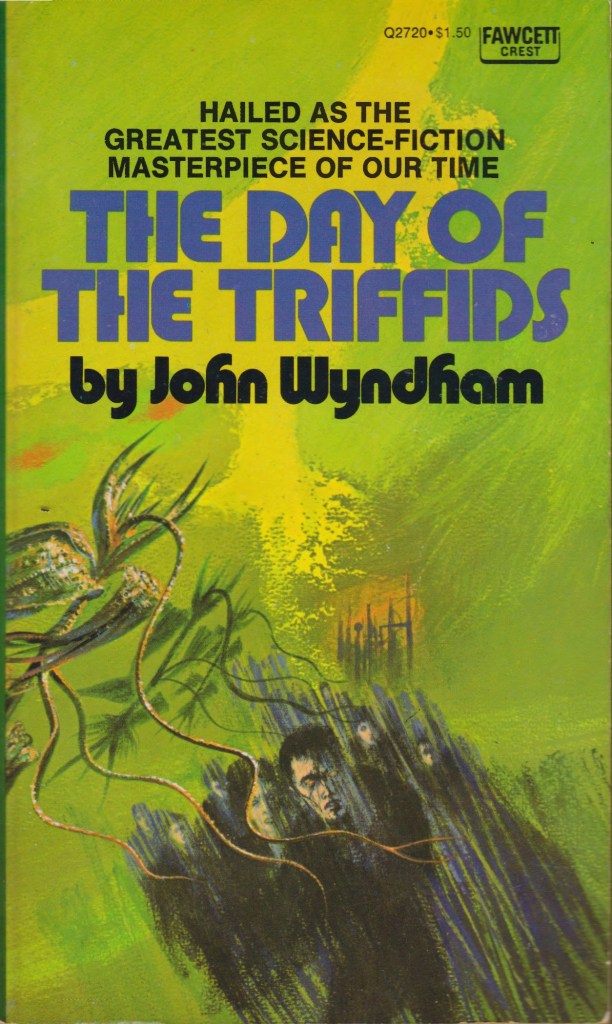
1. The Day of the Triffids, John Wyndham (1951)

From the back cover: “WHAT WERE THEY–

THESE HIDEOUS TRIFFIDS ROAMING THE RUINS OF THE EARTH?

Until a few short hours ago–before the sky exploded into a shower of flaming green hell–triffids had been regarded as merely a curious and profitable form of plant life. Now these shadowy vegetable creatures became crawling, killing nightmare of pain and horror.

Madness hung in the air, fear lurked in every side street, death hovered in every doorway. Stripped of civilized veneer by terror and desperation, the handful of surviving humans began to turn on each other.

Continue reading

Updates: Recent Science Fiction and Fantasy Purchases No. CCCXII (J. G. Ballard, Roger Zelazny, John Wyndham, and Joel Zoss)

Which books/covers/authors intrigue you? Which have you read? Disliked? Enjoyed?

1. The Impossible Man and Other Stories, J. G. Ballard (1966)

From the back cover: “THE IMPOSSIBLE MAN is the eighth book by J. G. Ballard to be published in the United States. Since the publication of his famous first two novels in 1962, The Wind from Nowhere and The Drowned World, no writer in modern science fiction has received higher acclaim from the critics:

“…the freshest new talent in science fiction since Brian Aldiss.— DAMON KNIGHT

“Ballard is one of the brightest new stars in post-war fiction… he may turn out to be one of the most imaginative of Wells’s successors.” — KINGSLEY AMIS

THE IMPOSSIBLE MAN gathers together nine of Ballard’s most recent stories. A few samples:

In “The Drowned Giant” an enigmatic visitor is subjected to the various kindnesses of man…”

Continue reading

Recent Science Fiction Purchases No. CCCV (William Golding, John Wyndham, Mervyn Peake, Joan D. Vinge, Ralph Blum, and an anthology)

Which books/covers/authors intrigue you? Which have you read? Disliked? Enjoyed?

1. 5 Tales From Tomorrow, ed. T. E. Dikty (1957)

From the back cover: “THE TIME: TOMORROW… when

…space travel is as simple as suburban commuting

…robots do everything from washing dishes to waging wars

…do-it-yourself surgery kits are as common as Band-aids

…giant electronic brains mastermind all human activity

THE PLACE: SPACE SPACE SPACE

where the cold, dark islands of abandoned planets drift in a fabulous universe flooded with blazing energy, the dust of old suns and the heat of smoldering new stars.

Space–the promise of new life to a crowded earth–the new frontier–the hope of tomorrow!”

Contents: Bud Foote’s “Push-Button Passion” (1954), Tom Godwin’s “The Cold Equations” (1954), Clifford D. Simak’s “How-2” (1954), Robert Abernathy’s “Deep Space” (1954), Everett B. Cole’s “Exile” (1954)

Continue reading

Recent Science Fiction Purchases No. CCXCIX (Henry Kuttner, C. L. Moore, Jack Williamson, Jacob Transure, Star Anthology)

Which books/covers/authors intrigue you? Which have you read? Disliked? Enjoyed?

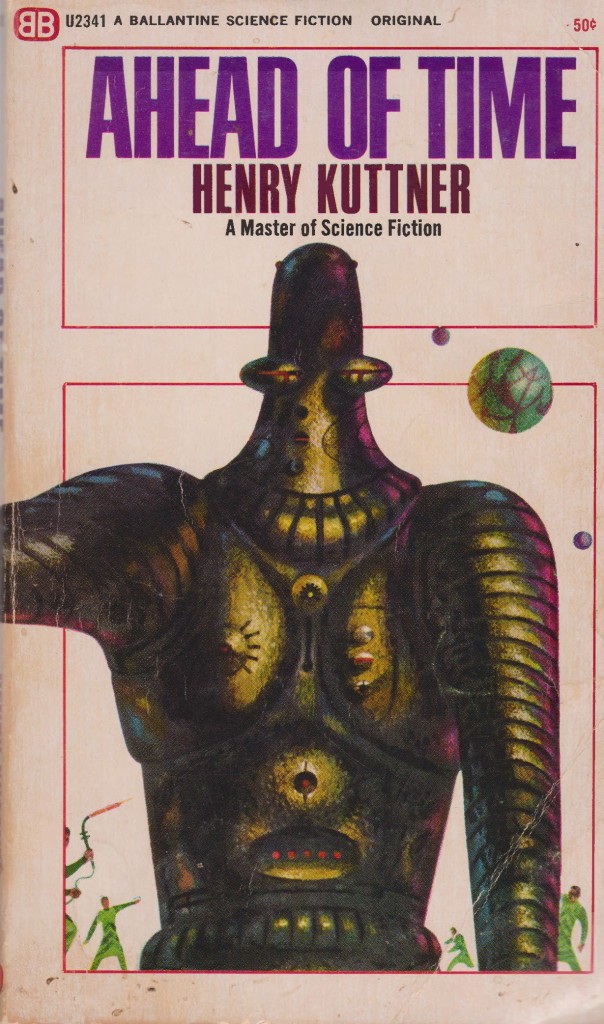
1. Ahead of Time, Henry Kuttner and C. L. Moore (1953)

From the inside page: “A brain in a box fights a criminal plot

A visitor from the future turns out to be peculiar even for his society

An eternal hillbilly family survives the centuries and gets into political trouble

A sick electronic calculator catches a psychosis from its operator

…these are some of the highly original and vividly written stories you will find in this selection of a master’s work.

Science fiction and fantasy grow constantly in popularity. Writing of this quality and imagination is the reason. Henry Kuttner demonstrates again in his book why more and more readers are becoming devotees of that intriguing fiction which is not content to stay in the world as we see it and know it, which takes us to the farthest reaches of space and time, to the farthest reaches of the human mind.”

Continue reading

Short Book Reviews: John Wyndham’s The Chrysalids (variant title: Re-Birth) (1955), John A. Williams’ Captain Blackman (1972), and Gina Berriault’s The Descent (1960)

Note: My read but “waiting to be reviewed pile” is growing. Short rumination/tangents are a way to get through the stack before my memory and will fades. Stay tuned for more detailed and analytical reviews.


1. The Chrysalids (variant title: Re-Birth), John Wyndham (1955)

3/5 (Average)

John Wyndham’s The Chrysalids (1955), my first exposure to his science fiction, transpires in a standard post-apocalyptic cozy catastrophe scenario with a deeply emotional core. The narrative follows David’s childhood in the backwater territories of Labrador, Canada hundreds of years after a nuclear war. The Church, inspired by Nicholson’s Repentances—which along with the Bible are only surviving books–imposes a draconian theology that “only God produces perfection” (51). Mutations, a visual sign of diabolical influence, must be destroyed. David, the son of the local strongman and preacher, discovers a young girl with a terrifying secret–she has six toes. David starts to accumulate secrets including his own mysterious telepathic abilities and recurrent dreams of a city in a world without cities. He shares them with his sympathetic Uncle Axel, who attempts to protect him from the forces narrowing in.

There are some nice touches throughout. Uncle Axel recounts his travels and knowledge of the world as a seaman and the effects is that of a medieval map, filled with pseudo-legendary beings, historical fragments, and “real” flora and fauna that, at first glance, seems too fantastic to exist (54-57).

Continue reading

Updates: Recent Science Fiction Acquisitions No. CLXXXVI (Wyndham + Conway + Brown + Wright)

Post-PhD job takes over… and books are not reviewed. But reading and buying still happens!

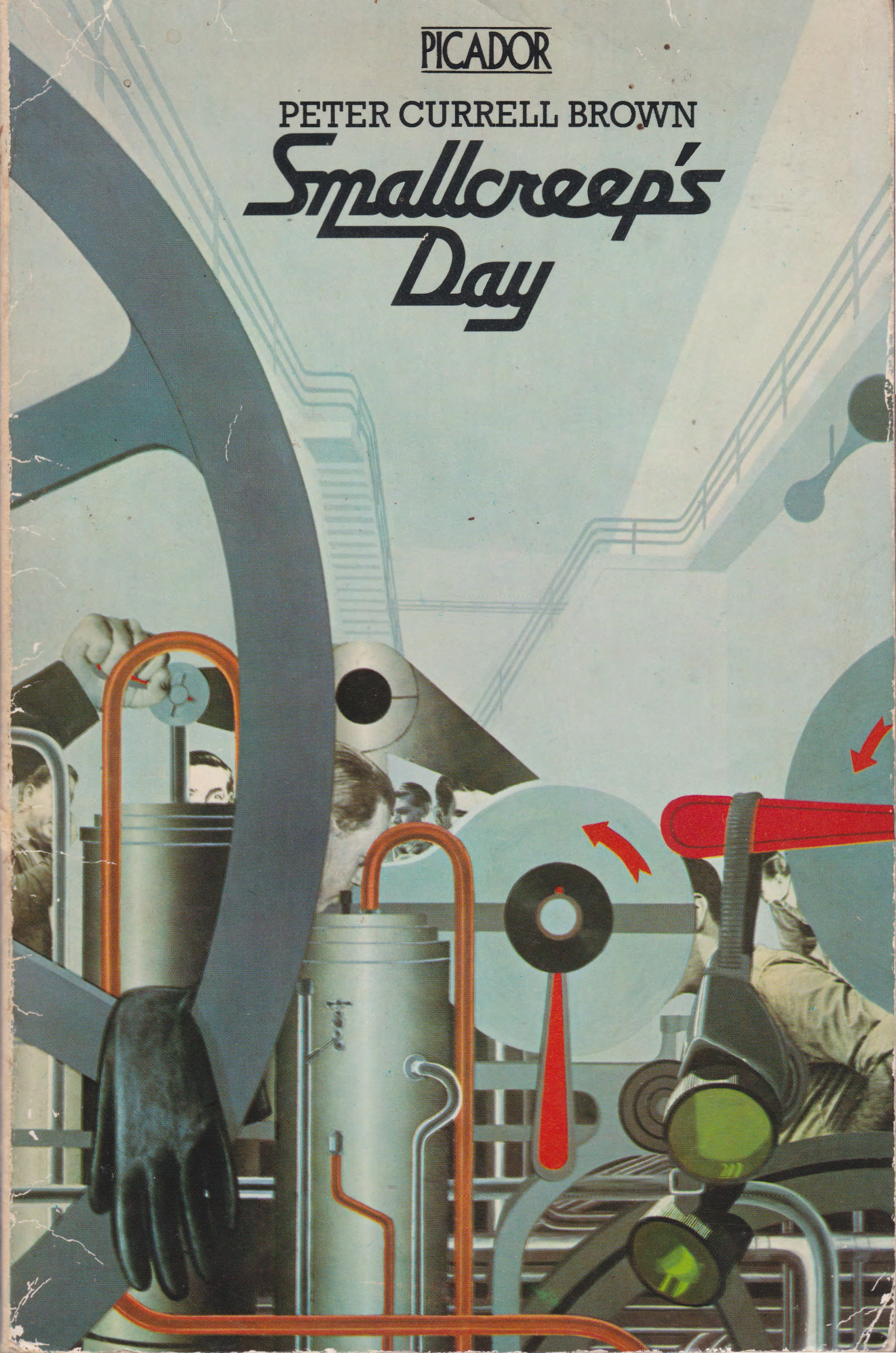
1. A supposed cult classic republished by Picador Press….. Has anyone read Smallcreep’s Day (1965)? Near the top of my “to read” pile. And I love Barbara Costall’s cover.

2. Early in the year I reviewed Conway’s short story “Mindship” (1971) in Universe 1 (1971), ed. Terry Carr. It was pretty solid. I tracked down the novel version which included the short as the prologue.

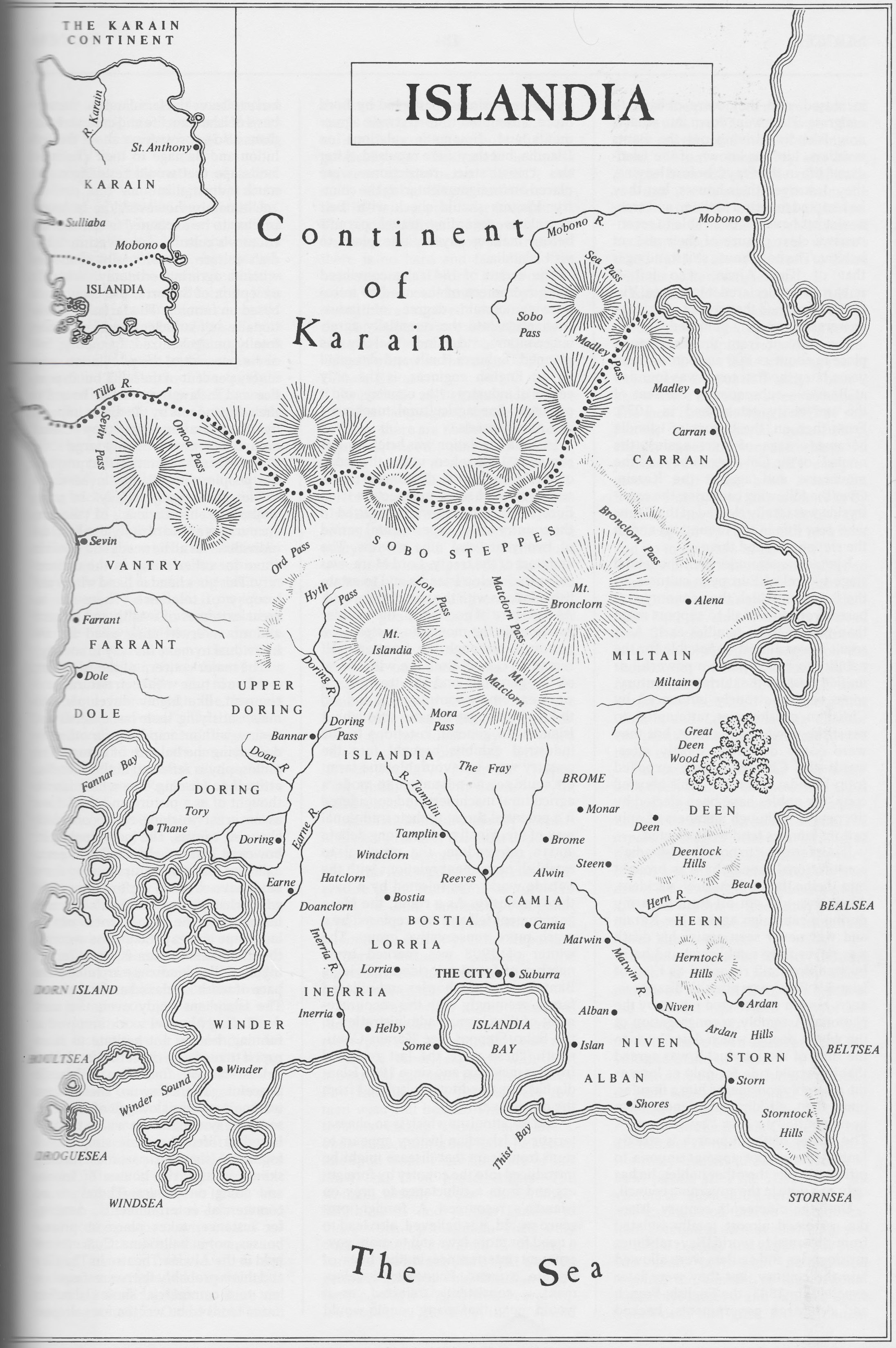
3. I was obsessed with Austin Tappan Wright’s Islandia (1942) as a kid. Not with the novel per se, which I never owned, but the lengthy and descriptive entry in Alberto Manguel and Gianni Guadalupi’s spectacular (and wonder inducing) The Dictionary of Imaginary Places (1987). And of course, the idea of  Wright slowly creating an imaginary world that could exist within our own and only “discovered” after his death resonated with a young me…

I’ve included the map from the entry in The Dictionary of Imaginary Places.

4. And finally, another John Wyndham novel… although the premise sounds downright bland and trite. But then again, I still have not read a lot of his work and I know he was a formative voice in SF.

~

1. Smallcreep’s Day, Peter Currell Brown (1965)

(Barbara Costall’s cover for the 1973 edition) Continue reading

Updates: Recent Science Fiction Acquisitions No. CLXXX (The Scotland Edition No. 2) (Ballard + Wyndham + Shaw + Aldiss)

Still abroad. Need my desk and familiar surroundings to write book reviews. Alas.

That said, more books from my Scotland travels. Here’s Part I in my Scotland series.

1) I need to read more John Wyndham. I often find short stories are the best place to start. And as I was journeying around the UK, Penguin editions are plentiful!

2) One of J.G. Ballard’s best known novels. The one Cronenberg got his hands on…. Relevant reviews: Billenium (1962), High-Rise (1975), and The Voice of Time and Other Stories (1962).

3) A late 70s Brian W. Aldiss collection. He’s long been a favorite on this site—especially his short fiction. I’ve reviewed the following collections: Starswarm (1964), No Time Like Tomorrow (1959), Galaxies Like Grains of Sand (1960), and Who Can Replace a Man? (variant title: Best Science Fiction Stories of Brian W. Aldiss) (1965).

4) And finally, another Bob Shaw novel. I’ve heard that The Palace of Eternity (1969) is one strange read.

Note: As I am still abroad and without my handy scanner, I’ve had to include cover images of two of the books which I do not own. At some later point I might replace the images with high-res scans.

As always, I look forward to your thoughts and comments!

1. The Seeds of Time, John Wyndham (1956)

(Uncredited cover for the 1966 edition) Continue reading