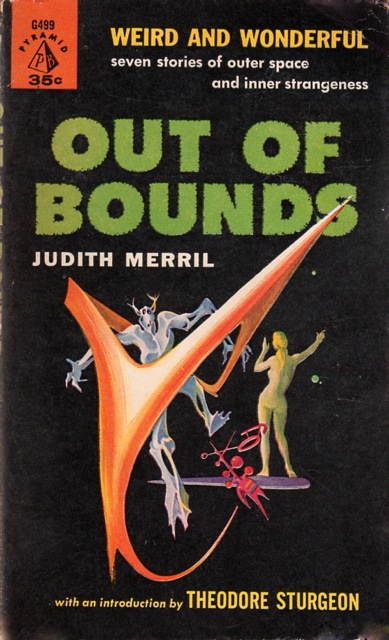
Book Review: Out of Bounds, Judith Merril (1960)

OTFBNDS1960

(Art Sussman’s cover for the 1960 edition)

3.25/5 (collated rating: Vaguely Good)

I have long been a fan of both Judith Merril’s fiction and edited volumes.   The eponymous novella in the collection Daughters of Earth (1968) is one of more delightful visions from the 1950s I have encountered. Merril reframes biblical patrilineal genealogy as matrilineal–i.e. humankind’s conquest of space is traced via the female descendants of an august progenitor.  The story is brilliant in part due to a remarkable metafictional twist, the story itself is compiled from historical documents to serve as an instructional template for future generations of women.  Despite substantial editorial control that forced Merril to include a rather hokey plot on two hokey planets, the story remains memorable for the well crafted feminist Continue reading

A question for my fellow SF fans: Which SF writer without a single author collection published within the last 10 years should receive a reprint?

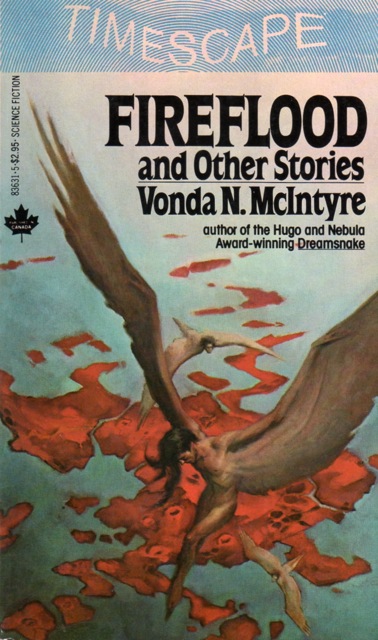
THDPFNCY401962 FRFLDNDTHB1981

On twitter [my account here — please follow!  I post interesting things!] I posed the following question:

Which SF author—for the purposes of this site’s focus, an author starting pre-1980—deserves a new (or reprint) single author collection?

GUIDELINES (please read): Said author cannot have a single author collection published within the last 10 years (you can fudge this a bit).   It also should be noted that many eBooks aren’t available in the United States (SF Gateway for example).  If the recent eBook edition isn’t available in the US, I guess the author fits the bill (*cough* — John Sladek).

XNGNSS4D1969Note: If you are thinking about doing some checking before you make your choice (see guidelines) I recommend using isfdb.org as it has mostly up to date publication histories for all but self-published authors.
My vote: Miriam Allen deFord (active from — SF Encyclopedia LINK

Published collections: Xenogenesis (1969) and Elsewhere, Elsewhen, Elsehow (1971)

Reason: Miriam Allen deFord (1888-1975) was one of the major voices in SF magazines from 1946 – 1978.   She never made the transition to novels and thus might have lost some readership as a result.  The stories in Xenogenesis (1969) shows an often radical voice right from her first story in 1946.  Although they might not be as polished as some of her more Continue reading

Updates: Recent Science Fiction Acquisitions No. CXXIX (Platt + Smith + Anthologies)

I bought these a while back with Admiral Ironbombs at Battered, Tattered,  Yellowed, and Creased at the best used SF store I’ve encountered in the United States—Dawn Treader Books in Ann Arbor, MI (if you are ever in Michigan it’s worth the trip).  I’m glad I don’t live there else I would have no money.  I also discovered that Admiral Ironbombs doesn’t actually buy books that are battered and tattered—I do.  I guess he’s more of a “collector” than me.  Haha.

Enjoy some nice covers!

Has anyone read the work of Evelyn E. Smith?

Thoughts?

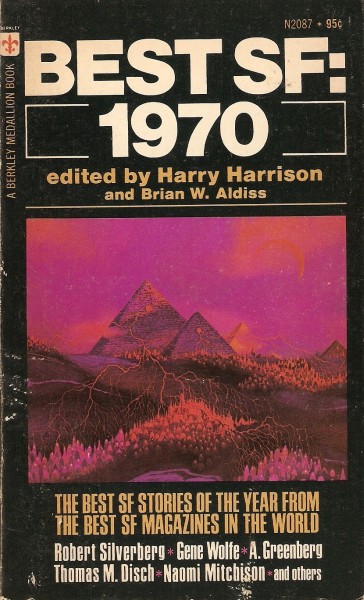
1. Best SF: 1970, ed. Harry Harrison and Brian W. Aldiss (1971)

BSTSFTSRHF1971

(Paul Lehr’s cover for the 1971 edition) Continue reading

Updates: Recent Science Fiction Acquisitions No. CXXVIII (Roberts + Cherryh + Blish + Knight + Pangborn)

Finally, a famous (“Joachim Boaz you will adore it”) fix-up novel by Keith Roberts enters my collection….

Overpopulation SF never gets old—even if I have low expectations about this one.

More Pangborn and a singleton Cherryh novel I had never heard of….

Thoughts?

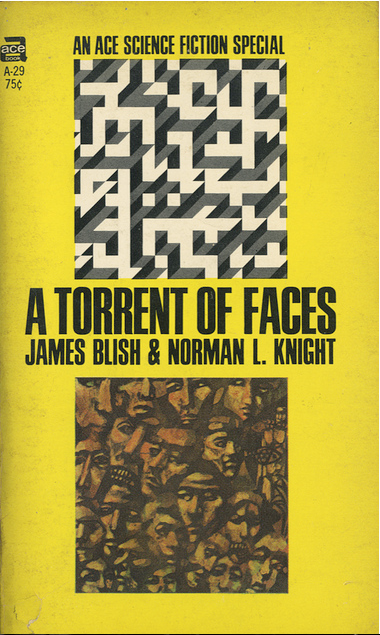
1. A Torrent of Faces, James Blish & Norman L. Knight (1967)

screen-shot-2013-02-09-at-12-16-53-am

(Diane and Leo Dillon’s cover for the 1968 edition) Continue reading

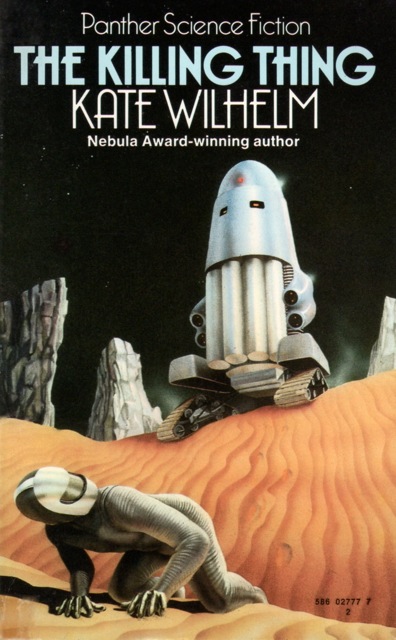
Guest Post: The Killer Thing, Kate Wilhelm (1967)

The sixth in my Kate Wilhelm’s SF Guest Post Series (original announcement and post list) comes via 2theD (twitter) over at Potpourri of Science Fiction Literature and Tongues of Speculation. He is a prolific blogger of vintage, translated, and newer science fiction.  Unfortunately, and much to my frustration (he knows!), he is on something of a hiatus (other than short story summaries and ratings).  Thus, when I approached him about participating in this series he volunteered one of his older reviews.  As I remembered it fondly, I agreed.

Thanks so much for contributing!

~

THKLLNGTHN1972

(Patrick Goodfellow’s (?) cover for the 1972 edition)

Kate Wilhelm is among a handful of female science fiction writers who need no introduction. She’s authored scores of short stories, about thirty-six genre novels, and eleven collections. She’s probably more prolific than many common and respectable male authors, yet she receives very little of the limelight that’s due to her (outside of SFMistress’s occasional posting on her work). Of her novels, I read her most popular work Where Late the Sweet Birds Sang (1976) and the much lesser popular Let the Fire Fall (1969), their respective popularity very much reflecting their quality. The two-story collection in Abyss (1971) had some Continue reading

Book Review: Starswarm, Brian W. Aldiss (1964)

STRSWRMPSJ1964

(William Hofmann’s cover for the 1964 edition)

4/5 (collated rating: Good)

Filth.  Decay.  Mud.  Transmutation.  Brian W. Aldiss’ SF is filled with such images:  Men—with limbs removed—who are slowly (and artificially) transmuted into fish, writhe around in the mud of their tanks grasping at the last shards of their humanity;  A powerful matriarch lords over a planet where her pets transform at will;  A tall tale about a planet filled with strange life and a human hero who cannot get over the fact that everything smells like garbage…. Aldiss’ novel The Dark Light-Years (1964), despite its poor delivery, is the best example of these themes—humans encounter sentient aliens who spend their days copulating, laying around, and eating in their own fifth.  And they are happy with their lot.

Starswarm (1964) is comprised of three novelettes and five short stories with conjoining explanatory material that links the previously published short fiction into a cohesive collection.  The modus operandi of such a conjoining concerns the “Theory of Multigrade Superannuation” where “the universe is similar to the cosmic clock; the civilizations of man are not mere cogs but infinitely smaller clocks, ticking in their own right” (7).  Thus, the inhabited solar systems of Starswarm—our galaxy—will exhibit all the characteristics through which a civilization can Continue reading

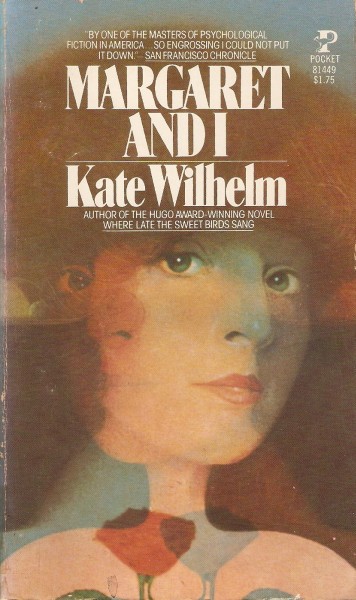
Guest Post: Margaret and I, Kate Wilhelm (1971)

 The fifth in my Kate Wilhelm’s SF Guest Post Series (original announcement and post list) comes via Max Cairnduff (twitter)—who reviews literature and occasionally SF over at Pechorin’s Journal.  In the past he has contributed to my Michael Bishop series. He is responsible for introducing me to one of my favorite works of all time, Anna Kavan’s phenomenal hallucination of a novel Ice (1967)—so check out his site.

Although he does not seem to have enjoyed Margaret and I (1971) as much as I did, his review does touch on the novel’s extreme psychological power and ingenious set-up.

Thank you so much for contributing!

~

MRGRTNDI1978

(Uncredited cover for the 1978 edition)

Nominated for the 1972 Nebula Award for Best Novel

The only Kate Wilhelm I’d read before Joachim invited me to take part in this Guest Post series was her novel Welcome, Chaos. I’ve not even read Where Late the Sweet Birds Sang (though I always thought I had, which ironically is probably what stopped me reading it).

Beyond those two titles I knew very little about her work. Joachim though knows his vintage SF, so when he invited me Continue reading

Updates: Recent Science Fiction Acquisitions No. CXXVI (Lessing, Silverberg, Sheckley, Dickson)

I have yet to read anything by the Nobel Prize for Literature-winning author Doris Lessing…  And she wrote numerous SF novels—I’m very excited that I found one in a clearance section for 2$.  I also found one of the very few 1970s works by Silverberg not in my collection.  Dickson’s supposedly most mature novel (which I doubt is very good) also joins my collection.  So far the only Dickson I can tolerate are a handful of his short stories. And finally, my last acquisition is one of Robert Sheckley’s best-loved novels.

Thoughts?

1. The Memoirs of a Survivor, Doris Lessing (1974)

0394757599.01.LZZZZZZZ

(Brad Holland’s cover for the 1988 edition) Continue reading

Guest Post: Year of the Cloud, Kate Wilhelm and Theodore L. Thomas (1970)

The third in my Kate Wilhelm’s SF Guest Post Series (original announcement and post list) comes via Mike White (twitter)—a research biologist at Washington University in St. Louis, MO—who blogs on mostly early SF (pre-1920) and a variety of science topics with a whole cast of other writers at The Finch and the Pea (a “public house for science”).  This is his first contribution to one of my guest post series and it is greatly appreciated (and won’t be his last).

He selected, on purpose (in very Joachim Boaz fashion I might add), what might be Kate Wilhelm’s least known SF novel.  Early in her career she wrote two novels with Theodore L. Thomas: the Nebula-nominated The Clone (1965) and Year of the Cloud (1970).

~

RFTHCLDXVQ1971

(Francois Colos’ cover for the 1970 edition)

Post-apocalyptic stories do many things, one of which is to question our mastery of nature. We’re used to relying on technology to bend the world to our will — science stands between us and the brute forces of nature. Extinction is for lesser species. But post-apocalyptic stories remind us of all the ways that nature could wipe us out: the Earth could collide with a comet or pass through a toxic cloud of space gas, the sun could fade or go nova, or some pandemic plague could arise that kills us directly, wipes out our food supply, or turns us into the walking dead.

As horrifying as these events would be in real life, there is a strain of post-apocalyptic fiction that doesn’t see these disasters as all bad. Killing off most of humanity offers, in fiction anyway, a chance to wipe the slate clean and start over. With the post-holocaust world much less crowded, noisy, and Continue reading