Guest Post: Margaret and I, Kate Wilhelm (1971)

 The fifth in my Kate Wilhelm’s SF Guest Post Series (original announcement and post list) comes via Max Cairnduff (twitter)—who reviews literature and occasionally SF over at Pechorin’s Journal.  In the past he has contributed to my Michael Bishop series. He is responsible for introducing me to one of my favorite works of all time, Anna Kavan’s phenomenal hallucination of a novel Ice (1967)—so check out his site.

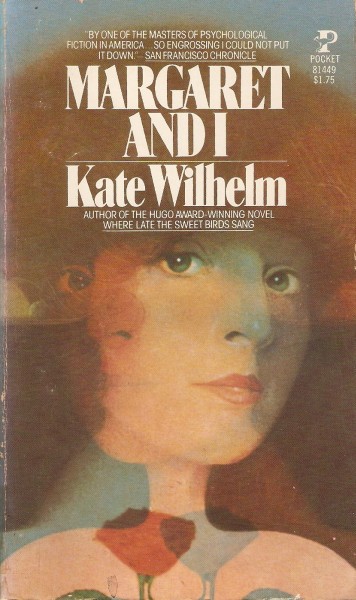
Although he does not seem to have enjoyed Margaret and I (1971) as much as I did, his review does touch on the novel’s extreme psychological power and ingenious set-up.

Thank you so much for contributing!

~

MRGRTNDI1978

(Uncredited cover for the 1978 edition)

Nominated for the 1972 Nebula Award for Best Novel

The only Kate Wilhelm I’d read before Joachim invited me to take part in this Guest Post series was her novel Welcome, Chaos. I’ve not even read Where Late the Sweet Birds Sang (though I always thought I had, which ironically is probably what stopped me reading it).

Beyond those two titles I knew very little about her work. Joachim though knows his vintage SF, so when he invited me Continue reading

Updates: Recent Science Fiction Acquisitions No. CXXVI (Lessing, Silverberg, Sheckley, Dickson)

I have yet to read anything by the Nobel Prize for Literature-winning author Doris Lessing…  And she wrote numerous SF novels—I’m very excited that I found one in a clearance section for 2$.  I also found one of the very few 1970s works by Silverberg not in my collection.  Dickson’s supposedly most mature novel (which I doubt is very good) also joins my collection.  So far the only Dickson I can tolerate are a handful of his short stories. And finally, my last acquisition is one of Robert Sheckley’s best-loved novels.

Thoughts?

1. The Memoirs of a Survivor, Doris Lessing (1974)

0394757599.01.LZZZZZZZ

(Brad Holland’s cover for the 1988 edition) Continue reading

Guest Post: Year of the Cloud, Kate Wilhelm and Theodore L. Thomas (1970)

The third in my Kate Wilhelm’s SF Guest Post Series (original announcement and post list) comes via Mike White (twitter)—a research biologist at Washington University in St. Louis, MO—who blogs on mostly early SF (pre-1920) and a variety of science topics with a whole cast of other writers at The Finch and the Pea (a “public house for science”).  This is his first contribution to one of my guest post series and it is greatly appreciated (and won’t be his last).

He selected, on purpose (in very Joachim Boaz fashion I might add), what might be Kate Wilhelm’s least known SF novel.  Early in her career she wrote two novels with Theodore L. Thomas: the Nebula-nominated The Clone (1965) and Year of the Cloud (1970).

~

RFTHCLDXVQ1971

(Francois Colos’ cover for the 1970 edition)

Post-apocalyptic stories do many things, one of which is to question our mastery of nature. We’re used to relying on technology to bend the world to our will — science stands between us and the brute forces of nature. Extinction is for lesser species. But post-apocalyptic stories remind us of all the ways that nature could wipe us out: the Earth could collide with a comet or pass through a toxic cloud of space gas, the sun could fade or go nova, or some pandemic plague could arise that kills us directly, wipes out our food supply, or turns us into the walking dead.

As horrifying as these events would be in real life, there is a strain of post-apocalyptic fiction that doesn’t see these disasters as all bad. Killing off most of humanity offers, in fiction anyway, a chance to wipe the slate clean and start over. With the post-holocaust world much less crowded, noisy, and Continue reading

Guest Post: The Infinity Box, Kate Wilhelm (1975)

The second in my Kate Wilhelm’s SF Guest Post Series (original announcement and post list) comes via Heloise Larou (twitter) who blogs on a variety of genres and topics over at Heloise Merlin’s Weblog.  She previously contributed an absolutely stupendous review for my Michael Bishop series (here).

Thank you for contributing!

~

TNFNTBX19XX

(Appelbaum & Curtis, Inc’s cover for the 1975 edition)

Science Fiction trappings are kept to an absolute minimum in this story collection first released in 1975, and even if the author does make use of some traditional SFnal gadget, she keeps it as unobtrusive as possible, like a time machine coming in the guise of an expensive but otherwise quite normal-seeming watch (in “The Time Piece”). And Kate Wilhelm does not bother with explanations either, not even a minimal hand-waving, some of the stories (most notably, and in spite of the title Continue reading

Adventures in Science Fiction Art: Tentacles and Other Strange Appendages

ALIENWL1964

(John Schoenherr’s cover for the 1964 edition of Alien Worlds (1964), ed. Roger Elwood)

Michael Whelan’s cover for the 1979 Dutch edition of Greybeard (1964) by Brian W. Aldiss appeared in a collection of SF art Space Wars, Worlds & Weapons (1977).  I remember encountering the collection at a used bookstore, perhaps in Philadelphia when I went to visit my grandparents…  It terrified me for years.  The bizarre metal construct looming over the destroyed world—and most of all, the strange tentacled hands…

…hence, today’s themed art post!

Tentacles and Other Strange Appendages.

 I have a confession:  I am warming to the art of Charles Moll—1974 edition of New Dimensions 3 ed. Continue reading

Updates: Recent Science Fiction Acquisitions No. CXXIV (Jakes + Anthology + Malzberg + Zelazny)

Roger Zelazny’s most radical (according to some critics) novel…

A fun Ace Double with a rather disturbing face imprisoned in a skull cover by Kelly Freas….

More Malzberg (one can never have enough)…

And another anthology from the single best year of SF — 1972!  (my opinion of course).

Thoughts?

1. Tonight We Steal The Stars / The Wagered World, John Jakes / Laurence M. Janifer and S. J. Treibich (1969) (Ace Double)

(Kelly Freas’ cover for the 1969 edition) Continue reading

Book Review: Friends Come in Boxes, Michael G. Coney (1973)

(John Holmes’ cover for the 1973 edition)

4.25/5 (Good)

“KEEP A CLEAN SHEET OR YOU’LL END UP AS MEAT” (72)

Michael G. Coney’s focus on everyday struggles—the normal minutiae of life—reached wonderful heights in the lyrical paean to youth and youthful travails Hello Summer, Goodbye (variant title: Rax) (1975).  While the true import of Hello Summer, Goodbye‘s narrative only slowly unfurls as the young man comes of age and perceives more about his world, the world of  Friends Come in Boxes (1973) relentlessly writhes and boils as each main character is compelled to commit a crime Continue reading

Updates: Recent Science Fiction Acquisitions No. CXXVIII (Malzberg + Robinson + Berk + Ball)

A few more books from Carl V. Anderson‘s gift + two acquisitions of my own.  Including my first Spider Robinson novel, an unknown post-apocalyptical quantity via Howard Beck, and more pulp by Brian N. Ball—not going to lie, Singularity Station (1973) was fun!

I now own a nearly complete Barry N. Malzberg collection of his SF solo works (i.e. no co-written novels with Bill Pronzini).  What I am missing: his first two novels which are more speculative rather than SF, Oracle of a Thousand Hands (1968), Screen (1968), his SF novel Scop (1976), his movie novelization Phase IV (1973) which I have held off buying despite seeing it for cheap in used stores, and his non-SF novel Underlay (1974).  I have all his collections of short fiction pre-1994 other than Final War and Other Fantasies (1969), The Best of Barry N. Malzberg (1976), and Down Here in Dream Quarter (1976).

Thus, I own a grand total of 28 Malzberg novels and collections!

Thoughts?

1. Overlay, Barry N. Malzberg (1972)

Screen shot 2015-03-11 at 10.14.49 AM

(Ray Feibush’s cover for the 1975 edition) Continue reading

Book Review: Orbit 8, ed. Damon Knight (1970)

(Paul Lehr’s cover for the 1971 edition)

3.25/5 (collated rating: Good)

The avant-garde leaning Orbit anthology series, edited by Damon Knight, had an illustrious run from 1966-1976.  Recently I have become more and more intrigued by the anthology as a way to access a wider range of authors and radical visions.  Despite my rather lowish collated rating of Best SF Stories from New Worlds 2, ed. Michael Moorcock, it was a satisfying collection which exposed me to the SF of Langdon Jones and Pamela Zoline.  Likewise, it somewhat rehabilitated my view of Charles Platt whose Planet of the Voles (1971) has long been one of my least favorite SF novels.

Anthologies are fascinating cross sections of the genre reflecting what was perceived as worthwhile SF by editors.  They will almost always be more uneven than single author collections.  But the exposure to forgotten authors and authors who never received a single author collection makes them almost always worthwhile.

Orbit 8 (1970) is no exception.  The anthology swings wildly from Gardner Dozois’ masterpiece “Horse of Air” (1970) Continue reading