Book Review: Worlds Without End, Clifford D. Simak (1964)

3.5/5 (collated rating: Good)

I’m a compulsive list maker. In the past few years I’ve gathered and submitted older science fiction short stories that depict worker unions–from Robert Silverberg’s “Guardian Devil” (1959) to Mari Wolf’s “Robots of the World! Arise!” (1952)–to the Hugo Book Club’s fantastic index. It’s about time I finally get around to reviewing a few of my submissions!1

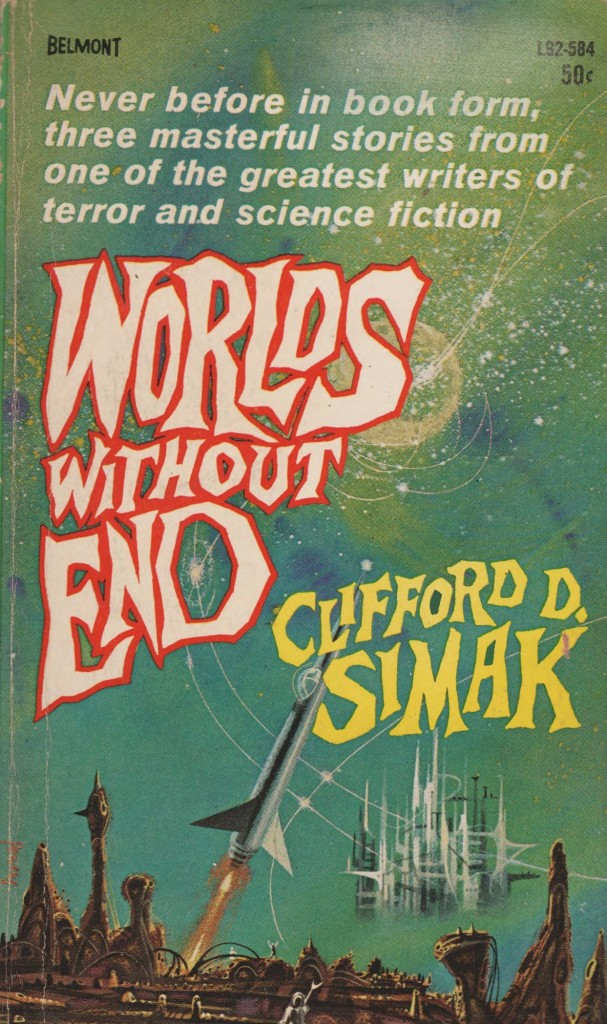
Clifford D. Simak’s collection Worlds Without End (1964) contains two novellas and one short story that appeared in Robert W. Lowndes’ magazines (second/third tier SF markets in the 50s). Two of three–“Worlds Without End” (1956) and “Full Cycle” (1955)–speculate on evolution of the trade union after the breakdown of the state.

Continue reading

Updates: Recent Science Fiction Purchases No. CCCXXX (Tim Powers, Octavia E. Butler, George Alec Effinger, and Tom Purdom)

Which books/covers/authors intrigue you? Which have you read? Disliked? Enjoyed?

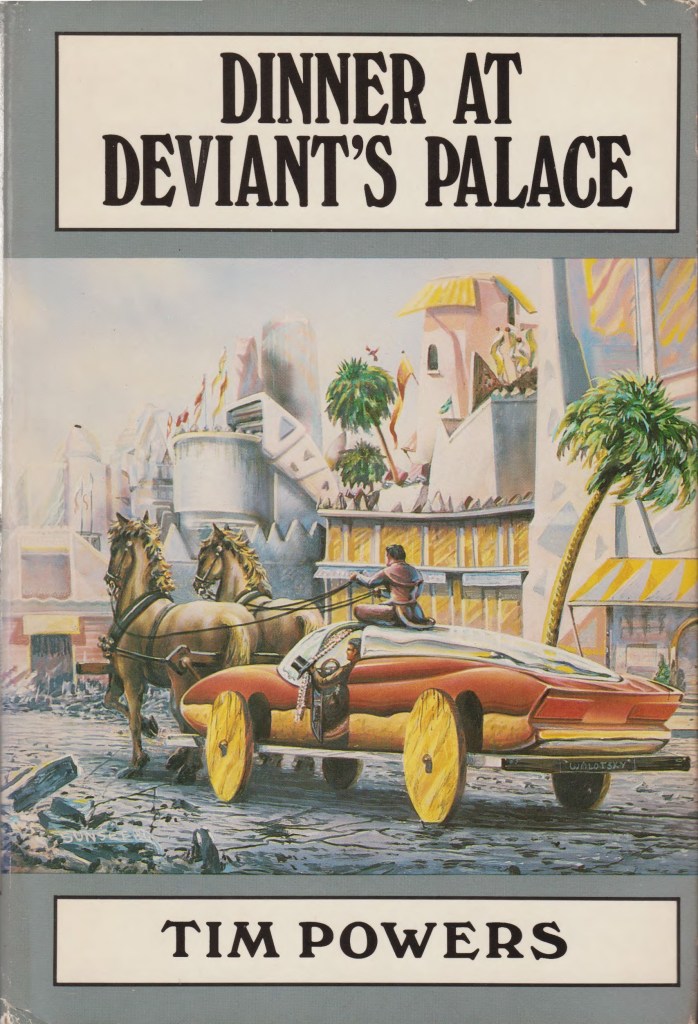
1. Dinner at Deviant’s Palace, Tim Powers (1985)

From the inside flap: “The civilized world had come to an end more than a century earlier, but in California life and society went on… taking strange, often horrifying forms.

Gregorio Rivas was a survivor–a proud, resourceful man who had, most recently, made his way from the corrupt, crumbling city of Venice to carve out a successful career as a musician within the walls of Ellay. He played his pelican with raw energy and flashy style, and people came from all over to hear him. But Greg’s real claim to fame had nothing to do with music. It was a part of his past he wanted to forget. And it had come back to haunt him…

Continue reading

Short Story Reviews: Howard Waldrop’s “Mary Margaret Road-Grader” (1976), David J. Skal’s “Chains” (1971), and Tom Purdom’s “Courting Time” (1966)

Howard Waldrop (1946-2024), David J. Skal (1952-2024), and Tom Purdom (1936-2024) all passed away since the beginning of the year. As I’ve only read Howard Waldrop’s “God’s Hooks!” (1982), “My Sweet Lady Jo” (1974), and “The Ugly Chickens” (1980) and Tom Purdom’s “Toys” (1967), I impulsively thought I’d stich together a post featuring a tale by each.

Please note that I have not read enough to identify their best work and a negative review is not intended to be a statement about their entire oeuvre and impact on the genre. If you have any fond memories, recommendations for stories, or other tangents related to the three authors, let me know in the comments.

Terry Bisson (1942-2014) also passed away this year but did not publish any short fiction until the 90s. I’ll make sure to review one of his 80s novels—Wyrldmaker (1981) or Talking Man (1986)–this year instead. I’ve also procured novels by Purdom and Skal to feature later this year.

Now let’s get to the stories!


4.5/5 (Very Good)

Howard Waldrop’s “Mary Margaret Road-Grader” first appeared in Orbit 18, ed. Damon Knight (1976). If you have an Internet Archive account, you can read it online here.

Nominated for the 1977 Nebula Award for Best Short Story. Lost to Charles L. Grant’s “A Crowd of Shadows” (1976).

Continue reading

What pre-1985 science fiction are you reading? + Update No. VIII

I hope you’ve gotten off to a great reading start to 2024! What pre-1985 science fiction are you reading this month?

If you’re new and curious about my rationale for the perimeters of my site, check out this recent interview and podcast. And follow me on Mastodon if you don’t already as I no longer post on my Twitter account. Also make sure to check out the previous installment of this monthly column

And, most importantly, let me know what pre-1985 SF you’ve been reading!

The Photograph (with links to reviews and brief thoughts)

  1. Adrian Mitchell’s The Bodyguard (1970) might be one of the oddest dystopias ever written.
  2. Kate Wilhelm’s Where Late the Sweet Birds Sang (1976) is a fascinating peek into her vast oeuvre of disquieting visions. While I read it before I started my site, a friend reviewed it for my guest post series on Wilhelm’s fiction. As I recently covered Wilhelm’s far lesser known anti-Vietnam War novel The Killing Thing (1967), her work was on my mind.
  3. M. John Harrison is rightly famous for his Viriconium Nights sequence: The Pastel City (1971), A Storm of Wings (1980), and In Viriconium (1982). If you enjoyed them, I highly recommend tracking down his first novel — The Committed Men (1971). From my review: “Possessed by destructive melancholy, the inhabitants of a post-apocalyptical UK–where political powers have sunk into oblivion–attempt to recreate a semblance of normalcy.  Clement St John Wendover, teeth long since rotted, still administers to the skin diseases and ailments of his one-time patients although he cannot cure them. […] Gathering together a troop of “committed men” (and a woman!), Wendover sets off across the corroded landscape with a newborn mutant child: a new species for an altered Earth or an accidental abnormality….”
  4. I recently covered a Barrington J. Bayley short story in my cities of the future series and it reminded me of his most extreme moments of off-the-wall invention — The Garments of Caean (1976) immediately came to mind.

What am I writing about?

Continue reading

Updates: Holiday Purchases! No. CCCXXIX (George Alec Effinger, Margot Bennett, anthology on Nuclear War, and Michael Conner)

Time for more holiday finds!

Which books/covers/authors intrigue you? Which have you read? Disliked? Enjoyed?

1. When Gravity Fails, George Alec Effinger (1986)

From the back cover: “In a decadent world of cheap pleasures and easy death, Marîd Audran has kept his independence and his identity the hard way. Still, like everything else in the Budayeen, he is available …for a price.

Continue reading

Updates: Holiday Purchases! No. CCCXXVIII (Robert Silverberg, S. P. Somtow, Janet Asimov, and a World’s Best Anthology)

Happy holidays. I hope you’ve been able to squeeze in a bit of science fiction reading.

Which books/covers/authors intrigue you? Which have you read? Disliked? Enjoyed?

1. Those Who Watch, Robert Silverberg (1967)

From the back cover: “CRASH LANDING FROM THE STARS.

Only three humans would ever know that the blinding flash in the sky on that night in 1982 was an exploding flying saucer. Only they would learn the truth about THOSE WHO WATCH–about the alien beings who came into this world in a crash landing from the stars. THOSE WHO WATCH is the strange, seductive novel of three accidental colonists from outer space whose chance encounter with Earth triggers interplanetary conflict. It is also the most unusual love story ever written.”

Continue reading

What pre-1985 science fiction are you reading? + Update No. VII

What pre-1985 science fiction are you reading this week?

I’ve settled on a monthly schedule for this column. Check out the previous installment!

If you’re new and curious about my rationale for the perimeters of my site, check out this recent interview and podcast. And follow me on Mastodon if you don’t already as I no longer post on my Twitter account.

And, most importantly, let me know what pre-1985 SF you’ve been reading!

The Photograph (with links to reviews and brief thoughts)

  1. Judith Merril’s collection contains one of the feminist visions of the 50s — “Daughters of Earth” (1952). Reworking a standard pulp plot of alien contact, Merril recasts the encounter through multiple generations of women in one family. She adeptly inverts the Old Testament trope of tracing generations through fathers. Simultaneously, the story itself is a metatextual collection of rewritten family documents containing the lessons necessary for future daughters in the family. Brilliant and heady stuff.
  2. Barry N. Malzberg’s The Men Inside (1973) remains one of his strangest works. A perverse (and Freudian) metafictional (and literary) retelling of Otto Klement and Jerome Bixby’s Fantastic Voyage replete with filmic flashbacks… For Malzberg fans only — if you’ve missed this one, track it down.
  3. And now for something completely different: Murray Leinster’s S.O.S From Three Worlds (1967). I am unsure why I enjoy Leinster’s Med Service so much. Sometimes positivist stories about spacemen devoted to selfless service solving medical crises–and reigning in rampant unchecked capitalism–with their friendly tormals (think furry mobile petri dishes) bring a bit of warmth to my bitter heart.
  4. I sneakily consumed Joe Haldeman’s masterpiece The Forever War (1975) while working my first job as an oil change cashier. In-between angry customers and running domestic incidents, I relished every moment of Haldeman’s defiant Vietnam War satire. As I’ve only reviewed Mindbridge (1976) on the site (I’ve read a bunch more), I’ve been meaning to return his work — maybe a resolution for 2024.

What am I writing about?

Continue reading

What pre-1985 science fiction are you reading? + Update No. VI

What pre-1985 science fiction are you reading this week?

It’s been over a month since the previous installment. Sorry! While I’d like to keep a schedule, I find myself pathologically unable to do so. As with so much on my site, I’ll post continue to post these updates when I feel the inclination.

As these posts seem to bring in new readers, if you’re curious about my rationale for the perimeters of my site, check out this recent interview and podcast. And follow me on Mastodon if you don’t already as I no longer post on my Twitter account.

Let me know what pre-1985 SF you’ve been reading!

The Photograph (with links to reviews and brief thoughts)

Continue reading

What pre-1985 science fiction are you reading? + Bimonthly Update No. V

What pre-1985 science fiction are you reading this week?

I apologize for the break in my update schedule. It’s been a month since the previous installment. Alas. As I say week after week, thank you for all the great conversation. The community that’s emerged over the years is one of the main reasons I keep writing. I’ve included a bit about the books in the photograph, birthdays from the last two weeks, and brief ruminations on what I’ve been reading and writing.

Continue reading