Book Review: Beyond This Horizon, Robert A. Heinlein (magazine publication 1942, novelized 1948)

(Sandy Kossin’s cover for the 1960 edition)

2.5/5 (Bad)

Beyond This Horizon (magazine publication 1942, novelized 1948) was Robert A. Heinlein’s second published novel and one of the few non-juvenile works he published until the late 50s and early 60s.  Interesting tangent: Starship Troopers (1959) was originally conceived as a juvenile but rejected by his normal publisher due to its more serious content.

Unfortunately, Beyond this Horizon is plagued by an utterly contrived Continue reading

Updates: Recent Science Fiction Acquisitions No. LVII (del Rey + Knight + Pohl + Kornbluth + Weinbaum)

A nice collection of old, venerable, classic authors….  I’ve yet to read any of Weinbaum’s pulp — a short story collection is probably a good place to start…. I was somewhat impressed with Lester del Rey’s The Eleventh Commandment (1962) so I look forward to his short stories — and, the fantastic Richard Powers collage cover will be a welcome addition to my collection.

1. A Martian Odyssey (variant title: A Martian Odyssey and Other Classics of Science Fiction), Stanley G. Weinbaum (1962) (MY REVIEW)

(Robert E. Shultz’s cover for the 1966 edition) Continue reading

Adventures in Science Fiction Cover Art: The Composite Cover (illustrating a multiplicity of scenes, stories, thematic elements)

Screen shot 2013-01-27 at 5.27.06 PM

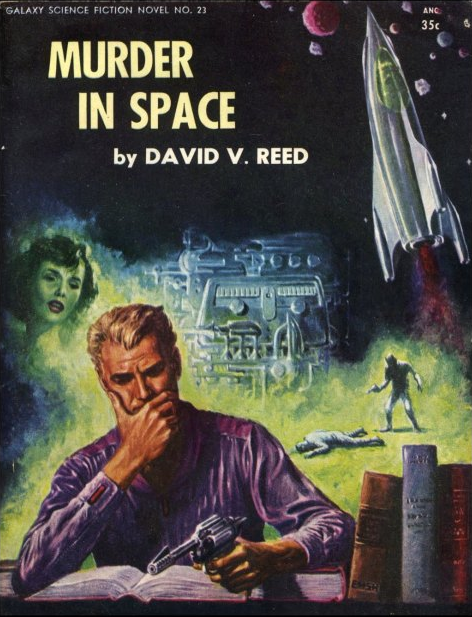
(Ed Emshwiller’s cover for the 1954 edition of Murder in Space (1944), David V. Reed)

Ed Emshwiller’s cover for the 1954 edition of Murder in Space (1944) perfectly embodies the composite cover comprised of sequences from the narrative.  Our hero (or villain) plots the murder in the foreground (guns, books, furrowed brow), commits the murder in the background, his love interest looks over his left shoulder (she’s constantly on his mind), and some random astroids/planets (let’s call them space rocks), a spaceship, and a strange piece of technology alert us to the science fiction aspect of the narrative…  The uncredited cover for the 1955 edition of The Altered Continue reading

Book Review: The Falling Astronauts, Barry N. Malzberg (1971)


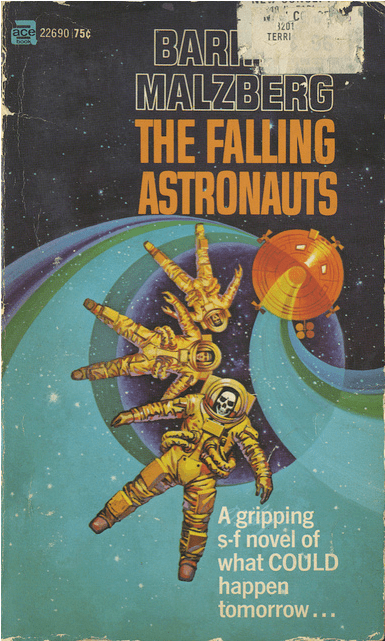
(Davis Meltzer’s cover for the 1971 edition)

4.25/5 (Good)

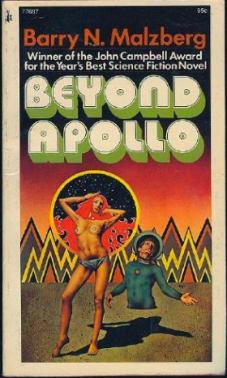
The Falling Astronauts (1971) (from now on FA) is the first in Barry N. Malzberg’s thematic trilogy on the American space program.  Although not as engaging or experimental as the other two masterpieces in the sequence — Beyond Apollo (1972) and Revelations (1972), FA is highly readable and a notable work in Malzberg’s extensive corpus.  FA attempts to debunk the so-called cult (in part propagated by the media) of the astronaut (and his ideal family) and in so doing questions the ultimate purpose of the space Continue reading

SF Article: Barry N. Malzberg (b.1939): Metafiction and the Demystification of the Cult of the Astronaut

This was my recent guest post on Little Red Reviewer.

For those who didn’t see it I decided to post it here….

——-

 Barry N. Malzberg (b. 1939): Metafiction and the Demystification of the Cult of the Astronaut
Screen shot 2013-01-14 at 1.55.20 PM

In the World Book Encyclopedia Science Service publication The United States Astronauts and their Families: A Pictorial Presentation (1965), each astronaut is allotted a two-page spread replete with staged photos of their family life and hobbies.  Otis L. Wiese, the editor of the volume, proclaims grandiosely “Man’s reach for the world of space is born of his insatiable curiosity about the unknown… his indomitable drive for accomplishment… his instinctive response to a challenge. Astronauts-Husbands-Fathers: these men are the men featured here but it’s essentially as family men that we portray them” (i).

The photographs are fascinating.  Roger B. Chaffee’s wife Martha teaches him lunar geography (22), L. Gordon Cooper, Jr. sits at the helm of his speedboat Bluebonnet which is capable of reaching 80 knots (28), in another photo him and his family spend time with their German shepherd (29), Donn F. Eisele teaches his daughter “the finer points of marksmanship” (35), while Alan B. Shepard, Jr. plays piano tunes for his daughters (61) and in the facing image shakes hands with John F. Kennedy (61).

Their families illustrate the epitome of the American family: the ultra-masculine man with his cars and boats, the supportive wife facilitating Continue reading

Book Review: No Time Like Tomorrow, Brian Aldiss (1959)

Screen shot 2013-01-10 at 11.21.02 PM

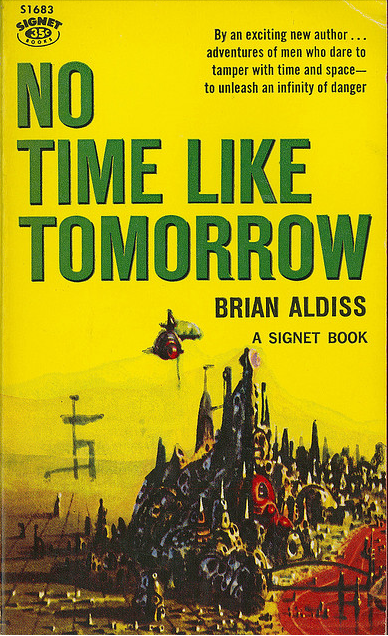
(Richard Powers’ cover for the 1959 edition)

3.75/5 (collated rating: Good)

This collection of Brian Aldiss short stories from the mid-to-late 50s is a notch above the middling Galaxies Like Grains of Sand (1960), collated from the same period, which I reviewed a few months back.  Aldiss is definitely one of the more bizarre and original (along with Philip K. Dick) sci-fi voices of the 50s (and beyond).

Most collections are purposely comprised of a mixture of good and bad stories hence the generally low collated ratings I hand out.  Unlike Galaxies, most of the stories in this collection are worth reading and none are egregiously bad.  ‘Not for an Age,’ ‘Judas Danced’, ‘The Failed Men’, and ‘Outside’ are all highly Continue reading

Updates: Recent Science Fiction Acquisitions, Magazine Edition No. I (Galaxy 2x, Worlds of If 3x, The Magazine of Fantasy and Science Fiction 1x)

My first science fiction magazines!

Although I’m not sure that I want to collect the entire catalogues of either Worlds of If or The Magazine of Fantasy and Science Fiction, I wouldn’t mind starting a collection of Galaxy (one of the more famous magazines).  I’ve been tentative in the past about purchasing magazines for one simple reason: a large percentage of their contents, especially if by well-known authors, are rewritten/expanded/re-conceptualized for later short story collections or novel publication form.  Thus, what version you read in the magazine is rarely the more polished version found in later editions.  For example, in the August 1965 issue of Galaxy Frank Herbert’s Do I Wake or Dream? was expanded for the 1966 novel publication under the title Destination: Void (which was revised again for the much later 1978 edition).  Novels like Dune (1965) are themselves fix-up novels from shorter novels previously serialized in magazines — Dune World (1963) and The Prophet of Dune (1965).  However, six magazines for one dollar each was too good of a deal to pass up….

The only magazine I desperately want to collect is New Worlds due to the quantity of experimental New Wave material which was published during Moorcock’s editorship.

(Gray Morrow’s cover for the August 1965 issue) Continue reading

Book Review: Dark Dominion, David Duncan (1954)

Screen shot 2012-12-22 at 9.06.53 PM(Richard Powers’ cover for the 1954 edition)

2.5/5 (Bad)

David Duncan, most famous for writing the screenplay to George Pal’s film The Time Machine (1960), produced a handful of genre and non-genre novels in the 1950s.  Bluntly put, the Dark Dominion (1954) was one of the more disappointing novels I’ve read this year.  It is worthwhile for one thing alone, Richard Powers’ gorgeous cover.  Duncan’s novel is characterized by an incredibly painful strain of melodrama even for the 50s, downright preposterous science Continue reading

Book Review: Lords of the Starship, Mark S. Geston (1967)

(John Shoenherr’s cover for the 1967 edition)

3.75/5 (Good)

Mark S. Geston’s first novel Lords of the Starship (1967), written at the age of 21 while he was an undergraduate history student, revolves around a fascinating premise: The construction of a massive (fake) spaceship intended to lift a society out of a crippling malaise.  The narrative covers hundreds of years and seemingly innumerable characters.  The lack of distinct characters is the most frustrating aspect of the work.  However, the extremely dark tone and satirical underpinnings lift the novel above the endless morass of earlier pulp sci-fi.

For fans of 50s/60s space opera and more traditionalist 60s Continue reading