Here’s to happy reading in 2026! I hope you had a successful reading year. Whether you are a lurker, occasional visitor, a regular commenter, a follower on Bluesky or Mastodon, thank you for your continued support. As I say year after year, It’s hard to express how important (and encouraging) the discussions that occur in the comments, social media, and via email are to me. I’m so thankful for the lovely and supportive community of readers, writers, and discussion partners that stop by.
What were your favorite vintage SF reads–published pre-1985–of 2025? Let me know in the comments.
Throughout the later part of the year I’ve dropped hints about a research project. Perceptive readers might have parsed together the contours of the research: late 19th/early 20th century, utopian, African American, the American South, radical politics… It’s taking longer than expected. I’ve read a good ten monographs, five dissertations, countless articles. I’ve written twenty pages. I hoped to have it posted by early in this year. Alas. It’s coming together–slowly. Stay tuned.
Without further ado, here are my favorite novels (I only read a few) and short stories (I read a ton of those) I read in 2025 with bonus categories. I made sure to link my longer reviews where applicable if you want a deeper dive.
Check out my 2024, 2023, 2022, and 2021 rundowns if you haven’t already. I have archived all my annual rundowns on my article index page if you wanted to peruse earlier years.
My Top 5 Science Fiction Novels of 2025
Alan Gutierrez’s cover for the 1985 edition
1. Octavia E. Butler’s Clay’s Ark (1984), 4.5/5 (Very Good). Full review.
Attilio Uzzo’s cover for the 1973 edition of Michael Moorcock’s The Ice Schooner (1969) (Galassia 163)
If you’ve ever browsed through an Italian SF catalogue, the name that springs out immediately is the fantastic Dutch painter Karel Thole (1914-2000). Thole’s surreal (and often stunning) covers dominated the Italian visual SF landscape for years and even appeared on a handful of American editions. However, the main Italian SF press Casa Editrice La Tribuna (with its Galassia series) frequently commissioned new artists, often fresh out of art school, for short runs of covers.
Galassia played an instrumental role in introducing Italian audiences to the New Wave movement. Issues often contained both translations of English-language authors and original Italian short stories and novels. Italian covers were often on the experimental side of the SF art spectrum. The styles changed on a dime. Cover art produced in Italy might be my second favorite after the United States for the 60s/70s.
Milan-based Italian artist, sculptor, and jeweler, Attilio Uzzo (unknown dates) created five covers for the Italian SF magazine Galassia (issues between #159-#176) in 1972. According to The Internet Speculative Fiction Database‘s (potentially incomplete) credits, Uzzo created two additional covers for Casa Editrice La Tribuna‘s Science Fiction Book Club series and one for Dall’Oglio’s SF Andromeda imprint. I’ve included all eight in this post. I could find little about him online. He has an old, and not very helpful, website with a few low-resolution examples of his art and jewelry. And here is a short video about a 1964 gallery exhibit in Milan with Uzzo’s work. In 1992, a book of his art title Attilio Uzzo: Pittore della Lealtà hit print. If anyone can find more information about him, let me know!
What pre-1985 science fiction are you reading or planning to read next month? Here’s the May installment of this column.
In my interview with Jaroslav Olša, Jr. about his book Dreaming of Autonomous Vehicles: Miles (Miroslav) J. Breuer: Czech-American Writer and the Birth of Science Fiction (2025), an interesting methodological question jumped out to me: what is the role of more ephemeral publications outside of Hugo Gernsback in the early history of genre? A bit of context: Miles J. Breuer also wrote in Czech. He published stories in Czech-language publications aimed at the immigrant community far earlier than their re-written versions appeared in Gernsback’s Amazing. In addition, he published in various medical journals (that occasionally ran SF) and university publications. As Olša points out in the interview, it obviously depends on the questions asked by the historian — and these publications had small audiences that make it hard to ascertain “influence” or “inspiration” for later authors. Food for thought.
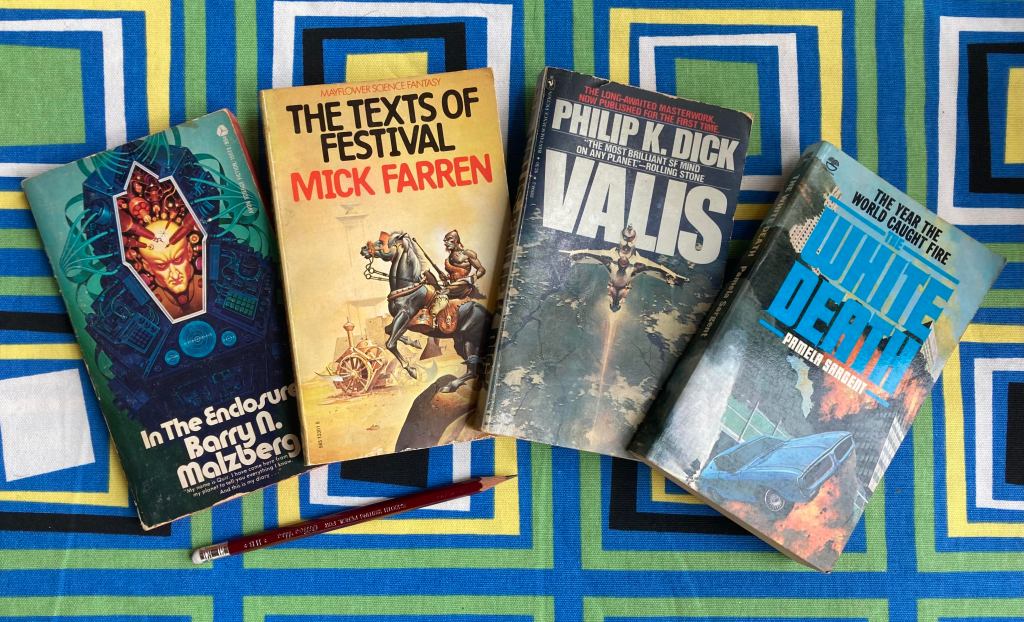
Before we get to the photograph above and the curated birthdays, let me know what pre-1985 SF you’re currently reading or planning to read!
Which books/covers/authors intrigue you? Which have you read? Disliked? Enjoyed?
1. Deus Irae, Philip K. Dick and Roger Zelazny (1976)
Richard Corben’s cover for the 1980 edition
From the back cover: “One their own, they have written landmarks works that have added whole new dimensions of wonder to the field of science fiction. Now, in Deus Irae, they have created what ALA Booklist calls “the most successful collaboration in years!”–set in in bizarre world where you will encounter…
A bunch of backwoods farmers who happen to be lizards…
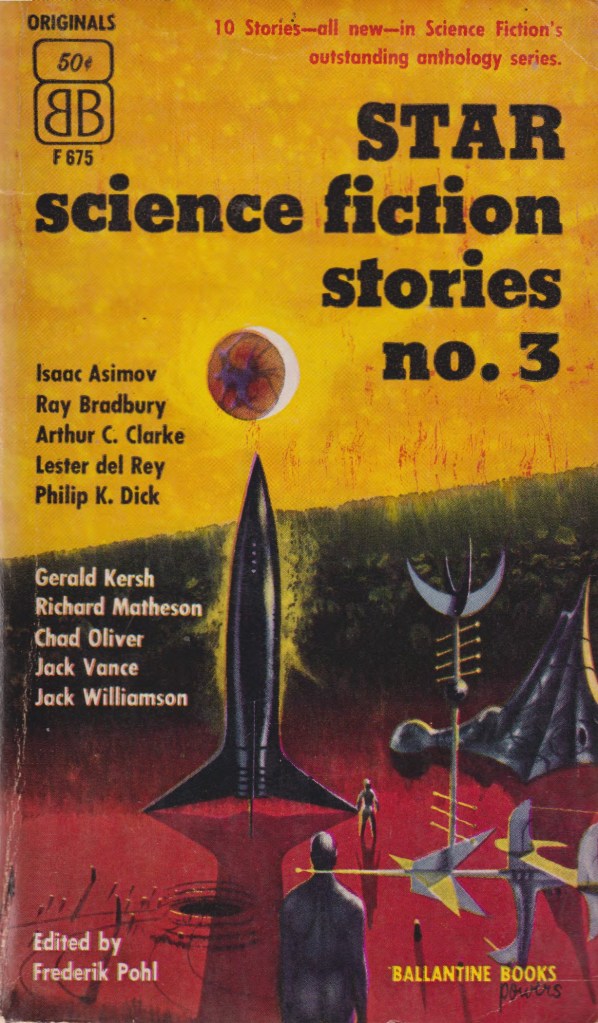
Ballantine Books’ illustrious science fictional program started with a bang–Star Science Fiction Stories. According to Mike Ashley’s Transformations: The Story of Science-Fiction Magazines from 1950 to 1970 Frederik Pohl’s anthology series of original (mostly) stories was “intended as both a showcase of Ballantine’s authors and a lure to new writers.” Paying better rates than magazines, the Star series foreshadowed the explosion of original anthologies that would provide a sustained challenge to the eminence held in the 50s by the magazine.
I’ve selected the third volume of the six-volume series.1 It contains an illustrative cross-section of 50s science fiction. Philip K. Dick’s “Foster, You’re Dead” (1955), Richard Matheson’s “Dance of the Dead” (1955), and Jack Williamson’s “Guinevere for Everybody” (1955) are not to be missed.
What pre-1985 science fiction are you reading or planning to read this month? Here’s the December installment of this column.
Lost texts, and the act of reconstructing the fragments, fascinates. The questions pile up. Would the contents reveal a pattern in an author’s work? Intriguing personal details? A startling modus operandi? At the 11th World Science Fiction Convention (Philcon 2), Philadelphia (September 1953), Philip José Farmer gave a speech titled “SF and the Kinsey Report.” Considering Farmer’s recent publication of “The Lovers” (1952), this is not surprising. Alfred Kinsey, the famous sexologist and founder of the Kinsey Institute for Research in Sex, Gender, and Reproduction on Indiana University’s campus, published his controversial Sexual Behavior in the Human Male in 1948. Sexual Behavior in the Human Female appeared in 1953. Like many of Farmer’s earliest speeches, he did not keep copies.
Deeply intrigued by what the speech might have contained, Sanstone and I (on Bluesky) managed to piece together a few general responses from fanzines and magazine con reports.
The following reviews are the 31st and 32nd installments of my series searching for “SF short stories that are critical in some capacity of space agencies, astronauts, and the culture which produced them.” Some stories I’ll review in this series might not fit. And that is okay. I relish the act of literary archaeology.
Philip K. Dick’s “Explorers We” (1959) reframes the triumphant astronaut’s return home as the ultimate horror.
James Tiptree, Jr.’s “Painwise” (1972) imagines the hallucinogenic journey of a post-human explorer severed from the experience of physical pain.
A brief note before we dive into the greater morass of things: This series grew from my relentless fascination with the science fiction of Barry N. Malzberg (1939-2024), who passed away last month. Malzberg wrote countless incisive visions that reworked America’s cultic obsession with the ultra-masculine astronaut and his adoring crowds. As I am chronically unable to write a topical post in the moment, I direct you towards “Friend of the Site” Rich Horton’s obituary in Black Gate. If you are new to his fiction, I proffer my reviews of Revelations (1972), Beyond Apollo (1972), The Men Inside (1973), and The Gamesman (1975). The former two are relevant to this series.
Ed Emshwiller’s cover for The Magazine of Fantasy and Science Fiction, ed. Robert P. Mills (January 1959)
4.5/5 (Very Good)
Philip K. Dick’s “Explorers We” first appeared in The Magazine of Fantasy and Science Fiction, ed. Robert P. Mills (January 1959). You can read it online here.
For a large portion of the year, I’ve been collecting evidence on unions in post-WWII to very early 60s American science fiction.1 To be clear, I am not on the hunt for the best by these authors. This project is about stories that reference unions. I will read all the stories I can by American SF authors on the topic during this timeframe for this project in order to understand how authors responded to the historical moment in which they lived. Exciting!
A Bit of Historical Context
During the Great Depression, there was broad consensus among leftist thinkers that the labor movement would lead to radical change. The Second World War and the economic recovery shattered that consensus.2 The unions themselves underwent substantial transformation in this period. American corporate powers and their conservative congressional allies unleashed a “propaganda campaign” against the labor movement.3 This culminated in the contentious passage of the Taft-Hartley Act (1947), which weakened the ability of unions to strike. Over the course of the 1950s, automobile manufacturers and their unions pioneered a new relationship—adopted by other industries—in which companies agreed to grant wage increases, health care, and retirement plans in return for union support of long-term contracts. Increasingly, the political and social transformation of capitalism became secondary to preserving their organizations and maintaining a harmonious relationship with industry.4
Before World World II, anti-capitalist intellectuals imagined the labor movement as the American Proletariat which would, at any moment, transform the capitalist system. After WWII, they struggled to grapple with an economic system they had expected to collapse and the lack of interest in socialism within American unions.5 C. Wright Mills (1916-1962) argued labor had been co-opted by state power.6 Those that continued to support elements of the labor movement, such as Sidney Lens (1912-1986), struggled to rationalize labor’s part in the militarization of Cold War America.7 The one-time Trotskyist, Seymour Martin Lipset (1922-2006), argued that while the labor-movement fell short of representing the “class-based aims of a unified working class” it continued to play a roll in “prohibiting antidemocratic mass movements” by offering workers a role in a “mediating institution.”8 Most involved in the 60s New Left abandoned labor completely as a force for change and grouped unions as part of the liberal establishment, irrelevant in the construction of a new radicalism.9 As in, trade unions “focused on material gains, not fundamental social change.”10
Science fiction written in the post-WWII world likewise reflected outright criticism, deep ambivalence, and confusion over the role of the labor movement. Philip K. Dick’s “Stand-By” (1963) satirizes unions and the media in a post-scarcity world but tentatively suggests conflict between both might lead to the overthrow of a ruling computer and the eventual reemergence of democracy. Milton Lesser’s “Do It Yourself” (1957), one of only a handful unabashedly positive accounts on unions in the 50s, imagines a post-apocalyptic future in which the American individualist ethos reigns supreme. While banned and publicly ridiculed, a union secretly sends out agents to facilitate the rebuilding project. And in H. Beam Piper and John J. McGuire’s “Hunter Patrol” (1959), a ragtag group of disaffected, including a union man (an object of jest), attempt to recruit a soldier from earlier in time to overthrow a dictator. More than a few 50s authors, like Robert Silverberg (whom I’ll feature in a later post) and Clifford D. Simak, read and engaged with contemporary writers on the labor movement.11
Let’s get to the stories!
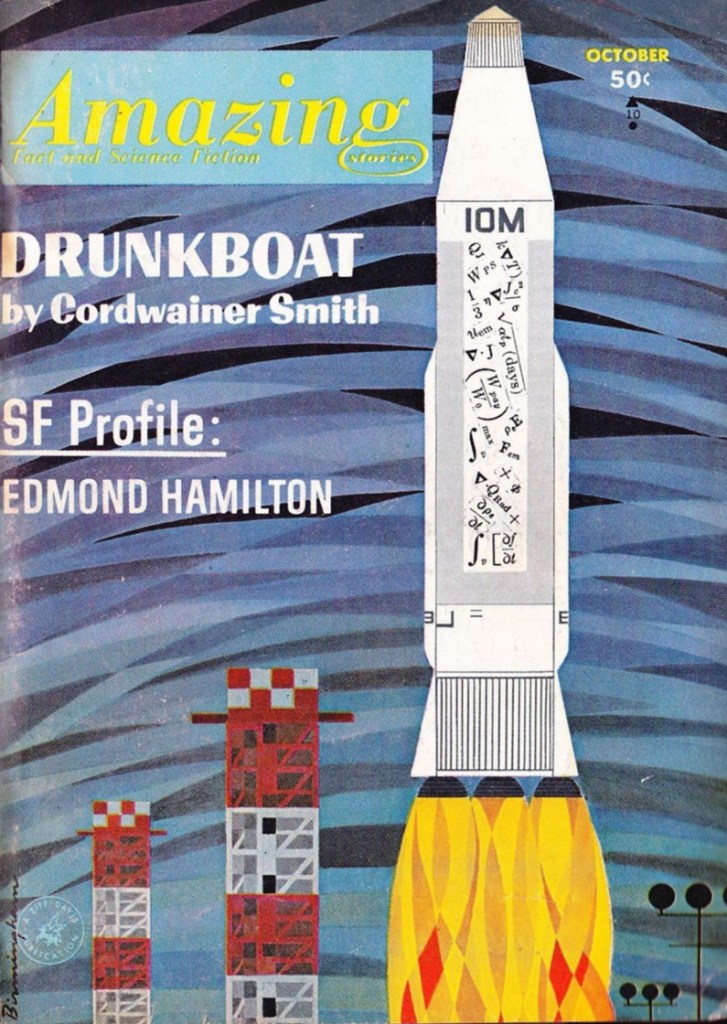
Lloyd Birmingham’s cover art for Amazing, ed. Cele Goldsmith (October 1963)
2.75/5 (Bad)
Philip K. Dick’s “Stand-By” first appeared in Amazing Stories, ed. Cele Goldsmith (October 1963). You can read it online here.
I’m periodically plagued by the virulent Esoterica virus, the relentless desire to catalogue and write about the less known, and even better, the completely unknown. While attending a Medieval English literature graduate class, I remember a conversation I had with the professor, Robert D. Fulk, during office hours about the sheer quantity of scholarship on Beowulf (here’s his edition of the iconic text). I pointed out the panic I experience if I’m unable to read ALL the scholarship on a popular text.




 Science Fiction and Other Suspect Ruminations