The following reviews are the 31st and 32nd installments of my series searching for “SF short stories that are critical in some capacity of space agencies, astronauts, and the culture which produced them.” Some stories I’ll review in this series might not fit. And that is okay. I relish the act of literary archaeology.
Philip K. Dick’s “Explorers We” (1959) reframes the triumphant astronaut’s return home as the ultimate horror.
James Tiptree, Jr.’s “Painwise” (1972) imagines the hallucinogenic journey of a post-human explorer severed from the experience of physical pain.
A brief note before we dive into the greater morass of things: This series grew from my relentless fascination with the science fiction of Barry N. Malzberg (1939-2024), who passed away last month. Malzberg wrote countless incisive visions that reworked America’s cultic obsession with the ultra-masculine astronaut and his adoring crowds. As I am chronically unable to write a topical post in the moment, I direct you towards “Friend of the Site” Rich Horton’s obituary in Black Gate. If you are new to his fiction, I proffer my reviews of Revelations (1972), Beyond Apollo (1972), The Men Inside (1973), and The Gamesman (1975). The former two are relevant to this series.
Ed Emshwiller’s cover for The Magazine of Fantasy and Science Fiction, ed. Robert P. Mills (January 1959)
4.5/5 (Very Good)
Philip K. Dick’s “Explorers We” first appeared in The Magazine of Fantasy and Science Fiction, ed. Robert P. Mills (January 1959). You can read it online here.
For a large portion of the year, I’ve been collecting evidence on unions in post-WWII to very early 60s American science fiction.1 To be clear, I am not on the hunt for the best by these authors. This project is about stories that reference unions. I will read all the stories I can by American SF authors on the topic during this timeframe for this project in order to understand how authors responded to the historical moment in which they lived. Exciting!
A Bit of Historical Context
During the Great Depression, there was broad consensus among leftist thinkers that the labor movement would lead to radical change. The Second World War and the economic recovery shattered that consensus.2 The unions themselves underwent substantial transformation in this period. American corporate powers and their conservative congressional allies unleashed a “propaganda campaign” against the labor movement.3 This culminated in the contentious passage of the Taft-Hartley Act (1947), which weakened the ability of unions to strike. Over the course of the 1950s, automobile manufacturers and their unions pioneered a new relationship—adopted by other industries—in which companies agreed to grant wage increases, health care, and retirement plans in return for union support of long-term contracts. Increasingly, the political and social transformation of capitalism became secondary to preserving their organizations and maintaining a harmonious relationship with industry.4
Before World World II, anti-capitalist intellectuals imagined the labor movement as the American Proletariat which would, at any moment, transform the capitalist system. After WWII, they struggled to grapple with an economic system they had expected to collapse and the lack of interest in socialism within American unions.5 C. Wright Mills (1916-1962) argued labor had been co-opted by state power.6 Those that continued to support elements of the labor movement, such as Sidney Lens (1912-1986), struggled to rationalize labor’s part in the militarization of Cold War America.7 The one-time Trotskyist, Seymour Martin Lipset (1922-2006), argued that while the labor-movement fell short of representing the “class-based aims of a unified working class” it continued to play a roll in “prohibiting antidemocratic mass movements” by offering workers a role in a “mediating institution.”8 Most involved in the 60s New Left abandoned labor completely as a force for change and grouped unions as part of the liberal establishment, irrelevant in the construction of a new radicalism.9 As in, trade unions “focused on material gains, not fundamental social change.”10
Science fiction written in the post-WWII world likewise reflected outright criticism, deep ambivalence, and confusion over the role of the labor movement. Philip K. Dick’s “Stand-By” (1963) satirizes unions and the media in a post-scarcity world but tentatively suggests conflict between both might lead to the overthrow of a ruling computer and the eventual reemergence of democracy. Milton Lesser’s “Do It Yourself” (1957), one of only a handful unabashedly positive accounts on unions in the 50s, imagines a post-apocalyptic future in which the American individualist ethos reigns supreme. While banned and publicly ridiculed, a union secretly sends out agents to facilitate the rebuilding project. And in H. Beam Piper and John J. McGuire’s “Hunter Patrol” (1959), a ragtag group of disaffected, including a union man (an object of jest), attempt to recruit a soldier from earlier in time to overthrow a dictator. More than a few 50s authors, like Robert Silverberg (whom I’ll feature in a later post) and Clifford D. Simak, read and engaged with contemporary writers on the labor movement.11
Let’s get to the stories!
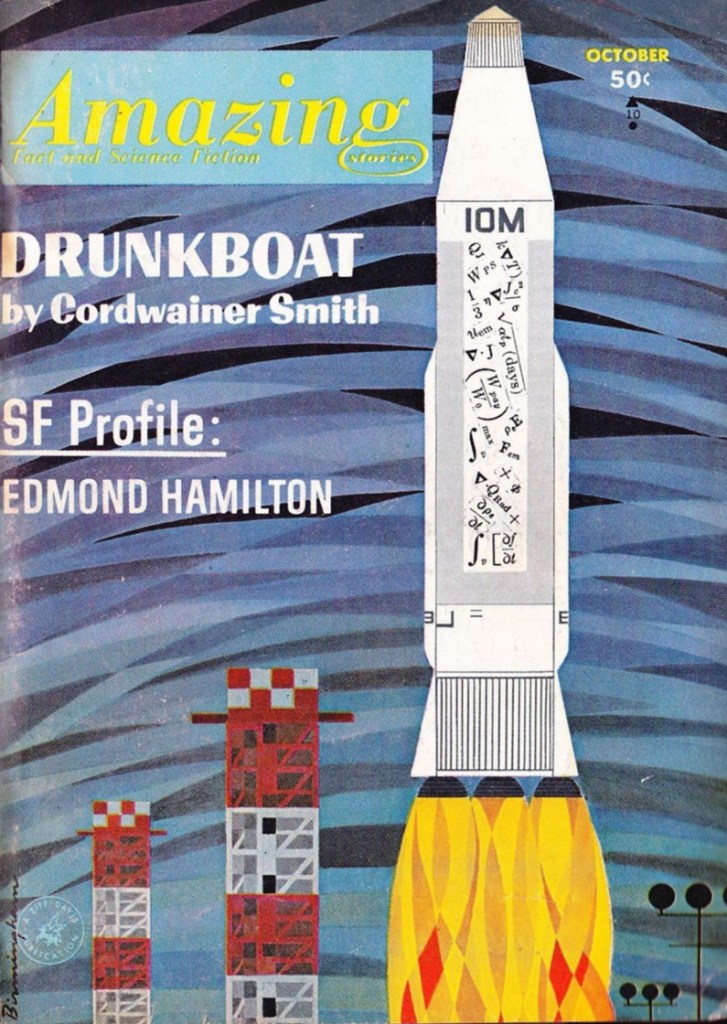
Lloyd Birmingham’s cover art for Amazing, ed. Cele Goldsmith (October 1963)
2.75/5 (Bad)
Philip K. Dick’s “Stand-By” first appeared in Amazing Stories, ed. Cele Goldsmith (October 1963). You can read it online here.
I’m periodically plagued by the virulent Esoterica virus, the relentless desire to catalogue and write about the less known, and even better, the completely unknown. While attending a Medieval English literature graduate class, I remember a conversation I had with the professor, Robert D. Fulk, during office hours about the sheer quantity of scholarship on Beowulf (here’s his edition of the iconic text). I pointed out the panic I experience if I’m unable to read ALL the scholarship on a popular text.
The following reviews are the 25th and 26th installments of my series searching for SF short stories that are critical in some capacity of space agencies, astronauts, and the culture which produced them. Some stories I’ll review in this series might not fit. Many are far from the best. And that is okay. I relish the act of literary archaeology.
I’ve paired two stories, one by Philip K. Dick (1928-1982) and another by prolific but forgotten Henry Slesar (1927-2007), that puncture the grandiose illusion of humanity’s progress.
Thank you Richard Fahey, “Friend of the Site,” for the PKD recommendation.
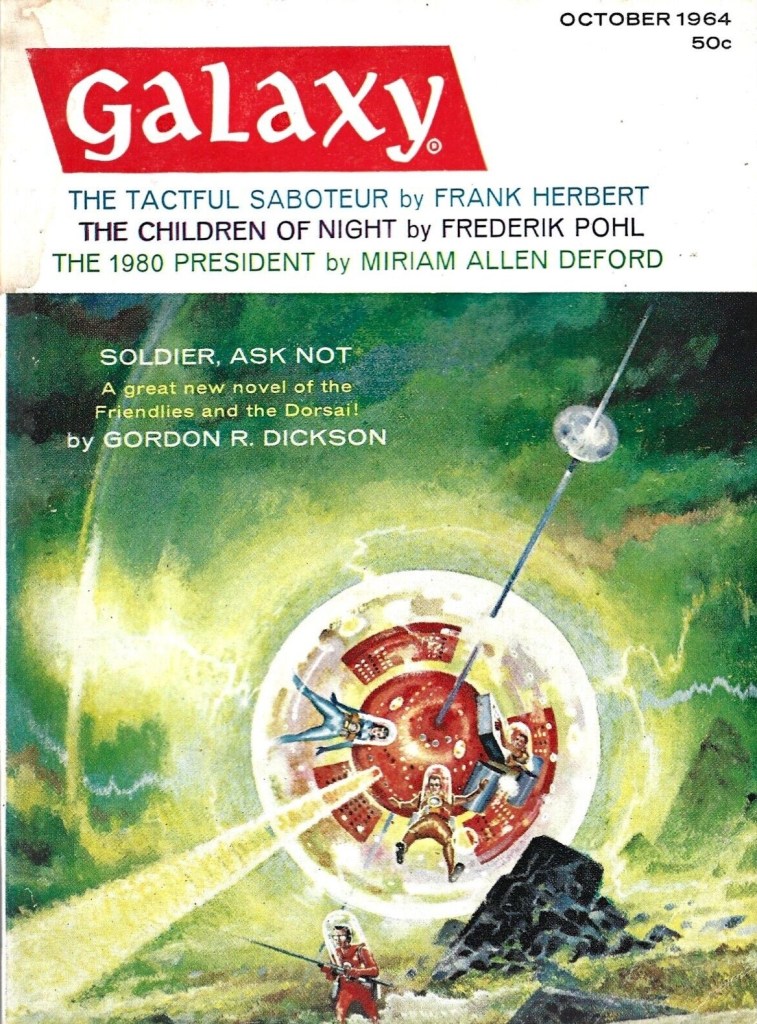
George Schelling’s cover for Galaxy, ed. Frederik Pohl (October 1964)
4/5 (Good)
Philip K. Dick’s “Precious Artifact” first appeared in Galaxy, ed. Frederik Pohl (October 1964). You can read it online here.
A vast array of scholarship charts the continuing allure Mars holds in the popular imagination [1]. David Seed writes that “since the late nineteenth century Mars has tantalized the literary imagination with the possibility that life might exist on that planet” [2]. The visions of Edgar Rice Burroughs, Leigh Brackett, Ray Bradbury, and countless others created a seductive and sometimes complex vista of longing and conquest. Brackett, for example, evocated a Mars that was “more complex and varied” than Burrough’s “imperial triumphalism” [3]. In Brackett’s “The Beast-Jewel of Mars” (1948) (scheduled for this series), Mars becomes the location for the revenge perpetrated by the colonized [4].
The following reviews are the 23rd and 24th installments of my series searching for SF short stories that are critical in some capacity of space agencies, astronauts, and the culture which produced them. Some stories I’ll review in this series might not fit. Many are far from the best. And that is okay. I relish the act of literary archaeology.
I’ve paired two 1950s stories, by Philip K. Dick and the far lesser-known James Causey, that explore the inability to understand the universe outside our Earth. Explorers find themselves at each others throats caught up in paranoid delusions of grandeur.
Allen Andersons’ cover for Planet Stories, ed. Jack O’Sullivan (May 1953)
3.5/5 (Good)
Philip K. Dick’s “The Infinites” first appeared in Planet Stories, ed. Jack O’Sullivan (May 1953). You can read it online here.
A preliminary note: I dislike writing about Philip K. Dick. As I mentioned in my 2021 review of “A Little Something for Us Tempunauts” (1974) for this series, “I find it far more enjoyable and liberating to write about lesser-known authors.” Or at least those whose works and lives are less encyclopedically covered by fans and academics alike. There are and will be far superior takes on this story. I don’t have the will or focus. And that’s okay. I rather focus my obsessive eye on others. To be clear, I love Philip K. Dick. Along with C. J. Cherryh, Frank Herbert, and Stanislaw Lem, he was one of the authors of my early twenties–right before I started this website.
Which books/covers/authors intrigue you? Which have you read? Disliked? Enjoyed?
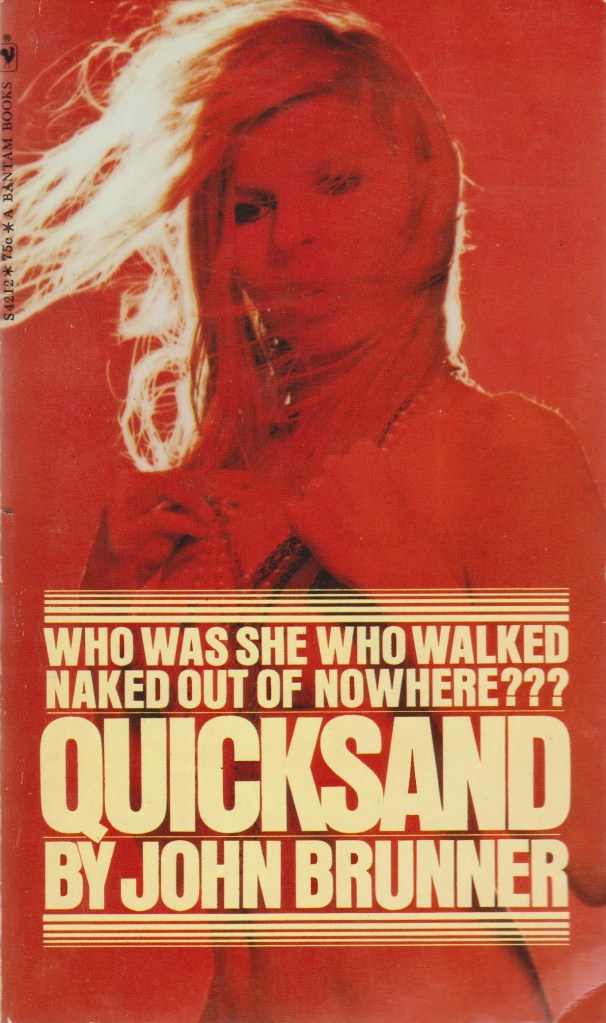
1. Quicksand, John Brunner (1967)
Uncredited cover for the 1969 edition
From the back cover: “She had nearly killed a man who tried to assault her. She spoke a language no one could understand. Commonplace objects like clothing and cars were a mystery to her.
Paul was haunted and entranced by her. He licked at the secrecy that surrounded her until, inevitably, his fate became linked to hers. And she gave him a vision of a world more beautiful than any he had ever known.
THEY LIVED IN A PARADISES OF SENSUAL ECSTACY… UNTIL IT WAS TOO LATE. BECAUSE HER LOVE WAS LIKE QUICKSAND.”
Initial Thoughts: My Brunner obsession in my early 20s generated a packed few years of reading as many novels–the good and the bad–that I could get my hands on. This one escaped my grasp.
The following review is the 8th post in my series searching for “SF short stories that are critical in some capacity of space agencies, astronauts, and the culture which produced them.” Some stories I’ll review in this series might not fit. And that is okay! I relish the act of literary archaeology.
Up next: Frederik Pohl’s (as Paul Flehr) “The Hated” (1958)
Vincent Di Fate’s cover for the 1st edition of The Best of Philip K. Dick (1977)
4/5 (Good)
Philip K. Dick wrote “A Little Something For Us Tempunauts” (1974) after a two-year hiatus. He explains that a friend brought by a copy of John T. Sladek’s brilliant “The Poets of Millgrove, Iowa” (1966) that spurred him to write again: “the first sf story in years that galvanized me into new life—like Kant reading Hume.” He further explains that Sladek’s satirical deconstruction of the cult of the astronaut “can stand in the ranks of the all-time great short stories in the English language” and that it “changed in a flash my entire conception of what a good sf story is” (source). I, too, adore Sladek’s story. One of three authors– along with Barry N. Malzberg’s general characterization of astronauts and the space agency and Samuel R. Delany’s “Aye, and Gomorrah” (1967) that inspired this series.
As always which books/covers/authors intrigue you? Which have you read? Disliked? Enjoyed?
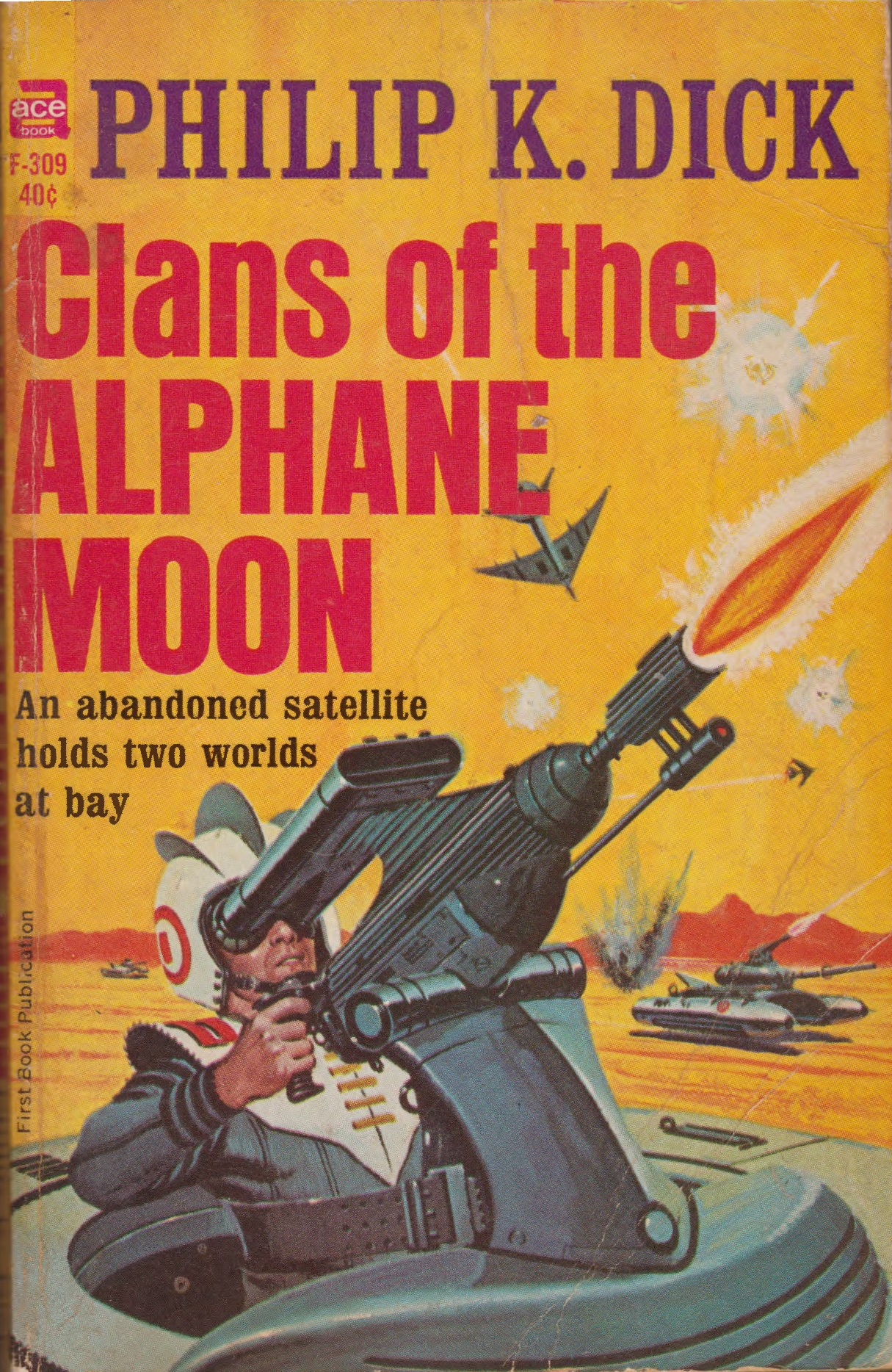
1. Clans of the Alphane Moon, Philip K. Dick (1964)
Ed Valigursky’s cover for the 1st edition
From the back cover: “Holding a precarious liberty as the result of an interstellar stalemate, the human survivors of Alpha Centauri’s hospital moon readied themselves for their war of independence.
Naturally, the Pares, always suspicious and sunning, assumed the leadership, leaving it to the Manses to provide the super weapons out of their sheer love of violence. Propaganda and other details would have been left to the Skitzes, the Heebs, and Polys, and the Ob-Coms.
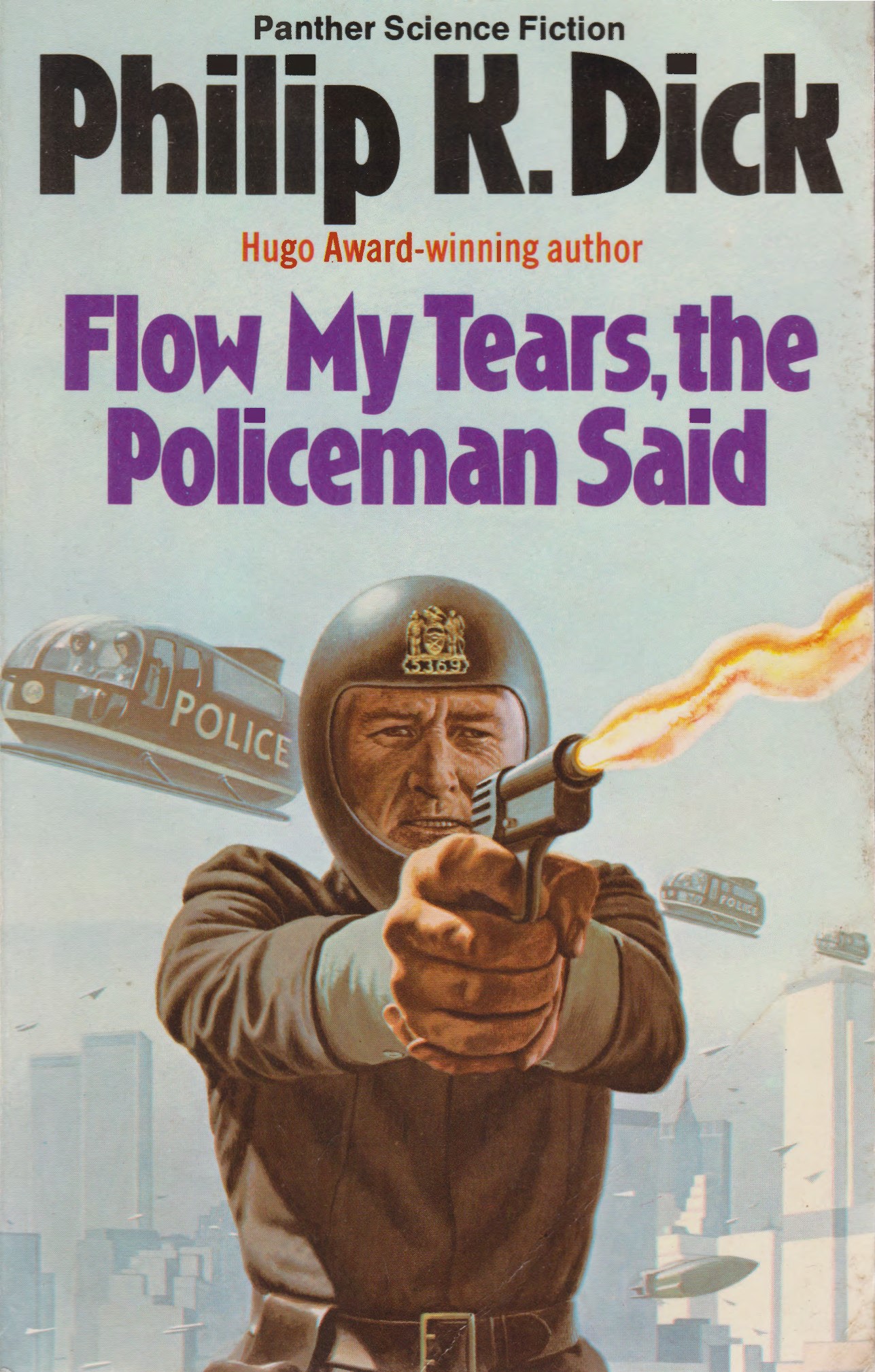
1. As I read the vast majority of Philip K. Dick’s novels pre-blog (i.e. pre-2010), many of the details have faded into a general morass of surreal fragments and paranoiac dreams. I know for certain Flow My Tears, the Policeman Said (1974) remains one of only a handful of unread works in his vast oeuvre.
This UK edition has a bizarre cover….
2. I thoroughly enjoyed Tanith Lee’s Don’t Bite the Sun (1976) and snatched another one of her early SF works—Day by Night (1980)…. the premise intrigues! A storyteller spins tales on a popular TV network that might not be stories at all…. but true accounts of the denizens from the other side of the planet.
3. A candidate for the worst cover of all time? The book by Gordon Eklund and Poul Anderson might not be much better. Certainly the risk purchase of the batch!
4. And finally, a riff on Brian Aldiss’ Helliconia formula? I can’t wait to read this one.
Let me know what books/covers intrigue you. Which have you read? Disliked? Enjoyed?
~
1. Flow My Tears, the Policeman Said, Philip K. Dick (1974)