Updates: An Incomplete List of Worthwhile Classic Science Fiction Blogs/Resources

I love the idea of a community of science fiction reviewers — so I’ve put together a list of a handful of book review blogs focused on classic/slightly more esoteric science fiction.  Obviously there are plenty of great blogs I’ve omitted that have reviews of new releases or only occasional vintage science fiction….  Or, blogs that refrain from reviews of vintage science fiction unless participating in certain reading challenges….

Please visit them, comment on their reviews, and browse through their back catalogues.

1] Speculiction….: An under visited /commented on blog with quality book reviews of classic science fiction — however, the reviewer, Jesse, is limited by the lack of older science fiction available to him in Poland.  I especially enjoyed his reviews of Ballard’s “beautifully strange enigma” that is The Crystal World (1966) and of course, my favorite science fiction novel of all time, John Brunner’s magisterial Stand on Zanzibar (1968).  An index of his reviews can be found here.  He also has a good mix of newer science fiction reviews as well.

2] The PorPor Books Blog: SF and Fantasy Books 1968-1988: I find this blog Continue reading
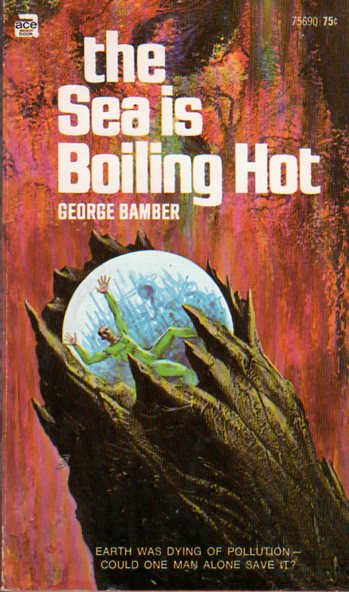
Book Review: The Sea is Boiling Hot, George Bamber (1971)

(Jack Gaughan’s cover for the 1971 edition)

2/5 (Bad)

The Sea is Boiling Hot (1971), George Bamber’s sole novel length contribution to the genre (thankfully), is the unabashedly pornographic version of the ecological disaster, humanity cooped-up in massive domed cities, let’s all get lobotomies to escape the horrors of the world science fiction.  As in, large portions of the narrative are endless sex scenes all gussied up with the accouterments of ecological “message” science fiction.

Unfortunately the sex scenes are there, in all their endless variation, simply to titillate to the reader rather than a necessary part of world building/character analysis — I’m thinking of Silverberg’s Continue reading

Book Review: Who Can Replace a Man? (variant title: Best Science Fiction Stories of Brian W. Aldiss), Brian W. Aldiss (1965)

Screen shot 2013-02-10 at 11.42.53 AM

(Don Puchatz’s cover for the 1967 edition)

4/5 (collated rating: Good)

Seven of the 1950s short stories in Brian W. Aldiss’ best of collection Who Can Replace a Man? (1965) I’ve reviewed before in No Time Like Tomorrow (1959) and Galaxies Like Grains of Sand (1960).  However, the collection contains seven additional 50s and 60s novellas/short stories that make up the majority of pages.  I’ve indicated the old material in the review with an asterisk Continue reading

Adventures in Science Fiction Cover Art: The Composite Cover (illustrating a multiplicity of scenes, stories, thematic elements)

Screen shot 2013-01-27 at 5.27.06 PM

(Ed Emshwiller’s cover for the 1954 edition of Murder in Space (1944), David V. Reed)

Ed Emshwiller’s cover for the 1954 edition of Murder in Space (1944) perfectly embodies the composite cover comprised of sequences from the narrative.  Our hero (or villain) plots the murder in the foreground (guns, books, furrowed brow), commits the murder in the background, his love interest looks over his left shoulder (she’s constantly on his mind), and some random astroids/planets (let’s call them space rocks), a spaceship, and a strange piece of technology alert us to the science fiction aspect of the narrative…  The uncredited cover for the 1955 edition of The Altered Continue reading

Book Review: Level 7, Mordecai Roshwald (1959)

(Sanden’s cover for the 1960 edition)

4.75/5 (Very Good)

I recently received a copy of Modecai Roshwald’s Level 7 (1959) from 2thD at Potpourri of Science Fiction Literature (his enthusiastic review of the novel here).  Roshwald’s novel should be considered along with Walter Miller, Jr.’s A Canticle for Leibowitz (1959, published 1960) as one the best nuclear disaster sci-fi novels of the late 50s (and all time).  Unlike Nevil Shute’s On the Beach (1957) or Pat Frank’s Alas, Babylon (1959) the allegiance (Soviet or American) of the protagonists of Level 7 remains Continue reading

Book Review: Lords of the Starship, Mark S. Geston (1967)

(John Shoenherr’s cover for the 1967 edition)

3.75/5 (Good)

Mark S. Geston’s first novel Lords of the Starship (1967), written at the age of 21 while he was an undergraduate history student, revolves around a fascinating premise: The construction of a massive (fake) spaceship intended to lift a society out of a crippling malaise.  The narrative covers hundreds of years and seemingly innumerable characters.  The lack of distinct characters is the most frustrating aspect of the work.  However, the extremely dark tone and satirical underpinnings lift the novel above the endless morass of earlier pulp sci-fi.

For fans of 50s/60s space opera and more traditionalist 60s Continue reading

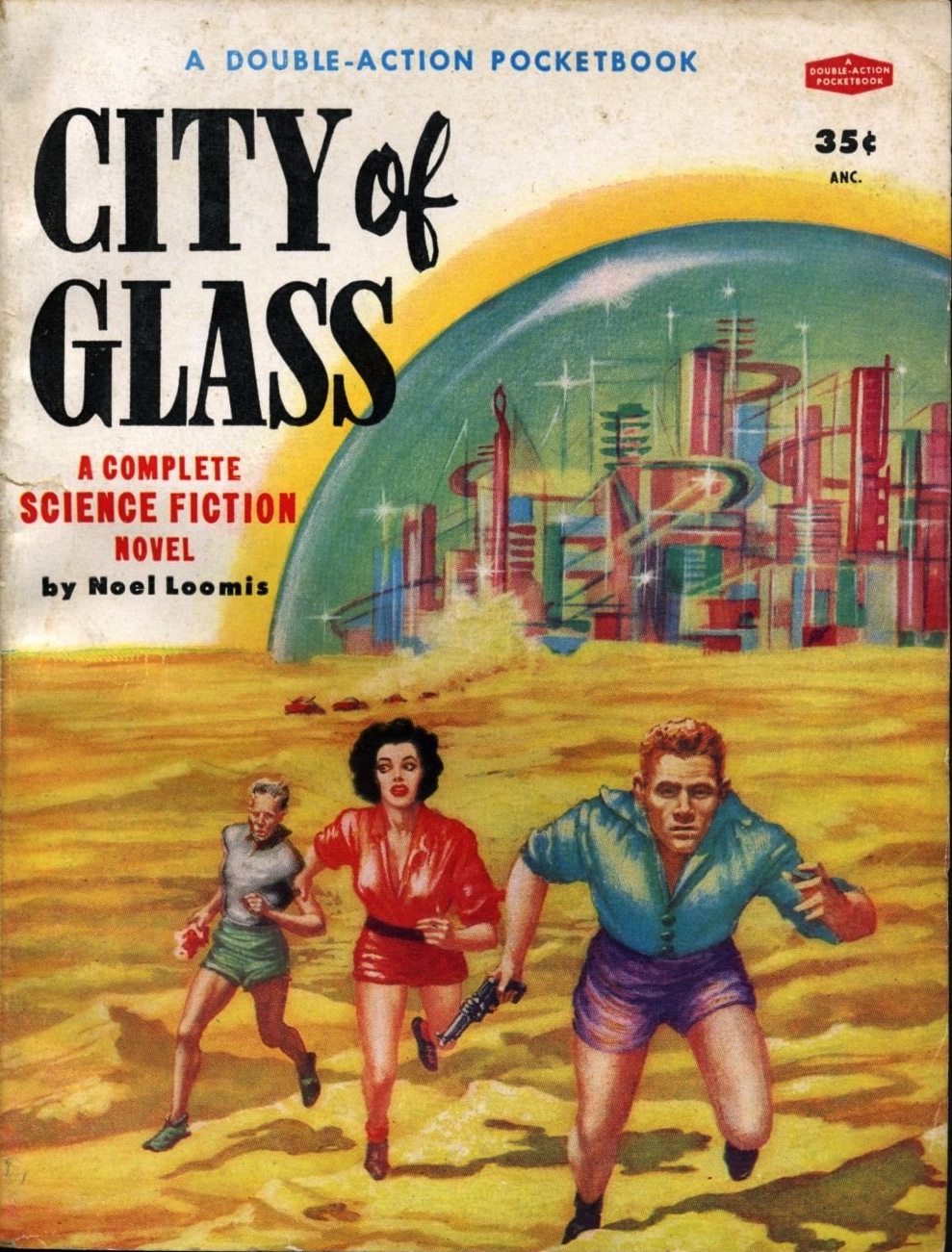
Adventures in Science Fiction Cover Art: Domed Cities of the Future, Part III

(Kelly Freas’ cover for the 1955 edition of City of Glass (1942 magazine), Noel Loomis)

Part I, Part II of my series on domed cities of the future.

Bob Watkin’s cover for the 1955 issue of If Magazine depicts an old man regaling stories of futuristic domed cities.  His fantastic visions are reduced to their key elements in sketch form — a translucent dome, buildings.  I’ve selected a variety of images from pulp 50s works until the late 70s depicting more fantastic/futuristic domed cities than the old man’s imagination conjures.  Ed Emshwiller’s cover for the  1953 edition of City at World’s End (1950) depicts two futuristic metropoli — a trend in future city development?  The first is a planned circular city spreading horizontally across the plain.  The other, an incredibly stylized “futuristic complex” Continue reading

Adventures in Science Fiction Cover Art: Nuclear Explosions + Mushroom Clouds, Part II

(Pattee’s cover for the November 1950 issue of Astounding Science Fiction)

In case you missed Part I.

Pattee’s cover for the Astounding Science Fiction November 1950 issue is visually stunning.  A transparent man (his arteries + brain showing) holds the atomic symbol aloft.  On the horizon a gigantic mushroom cloud is transposed with a spaceship.  Does man use atomic power for science and the good of mankind or evil and the destruction of mankind?  The message is made even more abundantly clear by the title of the piece of art — “Choice.”  Although this rhetoric might seem somewhat ham-fisted to modern post-Cold War readers, it produced some remarkable works of science fiction and science fiction art.  (If anyone knows the full name of the artist, I’d be grateful).

As with Part I, I’ve included some covers from the notorious hackwork spewing conveyor belt publisher Badger Books for giggles and Continue reading

Book Review: Galaxies Like Grains of Sand, Brian Aldiss (1960)

(Paul Lehr’s cover for the 1960 edition)

3/5 (collated rating: Average)

The concept behind Brian Aldiss’ short story collection Galaxies Like Grains of Sand (1960) is intriguing.  Take previously published stories (in this case from magazines in the late 50s), graft them together by means of mini-introductions, and arrange them so they fit into a future history framework à la Olaf Stapledon’s Last and First Men (1930) or Isaac Asimov’s Foundation Trilogy (1951-1953).

The quality of the stories makes the format less than successful.   Only three stories are worth reading — ‘Secret of a Mighty City’ (1958), ‘Out of Reach’ (1957), and ‘All Continue reading