My 2023 in Review (Best SF Novels, Best SF Short Fiction, and Bonus Categories)

Here’s to a happy 2024! I hope you had a successful reading year. Maybe you pulled down some dusty tome that you’ve wanted to dive into for a decade. I’d like to imagine you finally picked up a book I raved about in years past that you acquired with great anticipation but never opened. Whether you are a lurker, occasional visitor, or a regular commenter, thank you for your continued support and wonderful conversation.

What were your favorite vintage SF reads–published pre-1985–of 2023? Let me know in the comments.

Continuing a trend, I read only a handful of novels this year. Instead, my obsessions focused on my science short story review initiatives (listed below), collections, and histories of the science fiction genre. Without further ado, here are my favorite novels and short stories I read in 2023 with bonus categories. I made sure to link my longer reviews where applicable if you want a deeper dive into the rich seam of science fictional gems.

Check out last year’s rundown if you haven’t already for more spectacular reads. I have archived all my annual rundowns on my article index page if you wanted to peruse earlier years.


My Top 5 Science Fiction Novels of 2023 
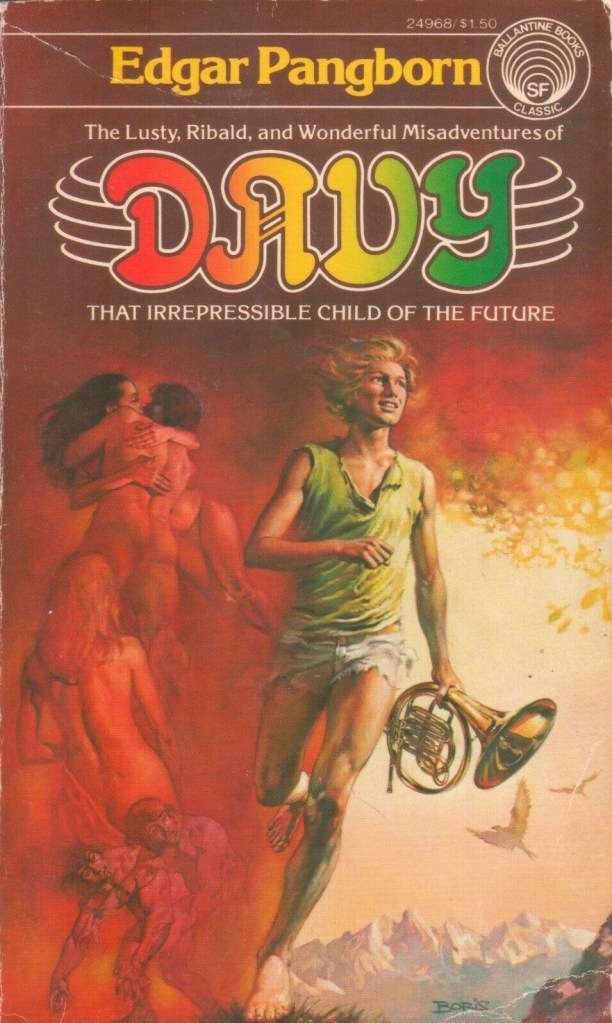
1. Edgar Pangborn’s Davy (1964), 5/5 (Masterpiece): Nominated for the 1965 Hugo Award for Best Novel. Full review.

Continue reading
Updates: Holiday Purchases! No. CCCXXVIII (Robert Silverberg, S. P. Somtow, Janet Asimov, and a World’s Best Anthology)

Happy holidays. I hope you’ve been able to squeeze in a bit of science fiction reading.

Which books/covers/authors intrigue you? Which have you read? Disliked? Enjoyed?

1. Those Who Watch, Robert Silverberg (1967)

From the back cover: “CRASH LANDING FROM THE STARS.

Only three humans would ever know that the blinding flash in the sky on that night in 1982 was an exploding flying saucer. Only they would learn the truth about THOSE WHO WATCH–about the alien beings who came into this world in a crash landing from the stars. THOSE WHO WATCH is the strange, seductive novel of three accidental colonists from outer space whose chance encounter with Earth triggers interplanetary conflict. It is also the most unusual love story ever written.”

Continue reading

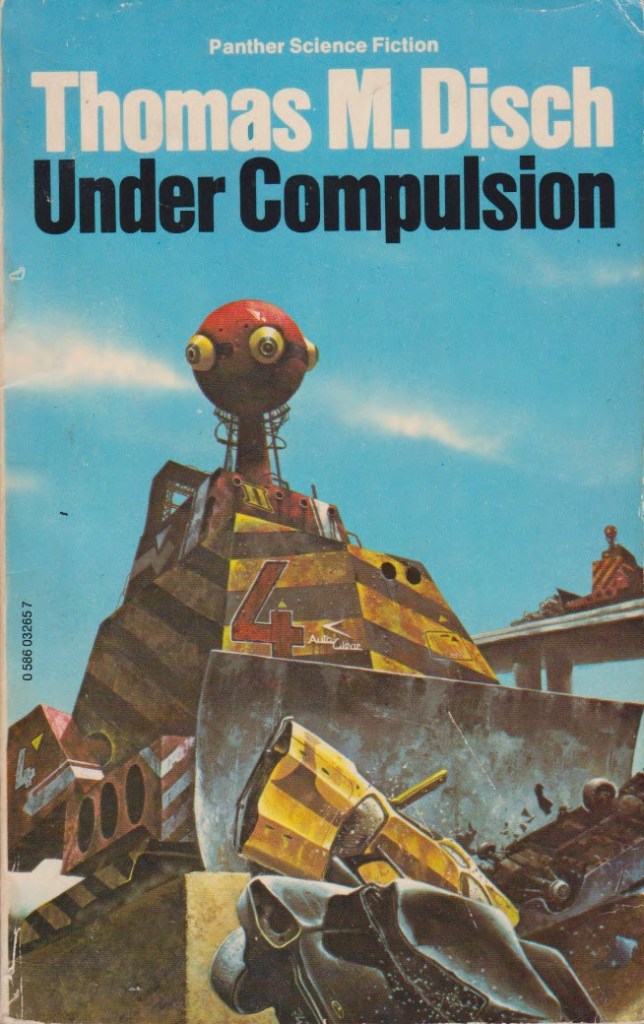
Updates: Recent Science Fiction Purchases No. CCCXXVII (Thomas M. Disch, Doris Piserchia, Ian Watson, and an anthology)

Which books/covers/authors intrigue you? Which have you read? Disliked? Enjoyed?

1. Under Compulsion (variant title: Fun with Your New Head), Thomas M. Disch (1968)

From the back cover: “A BLACK BANQUET OF PURE DISCH

A part-human, part-electronic brain going slowly mad in the Venus jungle.

The last man on earth rejecting the last woman.

A Russian astronaut looking for a good reason to die on the moon.

A chilling glimpse of a 21st century America where war is peace, freedom is slavery and ignorance is strength–and they like it like that.

Continue reading

Short Story Reviews: Robert Silverberg’s “Road to Nightfall” (1958) and Edgar Pangborn’s “The Music Master of Babylon” (1954)

I can’t escape the post-apocalyptic wasteland. Like a voyeuristic shadow, I follow the denizens of the charred surface as they plod their slow movements toward the end. I observe how they push away the looming violent redness that blots out the sky, and, when everything else seems lost, they turn interior. A final movement that lays bare tattered dreams and ephemeral memories…


5/5 (Masterpiece)

Edgar Pangborn’s “The Music Master of Babylon” first appeared in Galaxy Science Fiction, ed. H. L. Gold (November 1954). You can read it online here.

Fresh of Edgar Pangborn’s masterpiece Davy (1964), I decided to cover some of his short fiction on the site. He’s shaping up to be my author of the year. “The Music Master of Babylon” (1954), which I suggest should be included as part of his Tales of a Darkening World sequence due to multiple references to events and people present in the world of Davy, contains many of the embryonic concerns that crop up in the later novel. Pangborn is the master of interweaving narrative and personal memory and the ways art–in this instance music–lays bare the topography of self.

Continue reading

What pre-1985 science fiction are you reading? + Bimonthly Update No. V

What pre-1985 science fiction are you reading this week?

Thanks again for all the great conversation. Make sure to check out the previous installment if you haven’t already. As before, I’ve included a bit about the books in the photograph, birthdays from the last two weeks, and brief ruminations on what I’ve been reading and writing.

Let me know what pre-1985 SF you’ve been reading!

Continue reading

What pre-1985 science fiction are you reading? + Bimonthly Update No. I

What pre-1985 science fiction are you reading this weekend?

Every Saturday for more than a year, I’ve asked this question on Twitter (and since February on Mastodon) with a photo of books I’ve read and reviewed on my website from my shelves. Due to the painful implosion of Twitter and the confused and frustrating “what platform do we go to next” panic, I’ve decided to move my weekly question and photo to my site. This community is always first and foremost in my mind. Thank you commenters and lurkers!

Continue reading

Short Story Reviews: Robert Silverberg’s “The Seed of Earth” (1958) and Doris Piserchia’s “Pale Hands” (1974)

I’ve decided to reframe my series on 50s sex and sexuality to include my entire area of SF interest (1945-1985). Thus, I’ve paired Robert Silverberg’s “The Seed of Earth” (1958), a rumination on colonization and human/alien sex, with Doris Piserchia’s “Pale Hands” (1974), a distressing dissection of a future society designed to fixate all sexual desire on masturbation stalls.

Here are the earlier installments in the series:

  1. Philip José Farmer’s “The Lovers” (1952)
  2. Sherwood Springer’s “No Land of Nod” (1952)
  3. Wallace West’s “Eddie For Short” (1953)
  4. Fritz Leiber’s “The Ship Sails at Midnight” (1950)
  5. Theodore Sturgeon’s “The Sex Opposite” (1952)
  6. Ward Moore’s “Lot” (1953)
  7. Langdon Jones’ “I Remember, Anita…” (1964)
  8. Damon Knight’s “Not With a Bang” (1950)

If any short stories published between 1945-1985 on sex and sexuality come to mind that I haven’t reviewed yet, let me know in the comments. I have a substantial list waiting to be covered but it’s far from comprehensive.


3.5/5 (Good)

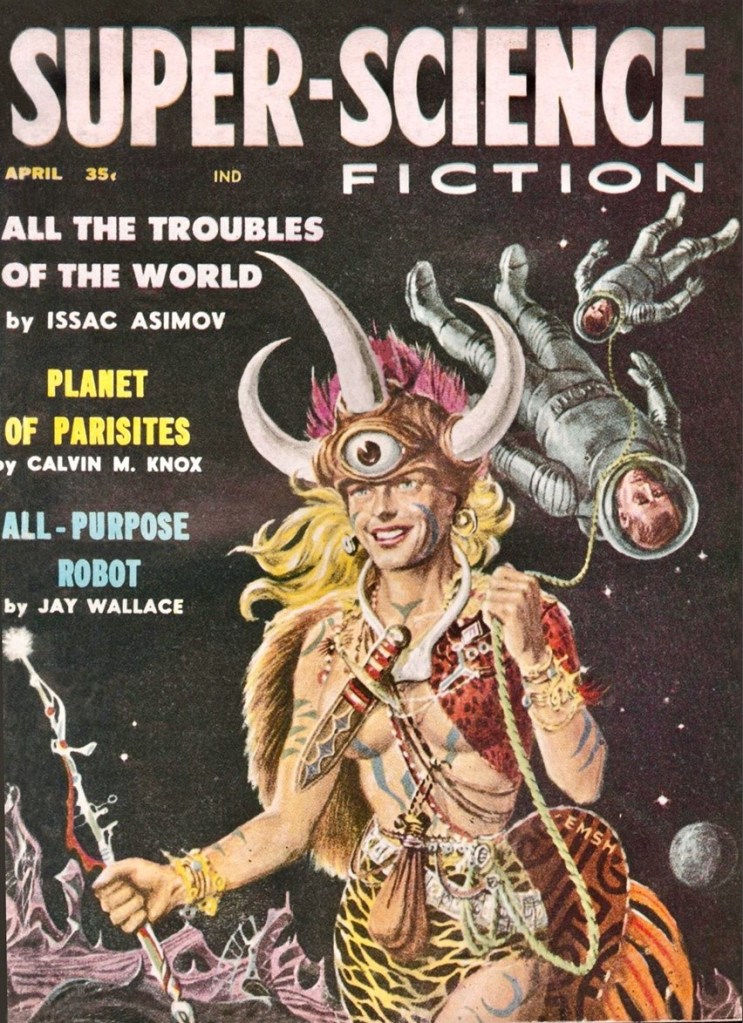
Robert Silverberg’s “The Seed of Earth” (variant title: “Journey’s End”) first appeared in Super-Science Fiction, ed. W. W. Scott (April 1958). You can read it online here. It is also available in his collection Dimension Thirteen (1969) that I plan on reviewing in the near future.

A preliminary note about publication: Silverberg reused the title “The Seed of Earth”–chosen by W. W. Scott over “Journey’s End”–for a later unrelated novella and a novel.

Continue reading

Updates: Recent Science Fiction Purchases No. CCCVII (Jack Williamson, William E. Cochrane, a Groff Conklin anthology, and an anthology of gay and lesbian SF)

Which books/covers/authors intrigue you? Which have you read? Disliked? Enjoyed?

1. 6 Great Short Novels of Science Fiction, ed. Groff Conklin (1954)

From the back cover: “THE BLAST: STUART CLOETE envisions New York City under atomic attack, and tells the story of the lone survivor.

COVENTRY: ROBERT HEINLEIN shows what happens to one of the last individualists, who request a sentence to purgatory.

THE OTHER WORLD: MURRAY LEINSTER reveals a savage, feudal civilization which lives off the sweat of slaves kidnapped from our world.

BARRIER: ANTHONY BOUCHER writers of a time traveler, and his strange encounters with the people who will come after us.

SURFACE TENSION: JAMES BLISH traces a race of microscopic men that works out its destiny under water on a planet somewhere far out of the galaxy.

MATURITY: THEODORE STURGEON depicts the agonizing plight of a super man born in our midst.

Continue reading

Updates: Recent Science Fiction Purchases No. CCXCVIII (Harlan Ellison, Edward Bryant, Murray Constantine, Sayko Komatsu, and an automobile-themed anthology)

Which books/covers/authors intrigue you? Which have you read? Disliked? Enjoyed?

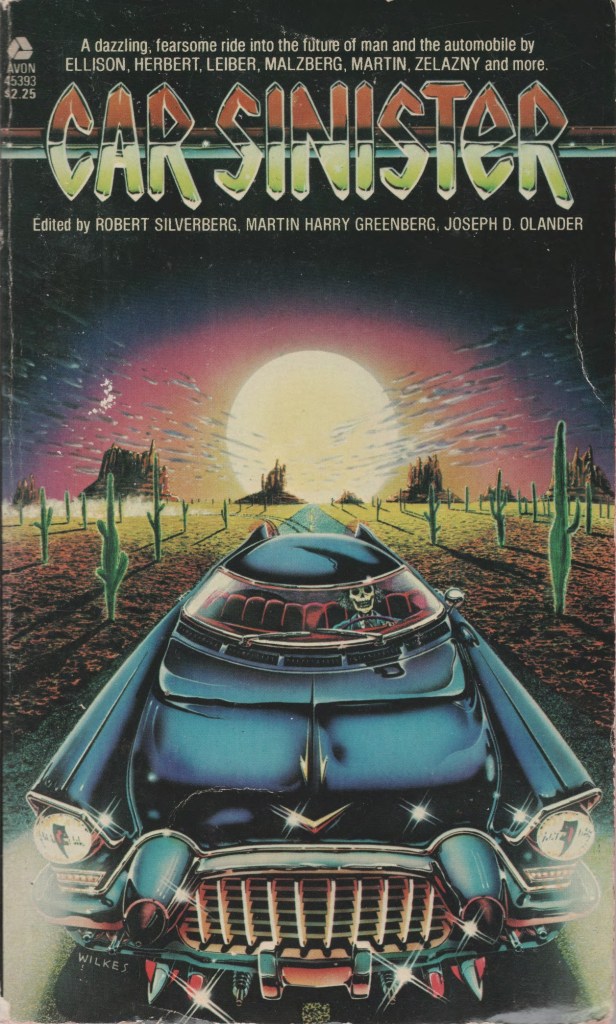
1. Car Sinister, ed. Robert Silverberg, Martin Harry Greenberg, and Joseph D. Olander (1979)

From the back cover: “MAN AND HIS MACHINE. The car is man’s most personalized machine; for teenagers it is a rite of passage and a statement of freedom; for adults it is a reflection of success, taste, and hopes; and for an entire culture it is a great and industrious mode of transportation–driving, perhaps, on the road of destruction. And the automobile–thrilling, honking, speeding, nerve-shattering–haunts us with the dark possibility that when our age of motoring innocence is over, we may no longer be the masters… CAR SINISTER–a splendid, imaginative vision of what lies down the road for all of us.”

Continue reading