Short Story Reviews: Hugo Correa’s “Alter Ego” (1967) and “Meccano” (1968)

Today I’m joined again by Rachel S. Cordasco, the creator of the indispensable website and resource Speculative Fiction in Translation, for the third installment of our series exploring non-English language SF worlds. Last time we covered Vladimir Colin’s Lem-esque story of an unusual alien encounter “The Contact” (1966, trans. 1970). We have stories from the Netherlands, Austria, Poland, and France in the queue.

This time we shift continents from Europe to South America with two stories by Hugo Correa (1926-2008). According to SF Encyclopedia, Correa was the “leading Chilean sf author of his generation.” Unfortunately, his best-known work, the novel Los altímos (The Superior Ones) (1951, rev. 1959) remains untranslated. Correa’s brief appearance in the American market–three short stories–came courtesy of Ray Bradbury. In 1961, the young Chilean author received a grant to participate in the writers’ workshops at the University of Iowa. He translated a handful of his own stories from Spanish to English and sent them to Ray Bradbury, who responded “with enthusiasm and encouragement.” Bradbury met with Correa when he visited Los Angeles, and the famous SF author sent a few of the translated stories to various magazine editors. Four stories eventually appeared in the North American market. It’s a shame that more of his work hasn’t been translated — yet alone a complete bibliography compiled at The Internet Speculative Fiction Database. The SF Encyclopedia entry mentions works that aren’t listed in the database. And this Spanish-language website contains a far more extensive bibliography.

We’ve selected two of his four translated stories for this post:

  1. “Alter Ego” first appeared in The Magazine of Fantasy and Science Fiction, ed. Edward L. Ferman (July 1967). You can read it online here.
  2. “Meccano” first appeared in International Science-Fiction, ed. Frederik Pohl (June 1968). You can read it online here.

Both are super short and worth the read.

Now let’s get to our reviews!

Rachel S. Cordasco’s Reviews

Continue reading

Guest Post: Pioneer Spaceships, Robot Therapists, and Oppressive Small Towns: “Survival Ship” (1951), Judith Merril, “Short in the Chest” (1954), Margaret St. Clair, “The Wait” (1958), Kit Reed

Megan (twitter) over at From Couch to Moon—who, with boundless wit and intelligence, enjoys exploring the turbulent seas of lesser known SF both vintage and contemporary—provides the sixth guest post in my SF Short Stories by Women Writers pre-1969 series (original announcement and list of earlier posts). Head over to her blog—do not miss her review of Brunner’s Stand on Zanzibar (1968) written in his style and more recent rundowns of various award slates, the 2015 Kitschies for example.

Here are three reviews of 1950s short fiction by Judith Merril, Margaret St. Clair, and Kit Reed.

As always, the required exhortation, find copies!

_________________________________________________________________

newwrmay55

(“Survival Ship” appeared in the May 1955 issue of New Worlds Science Fiction, ed. John Carnell, cover: Gerard Quinn)

Reviews of “Survival Ship” (1951) by Judith Merril, “Short in the Chest” (1954) by Margaret St. Clair, and “The Wait” (1958) by Kit Reed

By Megan

Not being much of a short fiction reader, these were all new-to-me stories that I thought I might appreciate. A selection of fifties SF, all of which are dark and strange and rebellious, and examine the social and political pressures that are often Continue reading

Adventures in Science Fiction Cover Art: Look, I’m Actually a Robot (chest flaps, faux skin, mechanical brains)

1964_12_if_graymorrow

(Gray Morrow’s cover for the the December 1964 issue of If)

One of Philip K. Dick’s trademark narrative devices is a character’s realization that they are not human as they previously believed but rather a robot — for example in one of my favorite sci-fi short stories, ‘Impostor’.  Generally these bewildered robots float to the ceiling and explode, which has to be one of the more terrifying and cataclysmic revelations possible (the knowledge itself and the devastation caused).

Unfortunately, cover artists don’t attempt to depict that sort of “look, I’m a robot” type Continue reading

Adventures in Science Fiction Cover Art: Imprisoned in Glass Vials (of the metaphoric + medical + experimental variety)

(Uncredited cover for the 1969 edition of The Fortec Conspiracy (1968), Richard M. Garvin and Edmond G. Addeo)

Humans and aliens in glass vials of all shapes and sizes waiting to be measured, matured, tested, analyzed, exposed to a variety of chemicals and emulsions.  The artists often combine the iconic laboratory scene filled with the tools of the trade with sci-fi speculation on human experimentation (queue babies grown in containers in Brave New World).  The result, humans in tubes.  The effect is downright terrifying and one suspects, evokes a certain moribund fascination.  As with the famous introductory sequence in Brave New World, the reader is horrified by birth entirety regulated by machines.  Or, we are simultaneously titillated Continue reading

Adventures in Science Fiction Art: Doomed Cities Part III (the attack of the metal missile casings, monks among ruins)

(Rod Turner’s cover for the 1952 edition of The G-Bomb (1952), Vargo Statten (i.e. John Russell Fearn)

Make sure to check out Part I and Part II if you haven’t.  Some of the doomed cities are stunning!

Of all the 50s pulp covers, Rod Turner’s series for Vargo Statten’s novels (John Russell Fearn) has become one of my favorites (above).  Although they adhere to every possible cliché, the pure exuberance of delivery is addicting — the books themselves are supposed to be pure drivel.

Enjoy monks among ruins, spaceships hovering above the fragments of past cities, hordes emerging from the wrecked husks of our august metropolises, the attack Continue reading

Adventures in Science Fiction Cover Art: A Handful of Funny Robots

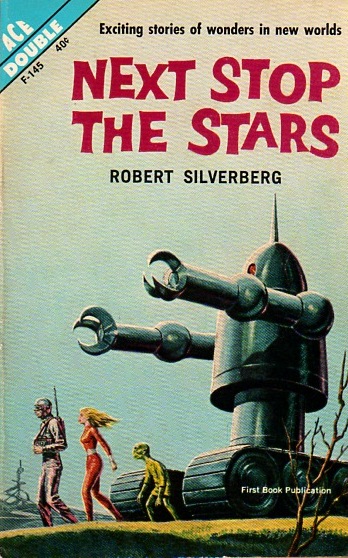
Unless those arms extend the robot's only use will be to run over people -- which it's about to do.

(Ed Valigursky’s cover for the the 1962 edition of Next Stop The Stars (1962), Robert Silverberg)

While browsing through my rapidly growing collection of cover images on my computer I couldn’t stop laughing at the hilarious robots that pop up every now and then.  From evil looking R2D2s (with legs) to multi-handed flying death robots with unfortunate double smiley faces!  Oh, and the crying rescue robot….

If I were in the robot designing business I’d conjure up a robot that could cry — a good use of time — as useful as Data with his emotion chip talking to his tricorder or finally understanding jokes: “Geordi: The Farpoint mission? Data, that was seven years ago. Data: I know! I just got it! Very Continue reading