Short Story Review: Raymond F. Jones’ “The Memory of Mars” (1961)

3.5/5 (Good)

Before Philip K. Dick’s “We Can Remember It for You Wholesale” (1966), Raymond F. Jones wrote the far lesser known “The Memory of Mars” (1961)–his own paranoid thriller about a vacation to Mars that might not have happened exactly as remembered. This is a plot-driven story. There are multiple twists and delusional layers that unfold at lightning speed–some more satisfying than others. You might want to read the story in the December 1961 issue of Amazing Stories, ed. Cele Goldsmith first.

“The Memory of Mars” has all the pieces of a paranoid masterpiece. A journalist named Mel Hastings, trained to be objective, waits for his wife Alice to be released from surgery. As he waits anxiously for news knowing that something has gone wrong, he recalls his wife’s persistent claim that they had gone on a vacation to Mars the first year of their marriage. The simmering terror of his own phobia of space and recurrent nightmares of being chased across the black void suggest there’s more than he remembers. Mel’s called into the surgery room with disturbing news. His wife is dead and something is terribly wrong with her viscera. Vigil Finlay’s top-notch interior art (above) hints at the terror that unfolds as Alice’s inhuman interior is laid bare….

Continue reading
Updates: Recent Science Fiction Purchases No. CCLXXVII (Octavia E. Butler, Harlan Ellison, James White, Poul Anderson)

As always, which books/covers/authors intrigue you? Which have you read? Disliked? Enjoyed?

1. Dawn, Octavia E. Butler (1987)

From the back cover: “XENOGENESIS: The birth of something new—and foreign.

Lilith Iyapo awoke from a centuries-long sleep—and found herself aboard the vast living spaceship of the Oankali. Alien creatures covered in writhing tentacles, the Oankali had saved every surviving human from a dying, ruined Earth. They healed the planet, cured cancer, increased human strength and disease resistance, and were now ready to help Lilith lead her people back to Earth.

Continue reading

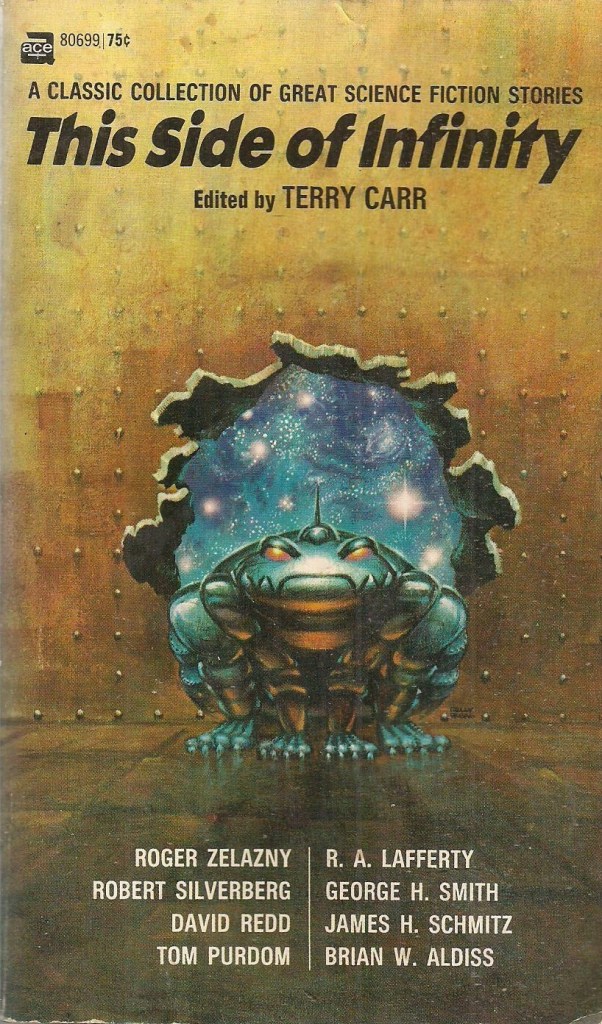
Book Review: This Side of Infinity, ed. Terry Carr (1972) (Zelazny, Silverberg, Aldiss, Lafferty, et al.)

3.25/5 (Collated rating: Vaguely Good)

Soldiers in mech armor plagued by existential crisis. Asexual insectoid aliens pretending to be human. Children wielding pet apes as weapons. This Side of Infinity, ed. Terry Carr (1972) gathers eight kaleidoscopic visions from stalwarts (Roger Zelazny and Robert Silverberg) to lesser known authors (David Redd and George H. Smith). As a collated whole, this is a solid collection without a defining standout masterpiece but worth acquiring for the sheer variety and hallucinatory power of it all.

Continue reading

Short Story Reviews: Carol Emshwiller’s “Baby” (1958), “Idol’s Eye” (1958), and “Pelt” (1958)

I’ve hit gold! Robotic nurses with adult “children.” A blind girl possessed by second sight. And a dog who cannot understand freedom. Here’s the fourth post in my series exploring Carol Emshwiller’s science fiction and fantasy–published between 1955-1979 in genre magazines–in chronological order. And if you missed earlier installments, check out Part III, and III.

In this installment, I have the first that I can confidently declare a 1950s masterpiece–“Pelt” (1958). If you want to participate in my explorations, links to the stories can be found below.

As always, feel free to join the conversation!

Her next three stories are covered in Part V.


“Baby” in The Magazine of Fantasy and Science Fiction (February 1958), ed. Anthony Boucher. 4/5 (Good). You can read it online here.

Raised by a robotic nurse, Baby, “six feet tall, lean, [with] the look of a hungry hunting animal,” encounters a slowly decaying world unable to provide his needs (115). Baby’s simulacra parent, and to a lesser degree Rob the repair robot, parrot the language, actions, and intentions of humans. He detects an emptiness to the space behind their words and increasing inability to explain the mechanical breakdowns that are never fixed. Saying “please” no longer works (116) but rather makes him angry. Nurse, with her “soft mother-arms” and “specially built place at her breast,” continues to follow her programming and treat Baby as if he were a child (118).

Continue reading

Adventures in Science Fiction Cover Art: Ferruccio Alessandri’s Insectoid Visages and Other Nightmares

Italian artist, author, translator, and comic book critic Ferruccio Alessandri (1935-) created twenty-two covers for the Italian SF magazine Galassia (most of the issues between #109-132) in 1970. Galassia magazine was instrumental in introducing Italian audiences to the New Wave movement. Issues often contained both translations of popular English language authors and original Italian short stories and experimental visions.

As a unit, Alessandri’s covers convey a terrifying hellscape of insectoid visages (#122, #110, #128, #130), encounters with the surreal (#115), the oddly humanoid shapes (#119, #114, #116, #127), etc. Like searing flashes of a planet bathed under neon light, they are micro windows into the wonderscape of science fiction. While his Galassia covers are unconnected to the contents of the issues (to the best of my knowledge), I find their cumulative effect unsettling and alien.

Continue reading

Updates: Recent Science Fiction Purchases No. CCLXXVI (Philip José Farmer, Barbara Paul, Knut Faldbakken, and Ward Moore)

Which books/covers/authors intrigue you? Which have you read? Disliked? Enjoyed?

1. Father to the Stars, Philip José Farmer (1981)

From the back cover: “John Carmody has no ethics, no morals and no conscience. Until he takes the Chance on Dante’s Joy, living through seven nights of wildest fantasies come true, he can’t even imagine why anyone would want a conscience. But Dante’s Joy is a truly strange place–and the phone calls from his murdered wife are only the beginning of his strange experiences.

Continue reading

Book Review: Twilight Country, Knut Faldbakken (1974, trans. Joan Tate, 1993)

4.75/5 (Near Masterpiece)

In 1968, the moody Canadian psychedelic pop group The Poppy Family released “Of Cities and Escapes,” a haunting song of urban emptiness. The song’s narrator intones: “I live in a one-room apartment, with windows on one side / I stare through the glass ‘cross the water, to where the big, ugly city lies.” In the second verse, later sampled by Deltron 3030 on “Madness” (2000), the narrator cannot escape the death spiral: “I’m caught in the grip of the city, madness and smog.” Twilight City (1974, trans. Joan Tate, 1993), by Norwegian novelist Knut Faldbakken (1941-), delves into a similar dystopian urban gloom. The refugees of a decaying city dust off the entangling membranes of lost paths and the weight of melancholy souls and attempt to chart a new beginning in the city dump.

Brief Plot Summary/Analysis

In an unnamed country, the metropolis of Sweetwater–“an eruption of urban geography” (2) possessed by an “ever-growing urban sprawl” (23)–suffers under the effects of global warming, industrialization, and malignant societal decay.

Continue reading

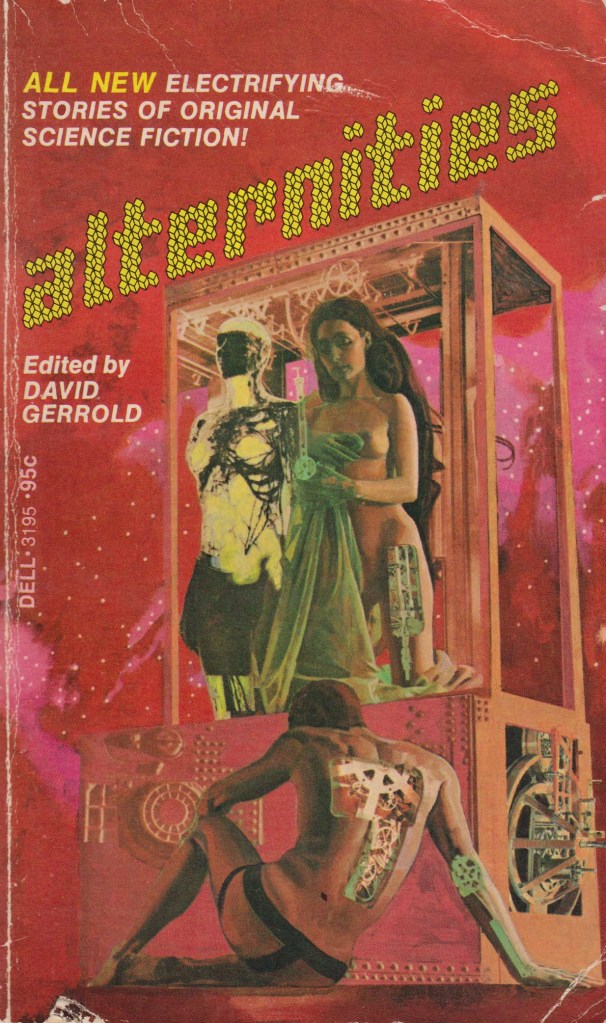
Book Review: Alternities, ed. David Gerrold and Stephen Goldin (1974) (Malzberg, McIntyre, Bunch, Bear, Sallis, et al.)

2.5/5 (collated rating: Bad)

David Gerrold and his associate editor Stephen Goldin collect a bizarre range of SF oddities including an epistolary nightmare from Vonda N. McIntyre’s pen and a one-sentence “sign” by Duane Ackerman. Gerrold argues that he wants “science fiction to be fun again” without “literary inbreeding and incestuous navel-studying” (8). With a more than pungent hint of hypocrisy, he spouts “I’m tired of the kind of bullshitting that creates false images in the readers’ minds” (8). Alternities (1974) reads like the cast off stories from a New Wave (i.e. deliberately literary) Judith Merril or Harlan Ellison anthology with heavy dose of erotic comedy and shock value. A few–including E. Michael Blake’s “The Legend of Lonnie and the Seven-Ten Split,” Vonda N. McIntyre’s “Recourse, Inc.,” and Edward Bryant’s “Cowboys, Indians”–rise above the dross.

To be clear, I enjoy devouring anthologies like Alternities. The stories are originals and few are anthologized elsewhere. I adore reading authors I wouldn’t otherwise encounter (Robert Wissner, E. Michael Blake, et al.). Gerrold’s nonsense of an introduction aside, the anthology with its deliberate attempts at the “literary” (Greg Bear’s “Webster” and James Sallis’ “The First Few Kinds of Truth”) and “edgy” (Steven Utley’s “Womb, with a View”) firmly fit in the passing mid-70s foam of the New Wave movement.

Continue reading

Recent Science Fiction Purchases No. CCLXXV (Tanith Lee, Anthony Boucher, Jack Womack, and Alexander Cordell)

As always, which books/covers/authors intrigue you? Which have you read? Disliked? Enjoyed?

1. Ambient, Jack Womack (1987)

From the back cover: “Twenty-first century New York. It’s a nightmare. Reaganomics has gone mad: there’s murder and mutilation on the bombed-out streets, and in the corporate conference rooms. Manhattan is a zoo. There’s guerilla war on Long Island. You’ll need to be rich to survive at all, and it’s easier to be dead than poor.

Seamus O’Malley is a bodyguard and assassin in the outrageously powerful Dryco organization, and he’s in deep trouble. Taking the job sounded like a good idea at the time.

Falling in love with his employer’s mistress Avalon, probably wasn’t so bright. Getting caught up in the Dryden family’s crazy, lethal rivalries didn’t help. Agreeing to murder the Old man was plain stupid. And being involved with the Ambient only complicated matters further. Before long O’Malley’s on the run, and there’s nowhere safe to hide. ‘Ready to kill, Shameless?’ Avalon said. ‘Ready to die.’

Continue reading