Adventures in Science Fiction Cover Art: Fractured Bodies (unraveling, decaying, [de]constructing)

CRMPTNDVDD1979

(Paul Lehr’s cover for the 1979 edition of Crompton Divided (variant title: The Alchemical Marriage of Alistair Crompton) (1978), Robert Sheckley)

Paul Lehr’s cover for the 1979 edition of Robert Sheckley’s Crompton Divided (1978) was the inspiration for this post.  I found the cover many years ago while looking through Lehr’s entire (mostly brilliant catalogue) and was intrigued.  The man, comprised of puzzle-like pieces that slowly morph into the swirls of his clothes, stares at us with hybridized eyes — a planet, a pupil — while one missing puzzle piece allows the viewer a glimpse of a barren landscape.  His brain, entirely a puzzle, is complete, but are his senses crumbling?

 Dean Ellis’ cover for the 1971 edition of Larry Niven’s collection All the Myriad Ways (1971) is even more fantastic — the puzzle pieces (bones, faces, limbs) dangle in the air Continue reading

Book Review: Xenogenesis, Miriam Allen deFord (1969)

(Richard Powers’ cover for the 1969 edition — there is some speculation that it might be a collaboration with Leo and Diane Dillon)

3.5/5 (Collated rating: Good)

Miriam Allen deFord—one of the more prolific SF short story authors of the 50s-70s whose works appeared in The Magazine of Fantasy and Science Fiction, If, Fantastic Universe, Galaxy, Worlds of Tomorrow, etc—deserves a Gollancz Masterworks volume.  But, as Ian Sales has pointed out so forcefully in his recent article (here), despite the number of prolific women SF authors in the 50s-70s they were rarely republished and are perhaps the least read group of SF authors for modern audiences.  There are some exceptions but few readers can name a women author pre-Ursula Le Guin.  deFord’s shorts were collected in only two volumes, Xenogenesis (1969) and Elsewhere, Elsewhen, Elsehow (1971) and both print runs were limited to the first year of publication.

Informed by her feminist activism (she was an important campaigner for birth control) and her earlier career in the newspapers, deFord’s stories tackle themes such as overpopulation, racism, colonialism, gender issues, sexism, and alienation.  Her works range from deceptively simple allegories to future histories vast in scope and complexity (for short stories).  Her female characters are almost all individualistic, resourceful, and highly educated–they often struggle against increasingly regimented/mechanized/homogenized societies in order to raise families in addition to their careers.  In short, deFord advocates forcefully the right to self-determination Continue reading

Updates: Recent Science Fiction Acquisitions No. LXXIX (Haldeman + Chalker + Oliver + Anderson)

Some Chicago finds from Powell Books (Hyde Park)…  I own too many SF novels in my to read pile (I have close to 300 waiting to be read so I am going to try to put a stop on rampant — yes, they are cheap — purchases).

Last one of these for a while?  Should I take bets?

Some titles definitely not my normal fare — I’ve read Haldeman’s The Forever War (1975), Forever Peace (1999), and Forever Free (1999) but not a single one of his short stories so Infinite Dreams (1978) is a welcome addition to my collection.

Chad Oliver is one of the “second-tier” greats whom I’ve not read…. And Chalker falls in that category as well.  Poul Anderson’s The Byworlder (1971) is generally not considered one of his best but it did snag a Nebula award nomination.

Thoughts?

1. Infinite Dreams, Joe Haldeman (1978)

(Clyde Caldwell’s cover for the 1979 edition) Continue reading

Updates (New Resource): List of Immortality Themed SF (a call to contribute!)

This post is a call for readers to submit their favorite immortality themed science fiction NOT included on my list below (and even examples they did not care for so I can make this a more substantial resource).  I’ll make a page with all the information I receive for easy consultation soon (INDEX of similar pages/articles).

A while back I started gathering a list of titles — via SF Encyclopedia, other online resources, and my own shelves — on immortality themed SF.  I have always been intrigued by the social space (one plagued by violence and despair or buoyed by the hope of a better future) that the possibility of immortality might generate.

I would argue that the single best example of social effects that the possibility of immortality might create is Clifford D. Simak’s Why Call Them Back From Heaven? (1967).  In similar fashion, James Gunn’s The Immortals (1962) takes place in a world where immortals do exist, they skirt Continue reading

Book Review: At the Seventh Level, Suzette Haden Elgin (1972)

(George Barr’s cover for the 1972 edition)

3/5 (Average)

At the Seventh Level (1972) is part of a loose sequence of novels that feature Trigalactic Intelligence Service agent Coyote Jones and his voyages to various worlds. Although this sequence ostensibly has the trappings of SF space opera, Suzette Haden Elgin subverts the genre conventions so that the premise functions as a polemical feminist text with satirical underpinnings.  At the Seventh Level is an important installment in a long line of “women as slaves trapped in vast repressive patriarchy propped up by appeals to tradition and brute force” type novels which, some might argue, culminated in Margaret Atwood’s The Handmaid’s Tale (1985).  It is important to note that there were many novels on similar themes before Atwood’s acknowledged masterpiece hit Continue reading

Book Review: A Way Home, Theodore Sturgeon (1956)

(Mel Hunter’s cover for the 1956 edition)

3/5 (collated rating: Average)

Although Theodore Sturgeon is generally considered a master of the SF short form, his collection A Way Home (1956) contains only two worthwhile stories — “Thunder and Roses” (1947) and “Bulkhead” (1955).  The rest I was either unable to finish or struggled to muddle through over the course of the last two or so weeks.  Fortunately,  the near masterpiece “Bulkhead” was almost worth the pain induced by the intelligent dog related subgenre of SF manifest in “Tiny and the Monster” (1947) or the cute accidentally destructive hurkle kittens of “The Hurkle Is a Happy Beast” (1949).

At this stage in my recent endeavor to brush up on the best of the 50s short story wordsmiths, I place Sturgeon below Robert Sheckley, Brian Aldiss, Philip K. Dick, Fritz Leiber, Miriam Allen deFord, Lester del Rey, Walter M. Miller, Jr., C. M. Kornbluth, and Frederik Pohl. (shocking to some, I know!).

However, before I make a more definitive conclusion I call on my readers to list what you consider his best short work Continue reading

Adventures in Science Fiction Cover Art: Diagrammatic Wonders (alien sand art + planning invasions + and other more mysterious formulations), Part I

1-1957_04_fantasticuniverse_finlay

(Virgil Finlay’s cover for the April 1957 issue of Fantastic Universe, ed. Hans Stefan Santesson)

At first glance this is a miscellaneous collection of covers on diagrammatic wonders — the aliens (or “advanced” humans) on Virgil Finlay’s cover for the April 1957 issue of Fantastic Universe conjure an image of earth with colored sand, generals plot invasions via maps and other diagrams depicting troop movements….

While some of the covers are themselves diagrams (Christopher Zacharow’s cover for the 1985 edition of Ancient of Days (1985), Michael Bishop) others place their characters in opposition to each other as pieces Continue reading

Book Review: And Strange at Ecbatan the Trees (variant title: Beneath the Shattered Moons), Michael Bishop (1976)

(Jonathan Weld’s cover for the 1976 edition)

4/5 (Good)

Michael Bishop’s And Strange at Ecbatan the Trees (variant title: Beneath the Shattered Moons) (1976) is a melancholic and allegorically inclined parable about a coming cataclysm that threatens a programmed and hierarchically rigid society (accomplished via genetic modification).  Bishop’s voice is an intensely humanistic once, futuristic technology is present but not a central concern…. The simple but effective plot is the perfect vehicle for his moralistic ruminations: a man forced into action, a world compelled — despite the external forces at play — to adapt.

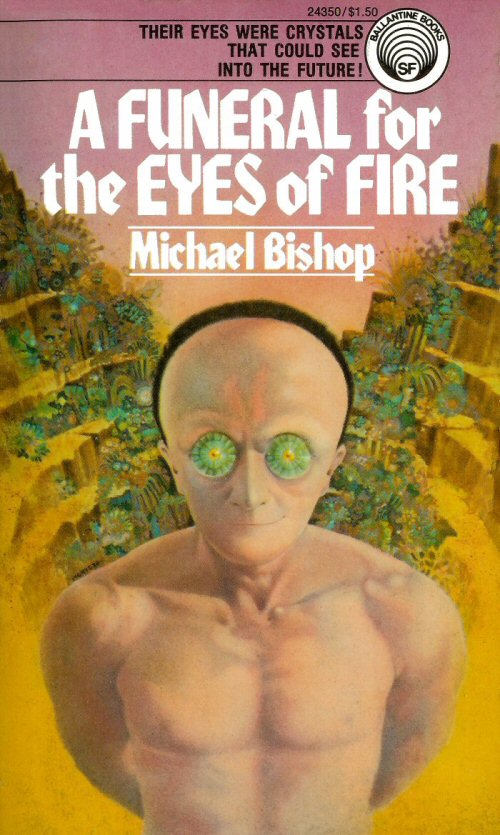
 And Strange at Ecbatan the Trees is the first of Michael Bishop’s works I have read and I am definitely intrigued enough to place his supposedly superior Nebula-nominated first novel, Funeral for the Continue reading

Book Review: Singularity Station, Brian N. Ball (1973)

daw2_0045

(Chris Foss’ cover for the 1973 edition)

4/5 (Good)

If one were to distill 70s space opera in a decanter filled with SF pulp the result would be Singularity Station (1973).  Combined with the dynamic Chris Foss cover — I’ve never enjoyed his work but it does embody the vigor and explosiveness of the novel — Brian N. Ball’s vision is an veritable adolescent SF wet dream filled with robots, cutting edge science (in this case, 60s speculation on the nature of black holes), a love interest (not the 30s/40s pulp versions) in distress, a mad scientist, and inventive spaceships and space stations.

70s pulp at its Continue reading