Book Review: Universe 10, ed. Terry Carr (1980) (Lafferty + Bishop + Tiptree, Jr., Waldrop, et al.)

screen-shot-2016-10-30-at-10-36-06-am

(Uncredited cover for the 1982 edition)

3.5/5 (collated rating: Good)

Fresh off Terry Carr’s novel Cirque (1977), I decided to return to his original Universe series of anthologies.  I’ve previously reviewed Universe (1971) and Universe 2 (1972).  As with the majority of SF anthologies, Universe 10 (1980) is sprinkled with both good and bad.  I selected it from the veritable sea of anthologies on my shelves due to the presence of authors I wish to explore further and those who are foreign to me: Michael Bishop and James Tiptree, Jr. in the former category; Lee Killough, Howard Waldrop, Carter Scholz, and F. M. Busby in the latter.

Michael Bishop’s “Saving Face”, James Tiptree, Jr.’s “A Source of Innocent Merriment,” and Carter Continue reading

Updates: Recent Science Fiction Acquisitions No. CLXIII (Simak + Moore + Universe Anthology + Lewin)

I had a choice, one of the worst SF covers I have ever seen vs. a standard Richard Powers cover. Despite my undying Powers love, I chose the worst (weird white face bathed in purple/pink strangeness)…. you know…. a conversation starter? As I have read little of Simak’s non-novel SF, I was quite happy to I come across one of his collections at the local bookstore.

Ward Moore’s 1953 alt-history classic fetches quite the price online. Perhaps due to a renewed interest as it was recently published in the Gollancz Masterwork series. Regardless, I found a 70s edition (alas, a bland cover) for a few dollars. I’ve been listening to his humorous satire of salesmen Greener Than You Think (1947) as an ebook while at the gym and thought I’d give his most famous novel a go…

My Universe anthology series grows and grows–and, this one contains authors new to me, including Howard Waldrop, F. M. Busby, and Lee Killough.

Thoughts/comments welcome!  I doubt many will support my choice of picking the hideous cover over Powers, but, I can submit a picture of it to our esteemed purveyor of trash covers, Good Show, Sir!

1. Bring the Jubilee, Ward Moore (1953)

screen-shot-2016-11-02-at-7-47-47-am

(Jeff Jones’ cover for the 1972 edition) Continue reading

Updates: Recent Science Fiction Acquisitions No. CLXII (Vance + Rucker + Kaye + Godwin + Orbit Anthology)

More SF joins the ranks that cover my shelves, from a Jack Vance Demon Princes sequence novel to a promising Orbit anthology with early Vernor Vinge, Carol Emshwiller, Harlan Ellison, etc.

And the covers!  Powers and Lehr at their best…

And what happened to SF art the 80s? (the Rudy Rucker novel cover terrifies — in a bad way).

As always, thoughts/comments are appreciated!

1.The Palace of Love, Jack Vance (serialized 1966)

thplcflvgw1967

(Richard Powers’ cover for the 1967 edition) Continue reading

Updates: Recent Science Fiction Acquisitions No. CLXI (Ellison + Sterling + Fast + Paul)

As is my wont, a wide range of authors, SF styles, and covers…. From Harlan Ellison’s collection with the first expanded and non-magazine publication of his famous  1970 Nebula Award-winning and Hugo-nominated novella “A Boy and His Dog” (1969) to Barbara Paul’s best-known SF novel.

And, how can you resist the gorgeous Karel Thole cover for Fast’s collection?  I know little about the author….

And finally, in my youth I was a cyberpunk fanatic and I adored (perhaps I was misguided, hah) Bruce Sterling’s Islands in the Net (1988).  At last I have his first novel in my hands!

As always, thoughts and comments are welcome!

1. The General Zapped an Angel, Howard Fast (1970)

thgnrlzppd1970

(Karel Thole’s cover for the 1970 edition) Continue reading

Book Review: Abyss, Kate Wilhelm (1971)

bsshvspmdn1973

(Lou Feck’s cover for the 1973 edition)

4/5 (collated rating: Good)

Kate Wilhem’s SF forms one of the foundational pillars propping up my fascination with the genre.  Her writing, sometimes oblique and interior, cuts to the very heart of things, exposing the hidden societal and psychological sinews that suppress and restrict.  Her 60s/70s women characters, from linguists and mathematicians to discontented housewives, subtly subvert our expectations of how genre characters should behave.  And for a few years in the early 70s, she dominated the award lists (four Nebula nominations in 1971, two in 1970, a win in 1968, and of course, her double Hugo and Nebula win in 1976 for her novel Where Late our Sweet Birds Sang).  Totals: 14 Nebula nominations Continue reading

Updates: Recent Science Fiction Acquisitions No. CLX (Delany + Disch + Sladek + Zelazny + Edmondson + Bryant + Sucharitkul)

It’s been too long since I’ve read anything by Delany.  I polished off Triton (1976), Nova (1968), The Einstein Intersection (1967), and Babel-17 (1966) long before I started my site.  For a SF reading group I reread Nova a few years back but never wrote a review.  One of the few SF novels I’ve reread.  And yes, I do not own a copy nor have I tackled the behemoth that is Dhalgren (1975).

As a teen I was obsessed with Delany’s first collection Driftglass (1971), although I probably did not understand the important of the stories.  It is hard to forget the images in “Aye, and Gomorrah…” (1967) or “We, in Some Strange Power’s Employ, Move on a Rigorous Line” (1968) even if the message was lost on my younger self.  Now I have an excuse to reread one of Delany’s best known stories, originally collected in Driftglass (1971) — “Time Considered as a Helix of Semi-Precious Stones” (1968) — in a fascinating anthology with other luminaries of the field, Disch, Sladek, and Zelazny.

I confess, I was seduced by Powers’ gorgeous cover for G. C. Edmondson’s novel despite the terrifying back cover blurb: “Good, Old-fashioned Science Fiction Adventure at its best!”

A few months ago I read and reviewed Somtow Sucharitkul’s Starship and Haiku (1981).  Although I did not care for the novel, I need more strikes against before I give up on an author completely.  And, why not a fix-up comprised of his best known stories?

Same thing with Edward Bryant…  His attempts at channeling extreme decadence, fascinating cityscapes, and odd hybrids come off as inarticulate and forced.  Albeit I have only read “Jade Blue” (1971) and “The Human Side of the Village Monster” (1971).  As with Somtow Sucharitkul, I need to read more of his stories to come to a firm stance on his abilities.

As always, thoughts and comments are welcome.

  1. The Shores Beneath, ed. James Sallis (1971)

the-shores-beneath_page_2

(Ron Walotsky’s cover for the 1971 edition) Continue reading

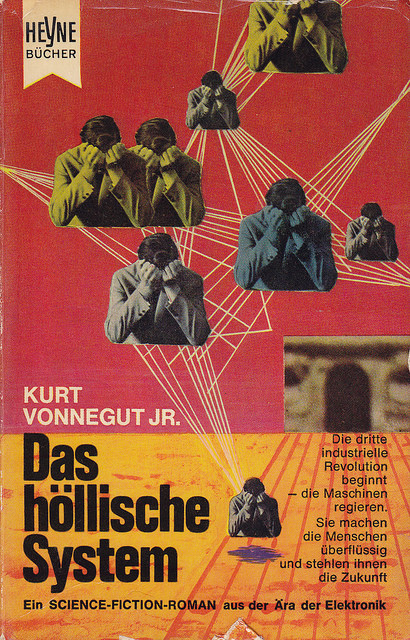
Adventures in Science Fiction Cover Art: The Cryptic Diagrams and Collaged Heads of Atelier Heinrichs

tumblr_nkuhinwfo61sp763oo1_500

(Cover for the 1964 edition of Piano Player (1952), Kurt Vonnegut, Jr.)

My whirlwind tour of the surreal covers of non-English language presses and artists continues!  We ogled the inclines and declines of The Futuristic Cities of Lima de Freitas (Portugal, Livros do Brasil under the Argonauta imprint); awoke our inner desires to create minimalistic stamps and prints with the twelve-month sequence of Mariella Anderlini’s covers for Galassia (Italy); and were transported to Anderlini’s later landscapes of stylized mountains and edifices for Libra Editrice (Italy).  I have many ideas for our future explorations…

…but first a range of SF covers by Atelier Heinrichs, Munich for Heyne Bücher (Germany).  I cannot find information online for Atelier Heinrichs (albeit my German reading comprehension is average at best and I do not know the standard German SF resources).  It is definitely not a Continue reading

Updates: Recent Science Fiction Acquisitions No. CLIX (Gerrold + Reed + Lewin + Anthology of European Non-English Language SF)

Digression: I have been thinking about “best of” lists and why I seldom approach an author by reading their “best known” work first.  Caveat: I compulsively read the Hugo list as a kid and was exposed to many wonderful authors.

Reading “the acknowledged best” reinforces our notions of what is canon or not canon.  And I am all about puncturing holes in our self-perpetuating notions of canon and SF grand narratives of what is “classic” SF and what is not.  The following dialogue often plays out:

A) “Have you read the best SF novels of the 1970s?”

B) “Yes, I have, from this great top 15 novels list!”

A) “What would you say are the best novels from the 1970s?”

B) “Oh, here you go!” Regurgitates original list.

A) “Have you read other SF novels from the 1970s?”

B) “Umm.”

I am guilty of this as well!  My top 1960s novels list undergoes regular revisions.  The original list was a product of my lack of knowledge.  Regardless, it remains to this day the most popular and commented upon post on my site!  Alas!

Sometimes “the less known” novels are a way to get a feel for what an author is capable of and seeing an author through their body of work leads (at least for me) to greater appreciation for their best (which might not be the ones anointed by the majority).  Barry N. Malzberg: I read In the Enclosure (1973) before  Beyond Apollo (1972).  Doris Piserchia:  Doomtime (1981) before A Billion Days of Earth (1976). Robert Silverberg: Thorns (1967) before Downward to the Earth  (1970).  Christopher Priest:  Indoctrinaire (1970) before The Affirmation (1981).

Third, I put great value on individual exploration. It is humorous and ironic that I have run this review site for six or so years but am reluctant to immediately follow-up on the reading suggestions of others.  I am sorry frequent readers!  I devour the reviews of others for sure (see Part I and Part II for worthwhile resources).  Well-argued reviews with evidence and an understanding of the work’s time and place and reflections on interactions with/or within genre, are more likely to remain with me.  And then, when I am in the book store, I remember what others have said.

The questions I have been pondering: Do I put together a best 20 novels of the 1970s list?  When do I decide whether I have read enough?  Or, do I play the “caveat” game and state that this is bound to change (which it is as I read more)?

Post proper:  My mapping of the contours of Kit Reed’s early oeuvre continues.  Her first SF novel Armed Camps (1969) and her stories in Mister Da V. and Other Stories (1967) demonstrate a knack for humanistic exploration of characters trapped in manifestations of cyclicality—be it social constructions or the forces of history.

David Gerrold’s novels do not inspire…..  At least so far: Space Skimmer (1972) + Yesterday’s Children (variant title: Starhunt) (1972).  Which means, time for short stories!  And yes, his acknowledged best The Man  Who Folded Himself (1973) waits in the wings [From Couch to Moon’s review —> here].

Non-English language SF other than Stanislaw Lem and Arkady and Boris Strugatsky: the biggest hole in my SF knowledge.

And perhaps the find/risk of the bunch, a satirical pseudo-governmental pamphlet that generated endless debate about its authenticity.

As always, thoughts and comments are welcome.

1. With a Finger in My I, David Gerrold (1972)

wthfngrnmc1972

(Mati Klarwein’s cover for the 1972 edition) Continue reading

Book Review: The Best SF Stories from New Worlds 2, ed. Michael Moorcock (1968)

THBSTSFSTR1969

(Paul Lehr’s cover for the 1969 edition)

3.75/5 (Collated rating: Good)

As New Worlds issues tend to be expensive and hard to find (especially in the US), Michael Moorcock’s anthology series provides satiating morsels from the magazine’s best period.  New Worlds was instrumental in the so-called New Wave movement.  I am at home in  eclectic and genre-challenging/subversive madness.

New Worlds combined SF stories/poems with experimental art and layout that is, unfortunately, lost in the anthologies.  One of my favorite examples is Vivienne Young’s collage (below) illustrating James Sallis’ “Kazoo” (1967) Continue reading