Short Story Review: Roger Zelazny’s “Halfjack” (1979)

The following review is the 10th post in my series searching for “SF short stories that are critical in some capacity of space agencies, astronauts, and the culture which produced them.” Some stories I’ll review in this series might not fit. And that is okay. I relish the act of literary archaeology.

As always, feel free to join the conversation!

Previously: Frederik Pohl’s (as Paul Flehr) “The Hated” (1958)

Up Next : Charles Runyon’s “First Man in a Satellite” (1958)
3.5/5 (Good)

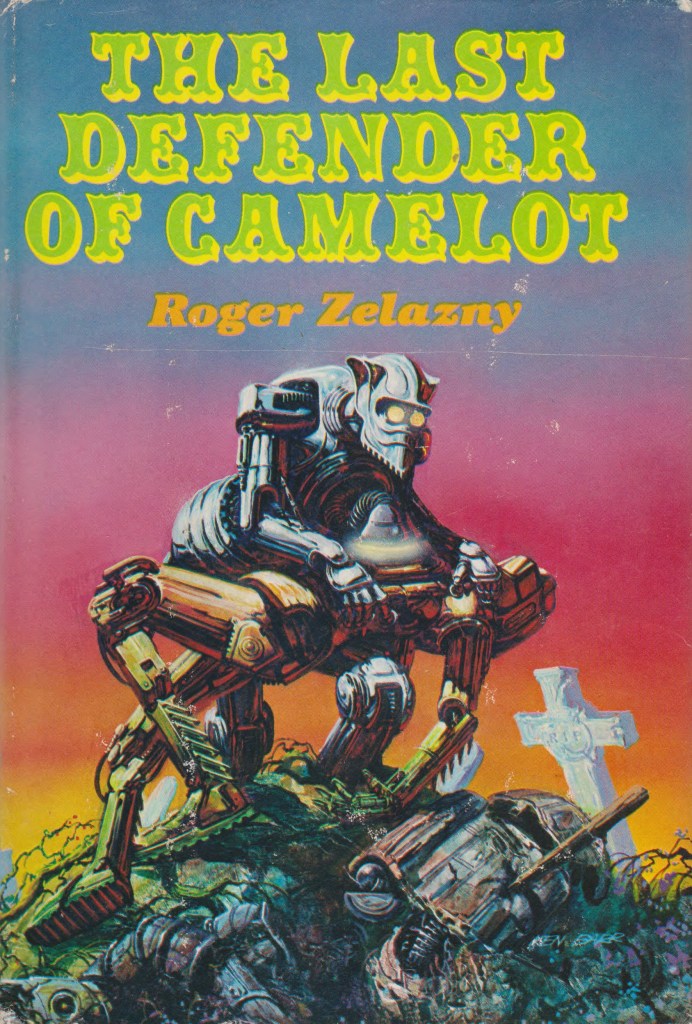
Roger Zelazny’s “Halfjack” first appeared in the June 1979 issue of Omni, ed. Don Dixon. You can read it online here. I read the story in the The Last Defender of Camelot (1980).

Continue reading
Short Story Reviews: Carol Emshwiller’s “Bingo and Bongo” (1956), “Nightmare Call” (1957), and “Hunting Machine” (1957)

Here are the next three stories of my series exploring Carol Emshwiller’s short stories (published between 1955-1979) in chronological order. And if you missed it, Part I contained her first three stories.

Emshwiller’s next three science fiction stories, all published by Robert A. E. Lowndes, are polished fables utilizing standard genre tropes (alien possession, humans abducted by aliens, etc.) to highlight humanity’s encounter with itself in idiosyncratic and grim ways. I am particularly entranced by the stories told from a non-human perspective. This distancing effect allows Emshwiller to play with tone (“Bingo and Bongo”) and spin macabre horror (“Nightmare Call”).

While lacking the intense power of “Animal” (1968) (the best story of hers I’ve read so far), all three are worth the read for fans of clever weirdness.

As always, feel free to join the conversation!

Her next three stories are covered in Part III.


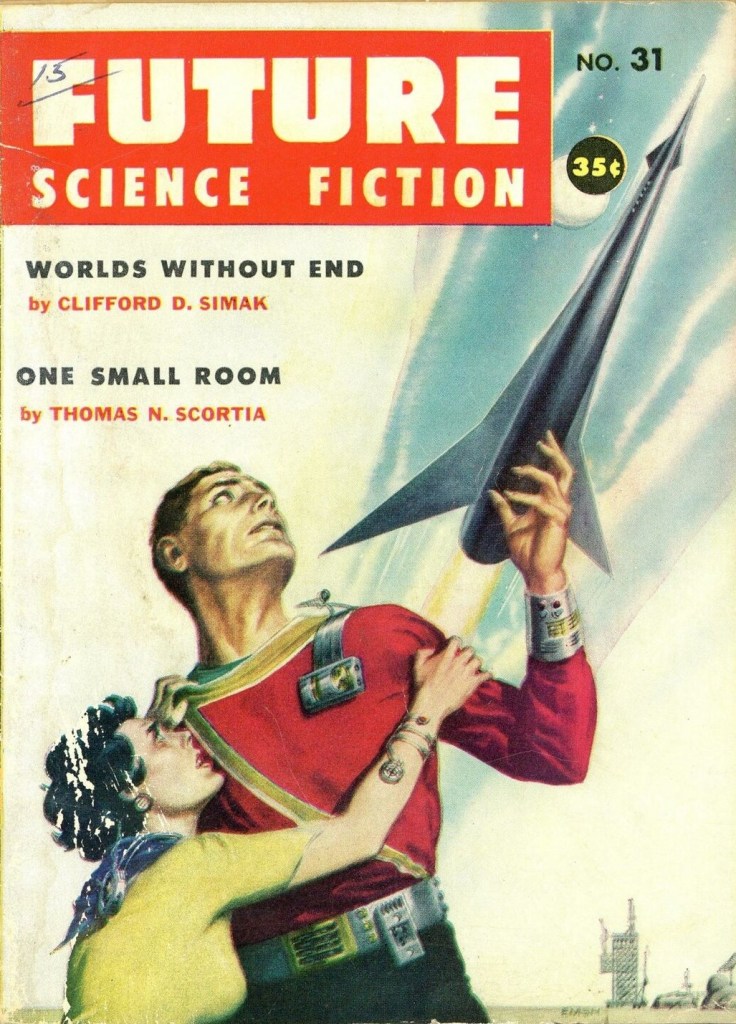
“Bingo and Bongo” (1956), 3.5/5 (Good): First appeared in Future Science Fiction, #31 (Winter 1956-1957), ed. Robert W. Lowndes. You can read it online here. In William Tenn’s Of Men and Monsters (1968) and F. M. Busby’s Cage a Man (1973), humans are imprisoned like lab rats by distant and truly alien aliens. The captives learn just enough about their world and captors in order to escape. Emshwiller brilliantly inverts the perspective. “Bingo and Bongo” is told from the perspective of an alien, a “Mother-Father-Aunt” entity with children, who believes humans are little more than non-sentient pets. The Mother-Father-Aunt’s progeny want new humans after the unfortunate death of their last in an escape attempt (they didn’t want to pay the money to have him professionally healed).

Continue reading

Short Story Review: Frederik Pohl’s “The Hated” (1958)

The following review is the 9th post in my series searching for “SF short stories that are critical in some capacity of space agencies, astronauts, and the culture which produced them.” Some stories I’ll review in this series might not fit. And that is okay. I relish the act of literary archaeology.

As always, feel free to join the conversation!

Previously: Philip K. Dick’s “A Little Something For Us Tempunauts” (1974)

Up next: Roger Zelazny’s “Halfjack” (1979)

3.75/5 (Good)

Frederik Pohl’s “The Hated” (1958) first appeared in the January 1958 issue of Galaxy Science Fiction, ed. H. L. Gold. He wrote it under the pseudonym Paul Flehr. You can read it online here.

“The Hated” (1958) postulates that astronauts will require psychological conditioning to survive the confines of space travel to Mars. In Pohl’s future, the Mars-craft crams six men in a space the size of a Buick (51). The continuous sounds of machine and crew, the fetid taste of the air filled with sweat, the omniscient fear of crushing your oxygen line while sleeping, the free fall, the dreams of drowning, generates an intense drive to kill your crewmates. Byron, the narrator, wants a knife for Sam, to strangle Gilvey with his bear hands, gun Chowderhead with one bullet to the belly, turn a tommy gun on Wally, and cage the captain with hungry lions. The conditioning is “like a straightjacket”–Byron elaborates: “You know how to make a baby cry? Hold his hands […] What they did to us so we couldn’t kill each other, it was like being tied up, like having out hands held so we couldn’t get free” (50).

Continue reading

Updates: Recent Science Fiction Purchases No. CCLXX (Brian W. Aldiss, H. Beam Piper, Ann Maxwell, and Bo Carpelan)

As always, which books/covers/authors intrigue you? Which have you read? Disliked? Enjoyed?

1. Empire, H. Beam Piper (1981)

From the back cover: “”H. BEAM PIPER beloved author of LITTLE FUZZY, SPACE VIKING, and other classics, has left behind a veritable treasure trove of short fiction in his passing. Collected here for the first time anywhere are four of the best stories by one of the Grand Old Masters of science fiction.”

Contents: “The Edge of the Knife” (1957), “A Slave is a Slave” (1962), “Ministry of Disturbance” (1958), “The Return” (1954) with John J. McGuire, “The Keeper” (1957).

Initial Thoughts: Years back I read, but never reviewed, H. Beam Piper’s pulp extravagance Space Viking (1963) and detested it. I get the sense Space Viking might not be representative of his work? Piper has a devoted following and I want to know why.

Continue reading

Book Review: Project Barrier, Daniel F. Galouye (1968)

3/5 (collated rating: Average)

In the early days of my site, I reviewed Daniel F. Galouye’s best-known novel Dark Universe (1961) and A Scourge of Screamers (1966). Since then I’ve attempted to read Simulacron-3 (1964), adapted into a fantastic German mini-series World on a Wire (1973) and The Thirteenth Floor (1999), three times without success. What can I say, I’m a reader of whim and in each instance I wasn’t in the mood. Maybe it was Bill Botton’s compelling/bizarre psychedelic cover for Project Barrier (1968) or perhaps Rich Horton’s comments on twitter about the title story but I decided to give Galouye’s short fiction a go.

Project Barrier (1968) contains four uneven tales with one notable standout–“Rub-a-Dub” (variant title: “Descent Into the Maestrom”) (1961)–which I highly recommend if disturbing psychological SF is up your alley. The others in the collection exude a more run-of-the-mill feel. I found it refreshing that Galouye, a veteran greatly impacted by war injuries, tends to eschew violent conflict for peaceful resolution.

Continue reading

Short Story Review: Philip K. Dick’s “A Little Something For Us Tempunauts” (1974)

The following review is the 8th post in my series searching for “SF short stories that are critical in some capacity of space agencies, astronauts, and the culture which produced them.” Some stories I’ll review in this series might not fit. And that is okay! I relish the act of literary archaeology.

Previously: Kris Neville’s “Cold War” (1949)

Up next: Frederik Pohl’s (as Paul Flehr) “The Hated” (1958)

4/5 (Good)

Philip K. Dick wrote “A Little Something For Us Tempunauts” (1974) after a two-year hiatus. He explains that a friend brought by a copy of John T. Sladek’s brilliant “The Poets of Millgrove, Iowa” (1966) that spurred him to write again: “the first sf story in years that galvanized me into new life—like Kant reading Hume.” He further explains that Sladek’s satirical deconstruction of the cult of the astronaut “can stand in the ranks of the all-time great short stories in the English language” and that it “changed in a flash my entire conception of what a good sf story is” (source). I, too, adore Sladek’s story. One of three authors– along with Barry N. Malzberg’s general characterization of astronauts and the space agency and Samuel R. Delany’s “Aye, and Gomorrah” (1967) that inspired this series.

Continue reading

Updates: Recent Science Fiction Acquisitions No. CCLXVIII (Norman Spinrad, J. G. Ballard, Jacquetta Hawkes, and Frederik Pohl)

As always, which books/covers/authors intrigue you? Which have you read? Disliked? Enjoyed?

1. Low-Flying Aircraft and Other Stories, J. G. Ballard (1976)

There’s not a back cover or inside cover blurb on my edition

Contents: “The Ultimate City” (1976), “Low-Flying Aircraft” (1975), “The Dead Astronaut” (1968), “My Dream of Flying to Wake Island” (1974), “The Life and Death of God” (1976), “The Greatest Television Show on Earth” (1972), “A Place and a Time to Die” (1969), “The Comsat Angels” (1968), “The Beach Murders” (1966)

Initial Thoughts: I’ve been on a weird (for me) music kick as of late. I’ve been listening to a lot of 80s post-punk/new wave/goth music (Bauhaus, The Cure, Echo & the Bunnymen, The Psychedelic Furs, The Sisters of Mercy, Siouxsie and the Banshees, etc.) and I came across the British band The Comsat Angels. And they’re named after a J. G. Ballard story! If you don’t know of the band but enjoy any of the bands in the above list, check out Sleep No More (1981) (cold, paranoid, hypnotic). This led me back to Ballard’s catalog to track down the remaining anthologies of his I don’t own.

Continue reading

Book Review: Survival Ship and Other Stories, Judith Merril (1974)

Derek Carter’s cover for the 1st edition

3.5/5 (collated rating: Good)

Ever since I read Judith Merril’s “Daughters of Earth” (1952), I’ve been fascinated by her subversive takes 1950s-60s gender roles and classic SF tropes. Survival Ship and Other Stories (1974) contains twelve short stories and a never-before-published poem selected by the author.

In addition to the merits of the tales within, I found Merril’s brief reflections on her early work fascinating. For example, she ruminates on the failure of her planned novel based on the generation ship launched by The Matriarchy in “Survival Ship” (1951), “Wish Upon a Star” (1958), and “The Lonely” (1963). She also describes a magazine “cover story” commission. The author would be provided with the cover art and asked to write a story containing its elements! The following three in this Continue reading

Adventures in Science Fiction Interior Art: Monday Maps and Diagrams 2/22/21: Cordwainer Smith’s Instrumentality of Mankind Timeline

Detail from Darrel K. Sweet’s cover for the 1st paperback edition of The Best from Cordwainer Smith (1975)

Today’s installment of my occasional Monday Maps and Diagrams series is a self-reminder that I must get over the poor taste left in my mouth by two forgettable Cordwainer Smith short stories and dive into the meat of his Instrumentality of Mankind sequence. Which should I have read?

I’m a sucker for future history timelines (Olaf Stapledon, Robert A. Heinlein, and Isaac Asimov come to mind). They add a sense of time and scope to what, at first glance, might seem like disparate pieces. I often wonder how much an author plans out a timeline. This one, scanned from The Best of Cordwainer Smith (1975), places each of the Instrumentality of Mankind stories into a functional timeline. I’m assuming it adds to the series’ sense of historical development and societal evolution?

Let me know what you think of the series and the timeline in the comments!

John J. Pierce’s timeline (he wrote the intro article) in the 1975 Ballantine Paperback edition

Isfdb.org note on the timeline’s publication history: “There are (at least) 2 variants of this timeline. A table version titled The Instrumentality of Mankind appears in the original July 1975 Nelson Doubleday hardcover. A reformatted graphical version titled Timeline from THE INSTRUMENTALITY OF MANKIND appears in Continue reading