Book Review: The Outcasts of Heaven Belt, Joan D. Vinge (1978)

(Vincent Di Fate’s cover for the 1978 edition)

3.25/5 (Average)

The title of Joan D. Vinge’s first novel, The Outcasts of Heaven Belt (1978), is an homage to The Outcasts of Poker Flat (1869) by the turn of the century western writer and poet Bret Harte.  He is famous for his depictions of resourceful women in California pioneer settlements.  Vinge creates a resourceful female captain of a powerful but weaponless spaceship who finds herself beset–with only a depleted crew–by a series of challenges in the decadent, grasping, and fractured pioneer societies of Heaven Belt.  Although the often less than amicable conflict between the egalitarian society with powerful women and the male-focused pioneer cultures could be the focus of the novel, Vinge is less interested in exploring the social ramifications (à la Le Guin and other works of the previous decade — the 1960s).  Instead, this conflict provides a suitable world-building backdrop for a traditional space opera — a bedraggled but technologically Continue reading

Updates: Recent Science Fiction Acquisitions No. XXVII (Gerrold, Panshin, Shaw, et al.)

My second to last backlog acquisitions post from Spring Break — a fruitful sci-fi hunting adventure indeed!

With my PhD Qualifying exams complete (proposal defense in months and months and months), I will actually get around to posting sci-fi art related (and perhaps get back to my film reviews) and reading my massive to read pile.

Enjoy!

1. Space Skimmer (1972), David Gerrold.  Another author whom I know little about and haven’t read yet.  As a Star Trek fan I know that he submitted the script that became The Trouble With Tribbles…

(Dean Ellis’ cover for Continue reading

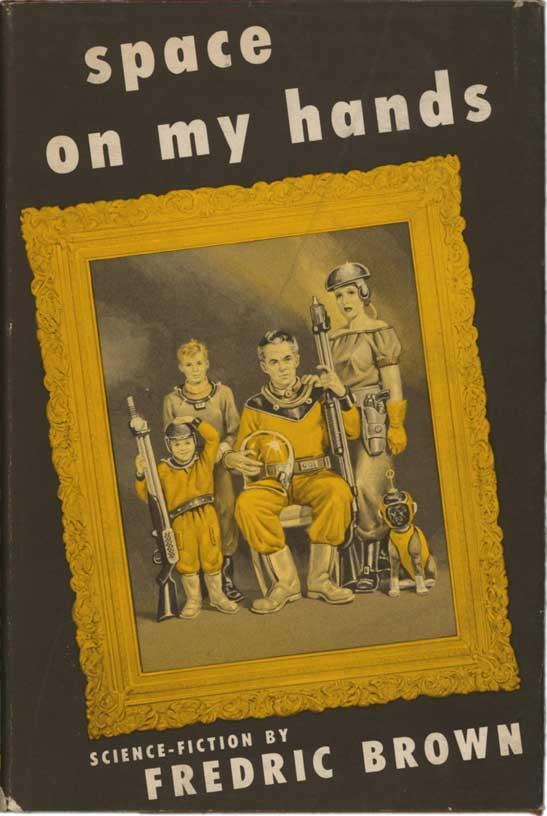
Adventures in Science Fiction Cover Art: The Space Age Family

(Malcolm Smith’s cover for the 1951 edition of Space on My Hands (1951), Frederic Brown)

I’ve scrounged through my collection of cover images over and over again trying to find families — and not alien families being slaughtered by intrepid earthmen à la The Red Planet (below).  Simply put, sci-fi generally revolves around characters who set off on their own, occasionally (at the end) finding a spouse (alien or not) and starting a family.  Heinlein’s juveniles are a great example — boy from broken family (dead mother, abandoned orphan…) learns all the math necessary for navigating in space from a book, sets off (or stows away) in the nearest possible spaceship and goes on grand adventures — perhaps killing some alien families along the way…..

I’ve still managed to find a few.  The best Continue reading

Updates: Recent Science Fiction Acquisitions No. XXVI (Malzberg + Wells + Gunn +Pohl)

A nice (varied) selection of finds….

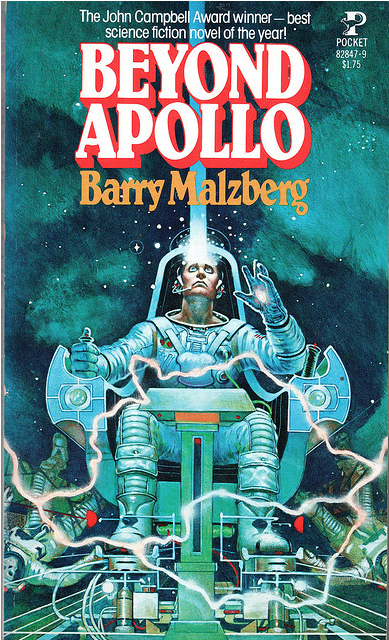
I’ve continued to be on the lookout for Malzberg’s novels and, due to the proliferation of comments by my readers about what is his best, I’ve acquiesced and picked up a copy of his acknowledged masterpiece, Beyond Apollo (1972).  I suspect it will be as good as In The Enclosure (1973).

If there is any area (besides sci-fi from the 21st century) that I haven’t read a good portion of the classics, it’s works from around the turn of the century.  I have read a large swathe of Verne’s works and from beginning of the 20th century  all of Edgar Rice Burroughs’ John Carter series — but, only a few of H. G. Wells’ oeuvre (The War of the Worlds and The Time Machine).  So, when I came across a 60s edition of The First Men in the Moon (1901) with a nostalgic looking cover I snatched it up!

The two short story collections are unknown commodities: Frederick Pohl’s In The Problem Pit (1976) and James Gunn’s Station in Space (1958).  I’ve never heard of Gunn and sort of dislike what I’ve read of Pohl so far.  Regardless, both works have intriguing covers!

Enjoy!

1. Beyond Apollo, Barry Malzberg (1972)

(Don Maitz’ cover for Continue reading

Updates: Recent Science Fiction Acquisitions N. XXIV (Simak + Henderson + Pangborn + Coney)

Returning to my old haunt (Texas) conjures the normal quality science fiction haul….  Not the range of Dallas’ spectacular Half Price Books but still a nice selection.

As always, I took a few risks.  I know very little about Zenna Henderson’s short stories — and the cover for the 72 edition of Holding Wonder (1971) (below) is atrocious!  But she’s generally considered a worthwhile author despite the rather hokey premise of her The People series.  I’m most interested in Edgar Pangborn’s A Mirror for Observers (1954) — and I promise not only because of the Richard Powers’ cover.  My father disliked Simak’s Our Children’s Children (magazine 1973) so I don’t have high hopes…  I’m rather ambivalent towards Simak.  I enjoyed City (1954) but would never call it a masterpiece.  Cemetery World (1973) was an interesting read but more in concept than delivery.  Way Station (1963) didn’t deserve the Hugo award but had its moments… etc.

Michael G. Coney’s The Hero of the Downway (1973) was an impulsive buy.  I know very little about the quality of his writing but was persuaded by Josh Kirby’s cover!  And underground societies usually hold my interest — even if they don’t achieve the heights of David F. Galouye’s wonderful Dark Universe (1961).

Enjoy the covers!  And the back cover blurbs!

1. A Mirror for Observers (1954), Edgar Pangborn

(Richard Powers’ cover Continue reading

Adventures in Science Fiction Cover Art: Rocket, Field, Figure Part I

(Rod Dunham’s cover for the 1953 edition of Planet of the Dreamers (1953), John D. MacDonald)

First (archetypal) incarnation: rocket, field, figure.  Second incarnation: rocket with extra fins, field with unusual terrain, human staring at alien figure (s).  Repeat with virtually infinite variation.

By far one of my favorite science fiction cover tropes, rocket/field/figure evokes covers spanning the entire history of science fiction.  Rod Dunham’s cover for the 1953 edition of John D. MacDonald’s Planet of the Dreamers (above) perfectly evokes the archetype in its pure unadulterated form.  Emswiller’s cover for the 1960 issue of The Magazine of Fantasy and Science Fiction (below) uses a more traditional perspective but manipulates the field with a Continue reading

Updates: Recent Science Fiction Acquisitions N. XXI (Silverberg + Compton + Malzberg + Anderson)

A few more Christmas gift card purchases…

Dying Inside (1972) is often considered one of Silverberg’s best works and I can’t wait to read it (I will after my soon to be hellish weekend grading ~60 undergrad history papers).  Despite a painfully negative review on Amazon slamming Compton’s The Silent Multitude (1967) as a dull imitation of J. G. Ballard, it is high on my to read list — almost any experimental (allegorical) work exploring a crumbling city intrigues me.  Malzberg’s Conversations (1975) was a shot in the dark — it might be the least read of any of his novels — hence, my interest.

Pohl Anderson is almost always worth reading — even his middling short stories are fun.

Enjoy!

1. Dying Inside, Robert Silverberg (1972)

(Jerry Thorp’s cover for Continue reading

Updates: Recent Science Fiction Acquisitions N. XX (Clifton + Aldiss + et al.)

Christmas giftcard expenditures continue…

An interesting collection of acquisitions — Clifton’s Eight Keys to Eden (1960) is considered, at least by the reviews I’ve found online, to be a little read classic — i.e. my kind of sci-fi novel.  Aldiss always has wonderful ideas and The Long Afternoon of Earth (variant title: Hothouse) is generally proclaimed one of his best — I’m still waiting for work which garners the same magic as his masterpiece Non-stop (variant title: Starship) (1958).

After reading Kornbluth’s masterful short story collection The Explorers (1953) I felt obligated to pick up a copy of one of the more famous Pohl + Kornbluth collaborations, Gladiator-In-Law (1954).

A few intriguing Malzberg stories in Future City (1973) compelled me to snatch one of his lesser known novels off of the shelf — In The Enclosure (1973) tells the story of an alien tortured by his human captives.  I find Malzberg’s relentlessly dark visions very appealing…  He has a HUGE catalog I’ve yet to read.

1. The Long Afternoon of Earth (variant title: Hothouse), Brian Aldiss (1962)

(Uncredited cover for the 1962 edition) Continue reading

Book Review: The Explorers, C. M. Kornbluth (1954)

(Richard Powers’ cover for the 1954 edition)

collated rating: 4/5 (Good)

I’ve stayed away from C. M. Kornbluth for far too long.  I read Kornbluth and Pohl’s The Space Merchants (1953) when I was quite young and was put off for some unexplainable reason.  What a shame!  This collection of short stories and novelettes contains some of the best short works I’ve ever read from the 50s (a few of Philip K. Dick’s early works are just as good).  As with The Space Merchants, Kornbluth exposes (in an often satirical manner) the dark underbelly of the usually glamourous 50s accounts of space travel, interplanetary trade, and the devastating social ramifications of technology on astronauts, new cultures, etc.  Kornbluth is equally adept at infusing his work with devastating commentary on American society.

This collection is brilliant throughout — only the annoying silly Continue reading