Updates: Recent Science Fiction/Fantasy Acquisitions No. CCXVIII (Wolfe + Saxton + Tilley + New Worlds Anthology)

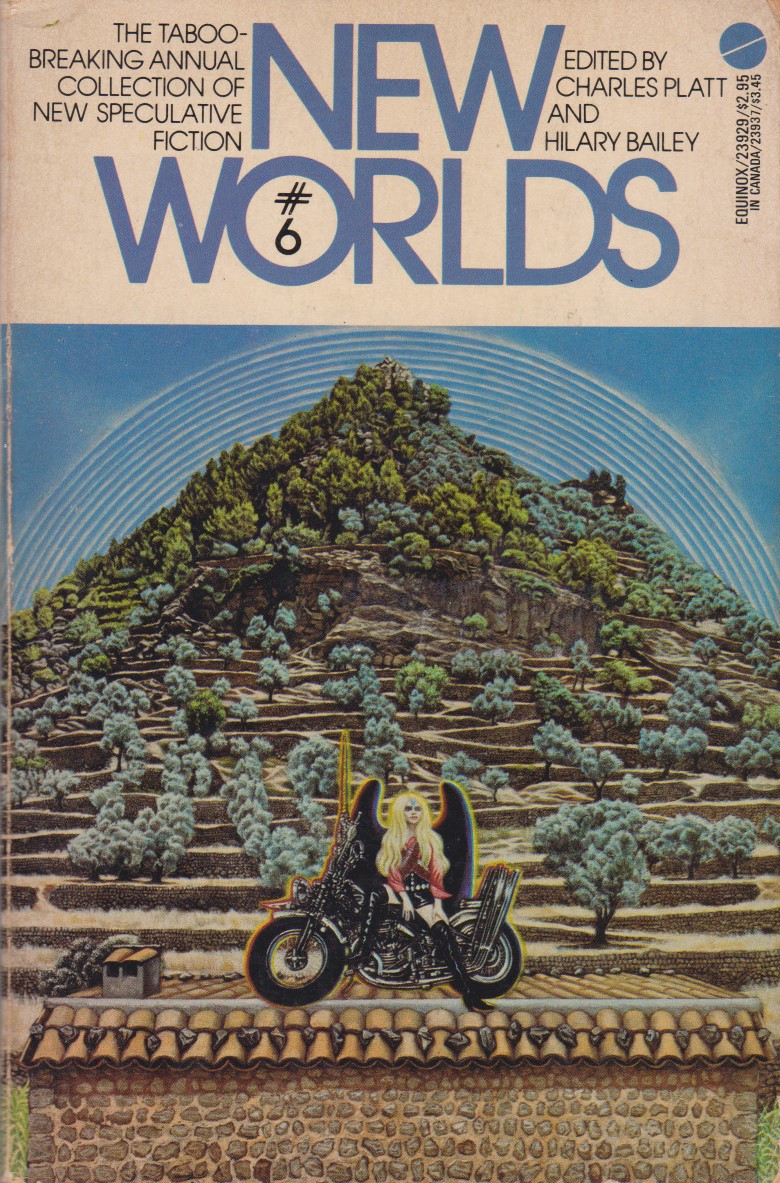
1. This looks like a splendid New Worlds Quarterly anthology replete with book reviews, articles, and interior art by John Clute and James Cawthorn. When I review it (hopefully soon), I’ll include a few examples of the art. The quantity of authors I’ve not read in this anthology is high—for example, A.A. Attanasio, Harvey Jacobs, Rachel Pollack, among many others. See content lists below.

For more fantastic Mati Klarwein covers check out my recent art post.

2. Gene Wolfe’s novels are a major hole in my SFF knowledge. Here is an early fantasy work that I might in the near future. I tend to take perambulatory paths before tackling an author’s great works. Thoughts on this lesser known one?

I’ve read quite a few of his 60s and 70s short stories. For example, the spectacular “Silhouette” (1975) and “The Changeling” (1968).

3. It’s been a while since I raved about Josephine Saxton’s delightful The Hieros Gamos of Sam and An Smith (1969). An author I must return to….

4. Silly early 80s post-apocalyptical adventure anyone? Sometimes you need a break from Christopher Priest and J. G. Ballard! hah.

Let me know what books/covers intrigue you. Which have you read? Enjoyed? Hated?

~

1. New Worlds #6 (variant title: New Worlds #7), ed. Charles Platt and Hilary Bailey (1974)

(Mati Klarwein’s cover for the 1975 edition) Continue reading

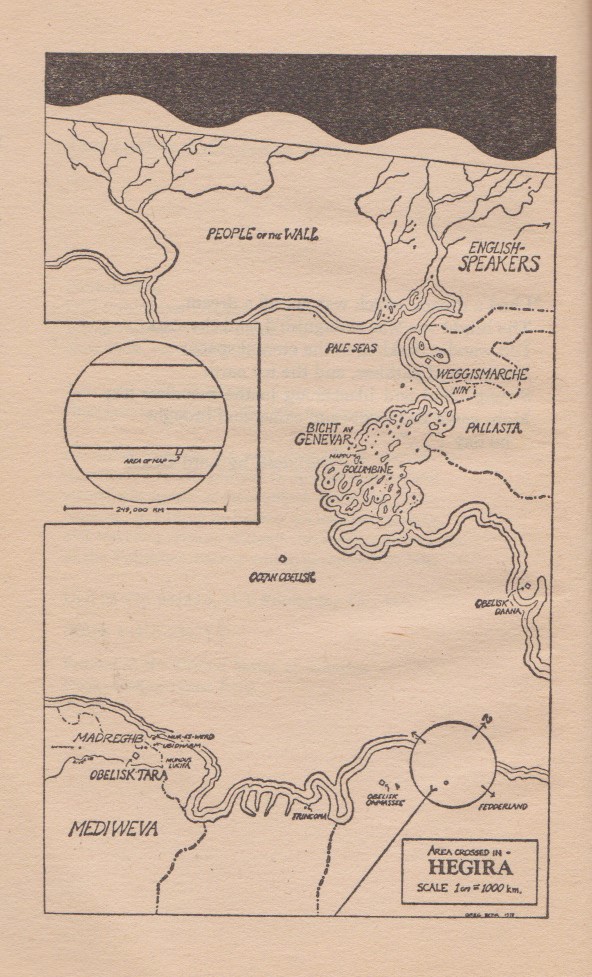
Adventures in Science Fiction Interior Art: Monday Maps and Diagrams (Science Fiction) 7/15/19: Greg Bear’s Hegira (1979)

Today’s installment of Monday Maps and Diagrams returns to a recent acquisition of mine—a signed copy of Greg Bear’s first published novel Hegira (1979), which seems to be a Riverworld and Ringworld inspired read involving the discovery of the nature of an unusual world…

I’m impressed with the simple effectiveness of Greg Bear’s map—created by his own hand (citation bottom right corner). The ocean is nicely indicated as are the rivers and regions (and of course, the unusual wall in the far north–one of the story’s many mysteries).

Enjoy! And, as always, comments are welcome and appreciated!

For my recent acquisition post which included novel’s plot blurb and discussion in comment section about the Greg Bear’s early works, click here.

Citation: Greg Bear’s own map for the Dell 1st edition of Hegira (1979), Greg Bear. Continue reading

[Short] Book Reviews: Samuel R. Delany and Howard V. Chaykin’s Empire (1978), Kate Wilhelm’s City of Cain(1974), Charles Sheffield’s Sight of Proteus(1978)

My “to review” pile is growing and my memory of them is fading… hence short—far less analytical—reviews.

1. City of Cain, Kate Wilhelm (1974)

(Uncredited cover for the 1978 edition)

3.5/5 (Good)

Kate Wilhelm’s City of Cain (1974) is a moody, streamlined, and psychologically heavy near-future SF thriller. Peter Roos returns from the Vietnam War a scarred man both mentally and physically. After a technical error on a helicopter, a missile it was carrying explodes killing half the crew and sending shrapnel into Roos’ body. Back in the US, Roos engages Continue reading

Book Review: Don’t Bite the Sun, Tanith Lee (1976)

(Brian Froud’s cover for the 1st edition)

3.75/5 (Good)

My friend Hergal had killed himself again. This was the fortieth time he had crashed his bird-plane on the Zeefahr Monument and had to have a new body made” (9).

Tanith Lee’s Don’t Bite the Sun (1976) posits a post-scarcity future  replete with advanced technology where youth, the Jang, are encouraged (and “taught” via hypno-schools) to engage in various forms of excess. The nameless female Jang narrator (N) attempts to find life’s purpose in a society without rules, struggle, Continue reading

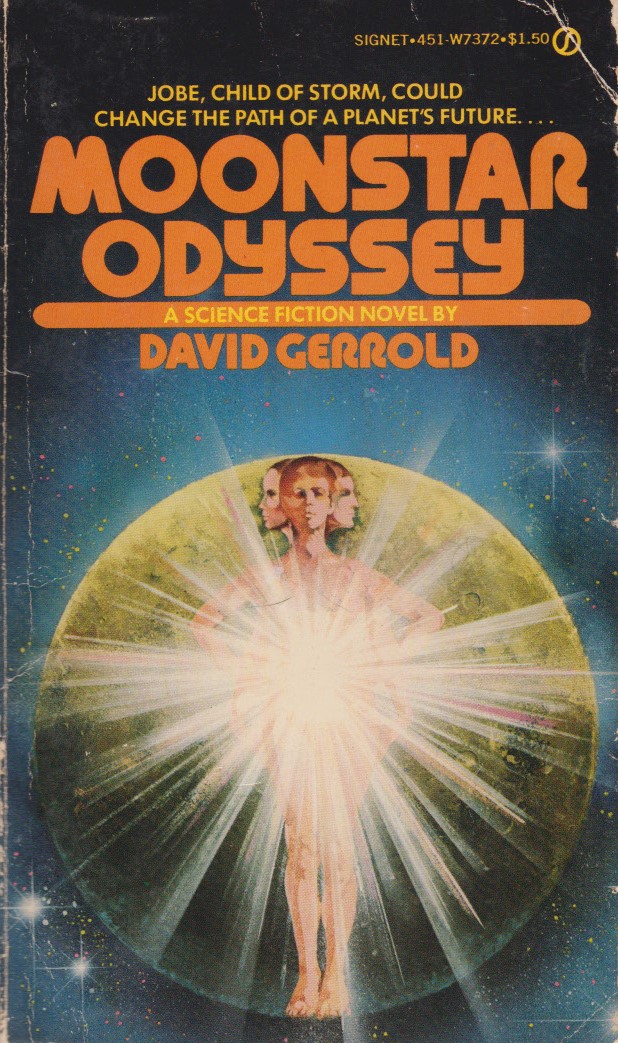
Book Review: Moonstar Odyssey, David Gerrold (1977)

(Gene Szafran’s cover for the 1st edition)

4.5/5 (Very Good)

David Gerrold’s Moonstar Odyssey (1977) is a careful and introspective reflection on identity and gender set in a fascinating world made habitable by terraforming.  While the back cover suggests the presence of a driving narrative–the fulfillment of a prophecy propelled by a catastrophic cataclysm–instead, Gerrold’s novel is a bildungsroman that follows the self-realization of a precocious child named Jobe.  The dominate struggle that forms the core of the novel is “The Choice”–the moment in a young person’s life when they chose to move from their androgynous state to either “Reethe [or] Dakka, between female Continue reading

Updates: Recent Science Fiction Acquisitions No. CCVIII (Sargent + Kelley + Ely + Anthology ed. Harry Harrison)

1. Leo P. Kelley is an author whose work I’ve encountered in various used book stores but never acquired…. until now. Here’s the SF Encyclopedia entry on his work. Let me know if you’ve read any of them!

Note: The Kelley edition and cover are different than the one I own. I accidentally mutilated the cover by removing (by incorrect means) a large sticker. I own the 1971 Berkley Medallion first edition.

2. I adored David Ely’s Seconds (1962). I hope to have a review up soon! I went ahead and acquired his only other SF novel.

3. Although I’ve read and complained vehemently about Pamela Sargent’s Cloned Lives (1976), I’m  not a reader who gives up on an author after a single novel. Like Cloned LivesThe White Death (variant title: The Sudden Star) (1979), creates a tapestry of characters presented with a crisis. I’ll read this one sooner than later.

4. An original anthology on the year 2000. I couldn’t pass it up especially as it contains a SF short story by Naomi Mitchison. I remember Memoirs of a Spacewoman (1962) fondly….

As always, let me know your thoughts on the books/covers/or tangents.

Enjoy!

~

1. The Coins of Murph, Leo P. Kelley (1971)

(Colin Hay’s cover for the 1974 edition) Continue reading

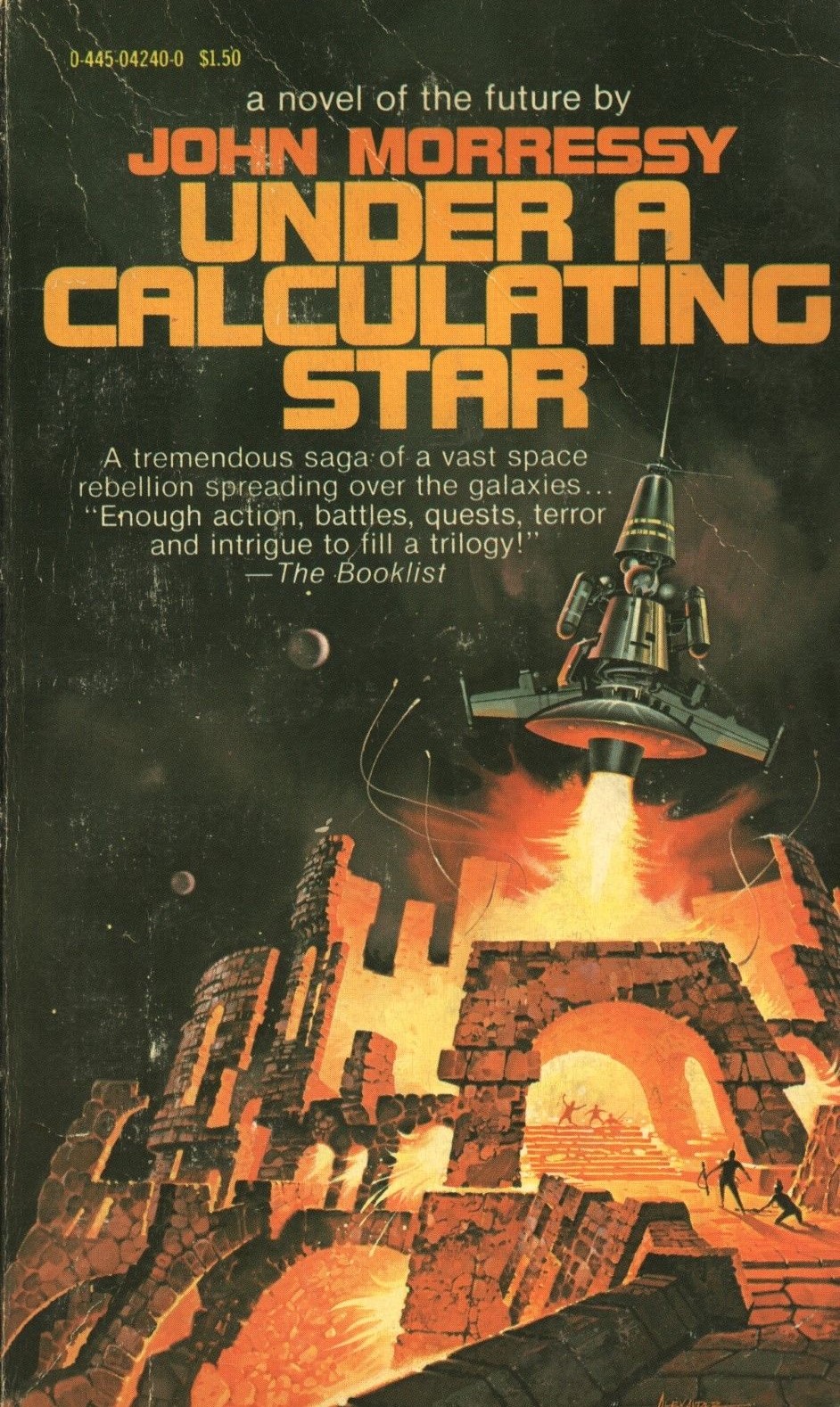
Book Review: Under a Calculating Star, John Morressy (1975)

(Paul Alexander’s cover for the 1978 edition)

3/5 (Average)

After finishing John Morressy’s Frostworld and Dreamfire (1977), I tracked down another volume of his Del Whitby sequence. Although far from as engaging and emotionally affective as the former, Under a Calculating Star (1975) provides the historical background to the Morressy’s weirdly primitive far future world: the origins of the Sternverein (the dominant business polity), the explanation of why swords and knives are the weapons of choice while high-tech spaceships roam the interstellar expanses, and the role of Old Earth in the colonization of the far flung reaches. Historical content aside, Under a Calculating Star‘s plot and characters fail to engage and the worlds and societies are one-dimensional in comparison to Frostworld and Dreamfire‘s metamorphic Onhla and the planet Hraggellon, locked in its unusual orbit. Continue reading

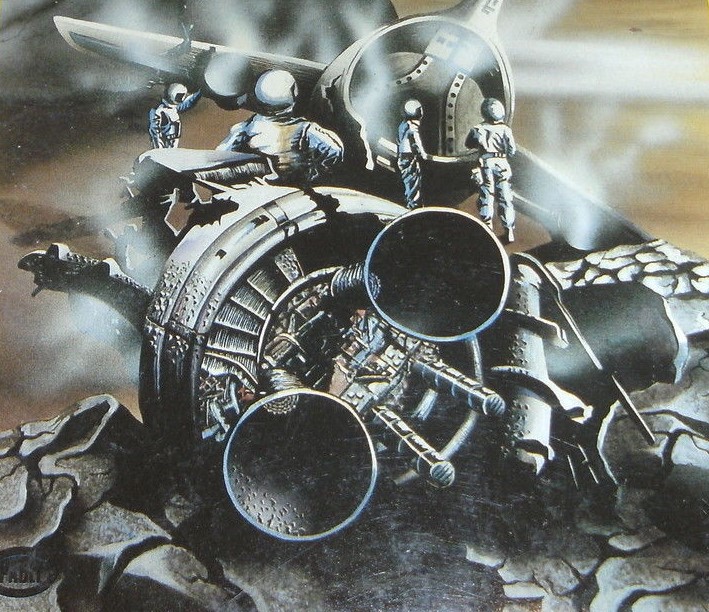
Adventures in Science Fiction Cover Art: Crashed Spaceships, Part III

(Detail from Alan Daniels’ cover for the 1980 German edition of Open Prison (1964), James White)

The crashed spaceship — a wrecked hulk spinning in the emptiness of space, shattered metal struts strewn across an alien landscape…. I find few SF scenarios more nostalgic than this one as a younger me was obsessed with books about the societies formed from the survivors of such cataclysms (Anne McCaffrey’s Acorna Universe sequence, of dubious quality now, was a cornerstone of my youth).

I have selected a range of fascinating covers which add to a series I made in 2012 (Part I) and 2013 (Part II). My favorite of the bunch is Tibor Csernus’ cover for the 1973 French edition of Clifford D. Simak’s Time and Again (1951) due to the verdant and wet landscape the spaceship finds itself in. My second favorite is Dean Ellis’ “descriptive” cover for the 1974 edition of Alan Dean Foster Icerigger (1974). It doesn’t try to be surreal but rather depicts a scene straight from novel. I usually prefer when the artist takes a more unusual approach but in this case Ellis narrows in on the wonder of the premise. Continue reading

Short Story Reviews: Four Stories from New Worlds Science Fiction (April 1964), ed. John Carnell

To mix things up a bit I decided to review four stories in John Carnell’s last issue of New Worlds Science Fiction (April 1964) before he handed over the reins of the dying publication to Michael Moorcock, who would elevate it to New Wave greatness. Other than the James White serial Open Prison, which I plan on reading in book form when I procure a copy, three of the four authors reviewed below owed much of their careers to John Carnell, and would see few stories in print after his departure (see the individual story reviews for details). Only Barrington J. Bayley, writing as P. F. Woods, would see continued publication (and growing popularity) in New Worlds under Moorcock.

Of the stories I recommend reading William Spencer’s rumination on overpopulation and urban life,  “Megapolitan Underground.” The others are worthwhile only for die-hard fans of Carnell’s New Worlds and other editorial projects. Continue reading