Adventures in Science Fiction Cover Art: The Flowering Bodies of Attilio Uzzo

If you’ve ever browsed through an Italian SF catalogue, the name that springs out immediately is the fantastic Dutch painter Karel Thole (1914-2000). Thole’s surreal (and often stunning) covers dominated the Italian visual SF landscape for years and even appeared on a handful of American editions. However, the main Italian SF press Casa Editrice La Tribuna (with its Galassia series) frequently commissioned new artists, often fresh out of art school, for short runs of covers.

Galassia played an instrumental role in introducing Italian audiences to the New Wave movement. Issues often contained both translations of English-language authors and original Italian short stories and novels. Italian covers were often on the experimental side of the SF art spectrum. The styles changed on a dime. Cover art produced in Italy might be my second favorite after the United States for the 60s/70s.

Milan-based Italian artist, sculptor, and jeweler, Attilio Uzzo (unknown dates) created five covers for the Italian SF magazine Galassia (issues between -#176) in 1972. According to The Internet Speculative Fiction Database‘s (potentially incomplete) credits, Uzzo created two additional covers for Casa Editrice La Tribuna‘s Science Fiction Book Club series and one for Dall’Oglio’s SF Andromeda imprint. I’ve included all eight in this post. I could find little about him online. He has an old, and not very helpful, website with a few low-resolution examples of his art and jewelry. And here is a short video about a 1964 gallery exhibit in Milan with Uzzo’s work. In 1992, a book of his art title Attilio Uzzo: Pittore della Lealtà hit print. If anyone can find more information about him, let me know!

Continue reading

Magazine Review: Galaxy Science Fiction, ed. H. L. Gold (October 1950) (Simak, Sturgeon, MacLean, Matheson, Leiber, Brown, Asimov)

Preliminary Note: I plan on reading all 116 issues of the influential, and iconic, SF magazine Galaxy under H. L. Gold’s editorship (October 1950-October 1961) in chronological order. How long this project will take or how seriously/systematically I will take it are complete unknowns. I am a reader of whim. I will choose whether to reread certain stories that I’ve previously covered. Serialized novels will only be reviewed after I complete the entire work and posted as separate reviews. Why Galaxy, you might ask?

First, I can’t escape the pull of 1950s science fiction focused on social commentary and soft science. Second, I am obsessed with 50s American politics during a time of affluence, the rise of TV and mass culture, and the looming terror of the Cold War. Third, there are a legion of well-known 50s authors I’ve yet to address in any substantial manner on the site who appeared behinds its illustrious covers. Fourth, H. L. Gold was interested in all different types of stories.

As SF Encyclopedia explains, Galaxy was an “immediate success” in part because “Astounding was at this time following John W Campbell Jr’s new-found obsession with Dianetics and was otherwise more oriented towards technology.” Gold’s interests, on the other hand, “were comparatively free-ranging: he was interested in psychology, sociology and satire and other humor, and the magazine reflected this.”

I hope you enjoy this series! Feel free to join.

Up Next: the November 1950 issue.


You can read the entire issue here.

Clifford D. Simak’s Time Quarry (variant title: Time and Again) (1950). Serialized over three issues. I will post an individual review after I complete the serialization.

Continue reading

Updates: Holiday Purchases! No. CCCXXIX (George Alec Effinger, Margot Bennett, anthology on Nuclear War, and Michael Conner)

Time for more holiday finds!

Which books/covers/authors intrigue you? Which have you read? Disliked? Enjoyed?

1. When Gravity Fails, George Alec Effinger (1986)

From the back cover: “In a decadent world of cheap pleasures and easy death, Marîd Audran has kept his independence and his identity the hard way. Still, like everything else in the Budayeen, he is available …for a price.

Continue reading

What pre-1985 science fiction are you reading? + Bimonthly Update No. I

What pre-1985 science fiction are you reading this weekend?

Every Saturday for more than a year, I’ve asked this question on Twitter (and since February on Mastodon) with a photo of books I’ve read and reviewed on my website from my shelves. Due to the painful implosion of Twitter and the confused and frustrating “what platform do we go to next” panic, I’ve decided to move my weekly question and photo to my site. This community is always first and foremost in my mind. Thank you commenters and lurkers!

Continue reading

Updates: My 2022 in Review (Best SF Novels, Best SF Short Fiction, and Bonus Categories)

2022 was the single best year in the history of my site for visits and unique viewers!

As I mention year after year, I find reading and writing for the site—and participating in all the SF discussions generated over the year—a necessary and greatly appreciated salve. Whether you are a lurker, occasional visitor, or a regular commenter, thank you for your continued support.

Continuing a trend from 2021, I read only a handful of novels this year. Instead, I devoted my obsessive attention to various science short story review initiatives (listed below), anthologies, and histories of the science fiction genre. Without further ado, here are my favorite novels and short stories I read in 2022 with bonus categories. Descriptions are derived from my linked reviews.

Check out last year’s rundown if you haven’t already for more spectacular reads. I have archived all my annual rundowns on my article index page if you wanted to peruse earlier years.


My Top 5 Science Fiction Novels of 2022 [TITLES LINK TO FULL REVIEWS]

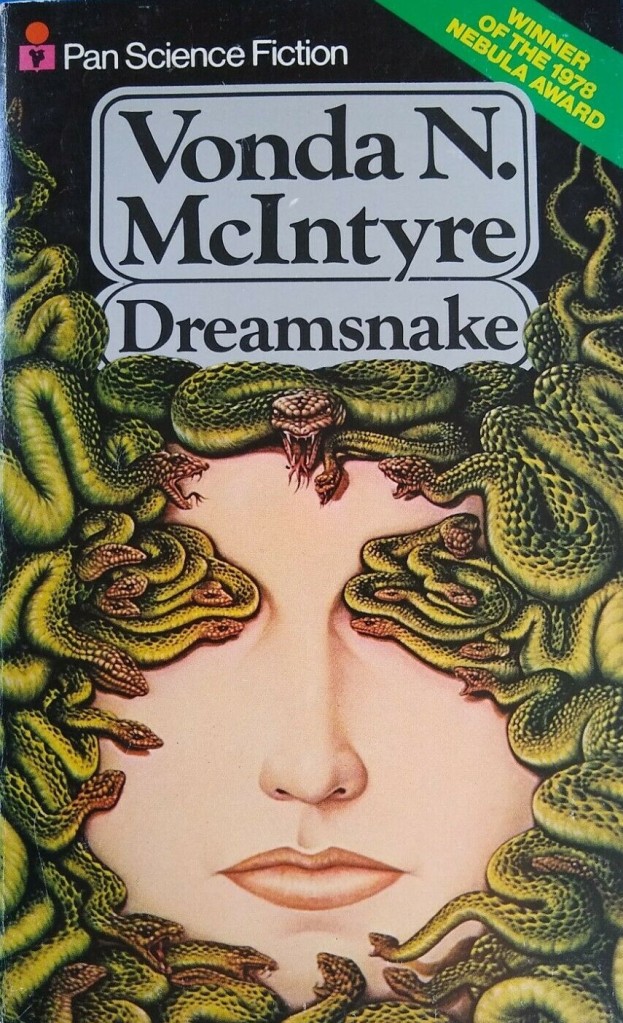
1. Vonda N. McIntyre’s Dreamsnake (1978), 4.75/5 (Near Masterpiece): Won the 1979 Hugo, Locus, and Nebula Award for Best Novel. Snake journeys across the post-apocalyptic wastes of a future Earth with three serpents healing the sick and caring for the dying. She is a member of the healers, who adopt orphans and rescue the oppressed and train them how to use the serpents. Mist and Sand are genetically modified vipers of terrestrial origin. But Grass comes from another alien world. Snake uses Mist and Sand’s venom to create vaccines, treat diseases, and cure tumors. Grass, the rare dreamsnake, with its alien DNA is the most important of them all–it provides therapeutic pleasure and dreams that facilitate conquering one’s fear and healing in the ill. In Snake’s voyages, she encounters prejudice and violence. A joyous sense of sexual freedom permeates the proceedings. A powerful and different take on a post-apocalyptic worldscape in every possible way.

Continue reading

Updates: Recent Science Fiction Purchases No. CCCX (R. A. Lafferty, Jan Morris, Star anthology, and an August Derleth anthology)

Which books/covers/authors intrigue you? Which have you read? Disliked? Enjoyed?

1. Strange Ports of Call, ed. August Derleth (1948)

From the back cover: “‘Begotten of Imagination, on the body of Technology, there springs forth the wild child Science Fiction.’ –Clifton Fadiman

The above is one of the many attempts that have been made to describe a department of fiction which, in spite of some sniping critics, continues to increase its followers. Recently Bertrand Russell observed that science fiction consists of ‘intelligent anticipation–much more intelligent than the expectations of statesmen.’

Continue reading

Updates: Recent Science Fiction Purchases No. CCCVII (Jack Williamson, William E. Cochrane, a Groff Conklin anthology, and an anthology of gay and lesbian SF)

Which books/covers/authors intrigue you? Which have you read? Disliked? Enjoyed?

1. 6 Great Short Novels of Science Fiction, ed. Groff Conklin (1954)

From the back cover: “THE BLAST: STUART CLOETE envisions New York City under atomic attack, and tells the story of the lone survivor.

COVENTRY: ROBERT HEINLEIN shows what happens to one of the last individualists, who request a sentence to purgatory.

THE OTHER WORLD: MURRAY LEINSTER reveals a savage, feudal civilization which lives off the sweat of slaves kidnapped from our world.

BARRIER: ANTHONY BOUCHER writers of a time traveler, and his strange encounters with the people who will come after us.

SURFACE TENSION: JAMES BLISH traces a race of microscopic men that works out its destiny under water on a planet somewhere far out of the galaxy.

MATURITY: THEODORE STURGEON depicts the agonizing plight of a super man born in our midst.

Continue reading

Short Story Reviews: Fritz Leiber’s “The Ship Sails at Midnight” (1950) and Theodore Sturgeon’s “The Sex Opposite” (1952)

Rob Latham in his article “Sextrapolation in New Wave Science Fiction” (2008) argues that in the early 1950s “a handful of stories were published in the magazines that dealt explicitly with sexual topics” long absent from genre. Latham suggests that some of the notable New Wave takes on science fictional sex read as reconceptualized versions of these stories [2]. With few exceptions, the 50s trailblazing tales were ignored by the major digests of the day and instead appeared in the failing pulps–Startling Stories and Thrilling Wonder Stories–or in “second- and third-tier digests just struggling to establish themselves” such as Howard Browne’s Fantastic Adventures. For example, my two previous posts in this series covered Sherwood Springer’s “No Land of Nod” (1952), which appeared in Thrilling Wonder Stories, and Philip José Farmer’s “The Lovers” (1952) in Startling Stories. The later was rejected by H. L. Gold, according to John Brunner, at Galaxy with the note: “I’ll publish this if you can get rid of the sex–I run a family magazine” [3].

Let’s get to the stories! Both Fritz Leiber’s “The Ship Sails at Midnight” (1950) and Theodore Sturgeon’s “The Sex Opposite” (1952) explore polyamorous relationships between humans and aliens. In Leiber’s case, a group of bohemians fall in love with a bisexual alien. In Sturgeon’s tale, a heterosexual couple both fall for a parthenogenetically female “alien” symbiote that appears male to women and female to men.

Previously: Sherwood Springer’s “No Land of Nod” (1952) and Wallace West’s “Eddie For Short” (1953)

Up next: Ward Moore’s “Lot” (1953) and Langdon Jones’ “I Remember, Anita…” (1964)


3/5 (Average)

Fritz Leiber’s “The Ship Sails at Midnight” first appeared in Fantastic Adventures, ed. Howard Browne (September 1950). You can read it online here.

Four self-proclaimed “‘wild’-young people, bohemians” (61), fresh out of college but still “sponging” off their parents “doing academic odd-jobs” (57), encounter the enigmatic and stunningly gorgeous Helen serving food at Benny’s, an all-night diner. Soon after meeting Helen, Es, “something of an artist,” starts to push the boundaries of her previously staid art (56). The narrator, Larry, who calls himself a writer but spends more time “reading magazines and detective stories, lazing around, getting drunk, and conducting […] endless intellectual palavers” (58) suddenly has something to actually write about–a carnal and intellectual love for Helen that they keep hidden from the rest. Louis, a philosopher, slowly encounters new avenues to explore rather than “merely cultivat[ing] a series of intellectual enthusiasms [..] and fruitless-excitement over the thoughts of other men” (57). And the gruff exterior of Gene, an atomic scientist, begins to mellow. All four view Helen as a “Great Books discussion leader” who serves as an intellectual midwife–who fosters, encourages, and inspires the expansion of their minds.

Continue reading

Updates: Recent Science Fiction Acquisitions No. CCCI (Angela Carter, Keith Roberts, J. L. Hensley, and a Leo Margulies Anthology)

Which books/covers/authors intrigue you? Which have you read? Disliked? Enjoyed?

1. Heroes & Villains, Angela Carter (1969)

From the back cover: “The Barbarians had attacked the village, looting and burning. And when they left, Marianne, a daughter of the scientists, went with them. Now she followed Jewel, leader of the barbarians, and lived with him as his captured bride…”

Initial Thoughts: A few years ago I read, and was blown away, by Angela Carter’s The Infernal Desire Machines of Doctor Hoffman (1972). I placed it on my best reads of 2016 list but never managed to write a review. Inspired by the novel, I wrote an article derived from a fascinating 1979 interview on Angela Carter’s views on science fiction–including her inspirations and the state of the British SF scene, Michael Moorcock’s prodigious production and New Worlds editorship, and the unescapable influence of J. G. Ballard.

Continue reading