Adventures in Science Fiction Cover Art: Domed Cities of the Future Part II

(Dean Ellis’ cover for the 1970 edition of Eight Against Utopia (1967), Douglas R. Mason)

Part II of my sci-fi art series on domed cities of the future (perhaps doomed as well) — part I.

Glass-domed against pollution, the ravages of evil space creatures, the vacuum of space (below: April, 1954 edition of If), adverse climates/atmospheres (below: The Sands of Mars, Trouble on Titan)?  Or, nagging fears that something might come — whatever it might be.  And of course, to keep people in (above: Eight Against Utopia).   Some of these seemingly fragile domes contain devastating weapons (below: The Lunar Eye), or are part of a vast computer network (below: Matrix), or contain the last remnants of a previous metropolis (below: The Years of the City)

Some truly wonderful works of art….  Are any of the books Continue reading

Book Review: Daughters of Earth, Judith Merril (1968)

daughters of earth

(Robert Foster’s cover for the 1970 edition)

4/5 (Good)

Judith Merril was not only an important early science fiction author of novels and short stories but a political activist and a member of the influential 1940s sci-fi group known as the Futurians (members included her husband Frederik Pohl, James Blish, Damon Knight, David A. Wollheim, C. M. Kornbluth, et al.).  Her fascinating collection, Daughters of Earth (1968), contains three novellas from the 1950s: ‘Project Nursemaid’ (1955), the highlight of the collection — ‘Daughters of Earth’ (1952), and the underwhelming ‘Homecalling’ (1956).  

All three contain a plethora of female characters Continue reading

Updates: Recent Science Fiction Acquisitions No. XXVIII (Ace Doubles: Brunner, Dick, Delany, et al.)

I’m the proud new owner of four ace doubles in remarkable condition!  And considering the general quality of many of the Ace doubles, I consider it quite the haul.  The contents: two early pulp works (of rather dubious quality) by John Brunner (one under his pseudonym Keith Woodcott), one early Philip K. Dick novel, two early Samuel Delany novels, and an assortment of works by lesser known authors (Tom Purdom, Jack Sharkey, and Bruce W. Ronald).  I will devour the Philip K. Dick and John Brunner works — yes, Brunner’s early works are terrible but I’m a Brunner completest which requires a high pain threshold for his pre-Stand On Zanzibar (1968) works.

1. Captives of the Flame/The Psionic Menace (1963), Samuel R. Delany, John Brunner (as Keith Woodcott)

(Cover by Jack Gaughan Continue reading

Updates: (New Resource) List of Generation Ship Novels and Short Stories


I recently checked out a copy of Simone Caroti’s scholarly The Generation Starship In Science Fiction: A Critical History, 1934-2001 (2011) (amazon link) from my library — its appendix contains a wonderful list of generation starship novels and short stories (and the very first non-fiction attestations of this fascinating sci-fi concept).

I highly recommend the book for all aficionados of this particular sci-fi subgenre.  Be warned, as a certain reviewer points out on amazon, it is a work of serious scholarship not a lighthearted romp projecting future developments.  It is not a complete list so I’ve gone ahead and added a few (for example, White’s The Watch Below) and starred them (*).  I’ve also included his chronological divisions.  I’ve supplied links for the few I’ve reviewed.  Also, I’ve included the list as a page in the right hand column of the main page.

If you know of any that I haven’t included or were skipped in Caroti’s study Continue reading

Book Review: The Dark Side of the Earth, Alfred Bester (1964)

(Uncredited cover for the 1964 edition)

3/5 (Average)

Despite enjoying Alfred Bester’s famous novels The Demolished Man (1952) and The Stars My Destination (1956), I found his short stories in The Dark Side of the Earth (1964) on the whole nowhere near as masterful.  Yes, they are witty, comedic, playful, silly, pseudo-intellectual (references to film directors such as De Sica, etc), and on occasion refreshingly experimental in structure (‘The Pi Man’).  Of those adjectives, ‘silly’ is the most constant.

Bester is at his best when he blends his satirical/comedic side with a fascinating concept — for example, an inventive theory of time travel in ‘The Man Who Continue reading

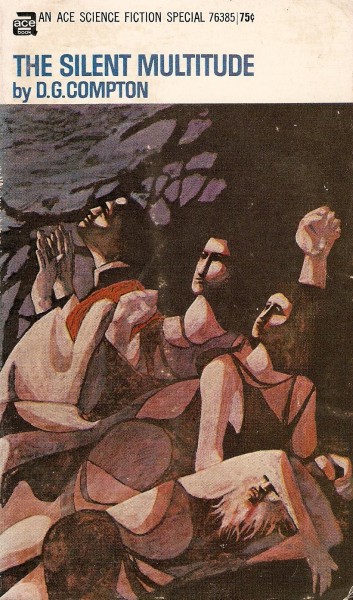
Book Review: The Silent Multitude, D. G. Compton (1966)

(Leo and Diane Dillon’s cover for the 1969 edition)

4.25/5 (Very Good)

“He was out now looking for signs.  He knew how to stay alive.  He was a strangely violent man, to him the fall of the city was some sort of unholy celebration (89).”

The decaying/empty city as allegory: its few post-evacuation occupants (a tramp and his cat, the cathedral’s dean, a young suburban woman, a troubled architect’s son — all well-drawn characters) wander the deserted streets of Gloucester consumed with their own obsessions.  The cement consuming fungus — a vague agent of destruction that severs us from our loci of civilization, our functionalist cityscapes, Continue reading

Updates: Recent Science Fiction Acquisitions No. XXVII (Gerrold, Panshin, Shaw, et al.)

My second to last backlog acquisitions post from Spring Break — a fruitful sci-fi hunting adventure indeed!

With my PhD Qualifying exams complete (proposal defense in months and months and months), I will actually get around to posting sci-fi art related (and perhaps get back to my film reviews) and reading my massive to read pile.

Enjoy!

1. Space Skimmer (1972), David Gerrold.  Another author whom I know little about and haven’t read yet.  As a Star Trek fan I know that he submitted the script that became The Trouble With Tribbles…

(Dean Ellis’ cover for Continue reading

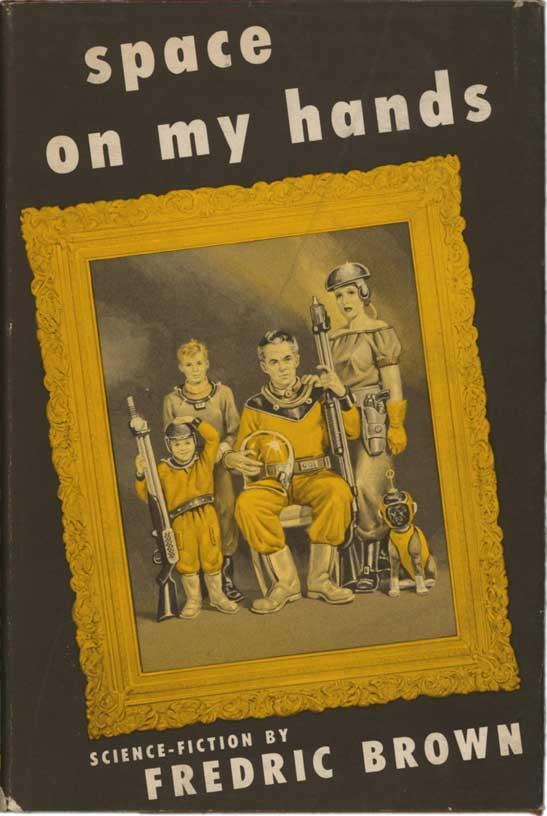
Adventures in Science Fiction Cover Art: The Space Age Family

(Malcolm Smith’s cover for the 1951 edition of Space on My Hands (1951), Frederic Brown)

I’ve scrounged through my collection of cover images over and over again trying to find families — and not alien families being slaughtered by intrepid earthmen à la The Red Planet (below).  Simply put, sci-fi generally revolves around characters who set off on their own, occasionally (at the end) finding a spouse (alien or not) and starting a family.  Heinlein’s juveniles are a great example — boy from broken family (dead mother, abandoned orphan…) learns all the math necessary for navigating in space from a book, sets off (or stows away) in the nearest possible spaceship and goes on grand adventures — perhaps killing some alien families along the way…..

I’ve still managed to find a few.  The best Continue reading

Updates: My Top 15 Science Fiction Novels from the 1960s

Everyone loves lists!

The 60s produced some of my favorite science fiction works.  Many authors moved away from the technologic naivete of pulp sci-fi and predicted less than positive futures (overpopulation, natural disaster, etc) and attempted to instill a more literary quality to their works.  I’ve cobbled together a top eleven list — I have probably forgotten a slew of amazing works that I read years ago.  Also, I read majority of them before I created my blog and hence do not have reviews — I’ve included a blurb for those without reviews.  I’ve linked those that do.  And, as I have promised before, a review of J. G. Ballard’s masterful The Drowned World (1962) is on the way!

EDIT: Over the course of reading the comments and glancing over my bookshelves I’ve discovered how much I’d forgotten had been written in the 60s (Vonnegut’s Cat’s Cradle, etc).  As a result, I’ll put together a more comprehensive top 20 or so in the near future.

EDIT: 06/26/2015: Because my post is receiving a substantial number of new visitors, I’ve decided to add a few novels I’ve read since I made the initial list three years ago.  Instead of a top 11 it’s now a top 15 in no particular order.

New additions:

Anna Kavan’s Ice (1967) — REVIEW LINK

Robert Sheckley’s Journey Beyond Tomorrow (1962) — REVIEW LINK

Josephine Saxton’s The Hieros Gamos of Sam and An Smith (1969) — REVIEW LINK

Naomi Mitchison’s Memoirs of a Spacewoman (1962) — REVIEW LINK

~

Feel free to list your top 11!

Original list:

1. Stand on Zanzibar, John Brunner (1968) — is by far the best of the overpopulated world genre (for additional works consult my index).  Brunner chronicles a dystopian future society in obsessive and awe-inspiring detail with shreds of newspapers, advertising jingles, quotations from invented books, and even current (60s) events.  Be warned: low on plot, heavy on world building, experimental structure…

(Steele Savage’s cover f Continue reading