Today I have the third post in my Exploration Log series.
I would like to welcome Adam Rowe to Science Fiction and Other Suspect Ruminations. He is the author of a brand new book–Worlds Beyond Time: Sci-Fi Art of the 1970s (2023)–on 70s science fiction cover art with a foreword by artist Vincent Di Fate. You can follow Adam’s art account on Twitter and Tumblr. I also recommend subscribing to his free 70s SF art newsletter. You can buy Worlds Beyond Time on Amazon and Barnes and Noble.
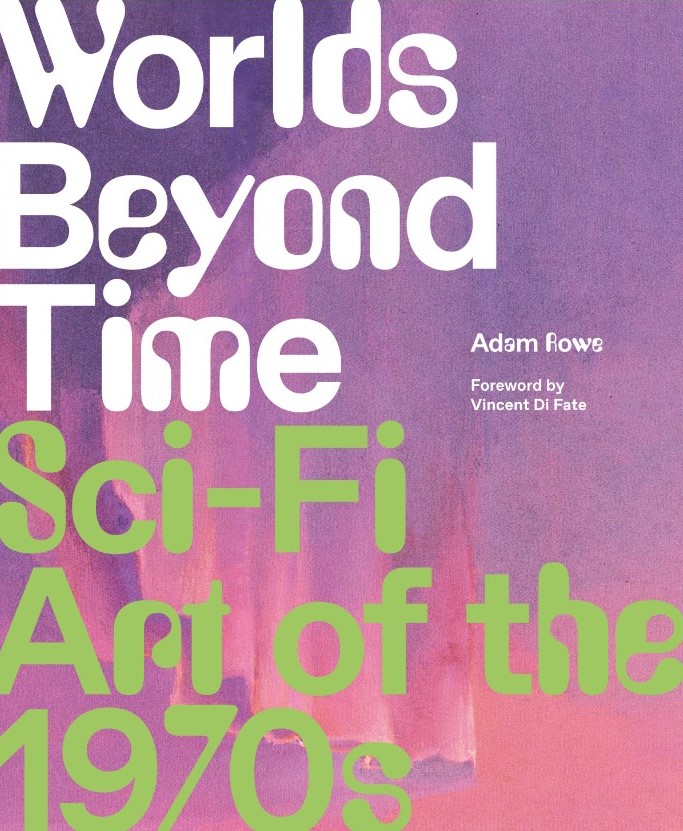
Adam Rowe is a writer who has been collecting retro science fiction art online since 2013. He covers technology at Tech.co and has been a Forbes contributor on publishing and the business of storytelling. He has also written for iO9, Popular Mechanics, Tor.com, and the Barnes & Noble Sci-Fi & Fantasy Blog. Worlds Beyond Time: Sci-Fi Art of the 1970s (2023) is his first book.
Thank you for agreeing to the interview. Now let’s dive into the fascinating world of 1970s science fiction art!
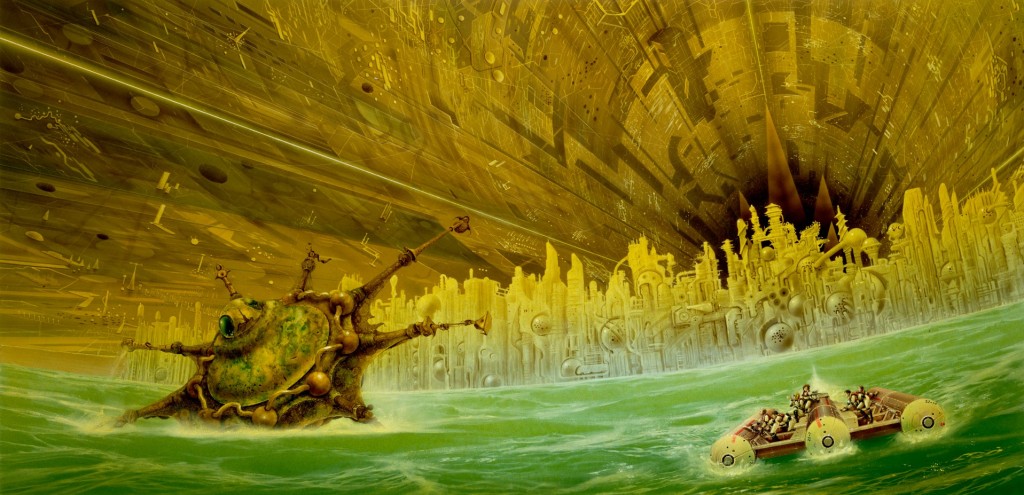
Jim Burns’ interior art “Rama: The Cylindrical Sea” in Alien Landscapes (1979)
Artist Vincent Di Fate writes in forward that your volume is a “vital step toward the acknowledgment and understanding of what science fiction art is and what it means.” Can you expand on that statement? What historical gap does your book fill?
Di Fate told me one thing in our interviews that stuck with me – he said he had hoped that there would be a wider critical reappraisal of science fiction illustration after he published his own book on the subject, Infinite Worlds: The Fantastic Visions of Science Fiction Art, in 1997. But, he told me, he never saw one.
I’m not sure why that gap exists, but this art does sit at the intersection of two things that have been at least a little stigmatized as lowbrow for decades: Commercial artwork and the science fiction genre. And I do agree with Di Fate that it’s a mistake! Given the impact 1960s-‘80s sci-fi art has left on culture to this day – Star Wars, Dune, an endless list of sci-fi video games – as well as how popular this art is with audiences, I think we should have a lot more art history books like mine.
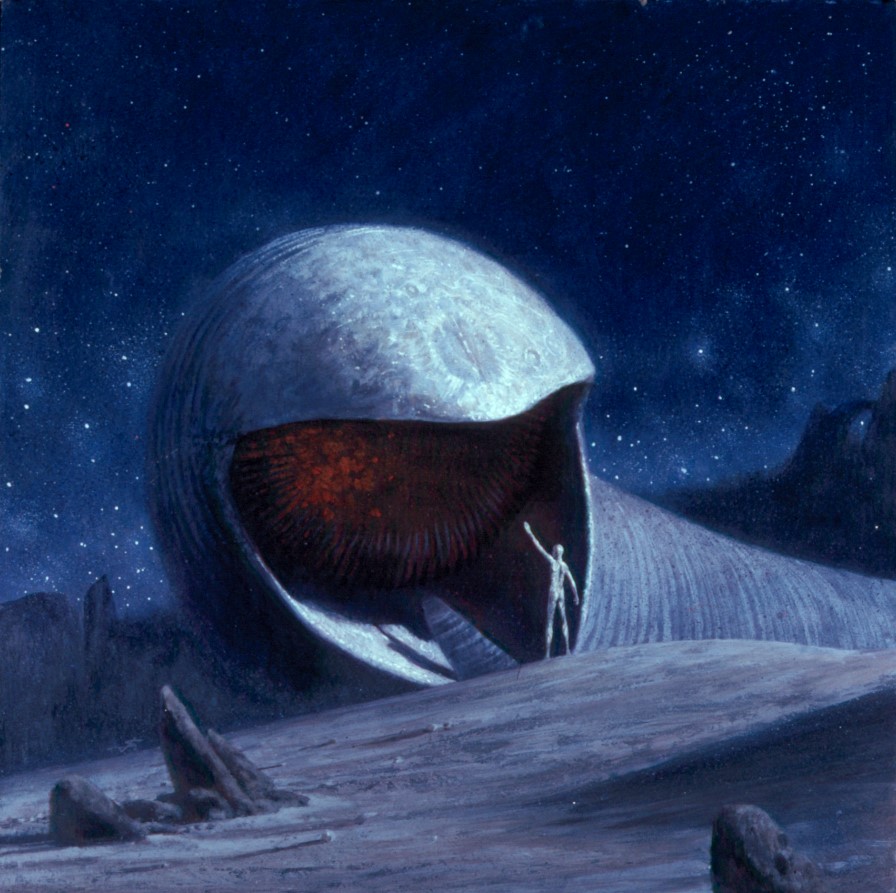
John Schoenherr’s art the Frank Herbert’s LP Sandworms of Dune (1978)
From your research into the artists and their work, can you tell us the basic process of creating a cover?
My understanding is that during this time, cover artists essentially would have to move or commute to New York City to get started, where they would visit magazine or book publishers to show them their portfolio and ask for work. Once they established a relationship, some would even get contracts for a certain number of titles from one publisher. Some might be asked to emulate the biggest cover artists as a cheaper alternative: The most copied artists were Chris Foss, John Berkey, and, in fantasy, Frank Frazetta.
The actual art was in a wide variety of mediums. I’m afraid that’s not my area of expertise, although I have heard that acrylics tended to be more popular than oils, since they dry quicker and cover artists tend to be in a rush.
Is there a particular cover or artist that got you hooked on science fiction art of the 1970s?
Sort of! I first became interested while I was goofing off online in 2013 while studying for finals in college and found a piece of 1977 art by an unknown artist, featuring a wizard on a giant mushroom. I realized I loved the style and subject matter, and I looked around for a Tumblr that I could follow for more of it. I couldn’t find one, so I started my own, and my first post was that initial piece of art that inspired me. I’m not sure why I called it “napkin art” in that post; it’s pretty clearly a piece of drawing paper.
What do you find appealing about 1970s science fiction art in particular?
It’s really hard to pin that down! And it’s only gotten harder over the years, as I gain a deeper appreciation for a wider range of very different styles that were all being used during that decade. There’s no confusing Mike Hinge with John Berkey, for instance. There’s just something about the colors, the details, and the “analog” impression offered by paint or ink as opposed to fully digital art.
The imagination used for the subjects of this type of art often strikes me as bolder and weirder than a lot of science fiction in popular media today, too. There are plenty of equally off-beat artists working today, but not as many make it to book covers.
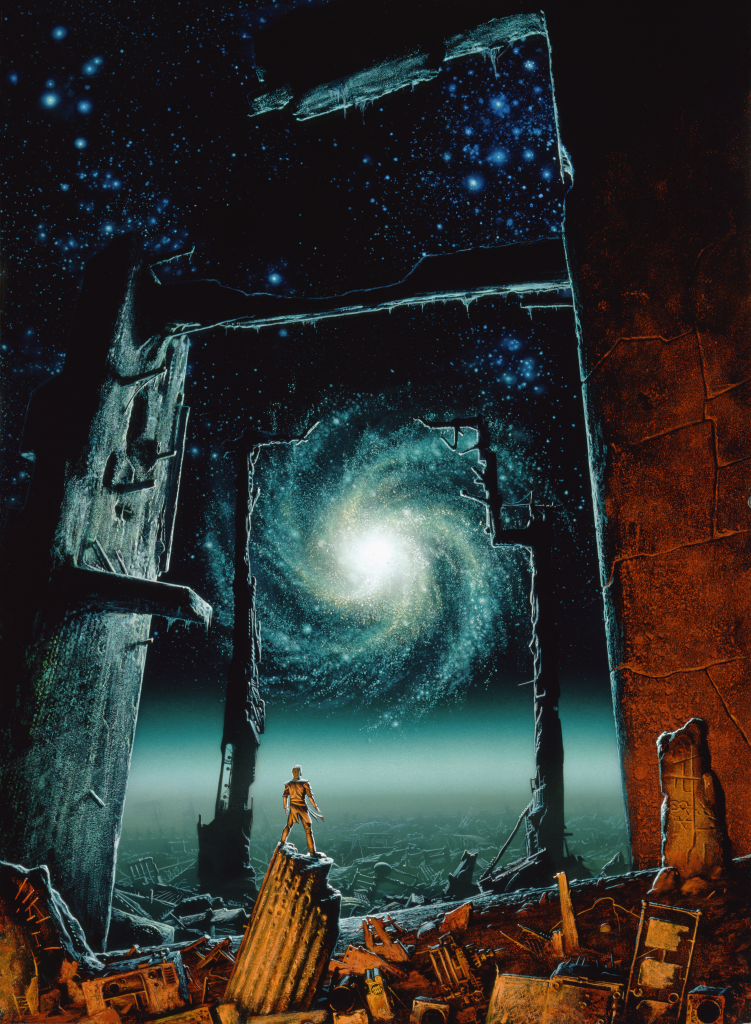
Michael Whelan’s cover art for the 1st edition of Isaac Asimov’s Foundation’s Edge (1983) — titled “Trantorian Dream”
What are the defining characteristics of 1970s SF art? Did Counterculture and surrealism-inspired visual language continue into the 70s? Did it depend on the country?
In sci-fi book covers, the single biggest defining trait over the ‘70s and ‘80s was bold, bright color. Other frequent traits were sharp details, which usually went hand in hand with frequently reoccurring visuals like spaceships, planets, and alien landscapes. There are plenty of exceptions, too – Bruce Pennington is one of the greats, and his style doesn’t have the crisper airbrushed details that you’ll see from frequently emulated artists like Foss and Berkey.
Surrealism definitely impacted covers everywhere across the 1970s and ‘80s, but remained much more dominant outside of the US and UK. My first draft was actually going to cover more surrealists in other countries, but sadly I wasn’t able to overcome the language barrier to connect with their estates to go more in-depth. My book wound up being fairly US/UK centric.
I’m currently doing some emails for my retro sci-fi art newsletter about those artists, though: Wojtek Siudmak in France, Horatio Salinas Blanch in Spain, and Henri Lievens in Belgium are a few to know. And I know we’ve talked about some others. You introduced me to the Italian artist Mariella Anderlini.
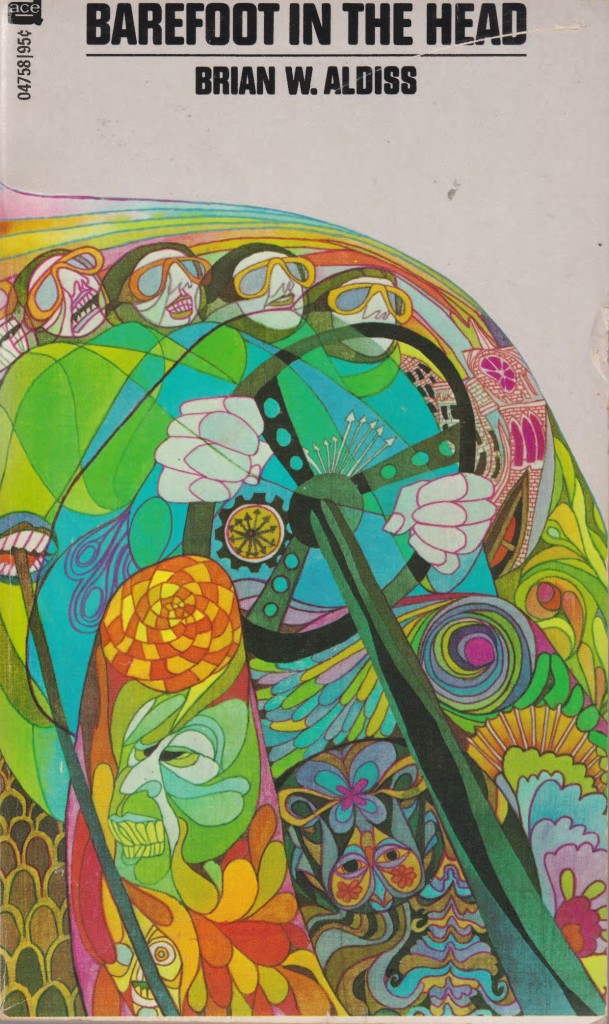
Diane and Leo Dillon’s cover art for Brian W. Aldiss’ Barefoot in the Head (1969)
What is your favorite artist?
I’m sure this is the answer that every art lover gives, but I really can’t pick one favorite! I have a handful that I really love. I think Angus McKie’s work is fascinating; It’s so whimsical, with a lot of hidden details. Frank Frazetta’s work has undeniable energy, and Syd Mead was brilliant at imagining new technology and innovations.
John Harris is amazing, and his artwork is so good at conveying a sense of majestic, ancient knowledge from far-off galaxies. He gets some of his ideas from his own lucid dreams, and – I found this out while researching the book – he credits these dreams to his time studying Transcendental Meditation under Maharishi Mahesh Yogi, the same guru that the Beatles studied with.
I also love Dean Ellis, which brings me to your next question…
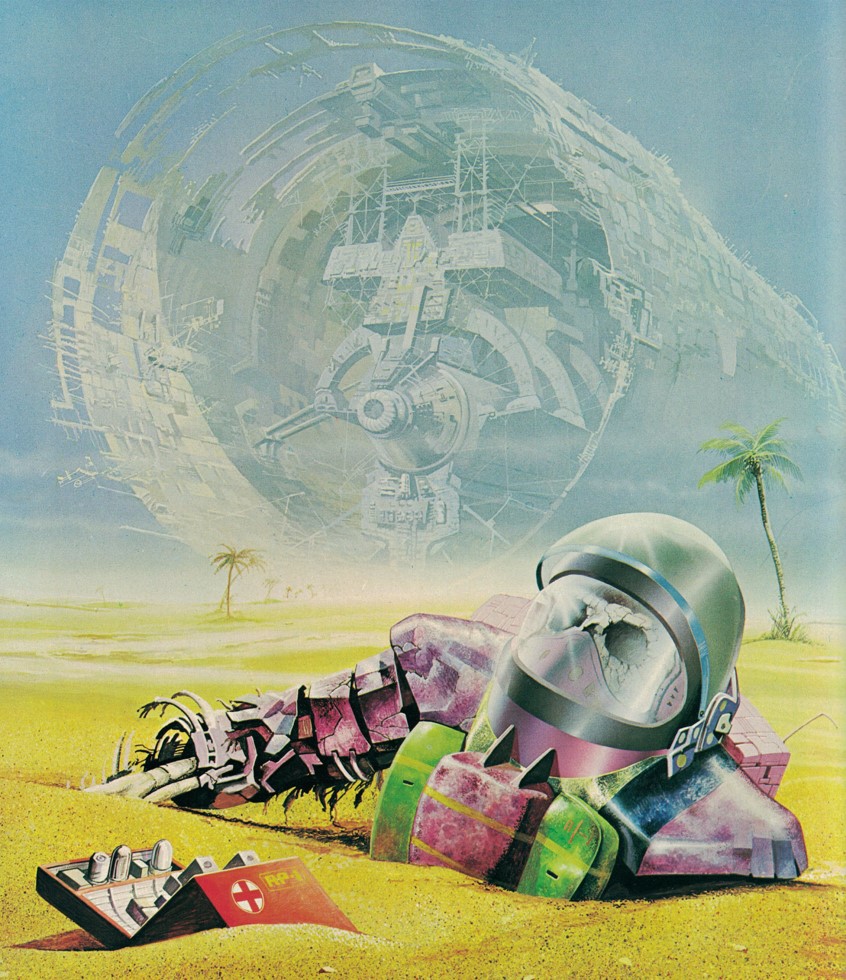
Angus McKie’s cover 1st edition of The Year’s Best Science Fiction No. 8, ed. by Brian Aldiss and Harry Harrison (1976)
What’s a name that you think should be better known?
Dean Ellis. He had a long and successful commercial illustration career that covered a lot of fields beyond paperback covers, including advertising and US stamps, but he has never been very well-known for science fiction covers in comparison to a lot of his peers in my book. That’s partially because he wound up going uncredited on many paperback covers – lack of credit is a practice that was common for cover artists at the time, but seems to have happened to Ellis a lot more than to most artists. It’s even possible he didn’t mind this, but he passed away in 2009, so I didn’t have a chance to ask.
At any rate, he’s a great artist at balancing tiny details with a single, cover-dominating shape like a spaceship or building. Those two things are in tension with each other, but they’re both key for paperbacks, since they need to be visually interesting both from far away and from close-up.
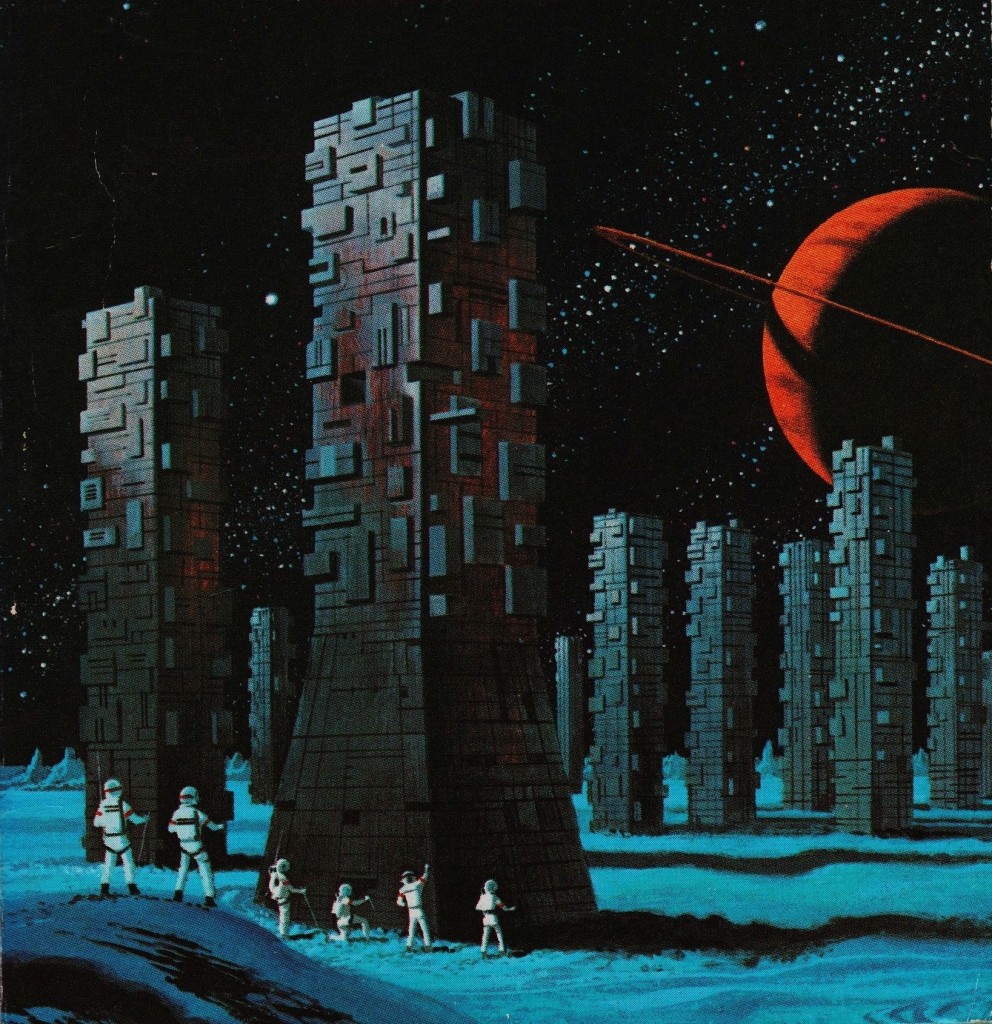
Dean Ellis’ cover for the 1974 edition Ben Bova’s As on a Darkling Plain (1972)
Many artists that you profile emerge as fascinating characters from behind their covers. What are some particularly memorable characters beyond their covers?
Richard Powers is definitely a big one – he liked pulling strange pranks with his art, like signing some of his covers “LAZ/org” after a fictional art collective that he’d just made up. You can see the signature on plenty of covers today! He’s basically the Bugs Bunny of retro sci-fi art.
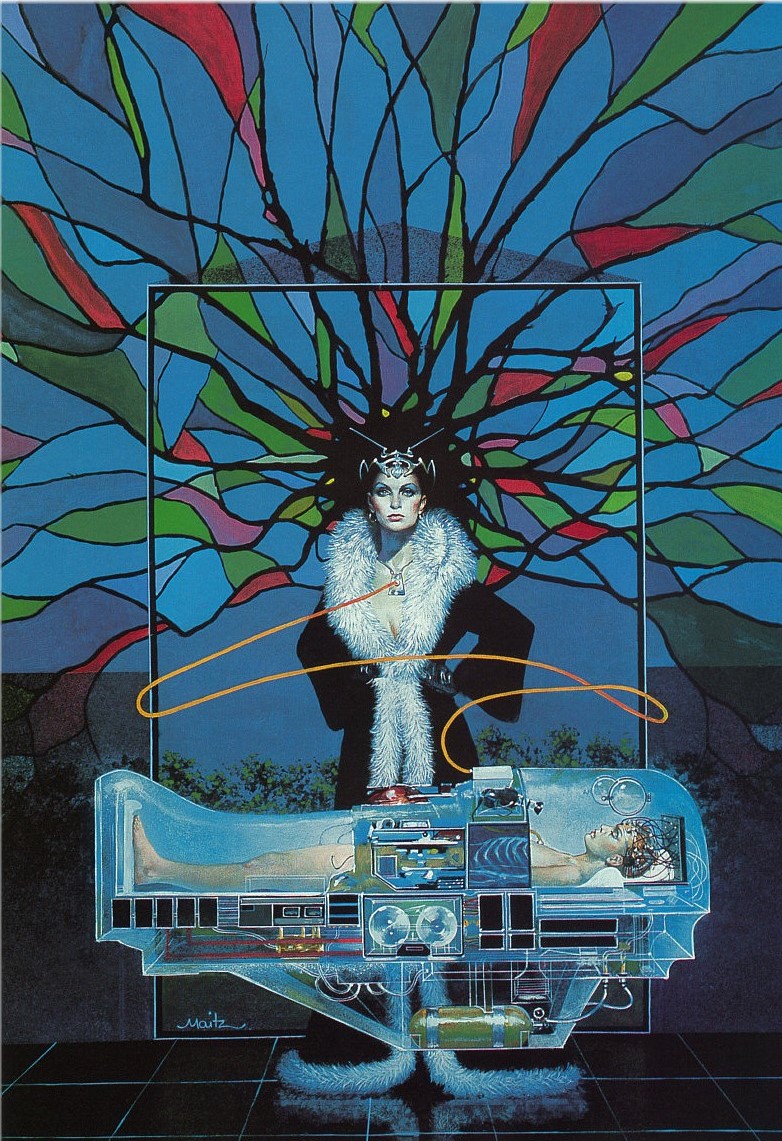
Your book is organized—in part—around visual themes. What was your favorite to gather covers for? What was the most historically interesting? Personally, I can’t keep my eyes off the “cryosleep” covers—in particular, Don Maitz’ artistic masterpiece for Tanith Lee’s Electric Forest (1979).
I remember being really happy with how the “Reflections in Space Helmets” two-page spread came together. In the process of writing the book, I wound up putting together about 20 spreads slightly more last-minute than the rest, and that was one of them.
By coincidence, I had already contacted most of the artists who had created the best examples – Peter Elson’s cover to Of Time and Stars, Rick Guidice’s beautiful NASA concept art, and Bob Eggleton’s Pitfall cover – so it was easy to get back in touch to get permission. Plus, I had already done a lot of thinking about that visual trope because I had been putting together a collection of 50 examples that year, posting one every Saturday. So the whole thing fell together in a few days, and I’m really proud of it.
I really love a few other ones that I added late: The Robert Tinney Byte magazine section was one, and actually, the Cryosleep one was, too! That Maitz cover is gorgeous.
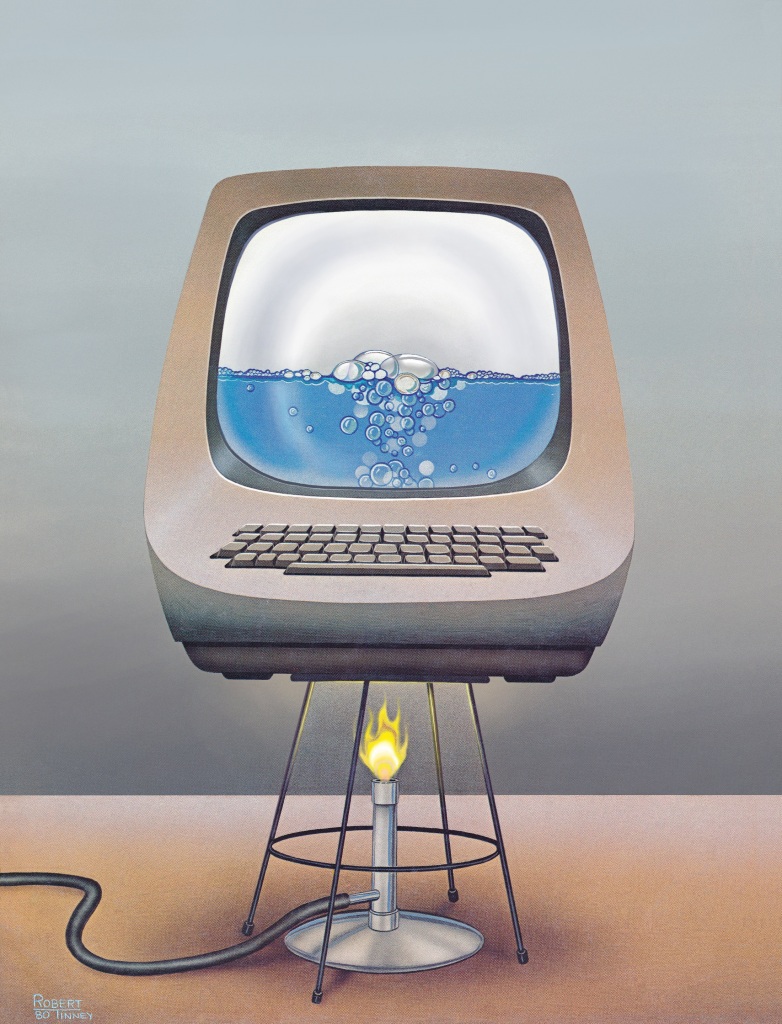
Robert Tinney’s cover for the March 1980 issue of Byte Magazine
I imagine that it was a challenge tracking down the copyright for the art you include. Are there any particularly fascinating stories? Are there artists that you wanted to include in the book but couldn’t (I noticed that Jerome Podwil is unfortunately absent)?
Yeah, plenty of artists that I couldn’t contact. I remember I couldn’t get through to Stephen Fabian. I really wanted to get a selection of interior artworks by Rod Ruth from Album of Dinosaurs, but even though he was a well-known artist, he passed away in 1987 and I couldn’t locate his family over the internet.
I believe I tried contacting a rare coin dealer named Ken Barr on two separate occasions while thinking I was getting in touch with the artist Ken Barr. He was fairly terse in responding to me… I wonder how often it happens to him.
There are a few workarounds, however: The covers themselves (with the title text, author name, taglines, and logos) are owned by the publisher who published that book. So, in some cases when I couldn’t contact the artist, I was able to use the book or magazine cover that their work had appeared on.
That’s the case for all the Creepy and Eerie covers that show up in the book. Plus, Galileo magazine bought the rights to Galaxy magazine and then went bankrupt (as I discuss in the book) and didn’t renew the copyright, so covers from both those magazines are public domain.
On top of all that, a few artists weren’t interested. Peter Andrew Jones felt that people could buy the art books he already has out instead, so I wasn’t able to include him. I tried hard to get a few artworks by the Brothers Hildebrandt, but wasn’t able to, either
Some artists made the process incredibly easy. Boris Vallejo very kindly gave me permission to use his art for free, even after I offered to pay.
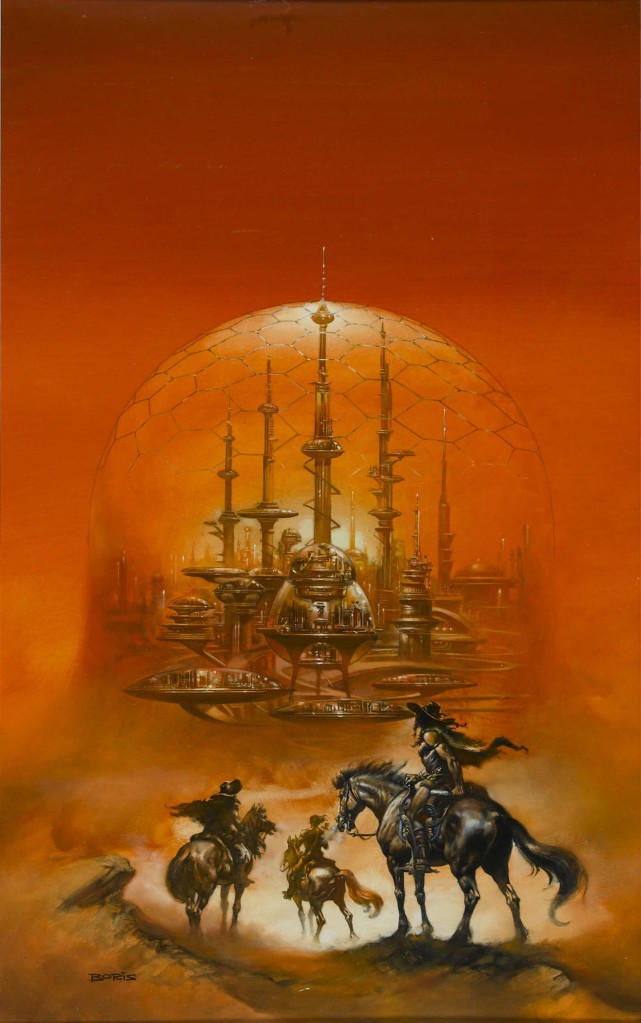
Boris Vallejo’s cover art for Arsen Darnay’s A Hostage for Hinterland (1976)
What are the next steps in charting 70s SF art?
More art books! There are two huge artists in particular who I was surprised to learn had never published a single stand-alone art collection: Paul Lehr and John Schoenherr.
I might do a podcast. My pipe dream would be a Netflix documentary. And there’s certainly enough material for me to do a volume two on this era of art. I haven’t even really had the chance to dig into the fascinating history of dolphins in outer space!
Thank you for agreeing to the interview.
Stay tuned for a guest post by Adam on the SF art books of the 1970s!
And make sure to snag a copy of his book! You can buy Worlds Beyond Time on Amazon and Barnes and Noble.
For book reviews consult the INDEX
For cover art posts consult the INDEX
For TV and film reviews consult the INDEX
 Science Fiction and Other Suspect Ruminations
Cool stuff. As it happens I do follow 70s Sci fi Art over on Tumblr.
Good good! The book is worth procuring if you want to know a bit more about the artists and context of the covers.
That’s a temptingly affordable tour of the book covers of my teen years.
Have a favorite artist from the 70s? Of those featured in the book, it would probably be Mike Hinge, the Dillons, and Powers (although I prefer his 50s stuff).
I would trample photogenic orphans to get to books with covers by Berkley, the Dillons, Ellis, or Sternbach.
I won’t let you near my collection. I essentially only own the older editions. My purchase posts include scans of my personal copies. Haha.
This book is amazing, glad to see this interview. One artist whose absence perplexes me is Charles Moll.
There’s a chance that he could not get copyright permission for Moll’s work (or, in the cases that he lists in the interview, simply couldn’t get in touch with someone). Adam certainly showcases his work on his Twitter and Tumblr.
I’ll ask him.
I assume its something like that, just curious. I dont think he’s particularly obscure and his style is very distinct (and iconic – at least to me – particularly his covers for Malzberg)
I’m a big fan of Moll as well. And yeah, his Malzberg covers are iconic (and the perfect accompaniment for Malzberg’s hellish black comedies that I so adore).
Obviously if I were to make the same book, I’d not give as much space to some artists and emphasize the works of others. I can’t be sold on Foss and his various clones. hahaha.
WOW! I have loved science fiction and fantasy art for decades, even managed to acquire a few pieces, mostly prints. The interview was a good lead-in for the webinar on Tuesday the 8th. Thanks for this!
No problem. Ah, what pieces do you have?
I’ll get back to you on this. Artists include Alan M. Clark (originals & prints), a Roger Dean poster and book, and Alan Gutierrez, but I can look to see who else.
Alan M. Clark is not a name I recognize on sight. That said, I looked him up and he seems to have been quite prolific from the late 80s onward. https://www.isfdb.org/cgi-bin/ea.cgi?10741
I wish the artists that really speak to me were affordable — hah. Richard Powers, Paul Lehr, Allison, W. Siudmak, Ed Emshwiller, etc
Yes, speaking through a medium might be pricey.
Paul Lehr also made found object sculptures that I wish I had seen beyond a few photos.
Ah, I did not know Pal Lehr made sculptures.
Many thanks for this feature. I love SF illustration of various eras, especially of the sixties and seventies.
No problem. Have a favorite cover artist from the 70s?
I like Vincent Di Fate and Leo and Diane Dillon, and the work of other artists whose names I can’t place right now, unfortunately. I especially like some of the surrealistic British covers in the sixties.
Who can forget the Dillons! I love them as well. And Pelham is one of the few beacons of UK cover art (along with Ian Miller) — Foss and his clones took over the aesthetic.
Neat to see the several illustrations, and see what comes from the wild imagination of some artists. If this collector ever manages to get a documentary on Netflix, I’d certainly be interested to check it out.
Glad you enjoyed it. At the very least, make sure to follow his free newsletter! I linked it in the intro.
A further answer to Joachim’s question: I also love the work of David Pelham (his illustrations of Ballard, etc.)
Me too. Great stuff!
Great interview. 😃 I’m really excited to order a copy of Worlds Beyond Time, having followed Adam for a little while now.
Thank you!
This was wonderful!! I was so excited reading this interview. I love to collect art books, esp. SF or Fantasy art related.
Thank you! Have a favorite science fiction/fantasy artist from this era?