Which books/covers/authors intrigue you? Which have you read? Disliked? Enjoyed?
1. The Company of Glory, Edgar Pangborn (serialized 1974, novel 1975)

Vincent Di Fate’s cover for the 1st edition
From the back cover: “BEHOLD DEMETRIOS! With the same rich imagination and dazzling insights that won him the International Fantasy award, Edgar Pangborn weaves a magical tapestry set far in man’s future.
It is a time when man, struggling to rise above the ashes of nuclear holocaust, has returned to the simpler values and lifestyles of medieval times. And in this society, Demetrios the storyteller is revered among men for his captivating tales of the Old Time, with its miraculous Telephones, and Jet Planes, and TV, and Automobiles. But Demetrios is also feared–for one storyteller with a head full of ancient truth can be dangerous.
So Demetrios is forced to flee, with six compatriots, and together they embark on a journey full of unexpected sorrows, and unimagined delights, a journey through realms of fantasy, philosophy, and rich human possibility, which the reader will be delighted and privileged to share.”
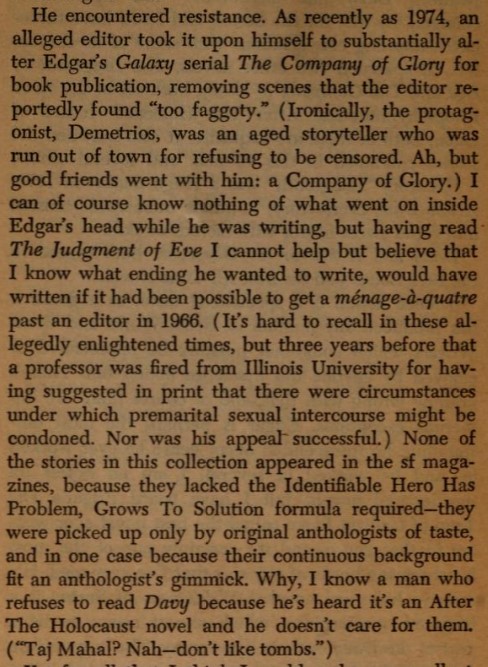
Initial Thoughts: After reveling in Pangborn’s masterpiece Davy (1964), I decided to acquire everything in the Tales of a Darkening World sequence I didn’t own already. According to Spider Robinson, the editor at Pyramid Books cut portions of the novel that was serialized in Galaxy… Inset image is from Robinson’s intro to Still I Persist in Wondering (1978).
2. Mind of My Mind, Octavia E. Butler (1977)

John Jude Palencar’s cover for the 1994 edition
From the back cover: “A brilliant talent unique in speculative fiction, multiple Hugo and Nebula winner Octavia Butler is the creator of extraordinary novels that combine the cultural vision of Alice Walker and Terry McMillan with the cosmic scope of Ursula K. Le Guin and Doris Lessing. Provocative, probing, and breathlessly paced, this is one of her finest novels….
For four thousand years, an immortal has spread the seeds of an evolutionary master race, using the downtrodden of the underclass as his private breeding stock. but now a young ghetto telepath has found the way to awaken–and rule–her superhuman kind, igniting a psychic battle for L.A. mansions to South Central slums, as she challenges her creator for the right to free her people… And enslave Earth.”
Initial Thoughts: Inspired by the Gerry Canavan’s brilliant Octavia E. Butler (2016), I tracked down a few more of her novels that I hadn’t read yet. I’m almost finished reading this one and should have a short review up in the next few weeks. It’s intense. Brutal. Unforgiving. Morally ambiguous.
3. Rings of Ice, Piers Anthony (1974)
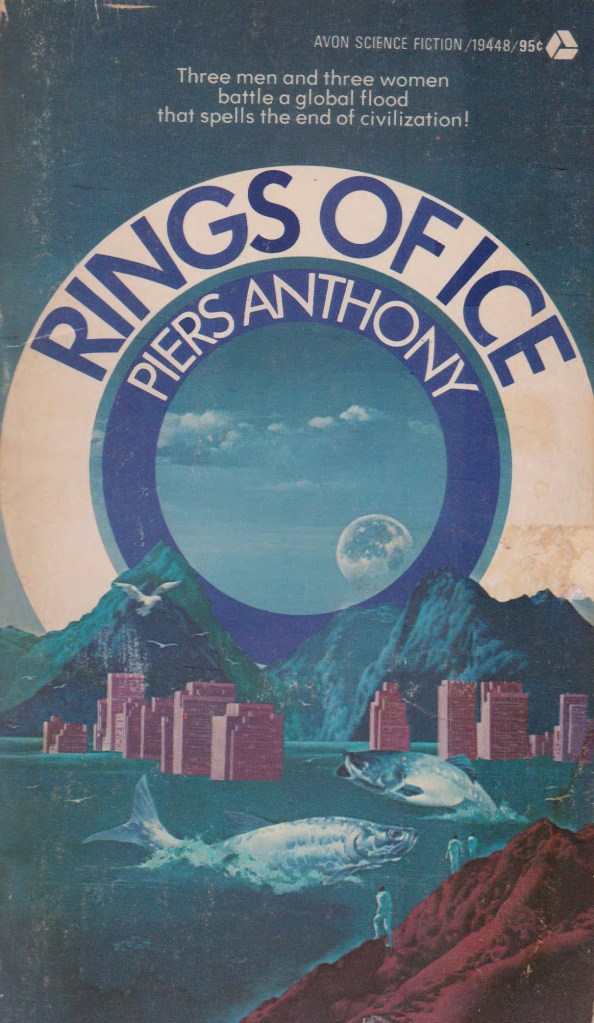
Vincent Di Fate’s cover for the 1st edition
From the back cover: “RINGS IN THE SKY
When Gus saw the wide, white rainbow, he knew what it meant. The official reassurances were a cover-up. He knew that it would be like Noah’s flood, only worse.
So Gus and his friend Thatch set out in a motor-home, desperately trying to escape the rising flood waters. Along the road, they pick up several hitchhikers, including a lovely young girl and a woman scientists. Gus and Thatch concoct a crazy scheme to “repopulated the Earth,” using their female companions–but it doesn’t quite work out that way.
Piers Anthony, famous for his totally original, meticulously accurate science fiction novels, has built a gripping, plausible drama of six misfits battling for survival, as Planet Earth is transformed into a hostile wilderness.”
Initial Thoughts: The back cover already makes this one sound sketchy in the Piers Anthony way… I still haven’t ready anything by Anthony.
4. Future Power, ed. Gardner R. Dozois and Jack Dann (1976)
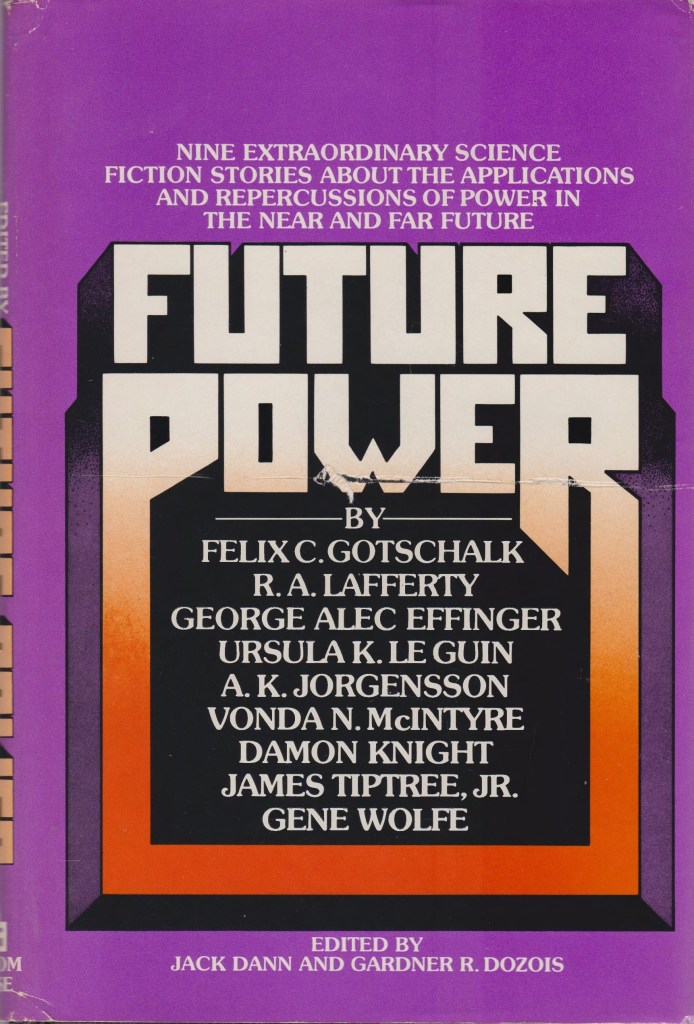
Uncredited cover for the 1st edition
From the inside flap: “Who will rule your future?
As drastically as science and technology have changed the quality of our everyday lives, they have also created new ways to power, and new powers. There are techniques for the invasion of privacy in use today that far outstrip 1984‘s telescreens, and today’s specialists in psychological warfare and media manipulation might well consider Brave New World‘s Newspeak childishly crude.
And tomorrow will bring new and undreamed-capabilities for the control of others. Within the next few years methods may be developed to artificially control human emotions, to induce rage, or joy, or fear, or passivity at will, possibly at long distance. Drugs and hypnotism and microsurgery may give us the power to wipe memory blank and then write upon it what we will, to edit a life, to shape personality for our own purposes. It may be possible for an experimental psychologist–or a dictator–to make a person sane or insane, or to shut off his heart, at the turning of a switch. Computer technology and superefficient PR may make it impossible ever to throw the rascals out of office. Sophisticated genetic science may give us the power to create living creatures–and human beings–to order, or to breed specific characteristics into our progeny with pinpoint accuracy. But which characteristics, and to whose specifications?
Every year brings new powers of man over man. Can we believe that they will never be used? If they are used, who will use them, and for what, and why?
Your life, and the lives of your children forever, may depend on the answers.
Here, some of the most renowned science fiction writers of all time –Ursula K. Le Guin, Damon Knight, James Tiptree, Jr., R. A. Lafferty, Gene Wolfe–as well as a selection of talented new stars–George Alec Effinger, Vonda N. McIntyre, Felix G. Gotschalk, A. K. Jorgensson–send us advance reports on the many possible worlds of a strange and complex future. With compelling skill, these expert dreamers show us worlds of nightmare, of sybaritic pleasure, of fantastic adventure, of bleak conformity, of bizarre humor, of amazing hope. Worlds that may be just around the corner, or so far in a remote and alien future that we can no longer recognize man as man. Worlds that we may or may not wish to inhabit, but that we will almost certainly have to face.”
Contents: Ursula K. Le Guin’s “The Diary of the Rose” (1976), Damon Knight’s “Country of the Kind” (1956), R. A. Lafferty’s “Smoe and the Implicit Clay” (1976), James Tiptree, Jr.’s “She Waits for All Men Born” (1976), George Alec Effinger’s “Contentment, Satisfaction, Cheer, Well-Being, Gladness, Joy, Comfort, and Not Having to Get Up Early Any More” (1976), A. K. Jorgensson’s “Coming-of-Age Day” (1965), Vonda N. McIntyre’s “Thanatos” (1976), Gene Wolfe’s “The Eyeflash Miracles” (1976)
Initial Thoughts: I need to read all of McIntyre’s early short fiction and this anthology is the sole place “Thanatos” (1976) appeared in print! Check out my recent review of McIntyre’s Fireflood and Other Stories (1979) if you haven’t already. As always, I’m look forward to the Effinger, Tiptree, Jr., and Wolfe stories as well.
For book reviews consult the INDEX
For cover art posts consult the INDEX
For TV and film reviews consult the INDEX
 Science Fiction and Other Suspect Ruminations
Robinson may have overstated the degree to which editing was inflicted.
https://web.archive.org/web/20030409064140/http://www.geocities.com/edgarpangborn/pangglory.html
Nice! I was going to see if I could verify the statement as well with my own comparison. I’m happy someone did it already. Thank you for the link.
I really should read more Butler. I read ‘Dawn’ ages ago and loved it but for some reason neither read the rest of the trilogy nor any of her other works.
I need to get a copy of that ‘Future Power’ anthology. It looks right up my alley.
I sadly wasn’t so impressed with ‘The Company of Glory’ as compared to, say, ‘Davy’. An unfair comparison, perhaps, but inevitable nonetheless. I did like the first chapter, but then it seemed to lose its narrative thrust after this (?). Maybe it was just a bad time to read the book?! I don’t know… I do recall enjoying the short story collection ‘Still I Persist in Wondering’ though.
Maybe read the Canavan monograph at least on Butler. Unlike many in the series, it feels like highly original research as he has access to her archives and endless drafts. It is a far more analysis-heavy monograph than many of the other more descriptive works in the same U. Illinois Masters of Science Fiction series. I struggle mightily with her fiction in that I’m not sure how I can contribute to studying it — so I’ll probably write a short review. And, I must confess, her fascination with comic books, superheroes (albeit, in her stories not acting very heroic), and telepathy in the Patternmaster series does not connect closely with my interests — although her ruminations on power and control are downright fascinating and harrowing.
Damon Knight’s ‘The Country of the Kind’ is one of the great SF stories. Certainly, Knight’s most significant story, addressing what should be one of the primary themes of SF — because it’s also maybe the primary problem of human history — which is: what do we do about the psychopaths?
Also in the FUTURE POWER anthology, the Wolfe and the Tiptree stories represent each of those authors pretty much at the height of their powers.
Yup, I look forward to both.
Its reputation definitely proceeds itself.
A story cited in National Review (though summarized incorrectly)
As evidence of what? I mean, my general view of Knight’s politics is that he was something of a leftist… like his wife.
JB: “As evidence of what?”
Nothing that Knight was actually saying. But best read for yourself. Here’s John Derbyshire, the writer, comically managing to miss every point in Knight’s story back in 2001.
https://www.johnderbyshire.com/Opinions/Culture/normal.html
Derbyshire: “In Damon Knight’s short story “The Country of the Kind,” the world has become a utopia of normality, built around universal benevolence and harmony. To prevent it all from sinking into a suffocating hell of boredom and conformity, the authorities have licensed one man to go around breaking into people’s houses and trashing them, just to introduce some uncertainty into things. To make sure this lone eccentric does not lapse into normality, the authorities, when operating on his brain, have also given him an intolerable smell so that no-one wants to get close to him. He is, of course, wretchedly unhappy.”
Wow nice find, that is some epic point-missing. Story is fantastic, obviously, definitely Knight at the top of his game, and the first thing I read of his that made me want to track down as much of his other writing I could find.
I have a half-memory that Knight actually wrote to the NR to correct Derbyshire.
Really cannot recommend anything by Piers Anthony – this is a man who titled one of his novels The Color of Her Panties…
I am definitely aware. Hence my snarky jab: “The back cover already makes this one sound sketchy in the Piers Anthony way.” As I am interested in understanding the historical moment in time and he was quite popular I feel like I have to read something of his — maybe Chthon.
IIRC, Chthon was his creative writing MA thesis, so perhaps not typical of his work when he was at his height. Of his more popular sf works, there’s the Bio of a Space Tyrant, but it’s not very good. The Incarnations of Immortality series was better. I read one book from the Cluster series, but can’t remember which one. And I think I read a couple of the Apprentice Adept series, which was basically sf and fantasy crudely welded together.
I remember reading Rings of Ice back when it came out. Even then it felt very average. Other books of his you might find of interest include Sos the Rope (v1 of Battle Circle) – it’s post-apocalyptic, after all! Macroscope (Hugo nominee bursting with ideas, crackpot, non-PC, and otherwise!) or Prostho Plus (the Laumer-esque adventures of an Earth dentist drafted in by aliens to tend to their captain, iirc. and it goes on episodically from there. A bit Hospital Station, I suppose. Several others had their momemts… Cluster has gen-ships in the background but you’ll save yourself loads of time by reading the description on Fantastic Fiction instead! https://www.fantasticfiction.com/a/piers-anthony/cluster.htm Maybe Omnivore (vol 1 of Of Man & Manta) Lots of stuff about the role of fungus as a 3rd strand of life beside animal & vegetable.
I remember the shop I worked for back then went big on the 1st book of Bio of a Space Tyrant because his sales until then had been building – and we were still trying to sell off the excess cheap years later! I have a feeling we took 80 of #1, 10 of #2 and less of the others!
I’ll second Macroscope as the best of his pre- Creepy-YA period — I’ve been wanting to revisit it for a while. I loved the Battle Circle books when I was 13 or so (take that for what it’s worth), and yes also to Chthon and at least Omnivore from that series. I was really shocked in real time when he just sort of collapsed into dreck.
Yes, I would recommend Macroscope as well. Not that it doesn’t contail quite a bit of creepy sexism as well an obsession with quantifiable intelligence, and on top of that a bizarre attempt to shoehorn in an argument for astrology! But there’s also some really good ideas that probably makes it as worthwile as he gets.
(Though to be fair it’s the only Piers Anthony book I’ve read – I had no idea about his reputation back then, and when I heard that his later works contained much more of what I found off putting in Macroscope I didn’t really want to read more).
I have a copy of Macroscope that I haven’t dived into yet.
MACROSCOPE is the only one I’ve ever found rewarding.
I’m happy to have found a .pdf of Octavia Butler’s SURVIVOR online last week!
I want a paper copy of Survivor. I saw someone on Twitter got a box of SF from some relative who didn’t want them and it included a paperback Survivor copy…. yeah, $750+.
I’d love one too, but if I weren’t willing to download the E-book, I’d never be able to read it at those prices! Maybe you’ll find it for a dollar in a thrift store whose owner doesn’t know its rarity.
Piers Anthony; I read “Prostho Plus “ many years ago and thought it decent light comedy SF – but I was about 13 or 14 years old, not long afterwards I read the original magazine serialisation of his Arabian Knights-esque serial “Hasan”, which I recall as quite entertaining as well as something of a novelty at the time. I’ve never read anything else by Anthony – nothing in his say ‘80s output sounded that appealing to me. I occasionally think about rereading “Hasan”, though, just to see how it stands up.
Yeah, Hasan was quite interesting; I got the Borgo Press edition a few years later and kept it for years because it was a nice edition.
I think I remember getting a bit bored by the end of it though.
I’ve always had a weird fascination with Lehr’s cover for Prostho Plus — it’s clearly his style but he takes a far more “realistic” approach then he normally does. Haven’t read it.