Happy holidays. I hope you’ve been able to squeeze in a bit of science fiction reading.
Which books/covers/authors intrigue you? Which have you read? Disliked? Enjoyed?
1. Those Who Watch, Robert Silverberg (1967)

Gene Szafran’s cover for the 1971 edition
From the back cover: “CRASH LANDING FROM THE STARS.
Only three humans would ever know that the blinding flash in the sky on that night in 1982 was an exploding flying saucer. Only they would learn the truth about THOSE WHO WATCH–about the alien beings who came into this world in a crash landing from the stars. THOSE WHO WATCH is the strange, seductive novel of three accidental colonists from outer space whose chance encounter with Earth triggers interplanetary conflict. It is also the most unusual love story ever written.”
Initial Thoughts: One of the few novels from Silverberg’s glory period that I have not read.
2. The Second Experiment, Janet Asimov (as J. O. Jeppson) (1974)
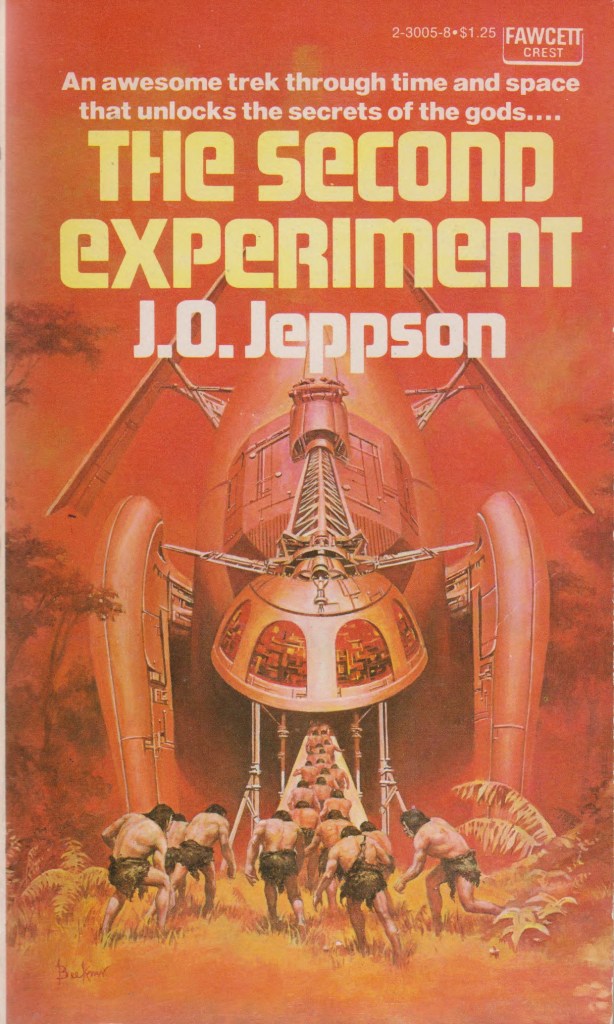
Douglas Beekman’s cover for the 1976 edition
From the back cover: “THE RUIISS–once masters of the universe, now evolved to pure thought forms. Engaged in war with Life itself, they had no time for R’ya, their single surviving daughter.
She was the last of the dynasty. With her faithful robot Tec, she took the last ship to a star with nine planets, the third of which had life.
Then she decided it was time to find a mate. And that this planet was as likely a spot as any to begin her search…
J. O. Jeppson [Janet Asimov], a practicing physician, is married to another accomplished SF author, Isaac Asimov. They live in Manhattan.”
Initial Thoughts: I don’s have any hopes for this one despite the evocative Beekman cover. Anything is better than the Peter Jones cover for the 1975 UK edition!
3. World’s Best Science Fiction: 1971, ed. Donald A. Wollheim and Terry Carr (1971)
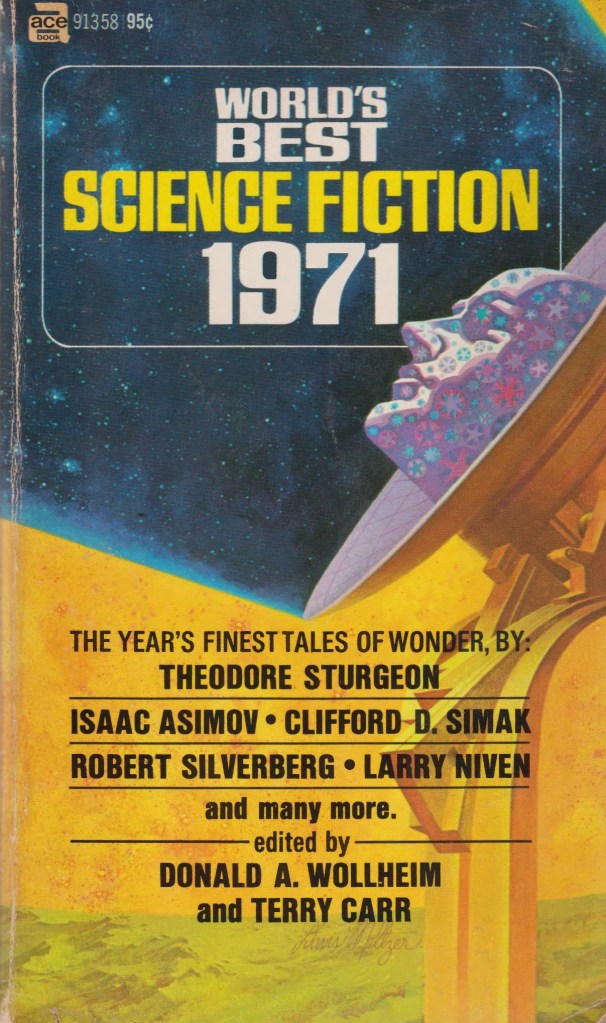
Davis Meltzer’s cover for the 1st edition
From the back cover: “In this latest edition of the anthology that has become an annual event in the SF field, the editors have chosen a generous sampling of the very best imaginative stories published anywhere in the past year:
DEAR AUNT ANNIE, Gordon Eklund’s tale of a computer that ruled the country through a newspaper advice-column
WATERCLAP, Isaac Asimov’s story of rivalry between the explorers of the Moon and those exploring the depths of Earth’s oceans
THE THING IN THE STONE, Clifford Simak’s tale of a man who could hear the stars talk.
Plus many, many more: a thick volume of the most enjoyable science fiction being written today.”
Contents: (almost all published in 1970): Theodore Sturgeon’s “Slow Sculpture,” “Larry Niven’s “Bird in the Hand,” Robert Silverberg’s “Ishmael in Love,” Bob Shaw’s “Invasion of Privacy,” Isaac Asimov’s “Waterclap,” R. A. Lafferty’s “Continued on Next Rock,” Clifford D. Simak’s “The Thing in the Stone,” Gregory Benford’s “Nobody Live on Burton Street,” Michael G. Coney’s “Whatever Became of the McGowans?,” Arthur Sellings’ “The Last Time Around” (1968), Neal Barrett, Jr.’s “Greyspun’s Gift,” Gerald Jonas’ “The Shaker Revival,” Gordon Eklund’s “Dear Aunt Annie,” Ron Goulart’s “Confessions,” H. B. Hickey’s Gone Are the Lupo.”
Initial Thoughts: I’ve enjoyed the two stories–Sturgeon and Lafferty (linked above)–I’d previously read from the anthology. I’m always eager to acquire Coney stories. Of the rest, the Benford and Jonas intrigue me the most.
4. Light on the Sound, S. P. Somtow (as Somtow Sucharitkul) (1982)
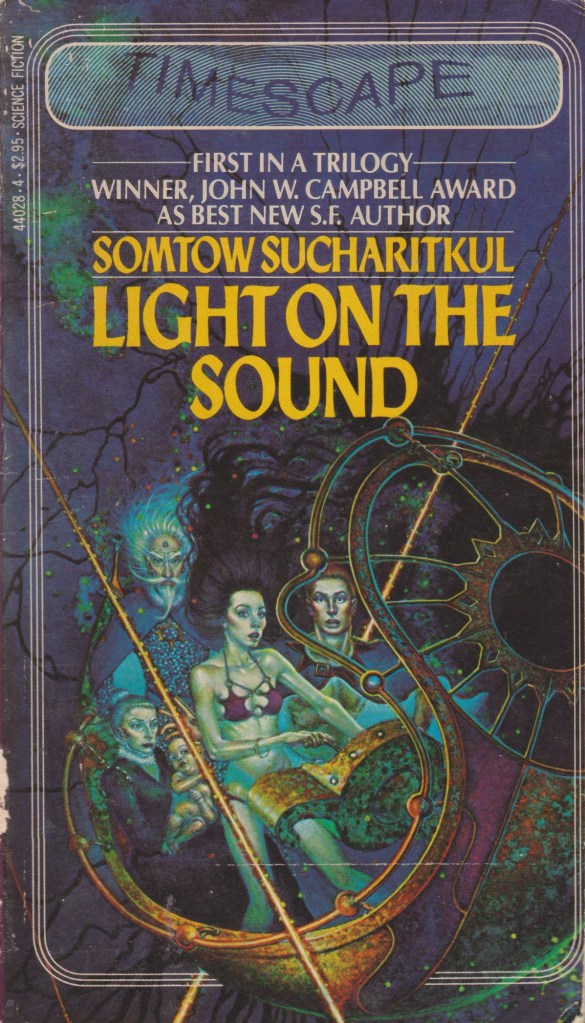
Don Maitz’s cover for the 1st edition
From the back cover: “ONE MAN PITTED HIMSELF AGAINST THE GREATEST POWER IN THE GALAXY, SEARCHING FOR SOMETHING HE WAS FORBIDDEN TO FIND…
Ton Davaryush had destroyed twelve utopias in the line of his duty as a Kingling of the galaxy’s all-powerful Inquest: he was delivering ignorant humanity from the throes of delusion. For it was written in the Inquestral Texts that man was a fallen being and all utopias inherently false.
But now, simmering with rebellion, Davaryush plotted the Inquest’s destruction and cursed the awesome extent of its power.
Now he stood ready to wreck havoc within the galactic tyranny. Now he was willing to risk the Inquest’s ultimate wrath. Because he had seen a thirteenth utopia, he had known the sin of joy… and he knew he would, he must, preserve it – at any price!
Initial Thoughts: I’ve only read, and mostly enjoyed, Somtow’s Starship & Haiku (1981). I find the premise of Light on the Sound, a man who destroys utopias, intriguing.
For book reviews consult the INDEX
For cover art posts consult the INDEX
For TV and film reviews consult the INDEX
 Science Fiction and Other Suspect Ruminations
“Dear Aunt Annie” strikes fear in my heart. Seems like a plausible dystopia now that ChatGPT et alii are getting their sea-legs. shudder
Hello Richard! Happy to see you back. I thought it might fit my media landscapes of the future series. But yeah, great premise. I can’t wait to read it.
…and see if you can ever sleep again…
Happy Yuletide, and a healthy new year, Dr. B.
Haha, maybe.
You too.
I certainly hope 2024 contains more opportunity for me to write. I wrote far less this year — alas.
That’s an ongoing challenge in Life…I’m absurdly lucky that I can spend all my time the way I want, with very few demands, while I still have the energy and intellectual capacity to enjoy it. (The occasional seismic health challenge aside, of course.)
I hope you’re doing better.
For sure. This year wasn’t harder at work or anything for me — if anything it was my easiest work year since 2017. But I found it difficult to put my thoughts to paper.
That struggle is harder because it can’t be externalized. Battles within cost more to fight than ones without.
Did you get to any worthwhile older SF in 2023?
I have to go look at my GR list to see if I read any at all, so no.
after checking I’m sad to say the only older SF that came my way in 2023 stank…THE REVOLVING BOY by Gertrude What’s-it and a lamer example of writing I haven’t encountered in quite a while.
I’ve never heard a good word about that book. I always find it in the used book store nearby and always put it back on the shelf…
Continue this course. It will save you much dyspepsia from trying to ingest its stodgy blobby writing. I got it as a gift from an old friend years ago and felt I should read it before putting it in the Little Free Library.
Ended up recycling it instead.
Silverberg’s THOSE WHO WATCH is indeed from his glory years, but IMO notable only for its competence.
In other words, it’s better than ACROSS A BILLION YEARS, which describes a beautiful android wandering around with naked breasts in its first few pages with approximately the literary style of a fifteen-year-old boy, IIRC, whereupon I gave up on that novel. But it’s not up to the level of, say, TO LIVE AGAIN (which I think is underrated, though it’s Silverberg rewriting Jack Vance’s TO LIVE FOREVER from 1956) or even THE SECOND TRIP.
But competent. It’s set in the US of the 1960s-70s, as I recall, so there’s not much sfnal world-building required to render the novel’s landscape, and there’s some sex between Earthings and aliens, which Silverberg also handles relatively well after all the experience he had churning out porn at the end of the 1950s into the 1960s. I think it might benefit a student writer to have a look at how Silverberg handled the basic carpentry of various scenes.
The Wollheim-Carr YEAR’S BEST 1970 wasn’t a bad year for that series, either.
SF readers back then probably expected Gordon Eklund to do more than he finally did. From a strong start, he pooped out relatively quickly, though he did linger, publishing a few stories here and there for the next two decades. Also, churning out books in the E.E .Smith franchise. Poor man.
I’m certainly not expecting Those Who Watch to be on the level of his best from the period — that’s for sure.
I’ve read To Live Again. I thought it was fine. I’d call something like The Man in the Maze his most underrated from that period. And I agree on The Second Trip as underrated as well. All three are reviewed on my site. A Time of Changes and Tower of Glass are the only Silverberg novels I’ve not managed to review. And his collection Capricorn Games…
Eklund: Yeah, he wrote some solid but unspectacular things in the early 70s. The Eclipse of Dawn (1971) had promise but didn’t do enough. I found “Stalking the Sun” (1972) surprisingly good but I didn’t write a full review of it so I don’t remember the details. “Three Comedians” (1973) was worth the read. And some of his co-written short stories with Benford were okay… I’ve reviewed two of those on the site.
JB: ‘I’d call something like The Man in the Maze his most underrated from that period.’
It’s good. Possibly it doesn’t get enough respect because it doesn’t come across as New Wave, just good solid classical SF, with affinities to some of the stuff Budrys did.
As for Eklund, “had promise but didn’t do enough” pretty much covers him. Yes, ‘If the Stars Are Gods’ is good, but that one feels like at least 50 percent Benford’s work.
I’d suggest that the focus on interior space — even if its prose is more traditional — is a common feature of the New Wave.
I think the Somtow is a fixup of pieces published in Asimovs (I certainly read some stories in the “investigator/destroyer of false utopias (and they’re all false)” universe back in the very early 80s).
Yup, the book indicates that two sections were previously published: “The Thirteenth Utopia” in the April 1979 issue of Analog and “Light on the Sound” in the August 1980 issue of Asimov’s. The isfdb.org entry needs to be updated: https://www.isfdb.org/cgi-bin/title.cgi?3070
There are a ton of books and short stories in the Inquestor sequence: Here’s the complete bibliography of the series: https://www.isfdb.org/cgi-bin/pe.cgi?1527
I never read the whole novel LIGHT ON THE SOUND but I read “The Thirteenth Utopia” and “Light on the Sound” in their magazine publications and quite enjoyed them. I thought Sucharitkul was going to become a star — and he did! But his career didn’t go in the direction I’d have preferred — which is fine, mind you! But most of his later writing was horror, not my thing, and his major artistic career is as a composer and conductor. Apparently a very good one! And his life story is pretty interesting. (For one thing, he is peripherally related to Anna Leonowens, the real person behind the (much romanticized) story told in THE KING AND I.)
I have not read THOSE WHO WATCH either, though I do remember that intriguing Signet cover. It was hard to keep up with Silveberg in those days! (I’ve never read ACROSS A BILLION YEARS either and somehow I thought it was supposed to be YA.)
I haven’t read THE SECOND EXPERIMENT. The stories she published in Asimov’s were pretty terrible, though, and every review I’ve read of her novels have hated them. It’s hard to to think — perhaps unfairly — that she sold much of her work on the strength of her husband’s name.
I have no doubt that the Janet Asimov tales are not great. I have a morbid curiosity when it comes to lesser known fictions.
Yeah, I’ve only read Sucharitkul’s Starship & Haiku (1981). I do enjoy science fiction about whales! https://sciencefictionruminations.com/2016/05/06/book-review-starship-and-haiku-somtow-sucharitkul-p-s-somtow-1981/
Have likewise never read the Silverberg, oddly; not sure I was even aware of it. Can imagine the premise going both ways in Silverbob’s hands: could be good if he leans into the psychology/sociology could be bad if he instead opted for generous descriptions of alien breasts.
Definitely one of the lesser novels from that highly productive string of masterpieces and almost masterpieces starting with Thorns.