Which books/covers/authors in the post intrigue you? Which have you read? Disliked? Enjoyed?
1. The Witling, Vernor Vinge (1976)

George Barr’s cover for the 1976 edition
From the back cover: “Witling: A pretender to wit. (Webster’s Dictionary)
In the eyes of the inhabitants of Giri the scientific explorers from outer space were witlings. In the context of that primitive-seeming planet, they were.
Because on Giri a peculiarity of evolution had given a special talent to all living things–and this talent had made unnecessary most of the inventions associated with intelligent life elsewhere. Roads and planes, engines and doors… these were the products of witlings, not of ‘normal’ people.
So when the little band from Earth’s exploration team fell into Giri hands, their problem was unprecedented. How to demonstrate that science is worthwhile and how to keep the medieval masters of Giri from realizing their potential for cosmic mischief.”
Initial Thoughts: Vernor Vinge passed away on March 20th. Here’s Rich Horton’s obituary in Black Gate. I thoroughly enjoyed his fiction before I started my website: I’ve read A Fire Upon the Deep (1992), A Deepness in the Sky (1999), The Peace War (1984), Marooned in Realtime (1986), Rainbows End (2006), and “Grimm’s Story” (1968). I thought I’d acquire some of his work that fit the perimeters of my site that I’d missed. I have a collection of his short fictions arriving any day as well.
2. To Challenge Chaos, Brian Stableford (1972)
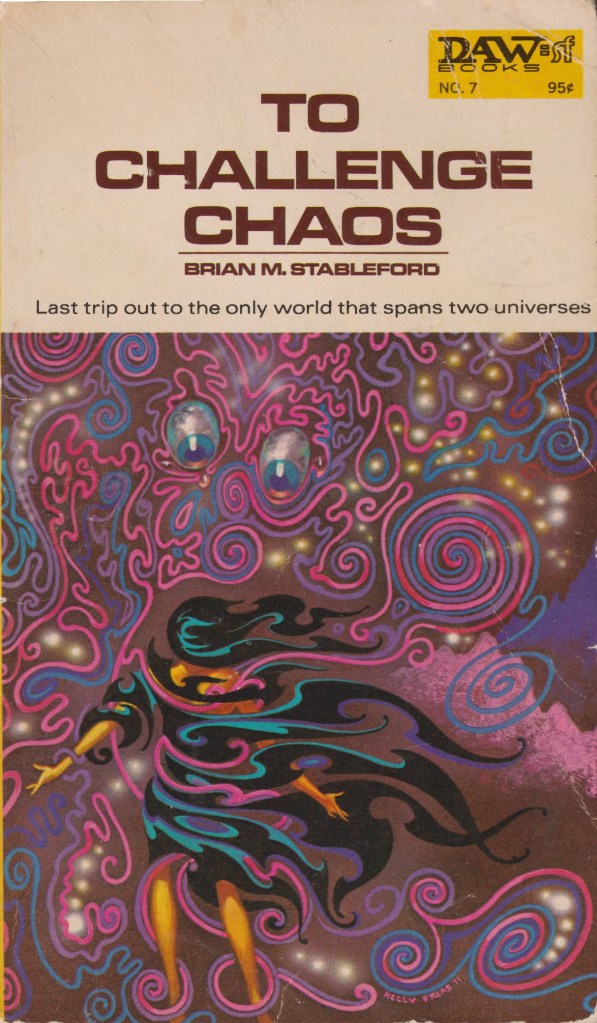
Kelly Freas’ cover for the 1st edition
From the back cover: “They named the planet Chaos X, because one hemisphere was not in this universe–and no one who ventured there would ever return. They named the other universe Ultra, because it was beyond the laws of the Milky Way galaxy. It was only by means of Ultra’s non-Euclidean physics that men could travel the stairways. They named the ruler of that “immobile” planet Fury, because that was the effect of his power on people. But they were afraid to call Craig Star Gazer by any other name, because he was the space captain who was going to cross into Fury’s domain and wrench his loved one from Ultra’s power–and this was something that no one had ever done before except the legendary Orpheus.”
Initial Thoughts: Brian Stableford, prolific author, editor, and science fiction scholar, passed away on February 24th. Here is his obituary on Locus. While I have not found the Stableford work that has entirely spoken to me, what I have read demonstrates his often engaging ideas and worlds. I know little about this particular volume–I had it sitting on my pile of unprocessed books and thought I’d feature it now. Of those I own, I’m most likely to get to Man in a Cage (1975) this year.
3. Mind Song, Joan Cox (1979)

Esteban Maroto’s cover for the 1st edition
From the back cover: “THE ORIGINAL PEOPLE DISAPPEARED IN A WRINKLE OF TIME.
On the planet Eden, a terraformed paradise in the midst of a Hellenic Age, one man hunts the supreme secret–that may be only a myth…
Call him Don Eal of Erl.
Call him lover, dreamer, rebel, seer.
Death-sentenced on his own world, rescued and led across wild and nomadic lands to the gleaming Citadel with its hidden ultramodern room–he alone can pass unscathed into the world of blue-green skies and bustling spaceports, searching the galaxy for treasure too close to see.
He alone can unlock the mystery for which an ageless race lost their memories to save their lives.”
Initial Thoughts: All I know about Joan Cox, I’ve cribbed from the brief entry on SF Encyclopedia: “US rancher and author whose first sf novel, Mindsong (1979), features a planet terraformed into a Hellenic Eden. Her second, Star Web (1980), is somewhat less engaging.” We shall see!
4. Time Out of Mind, Pierre Boulle (1963., trans. by Xan Fielding and Elisabeth Abbott 1966)
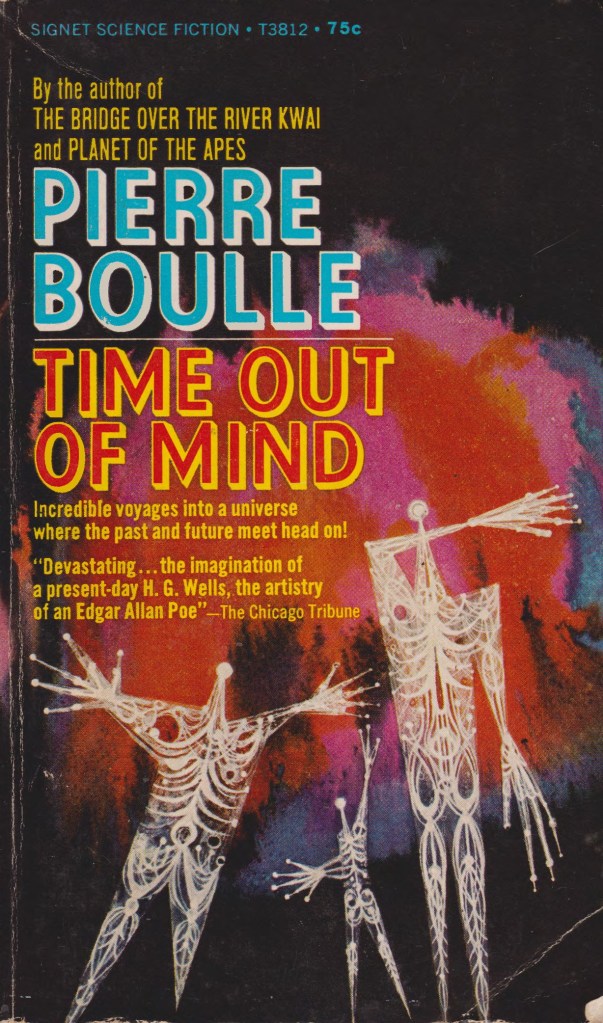
Richard Powers’ cover for the 1969 edition
From the back cover: By the author of PLANET OF THE APES.
DARING, PROPHETIC ADVENTURES IN TIME AND SPACE
Masterful, provocative tales of an improbable but all-too-possible, fantastic but all-too-real world in which:
A robot is made perfect when programmed to fail.
A murderer from a dead civilization pursues himself through time.
A miracle converts a scientist–and causes a priest to lose his faith.
Weightless sex is found to have its peculiar ‘delights.’
A man and a computer battle in a duel of honor.
Hiroshima blossoms with deadly nuclear flowers.
This i the rich and varied universe of Pierre Boulle, the disturbing genius who gave the world PLANET OF THE APES.”
Contents: “Time Out of Mind” (1953), “The Man Who Picked Up Pins” (1965), “The Miracle” (1957), “The Perfect Robot” (1953), “The Enigmatic Saint” (19665), “The Lunians” (1957), “The Diabolical Weapon” (1965), “The Age of Wisdom” (1953), “The Man Who Hated Machines” (1965), “Love and Gravity” (1957), “The Hallucination” (1953), “E=mc2” (1957).
Initial Thoughts: While I have seen the original Planet of the Apes film, I have not read any of his fiction. I followed Rachel S. Cordasco’s review series of ALL of his translated fictions and finally acted on some of her reviews! Here’s her review of Time Out of Mind (1963, trans. 1966).
For book reviews consult the INDEX
For cover art posts consult the INDEX
For TV and film reviews consult the INDEX
 Science Fiction and Other Suspect Ruminations
I loved all of the Planet of the Apes media, growing up in the 1970s and 80s. Certainly one of my *gateways* to sf. Later, I read ‘La planete des singes‘ (translated as ‘Monkey Planet‘) in my teens, and was struck not only by how it differed from the 1968 film, but perhaps even more was impressed how the low budget cartoon that I had loved as a c. 10 year old seemed to hew closer to the conception of ape society found in Boulle’s original novel:
https://en.wikipedia.org/wiki/Return_to_the_Planet_of_the_Apes
I should read the original book. Until I looked up the show you linked, I did not realize how much they had change about the Ape society (albeit, it makes sense because of budget).
Two Ballard covers, the original Cape hardback of Vermilion Sands and a Penguin edition of “Four Dimensional Nightmare”. The former is both very beautiful, and captures the essence of the lazy ennui of many of the stories, while the latter appeal to me as a pleasing representation of mitochondria, my research subject at around the time it was published.
This Vermilion Sands edition? https://www.isfdb.org/cgi-bin/pl.cgi?53282
I hadn’t seen this edition. Thanks! I do remember the Penguin edition of The Four-Dimensional Nightmare: https://www.isfdb.org/cgi-bin/pl.cgi?119191
And of the covers, authors, or books in this blog post intrigue you as well?
Sorry it’s taken a while to reply. Well, I have to confess ignorance of most of them. I’m British and so most of the sci-fi I’ve encountered has been in British editions. However, John Brunner and Clifford Simak always struck me as having interesting ideas. Ray Bradbury has an ability to tackle the uncanny with conviction, and I have a special regard for Susan Cooper’s Mandrake, which I read when I was quite young. Her later sequence “The Dark is Rising” shows her ability to sustain an idea across several novels. I would also mention James Blish as having had some excellent covers – The Day AFter Judgement and Black Easter (both Doubleday editions), and Dr Mirabilis (Arrow Books). Although it’s speculative fiction rather than sci-fi, Alan Garner’s Red Shift in the Collins hardback had a great cover.
I have a Flickr album of favourite book covers – https://www.flickr.com/photos/laoshu64/albums/72157623620686161/with/4642903275 most of these are sci-fi.
https://www.flickr.com/photos/laoshu64/albums/72157623620686161/with/4642903275
Thanks for responding. Yes, I’ve looked through every single British major publisher’s listing on isfdb.org. I know their covers in and out — and I’ve perused stores in Scotland and London on my various travels. That one had happened to pass me by…
I recently covered Mandrake on the site. I was not as enamored with it as you are. https://sciencefictionruminations.com/2023/10/07/short-book-reviews-octavia-e-butlers-mind-of-my-mind-1977-and-susan-coopers-mandrake-1964/
And her Dark is Rising sequence is certainly popular in the US and I consumed it greedily as a child.
I have Red Shift on my list.
Hi Joachim, have loved and followed your writing for a long while now. Just came here to post about an obscure book I recently enjoyed and I think you would too. Please consider reading Jandrax by Syd Logsdon (1979). Colony ship, survivalism & ways to build a society, sociopolitical ideas, all the good things. I think it is right up your alley.
Red Shift is excellent!
Thank you for your comment and kind words.
Yes, the author used to comment on my site (he had his own blog). I know he’s quite old and has cut back on his blogging. I have not read the book yet.
I read Boulle’s Garden on the Moon and really liked it. I picked up my copy in a used bookstore when I was sleep-deprived because the blurb refers to the scientists behind the moon race as lunatics and my sleep-deprived mind turned that into it being a story about the moon being inhabited by people labeled lunatics.
Your comment made me think of PKD’s Clans of the Alphane Moon (1964) in which “psychiatric diagnostic groups have differentiated themselves into caste-like pseudo-ethnicities” on the moons in the Alpha Centauri system.