
Cover art by Atun Purser
My article on organized labor in the 1940s and ’50s science fiction of Clifford D. Simak went live! I’d love to hear your thoughts. I’ve spent the last half year researching and reading religiously for this project–from topics such as Minnesota’s unique brand of radical politics to the work of contemporary intellectuals like C. Wright Mills (1916-1962) whom Simak most likely read.
Please check out the complete issue edited by Olav Rokne and Amanda Wakaruk over at Journey Planet. I have also embedded the PDF below.
The issue contains great work on the depiction of labor rights in a vast variety of other SF mediums. There are four articles that touch on vintage SF. The first two listed are by wonderful community members and official “Friends of the Site.”
- Rich Horton’s “Pohl Position” [the SF of Frederik Pohl]. You can check out Rich’s website here.
- Brian Collins’ “Alienation and Automation: Richard Matheson’s “Steel” and the Worker as Product.” You can check out Brian’s website here.
- Camestros Felapton’s “A Nightmare of Shopkeepers” [Anthony Burgers’ 1985].
- Kris Vyas-Myall’s “Fighting the Suits: Workers’ Rights in Televisual Doctor Who“
Here is my article if it’s easier to read on the site. Click each image to enlarge.
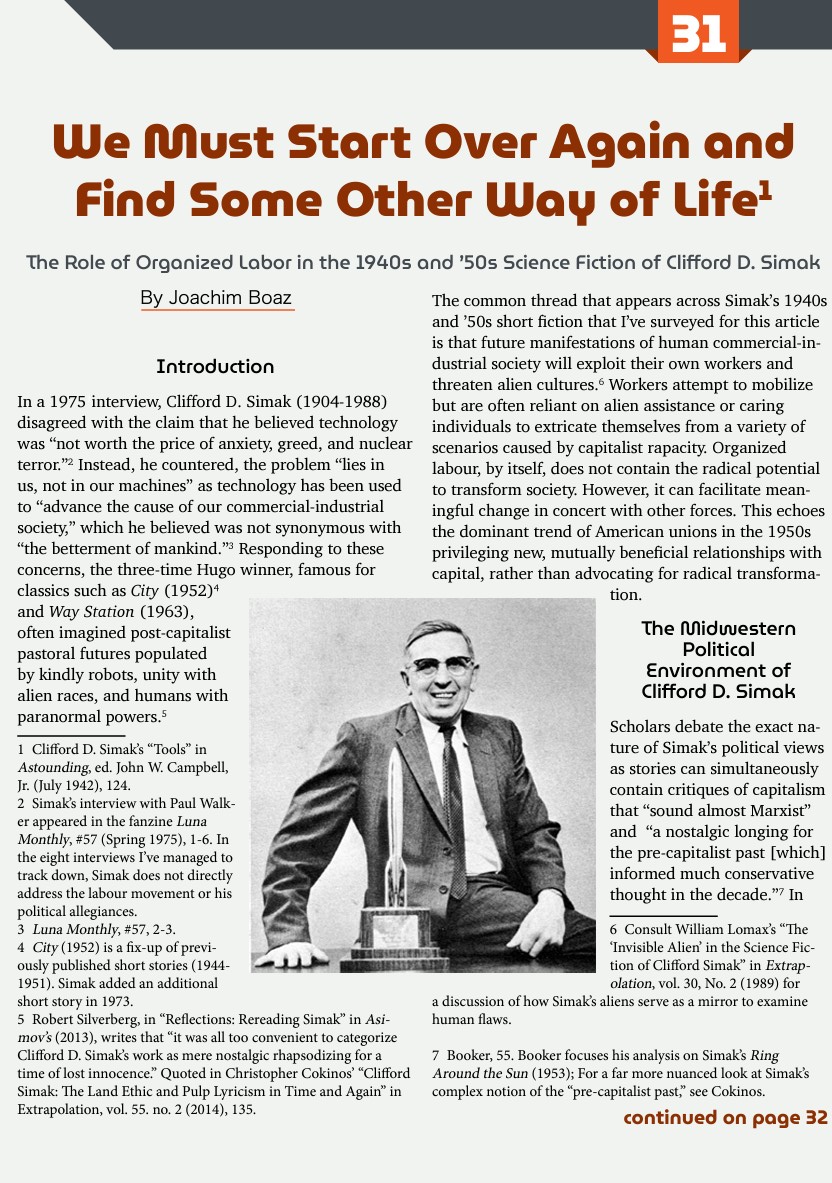
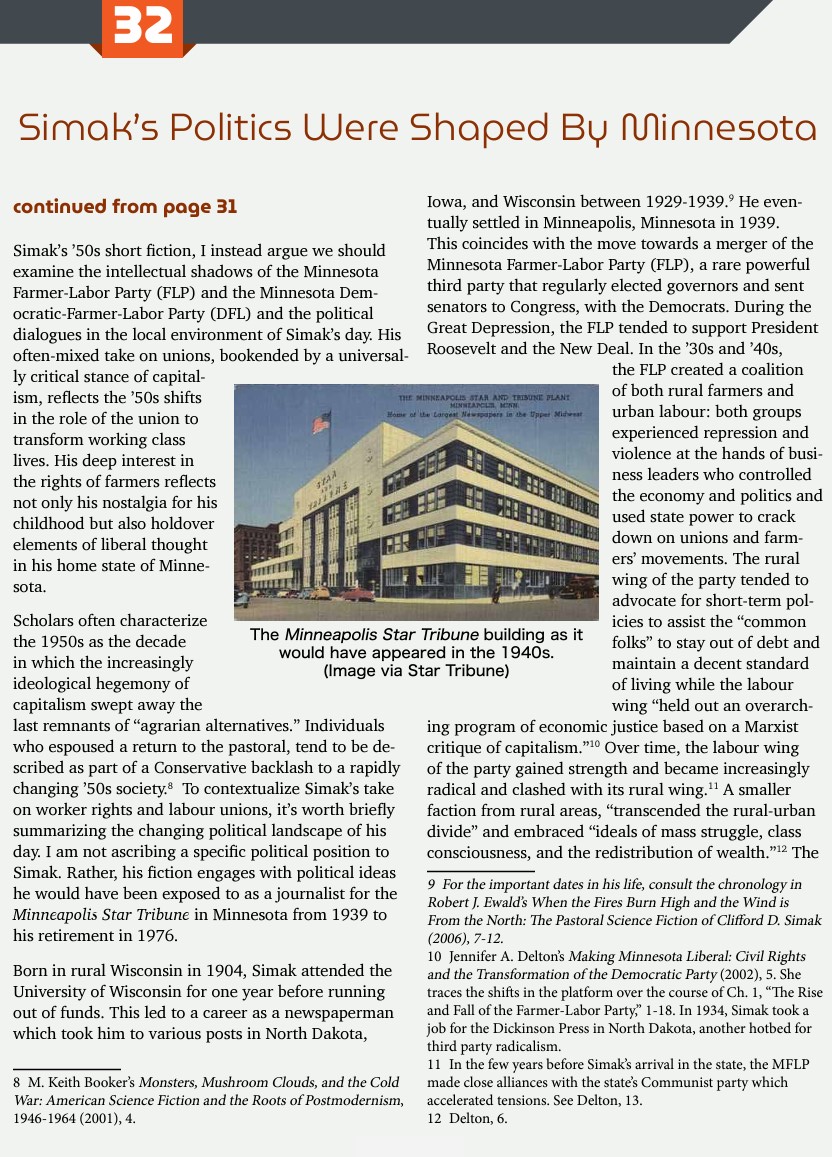
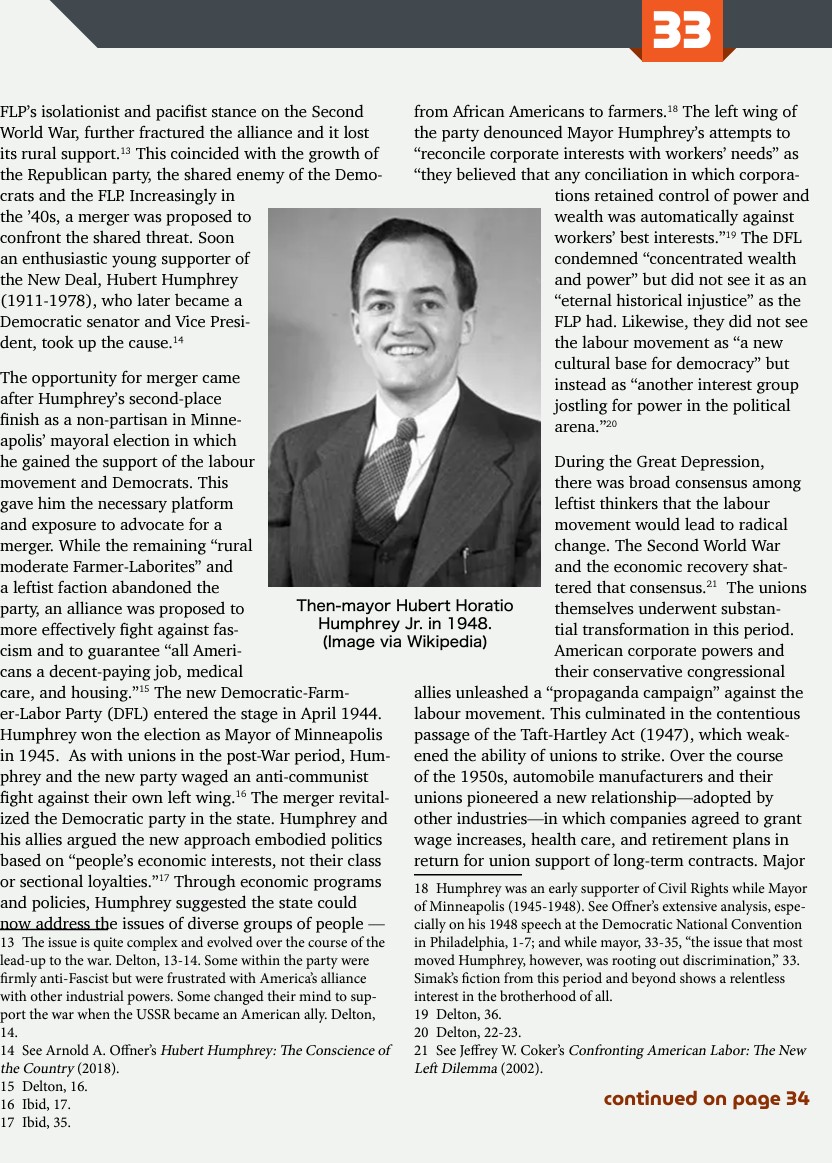
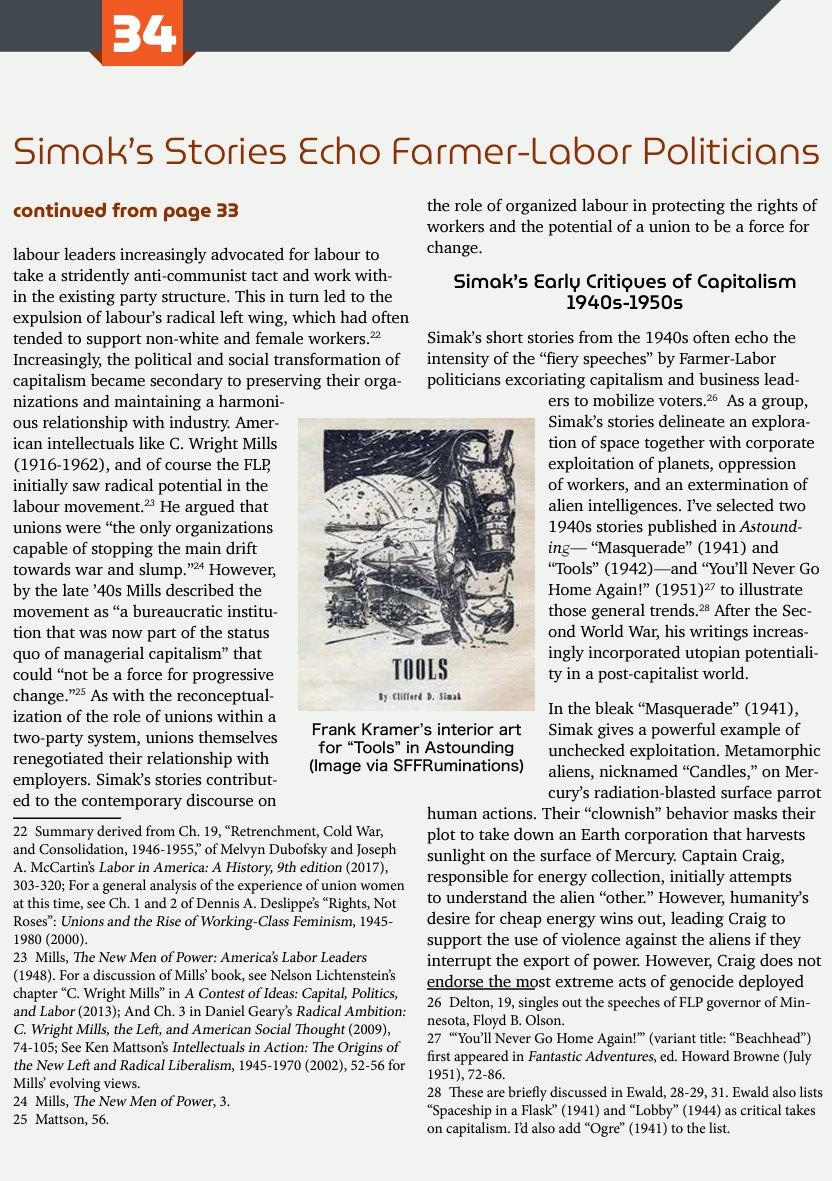
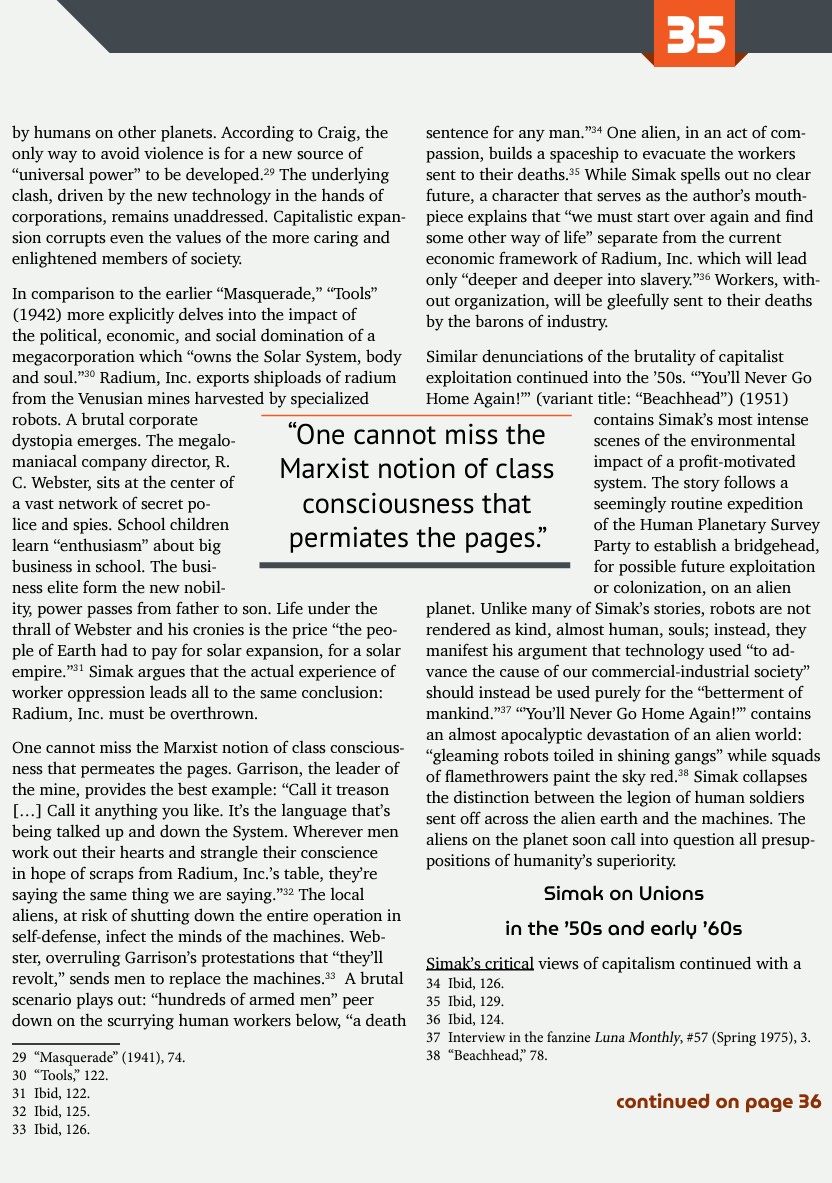
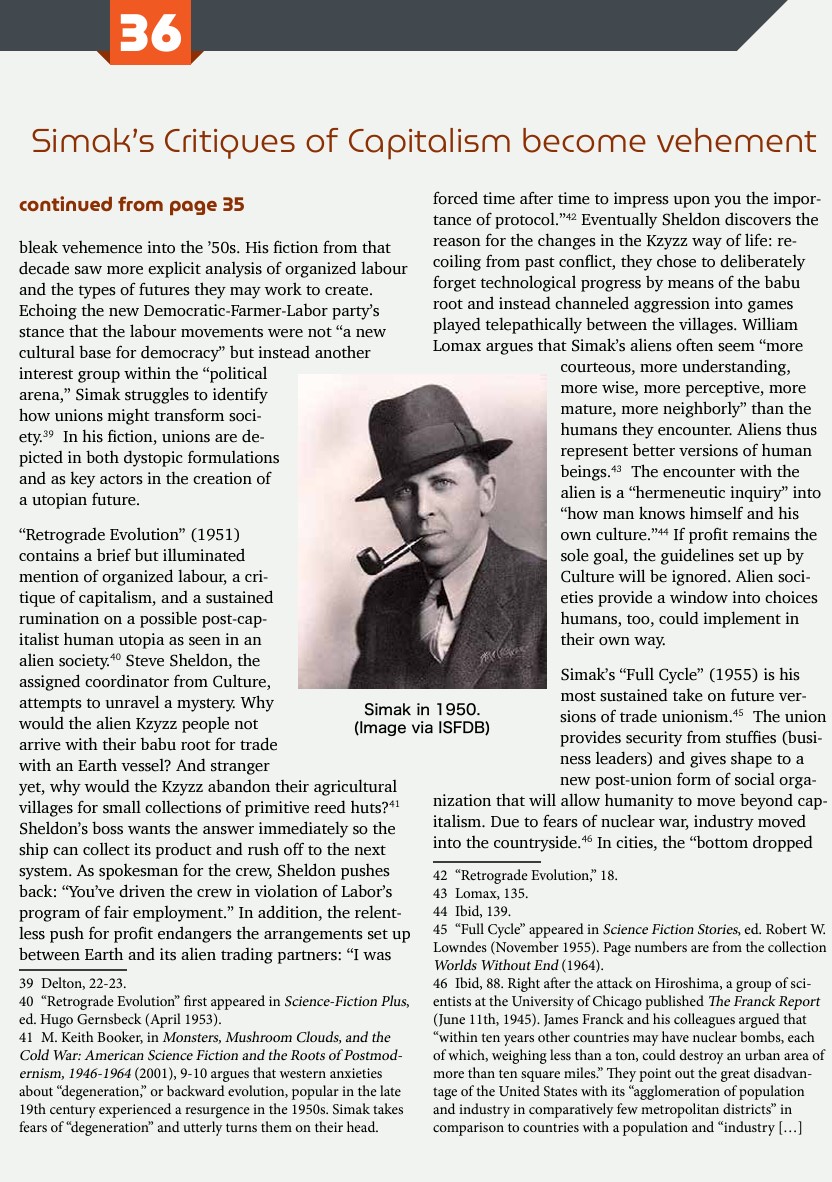
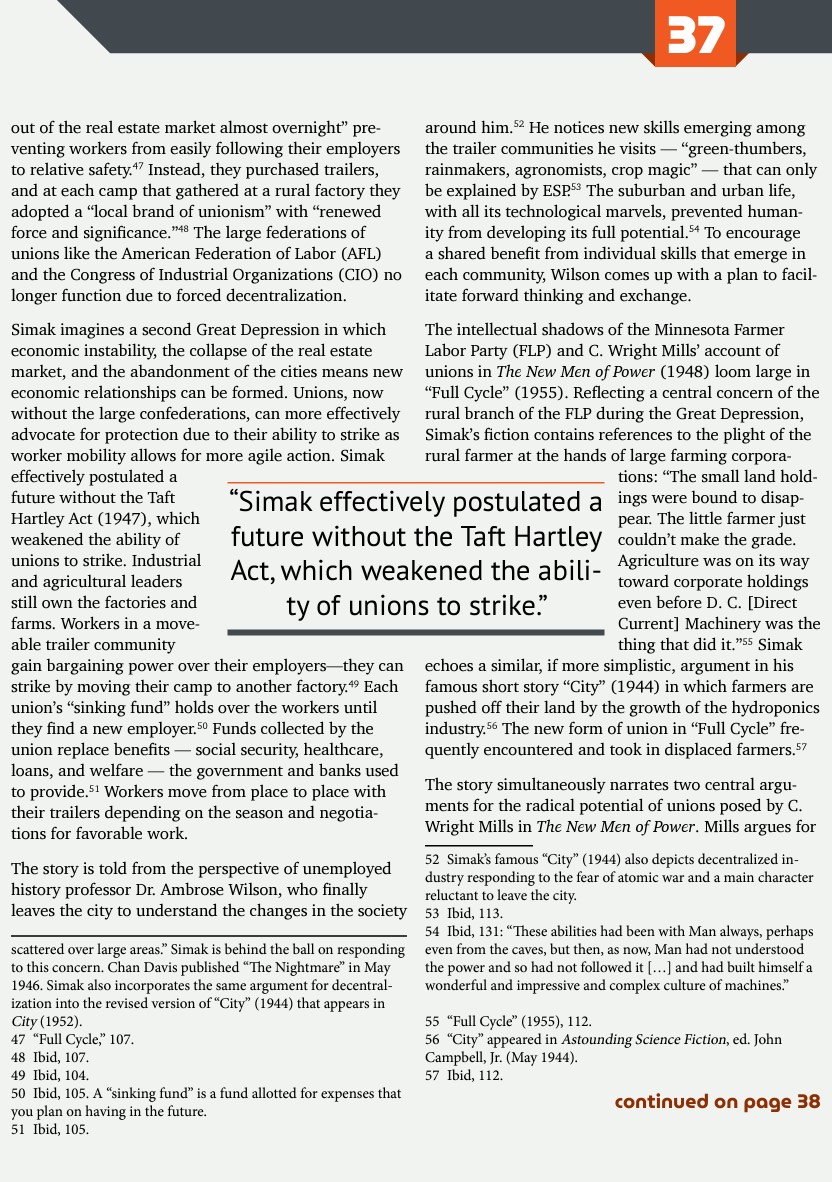
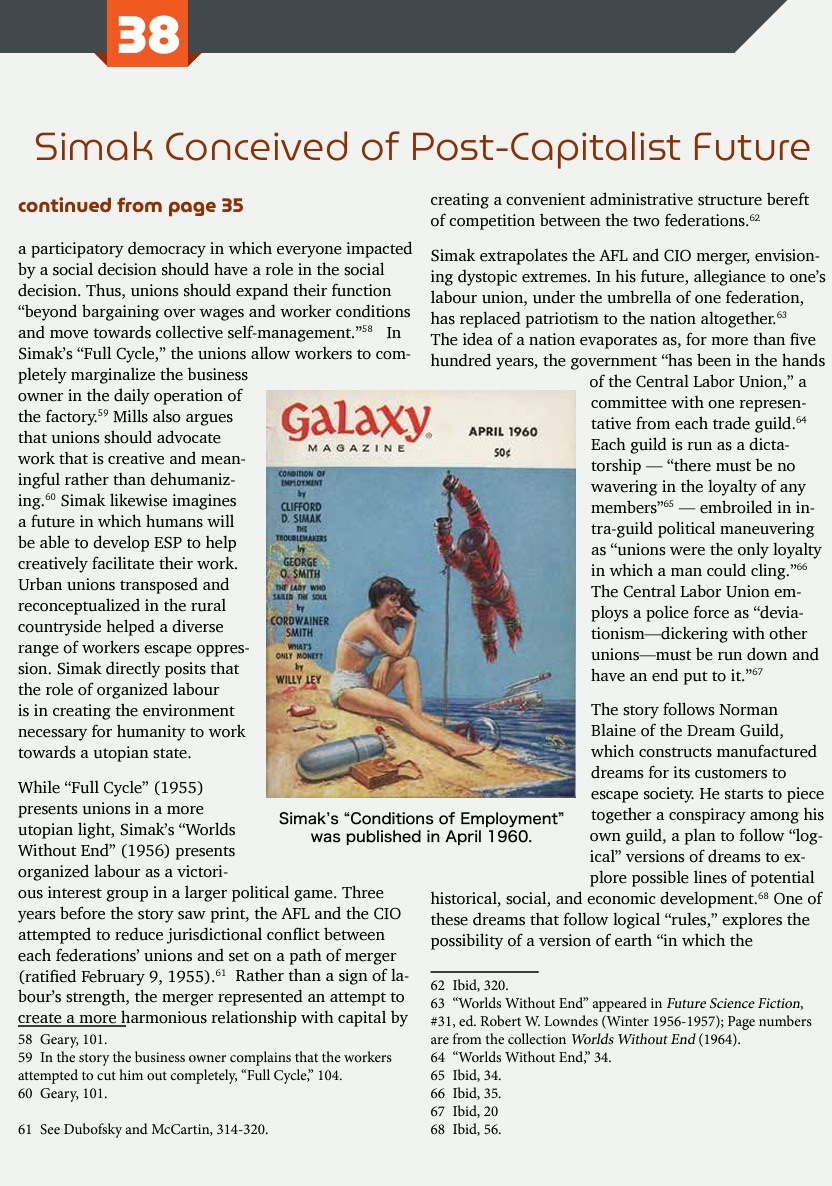

For book reviews consult the INDEX
For cover art posts consult the INDEX
For TV and film reviews consult the INDEX
 Science Fiction and Other Suspect Ruminations
As someone who was perplexed by some of the political perspectives in the smattering of Simak’s work that I have read, this provided a lot of illuminating context. Nicely done!
Thank you for the kind words! Of the stories I cover in the article, “Full Cycle” is definitely the most interesting take on trade unionism.
I truly appreciate the detailed analysis of the last-century struggles and ideologies of all those that made the world as it is today – in the lens of speculative fiction narrative. When an author takes the time to provide granular detail on its characters and settings, one can’t help but seek out more spohisticated answers than simply ‘us vs them’. Though, I do lean towards a more Ayn Rand-ian ‘take’ on the world in seeking out individualism, hyper-rationalism, post-emotional-group-bonds, and other such self-directed quests to push the limits of society, knowledge, and technological-know-how.
I’m glad you enjoyed the article. Have you read any of Simak’s work?
Funnily enough, I can only recall short stories where the protagonist was an individualistic stoic-type persevering against great odds in otherwise countryside or rugged settings. Early 60s (or before) shorter works appeared to include dog/ domestic animal companions and near-compassionate robot sidekicks. I believe at least one of his less ‘dark’ short stories became an episode of Outer Limits. In general, a fascinating author for which I can only recall heroic glimpses but haven’t pursued a dedicated re-reading. It seems that one who reads mostly short stories, compilations, and anthologies from the golden and silver ages tends to have a bit of a different take on an author or theme – one may posit Silverberg as another.
Yes, he’s best known for the City stories published between (1944-1951). Gathered together with some slight edits and modifications as City (1952). I suspect you read one of the early city stories like “City” (1944) or “Huddling Place” (1944) or a classic like “The Big Front Yard” (1959), not a City story, but contains a standard Simak main character in the countryside. I covered the first story — “City” (1944) — very recently here: https://sciencefictionruminations.com/2024/08/18/short-story-reviews-clifford-d-simaks-city-1944-ogre-1944-and-spaceship-in-a-flask-1941/ . Unfortunately, I could not reread it in time to add more than a footnote about it in the article (I read the full City volume last as an older teen). But it fits the general argument I was making.
I don’t entirely understand what you mean here: “It seems that one who reads mostly short stories, compilations, and anthologies from the golden and silver ages tends to have a bit of a different take on an author or theme – one may posit Silverberg as another.” A different take than what? Than who? Me?
It seems like you want to directly disagree with my article in some way but you aren’t exactly making your position clear or I could be misreading your intent. If it’s the former, then I’m all for debate (as long as its civil). If it’s the latter, then apologies for misreading your comment. It’s hard to exactly know where people are coming from across the interwebs.
Pingback: Pixel Scroll 9/14/24 Scrollchak, The Night Pixel | File 770
Thanks for the shout out!
Your article really is very impressive, and I had not really appreciated that aspect of Simak’s politics, nor its Minnesotan context. And … 75 footnotes! Wow! I really meant to add one token footnote to my piece just to help Olav and Amanda set the record but I forgot!
I think it may be true that for some authors their short stories offer a different perspective than their novels on their views. A variety of potential reasons — short stories offer more opportunities for experimentation, short stories may be predominantly written (for some writers) when younger and their views are different, novels may be more “commercial” and so avoid controversial positions. None of these apply to all authors, of course, and I’m not sure they really apply to, say, Silverberg, or even Simak. In Silverberg’s case, the division seems mostly be career stage — routine work early, ambitious work in the middle period, polished and professional but less challenging work late in his career. To a first approximation. And he wrote short stories all along.
Thank you for the kind words. I think Pohl in many ways matches up with the shift that occurred in lots of the radical left in the immediate post-WWII environment (which parallels a lot of the 50s social criticism). I am happy to talk to it more outside of the comments as I have grand ideas for future projects that I don’t want to spill here.
For me there isn’t much of a divide between Simak’s short fiction and novels in this period covered by my article (40s-late 50s). He didn’t need to be commercial, he had a career that actually paid the bills and it wasn’t writing SF. He did not need to be radical/experimental in short stories instead of novels.
Thus, I don’t see the Simak comparison to Silverberg made earlier by Designguy (unless he provides additional explanation) — at least within in the date range that I covered in my post (40s-late 50s with one 60s short story). Simak did not write novels religiously until the 60s. And my footnotes do indicate similar arguments in the early 60s stuff, like They Walk Like Men (and of course 50s fix-ups like City in the earliest sections).
Within the date range of my article I could have included more discussion of novels — they all support my argument that he’s in dialogue with anti-capitalist radical/progressive thought present in the midwest. And, as I mentioned in another footnotes, I could easily have focused extensively on the Ring Around the Sun (1953) but M. Keith Booker did in his monograph so I chose not to.. Time and Again (1951) also contains similar themes, but it was covered by Cokinos’ article that I cited in the footnotes. Empire (1951), written earlier from a draft provided by Cambell, also contains strident anti-capitalist moments. In short, ALL Simak’s 50s novels (original novels, fix-ups or stuff written earlier and published in the decade) contains strident anti-capitalist views and often speculations on post-capitalist futures. As they did not cover organized labor overtly and/or were covered by others in substantial, I didn’t include them in my analysis.
I was quite impressed with your article for two reasons. First, because of the detailed analysis of Simak’s stories and connecting them to the real-world politics of the 1940s and 1950s. Second, because it makes me think of Simak in a new light. I never knew he was so political. Your article made me think that Simak does deserve an in-depth biography and also a full-scale analysis of his work.
I would be great if Alec Nevala-Lee took up the challenge like he did for Buckminster Fuller. Of course, Nevala-Lee is also hard on people’s legacies, revealing their flaws, especially for Campbell, Heinlein, Asimov, and Hubbard. William H. Patterson’s biography of Heinlein had the research and details I’d like to see in a Simak biography, but he was too worshipful of his subject, and sadly he’s not available.
The trouble is our genre doesn’t attract real biographers. Nevala-Lee is the only one I can think of who wrote a genuine biography of SF writers with his book Astounding.
Thank you for the kind words. I can only assume Simak will eventually receive a volume in the U. Illinois Masters of Science Fiction series at some point. https://www.press.uillinois.edu/books/find_books.php?type=series&search=MSF
While not exactly biographies, they do contain a lot of great information about the authors they feature. Sometimes I wish they were more like biographies. Unfortunately, Nevala-Lee barely gave Simak a mention in his Astounding volume despite Simak’s presence in Astounding. As for a biography of Simak, I would imagine it would be quite challenging to create. SF was not his career and he was not heavily involved in fandom until after his retirement from his main newspapers. Large portions would focus on his newspaperman job. Muriel R. Becker’s Clifford D. Simak: A Primary and Secondary Bibliography (1980) is pretty cool as it contains listings for all his non-fiction work for the newspapers.
Excellent piece and reminds me I really need to finish my project of reading all of Simak. In addition to the capitalist critique in They Walked Like Men, Simak’s later The Visitors contains elements of that (crashing the world’s economy through cheap, alien-produced goods as I recall).
Coincidentally, I’ve recently become interested in the Nonpartisan League (NPL) due to my strong North Dakota ties. I suspect you came across references to them in researching Minnesota’s FLP, that state’s political descendant of the NPL.
I was unaware of Simak’s many journalist jobs outside of Minnesota. Given when he was born and his jobs in North Dakota, Simak would have been well aware of the NPL rise to power in North Dakota. To simplify greatly, the NPL regarded North Dakota as sort of a colony exploited by “Eastern” money interests — particularly out of St. Paul.
Many states (Montana, Idaho, South Dakota, Minnesota, Wisconsin, and Iowa) tried to emulate the NPL’s influence in North Dakota. As Simak would have known, it was rather violently suppressed in Minnesota. (Charles Lindbergh’s father was an NPL candidate and threatened with violence.)
Given the agrarian concerns of self-employed farmers, the NPL isn’t particularly relevant to labor unions. However, “Full Cycle” would seem to be influenced by the NPL’s concern.
The NPL’s reforms in North Dakota were a mixed bag and not all survived, but there are three lasting ones, some quite peculiar to North Dakota: a state-owned Bank, a state-owed flour mill, and a ban on corporate farming.
Thank you for the wonderful comment. I made sure to note North Dakota in one of the footnotes to hint at other midwestern radical third parties! There was a lot to talk about. I could have mentioned the Socialist party in his home state of Wisconsin as well.
“Given the agrarian concerns of self-employed farmers, the NPL isn’t particularly relevant to labor unions. However, “Full Cycle” would seem to be influenced by the NPL’s concern.” — this is why I suggested the Farmer-Labor Party of Minnesota influenced Simak as it tried to create an alliance between the urban worker and rural farmer, and the writing of C. Wright Mill, whom I’d wager he read (at least a review of his work on unions in the newspaper he worked for). The same concern comes up in “City” (1944), which I mentioned in passing.
I am continuing my union and organized labor project. Stay tuned!
While I have not read The Visitor, I have heard about it. I did not read it for this project due to my article coverage range.
If you haven’t come across it in your research, North Dakota Public Television did a three part series on the NPL starting with: https://youtu.be/awLIsiMwzUM?si=iwwjBRWuwLFTbvsl
Thank you for the link!
Thanks for the article. It definitely made me want to pull out my Simak anthology and do some reading/re-reading.
I’m glad you enjoyed the article! All the Simak stories I featured in the article are available online. I can’t say they are all his best stories, I was more interested, obviously, in exploring a theme vs. covering his best work. Of the stories I featured, “City” (1944), “Full Cycle” (!955), and “Conditions of Employment” (1960) were the best. I’ve linked my original reviews which in turn contain links to online copies if you don’t own copies of the stories.
Excellent work contextualizing and propagating Simak’s work. A lot of authors wrote for their market; others wrote what they wanted and let the market come to them. I think Simak was in the latter camp. What he writes is irretrievably him.
That he tried to point the way to a brighter future through Minnesota populism/pastoralism is just part of his charm. 🙂
Thank you!
It is quite shocking when you realize how few SF authors actually made a living from their SF. Most had some other career.
¡¡¡Wow, great article!!!. I loved it. How much detail and history I didn’t know….About Masquerade I have something that can be interesting… at least for me ….
A couple of years ago I dedicated myself to translate into Spanish some of his work that was not yet translated, and already with some knowledge about his biography and his context, I was surprised by this story, because it always seemed to me consistent with his ideas and without too many deep-rooted racist prejudices. Seeing a stereotypical African American in the first publication of the story caught my attention, although in reality I suppose it was common, but seeing that subsequent editions eliminated the character (Rastus) seemed to me that it could be the work of a change of perspective in the way of understanding or trying to amend the story. But I never knew if it could be Simak’s hand or some editor’s hand to save space…..
I’ll detail it for you below.
I looked for help on this at:
https://www.sffchronicles.com/threads/549645/page-42
The story Masquerade aka Operation Mercury (1941) has two versions, the original Astounding from 1941 (about 9,174 words) and a 1954 edition of the ACE-DOUBLE book collection edited by Donald A. Wollhiem: Adventures in the Far Future /Tales of Outer Space (about 7,611 words).
Astounding Science Fiction vol. 27 iss. 1] – (1941) .jpgtalesouterspace_us_pb_ace1954_operationmercury.jpg
The latter is the best known and translated into other languages. It is characterized by being shortened, eliminating a character from the original and all its paragraphs… The character called Rastus, a “Black” as mentioned in the story.This version of the 1941 original was not republished until 1997, in the book “The Civilization Game and Other Stories”, by the editor of several Simak books and the person responsible for one of the few biographies of Simak, Francis Lyall, although he himself says that it is not specifically a biography.The editions that I found in Italian and Russian editions I looked at use Wollhiem’s short version.
I still don’t understand why the cut, or if Simak himself had a part in it. It’s not a rewrite, but some parts needed fixing and rewriting to “fit” the missing character Rastus.
I thought it could be due to a matter of “Political Correctness” so as not to give an idea of racism in the story, but then it occurred to me that in 1954, they should not have bothered too much about it, and that the cut was due only to a question to limit the number of pages… although it might have been easier to remove some sections without having to remove the complete character Rastus.Although this cut does not substantially alter the story, it was at least for me curious to find this detail.It would be interesting to know if the edition corresponded to Simak or if it was just a decision of the editor…
I hope this is of interest and again I thank the post and all those who make it possible for the work of this “Great Master” not to be forgotten.
Cordial greetings from Argentina.
What do you think in connection with his “critique” of capitalism?
As a Simak fan I am infinitely grateful.
¡¡¡¡Saludos y Gracias por tu fabuloso trabajo!!!!!!!!