Which books/covers/authors intrigue you? Which have you read? Disliked? Enjoyed?
1. Deus Irae, Philip K. Dick and Roger Zelazny (1976)

Richard Corben’s cover for the 1980 edition
From the back cover: “One their own, they have written landmarks works that have added whole new dimensions of wonder to the field of science fiction. Now, in Deus Irae, they have created what ALA Booklist calls “the most successful collaboration in years!”–set in in bizarre world where you will encounter…
A bunch of backwoods farmers who happen to be lizards…
A tribe of foul-mouthed giant bugs who worship a dead VW sedan…
An automated factory that can’t decide whether to serve its customers–or kill them.
Across this nightmare landscape–pursued by an avenging angel on a bicycle–one man makes a painful pilgrimage in search of the one who changed the world so drastically–the legendary, by very, God of Wrath…”
Initial Thoughts: I’ve heard that this co-written book by Dick and Zelazny is far from their respective best. I’m still curious!
2. Staroamer’s Fate, Chuck Rothman (1986)
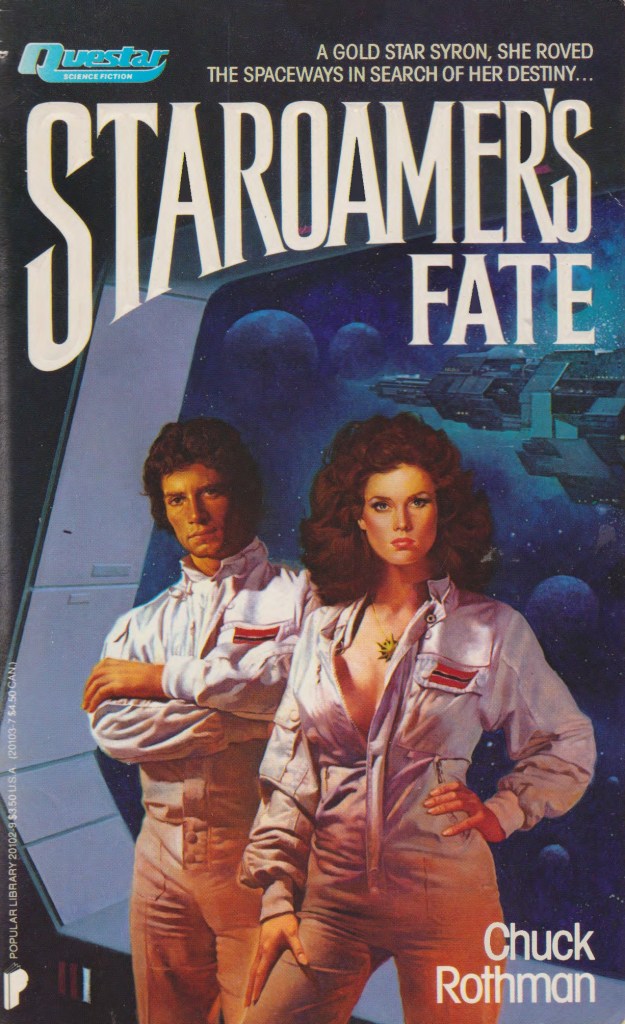
Enric’s cover for the 1st edition
From the back cover: “QUARNIAN DOW. Space salvager, planet tamer, dreamstone thief, revolutionary–Quarnian was a woman with a destiny, a gold star syron gifted with the ability to “know” the future and to see into the hearts and minds of others. But the very talent that let her bend others to her will was the curse that made her a lone adventurer, called by some inner voice to world after world, challenge after challenge.
Now the destiny was again calling Quarnian… this time to a rendezvous with a long-lost legend–and a journey of discovery that could change the fate of all who roamed the skies…”
Initial Thoughts: I acquired this one as it contains a generation ship. I am an aficionado of the generation ship. Here’s a list I’ve compiled on the topic with links to those I’ve reviewed. I assume the novel will be poor despite the theme.
3. Flesh, Philip José Farmer (1960)
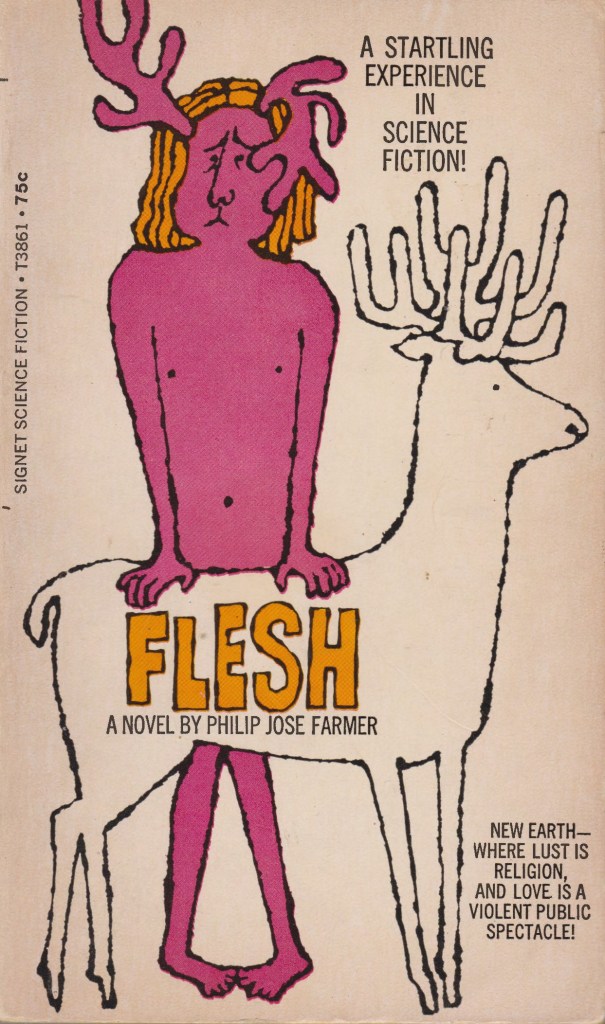
Ellen Raskin’s cover for the 1969 edition
From the back cover: “HE WAS THE SUNHERO. STUD-GOD TO A MILLION ADORING FEMALES.
After 800 years of exploring the stars Space Commander Stagg had expected a hero’s welcome–but this was awesome. First, they grafted real antlers on his head. Then they invested him with the pure sex power of 50 bulls and turned him loose on a screaming frenzy of fire-up virgins. Now he was on an ecstatic public fertility tour that took in every available female–and could soon take his life…”
Initial Thoughts: In January, I acquired the 1st edition of Farmer’s Flesh. He revised the novel for all the post-1968 printings. If rewrites occur within my date ranges, I’m always interested in the nature of revision especially as the early 1960s vs. late 1960s were radically different in the allowed content. Perhaps the revisions reflect this. We shall see!
4. Future Love: A Science Fiction Triad, ed. Roger Elwood (1977)

Don Carroll’s cover for the 1st edition
Contents: Anne McCaffrey’s “The Greatest Love” (1977), Joan Hunter Holly’s “Psi Clone” (1977), and Jeffrey A. Carver’s “Love Rogo” (1977).
From the back cover: “Anne McCaffrey, who is probably well known to most readers of this book, examines in her story a mother love that goes beyond the physical, in a new and different sense of that phrase; a sense, in fact, not possible until present-day medical technology gave us the means of realizing it. That particular gift of Anne McCaffrey is that she can infuse such an intense human light and warmth into a hitherto-unknown, laboratory-cold subject that it takes on the familiar, common quality of everyday readerly lives.
Joan Holly, who has also been writing SF successfully for years, deals with a different kind of parent-child pattern. Again there is a love situation emerging out of a relationship which would have been impossible before present-day science gave it to us as something that could happen. But here again, through Joan Holly’s creativity, we have an intense, swift-running story, like a landslide channeled between canyon walls so deep they almost shut out the light.
Jeffrey Carver goes one step beyond the interaction of ordinary human love. He plunges the reader into a small whirlpool of individual lives, carried along with the rushing current of power, plunging ever more swiftly toward the bring of a waterfall. Here, the love is not between human and human, but between human and something else–a love that in the end betrays.”
Initial Thoughts: I have not read any work by Holly or Carver. As for McCaffrey, she was an adored author of my childhood—I read and reread and reread her Pern novels (and the endless prequels and side-series and volumes written with her son). I suspect she’s an author that would lose a bit of the luster if I returned to my nostalgic favorites.
For book reviews consult the INDEX
For cover art posts consult the INDEX
For TV and film reviews consult the INDEX
 Science Fiction and Other Suspect Ruminations
“Deus Irae” took about ten years to write, but it should have been written in the 1960s. The trouble was that Dick got writer’s block and sought to have a collaborator to complete it. Ted White was to do it with him, but apparently didn’t like the core notes for the novel. In essence it’s one of his 1960s novels, but permeated by the changes that had already occurred in his writing by the time it was completed and the fusion with Roger Zelazny’s own style, I think it created an insipid cocktail of a novel.
I don’t remember much about “Flesh” now. I think I found the concept daring at the time, but the entire novel was rather dull. Farmer has long vanished from my SF scanner.
Yeah, I read a bit about the collab in F. Brett Cox’s monograph Roger Zelazny (2021) — I should take a look at the volume again to see if there’s any other interesting nuggets about their partnership.
It only gets briefly mentioned in the Six Volume Zelazny story collection in the biography section.
Ah, have you read the Cox volume yet? I feel that I’ve suggested it to you before — completely worth it! He’s a bit of a revisionist when it comes to Zelazny and sets out to rehabilitate some of his later works. It seems that a lot of critics enjoy his early work more (I might be one although I read his best known stuff as an older teenager and haven’t returned) and see his quality declining substantially when he retired from his day job and devoted himself to writing…
its’ on mount TBR
I know the feeling.
Alas, it is my sad duty to report that Staroamer’s Fate is indeed poor.
One of those “I only bought it because there’s a generation ship and I am obsessive when it comes to themes I enjoy” type books. Did you review it somewhere?
EDIT: I see your review is linked. Sorry! I’ll look.
Sounds like lots of cool ideas — including the actual generation ships part — and then other really awful ideas that clash and ruin the entire novel.
That sums it up well. The author lacked the editorial guidance to know which of his many ideas were compatible and which weren’t, and so threw them all into the pot.
That Questar / Popular Library press can be quite low quality.
I still remember one moment from Deus Irae that had me laughing out loud, and I remember the book fondly. I was a big fan of Zelazny’s work from the 60’s, but have never been a fan of PKD. I’ve read several of his novels, including some of the so-called masterpieces, and they always leave me cold. So a dissenting opinion, and mild recommendation for Deus Irae.
I enjoy both authors. We shall see!
I’d read the Philip K Dick because even bad PKD is at least interesting.
The Philip Jose Farmer rewrite could be good… or it could be bad in the way that science fiction about sex from the late ’60’s can be. The antlers thing makes it sound like that future is pagan.
I agree on the PKD point. To be honest, the literary quality won’t be the primary reason I’ll read it — rather as a lens to understand the era. I have an interested in depictions of sex in SF before the New Wave. I should get back to that series. For example, I wrote about Farmer’s The Lovers here: https://sciencefictionruminations.com/2022/08/07/short-story-review-philip-jose-farmers-the-lovers-1952/
I have Flesh on my bookshelf. Something just caught my eye about it, but I am too worried to read it incase it isn’t what I expect it to be, if that makes any sense, ha
Which version do you own? I think the contents of the 1960 original vs. the late 60s revision might show some fascinating differences… we shall see!
Some beautiful covers right there. Thanks for sharing.