In the past few years, I’ve put together a series on the first three published short fictions by female authors who are completely new to me or whose most famous SF novels fall mostly outside the post-WWII to mid-1980s focus of my reading adventures. To be clear, I do not expect transformative or brilliant things from first stories. Rather, it’s a way to get a sense of subject matter and concerns that first motivated authors to put pen to paper.
Today I’ve selected the first three science fiction short stories by New Zealander author Cherry Wilder (1930-2002). Here’s her bibliography. In the past I’ve picked up her best-known novel Second Nature (1982) and gazed at the evocative Tony Roberts cover! But never managed to get past the first few pages… According to SF Encyclopedia, Wilder’s work is “notable for its narrative skill, evocative style and rounded characterization, should have long since given her a higher reputation.” My general sense from her first three stories is that they’re relatively well-told, traditional, and a bit on the slight side of things. I still look forward to reading Second Nature (1982).
So far I’ve featured Leigh Kennedy (1951-), Alice Eleanor Jones (1916-1981), Phyllis Gotlieb (1926-2009), Sydney J. Van Scyoc (1939-2023), Josephine Saxton (1935-), Carol Emshwiller (1921-2019), Wilmar H. Shiras (1908-1990), Nancy Kress (1948-), Melisa Michaels (1946-2019), Lee Killough (1942-), Betsy Curtis (1917-2002), and Eleanor Arnason (1942-).
Let’s get to the stories!

Tony Roberts’ cover for the 1975 edition of New Writings in SF-24, ed. Kenneth Bulmer (1974)
3.5/5 (Good)
“The Ark of James Carlyle” first appeared in New Writings in SF-24, ed. Kenneth Bulmer (1974). You can read it online here. Nominated for the 1975 Ditmar Award for Best Australian Long Fiction.
Carlyle spends his tour of duty in a hut with a wood platform on small landmass surrounded by an “oily purple sea” on an alien planet (56). The alien “quogs” squat around the platform: “they had been described as small land mammals, semi-erect bipeds, modified baboons. They were docile, certainly, and capable of performing many tasks; but they were also ugly, elusive and rank-smelling” (58). A few visiting anthropologists had attempted to study the quogs, and whether or not they had language, with little progress. However, through a complete, nearly cataclysmic, accident, Carlyle will finally learn their secrets. Each of the islands on which the quogs dwells contains a massive tree. Carlyle had cut down the tree to build his hut and platform. He soon discovers the quogs can detect changes in barometric pressure. And as a massive flood approaches, the quogs huddle on the stump of their tree… The trees provided the only way to escape the rising water. Carlyle must take drastic action to save the community!
Of Wilder’s first three short stories, “The Ark of James Carlyle” is the absolute frontrunner. It’s an auspicious work of anthropological SF that doesn’t quite hit on all cylinders. “The Ark” contains a gentle satire of human inability to understand the impact of their ecologically destructive actions. It’s warm-hearted, simple but polished, and it’s hard to not care about the quogs and their fate. Somewhat recommended.

Uncredited cover for New Writings in SF-26, ed. Kenneth Bulmer (1975)
3.25/5 (Above Average)
“The Phobos Transcripts” first appeared in New Writings in SF-26, ed. Kenneth Bulmer (1975). You can read it online here.
The mothership Theta Nebraska lays stranded. It sends its shuttle with three crewmen on a rescue mission to Marsport. Dr. Quentin D. Thomas, the Director of Psychological Testing Studies, dismisses the strange events that transpire as delusions, symptoms of stress, and regurgitated plot points sensationalist science fiction stories. But all three crewmen attest to their veracity–through their own unique interpretive lens. First, there’s the young John Gale who sustained a concussion and a broken collar-bone in the accident on the Thea Nebraska. The two other crewmen conveying him to Marsport—Erikson and Morris–are space veterans. The shuttle crashes on the moon Phobos and comes into contact with a wandering alien protoplasm. Gale, controlled by the protoplasm, warns Erikson that Morris wants to kill him. Will Eriskon believe the Gale or trust his colleague?
A few elements elevate “The Phobos Transcript” over others of its ilk. It’s legitimately tense (for at least the first half) and occasionally creepy. Insane astronauts doing dangerous things! Also the epistolary frame, we’re reading transcripts of the dialogue recorded on the ship with camera footage, adds a “found story” sense to proceedings. However, the official refusal to acknowledge what transpires as caused by an alien presence feeds into banal ufology territory. It’s all a bit conspiratorial.
If a traditional contact tale with a strange alien-type in which the government refuses to acknowledge what happened is your bread and butter maybe you’ll enjoy this one more than me. Somewhat recommended.
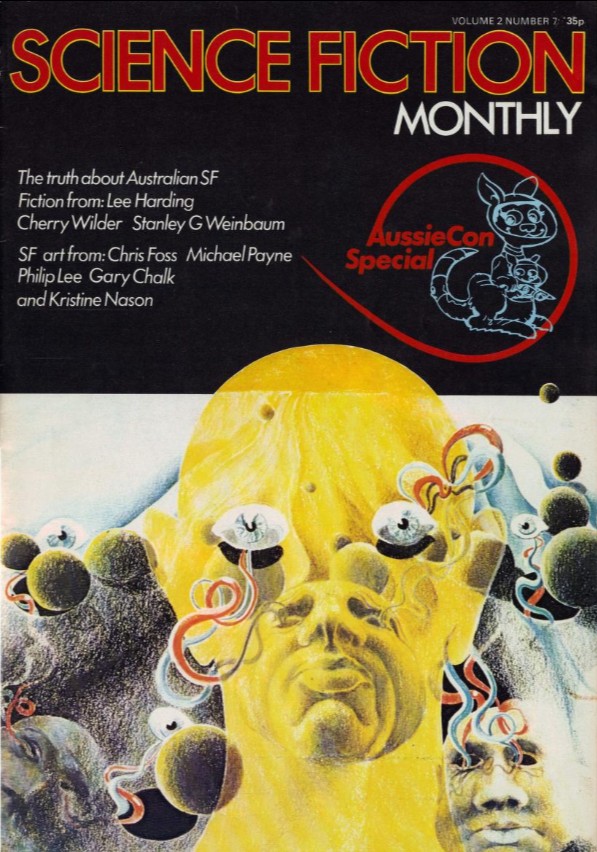
R. Michael Payne’s cover for Science Fiction Monthly, ed. Julie Davis (July 1975)
2.5/5 (Bad)
“Way Out West” first appeared in Science Fiction Monthly, ed. Julie Davis (July 1975). You can read it online here. Nominated for the 1976 Ditmar award for Best Australian Long Fiction.
Bearing surface resemblance to Clifford D. Simak’s focus on rural America, “Way Out West” transposes contact between human an alien in the New Zealand backcountry (or maybe the Australian outback as I am not sure sections of New Zealand can be described as flat and brown). Old Man Ryan lives in Barney’s Bluff, population 15 “when the beer’s on” (27). He watches tourists in their Landrovers enter the “town” and he takes especial notice of the pretty blonde. Observing everything are small mechanical gadgets controlled by an alien force. They seen trap the tourists and Old Man Ryan must save the day using “primitive” Earth technology.
This is a gentle but trite celebration of “good rural” resolve. As with “The Phobos Transcripts,” “Way Out West” feeds into conspiracy theorist undercurrents of ufology. It’s the definition of forgettable and minor.
For book reviews consult the INDEX
For cover art posts consult the INDEX
For TV and film reviews consult the INDEX
 Science Fiction and Other Suspect Ruminations
I guess I must have read Way Out West when it appeared in SF Monthly as I collected them all as they came out. But I remember absolutely nothing about it from your description. I do remember stocking her Rulers of Hylor quartet (the Unwin/Unicorn imprint ones) and that sales were extremely slow
I did read her later collection Dealers in Light and Magic in the late 1990s and enjoyed the stories a lot; several of them are early enough to be before your self imposed cut off date for reading, so maybe you’ll get to them some day!
“Way Out West” is certainly the most forgettable of the three so I’m not surprised! I read it only a week ago and I had to relook through it to remind myself.
Six of the nine stories in her Dealers in Light and Magic collection would fit my pre-1985 date. As I point out in the review, I think I should still try to read Second Nature (1982) again. When I picked it up I got the sense of a dense anthropological take on contact. I’m not sure why I put it down.
I finished The Ark and uring reading it reminded me a bit of Le Guin’s The Word for World Is Forest but with both less arrogant and less understanding humans. The setup in this story IMHO needed more polishing – only one tree on the island and it is used even if for emergencies the protagonist has a raft, but not an inflatable habitat? Locals, whom Terrans don’t actually care to test for ‘sentinence’… Overall, it was interesting even if I disagree with what/whom James became according to the last paragraph. 3/5 for me
I agree on the need for polishing. I enjoyed the fragments of the world that we learn about but it all feels a bit surface. I didn’t get the sense it was an actual raft. Rather, the platform he built from the vast tree for his hut and observation point became a raft. But yeah, you get the sense that the humans aren’t really that careful in their study of the aliens.
Yes, you’re correct. To quote from the story:
He was calculating … One life-raft, inflatable, fully provisioned and powered, capacity six humans. All he had to do was launch the thing. And figure out some way of transporting thirty quogs to the plateau. The receiver gave his call signal but Carlyle paid no attention. He rushed out on to the platform again, into the deluge, and saw with alarm that the water was up to the cross supports. The scrap of beach and the lowest rank of undergrowth were already submerged. Sea and sky were joined in a blue-black curtain of moisture. Suddenly Carlyle gave a triumphant cry that brought the old quog scuttling to his side; he had realised that they were standing upon a raft.
He explained it to the Chief as he dug out the axe. The tribe must come aboard now, pronto; when the water rose he would knock out the supports of the platform and they would be launched. The wind and the current were driving towards the plateau … Maybe they could use the power pack of his own inflatable boat…
As I understand it, they really moved on a platform, which appeared to be floating. I meant more – why he had some stuff for emergencies (a life-raft) but not for what he 100% will need – living quarters.
From the Intro in the same book, I see that the editor was concerned with predatory usage of oil and other final resources so cutting a tree that is a life savior for locals fits the idea well
Yeah, cool ideas but a bit vague/confused in its delivery — on multiple levels.
I finished “The Phobos Transcript” as well. I agree that creepy parts are well-done, but e.g. the later solution of Morris’ madness brings a question whether all creepy stuff earlier was necessary, except for the story. 3/5
I think it would have been a far more substantial story if the exact nature of Morris’ madness wasn’t made clear and that the possibility of insanity or mass delusion was a narrative suggestion. I think it would make the “cover up” more meaningful and not feed into ufology paranoia about government knowing the real secrets and not sharing it with us…
I finished the last story, “Way Out West”. I agree, it is the weakest of the three. I haven’t had Simak’s vibes, maybe because for him, as I understand it, rural people were “we”, while from my reading of this story, for the author these people were “they”
I don’t know a ton about Wilder but it does seem that she was born in Auckland, NZ. So yeah, I think the “they” designator of “rural folk” is the correct one. That said, Simak is remembering his youth (and his firmly aware that he is exploring the realms of nostalgia) — he did not live for long in the countryside. He moved and lived most of his life in Minneapolis so those divisions don’t always work. I was born in rural Virginia but have lived in some substantial cities since then (Washington DC, Austin, San Antonio, Paris, Indianapolis). I think back fondly on my rural childhood — like Simak — but know for certain that actually living (the political and religious environment) and trying to find a way to make a living in economically depressed regions of America would be a challenge.