Today I’m joined again by Rachel S. Cordasco, the creator of the indispensable website and resource Speculative Fiction in Translation, for the sixth installment of our series exploring non-English language SF worlds. Last time we covered Arkady and Boris Strugatsky’s ruminative “Wanderers and Travellers” in International Science Fiction, ed. Frederik Pohl (November 1967).
Please note that Rachel and I are interested in learning about a large range of authors and works vs. only tracking down the best. That means we’ll encounter some stinkers. Thankfully, not this time! We got a powerful one.
Unfortunately, Izumi Suzuki’s “Terminal Boredom” (1984, trans. by Daniel Joseph 2021) does not exist online. A large range of her SF stories were translated and published in two volumes by Verso books with various translators. You can acquire Terminal Boredom (2021) and Hit Parade of Tears (2023) at relatively inexpensive prices online. Despite my substantial qualms with the editions (see my review below), I recommend acquiring them.
“Terminal Boredom” (1984) does double duty as the 35th installment of my review series on media landscapes of the future.
Previously: George H. Smith’s “In the Imagicon” (1966).
Up Next: TBD
Enjoy!

Rachel S. Cordasco’s Review
In an article on the “iconoclast” Japanese sf writer Izumi Suzuki, Andrew Ridker distills her stories down to three words: “Ambivalence, disappointment, resignation: Suzuki’s stories speak so eloquently to our burnt-out moment that it’s easy to forget the importance of her cultural context” (LitHub, 5/7/21). We are indeed burnt out, more burnt out even than when Ridker was writing just four years ago. It’s now 2025 and time to face the fact that Facebook and YouTube have been around for over twenty years. The iPhone has been around for nearly that long, and for an entire year, the world was turned upside down during a pandemic, during which time we were even more closely connected to our devices. We’re burnt out by phones, by the rapidly-developing world of AI, by the streaming services that offer us so many choices that it’s nearly impossible to pick something to watch.
It’s almost as if Suzuki foresaw this moment, for her story “Terminal Boredom” is about this addiction to technology, though since her piece was written in the 1980s, it’s television—not the smartphone—that has snared everyone. The protagonist/narrator, a nameless young woman (everyone is nameless in this story) leads a dreary life, with very few job prospects and only television to keep her company. In fact, everyone is very connected to their tvs—so connected, that they’ve started having devices wired into their brains to make the watching experience more immersive. As the narrator’s mother explains, “When the monitor is turned on, it begins to stimulate the brain. The subject no longer has to flip the switch each time; instead, a weak electrical current is transmitted automatically at appropriate intervals” (204).
Despite the ubiquity of tv, real conversations do happen. Three of these conversations make up the bulk of “Terminal Boredom”–two are with the narrator’s sometime “boyfriend,” while the other is the aforementioned talk with her mother. Only referred to as “HE” and “HIM,” the boyfriend talks to the narrator about another girlfriend he has who actually wants to have a baby the “old fashioned way.” The narrator marvels at this and both think about how the people of their parents’ generation seem to have so much energy and drive, while their generation has none of that—the tv has taken over everything. Now, with these devices connected to their brains, people can feel as if they are participating in the story they’re watching, which is more interesting than their boring, real lives.
During this conversation, the two witness a man beat a woman to death on the street. Capturing it on film, the boyfriend later tells the narrator that he finds it thrilling and plays it over and over again in his room. As he explains “I end up putting a frame around everything I see…It makes it seem fresh, helps me relax as a viewer” (200). This eruption of violence into a tv-addicted, tightly-constrained society, where one isn’t allowed to linger in a public place for more than twenty minutes, is what makes this story so unnerving. The narrator finds herself thinking about her parents’ divorce and her father’s remarriage, only to then find out from that second wife that her father committed suicide. At the end of the story, her boyfriend asks her to help him kill his pregnant girlfriend because he doesn’t want the responsibility—he just wants to “slip quietly into oblivion, all by myself.” He tries to convince the narrator with “[t]hink of it as a TV show. Pretend you’re an actor” (216). Only violence ultimately gets a reaction out of the narrator, since she winds up crying for the first time in her life.
The constant stimulation from the TV has wound up dulling the narrator’s mind (as it has everyone else’s), such that the tendency toward a sedentary lifestyle has made them all weak and tired. And yet, the fact that the narrator has extended conversations with the two main people in her life (despite her brief, dull answers), offers a spark of hope—that she, as someone who hasn’t yet adopted the brain device, might still be able to think for herself and do something—anything—that might make life have meaning again. One gets the sense that what has happened to the larger society wasn’t an accident—the brief glimpses of an oppressive police state suggest that a passive society is an easily-patrolled one. Breaking out of her boredom would require the narrator to rebel against more than just her tendency to sit and watch tv.
Suzuki’s story is part of a larger collection that offers us a window into unusual worlds. Her work fits into the larger, complex, and wonderfully varied universe of Japanese science fiction, which blossomed after World War II, energized by the American sf that flooded it during the US occupation. Some of the best translated science/speculative fiction to come to American readers over the past 60 years, in my opinion, has been Japanese, including that by Yoshiki Tanaka, Yoko Ogawa, Mariko Ohara, Hoshi Shinichi, Yasutaka Tsutsui, Kobo Abe, Koji Suzuki, Taiyo Fujii, and so many more. Here one can find everything from space opera and body horror to har science fiction and surrealism. For Anglophone readers, Izumi Suzuki can take her place alongside these writers, with two collections now out in English.
A work of simmering horror and technological dystopia, “Terminal Boredom” will make you want to read more Izumi Suzuki and explore her grim, dark worlds.
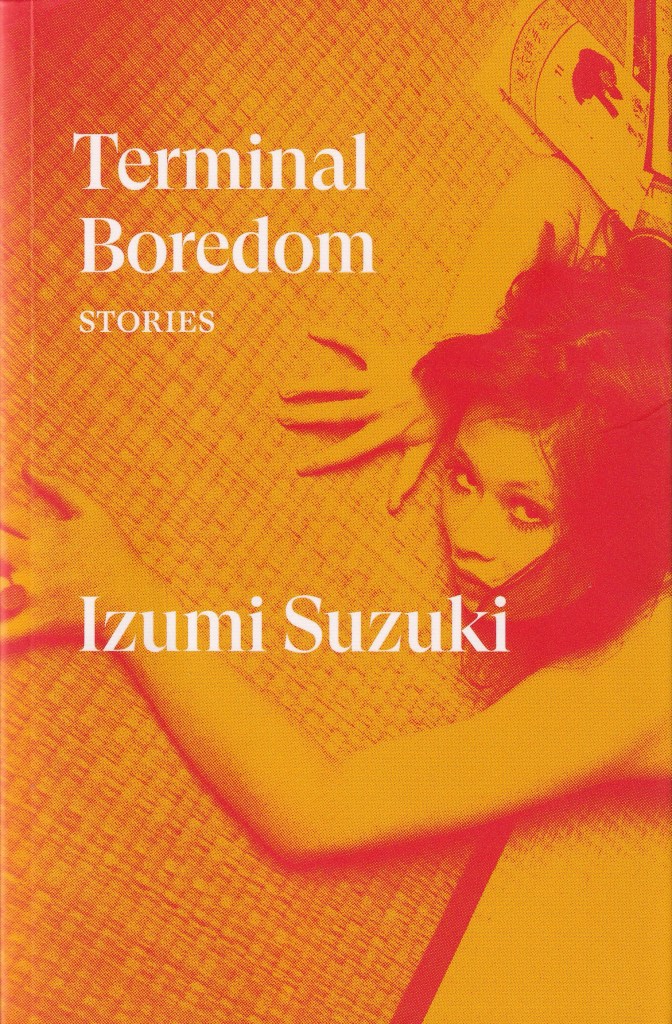
Cover photo by Nobuyoshi Araki for the 1st edition of Terminal Boredom (2021)
Joachim Boaz’s Review
4.5/5 (Very Good)
A Preliminary Note about the Verso edition that I wish I didn’t have to make: It’s a shame that the editors of Terminal Boredom (2021) did not commission an introduction about Izumi Suzuki and her place in the larger Japanese literary/SF world or even include the original Japanese publication dates for the seven stories included. I identified the date for “Terminal Boredom” (1984) and “Smoke Gets in Your Eyes” (1979) from a Japanese-language website and “Women and Women” (1977, rev. 1978) and “Night Picnic” (1981) from SF Encyclopedia. It’s embarrassing/lazy that this information isn’t included in the edition. If you know of the rest of the publication dates for “You May Dream,” “That Old Seaside Club,” and “Forgotten” in the collection let me know. As the organization appears to be chronological, I assume they were published between 1977-1984.
I imagine you’ve heard of the Japanese hikikomori, reclusive individuals withdrawn from social life, seeking “extreme degrees of isolation and confinement” often due to the pressures of modern Japanese society. Izumi Suzuki, more than a decade before psychiatrist Tamaki Saitō researched and popularized the term, imagines a similar phenomenon facilitated by new patterns of media consumption on an epic, and destructive, scale. There are a lot of angles to approach “Terminal Boredom” (1984), and its place within Suzuki’s work (both fiction and film). I imagine someone far more immersed in Japanese society and culture could tackle her take on gender and society in a more adept manner than myself! With that in mind, I will, as always, engage with an element that particular spoke to me: Sukuzi’s rendering of the media landscape of the future.
First a few words about the basic plot. A nameless young female main character recounts her interactions with “HE,” her one-time boyfriend. HE wants to reconnect with his mother, who abandoned his family. HE joins a staged show called The Psychoanalysis Room (“or something”) in an attempt to convince his mother to take “pity and come and find” him (193). She also has a dysfunctional family. Her mother, a TV executive, struggles/refuses to connect to her daughter. Like some manifestation of the modern hikikomori, they often refuse to communicate with others, eat as a group or eat at all for days on end, or leave their dwellings for the sun and vista of the “aboveground” (191). Both youth find solace and escape in the vacuities and artifice of television.
One of the recurrent patterns illustrating societal change Suzuki deploys is the TV frame (“ultravision”) as the new way of engagement with the world. Elections, if you can call them that, seem to be conducted via TV celebrities–people vote for a celebrity who then somehow chooses from a slate of candidates (195). Restaurants brag about their TV programs instead of their food. She confesses “it’s hard to relax without something to look at” (193). HE mixes up the real and the unreal. In one instance he watches a woman being beaten: he poses, in front of the bloody woman, as if an actor in a scene from a TV show (199). He purchases an illegal copy of the beating, recorded by an observer, to relive the experience. And, as the horrifying finality of the tale sets in the appearance of a futuristic tech to connect with a program, ultravision becomes the only way of seeing and feeling.
It’s punchy yet quiet. And like a Michael Haneke film, I found it possessed an unnerving ability to get under the skin.1 Suzuki adeptly renders the conversation, mentalities, and actions of the disaffected and deeply depressed: “Come on, how often do you think I can do something like that? It’s exhausting” (192) (a conversation about sex).
Highly recommended.
Notes
- I’m thinking Haneke’s The Lost Continent (1989) and Benny’s Video (1992). Both rank amongst my most disquieting filmic experiences. The latter of the two has some thematic relevancy to Suzuki’s “Terminal Boredom” (1984).. ↩︎
For book reviews consult the INDEX
For cover art posts consult the INDEX
For TV and film reviews consult the INDEX
 Science Fiction and Other Suspect Ruminations
I was genuinely stunned by the Terminal Boredom collection when I read it a little while ago, one of thise situations where I had no real context for understanding where it came from or what informed its sensibilities beyond the broad outlines of her bio. I share your irritation with the reprint’s lack of publishing details.
This story in particular was one of the most unnerving, an apt descriptor. In other stories some black humor peaks through but this one was dominated by its bleakest aspects, the dehumanized violence, the apathy. Always illuminating to see prior generations sharing the same reaction to their media landscape as we have to ours.
I should definitely read the rest of the stories in the collection. I am currently debating with Rachel what to cover next — perhaps we’ll return to her soon.
But yes, I often find these media stories quite conservative (often jarring with the political sensibilities of their writers) in their outlook (younger generations ignoring the ways of the old, etc.). The number of positive takes on transforming media are definitely a minority.
I tore through both collections of hers that I could find dairly quickly, I don’t think you will be disappointed.
That’s an interesting point about the conservative reaction to new media being fairly consistent – its true I cant think of many (any?) stories from the 50s that were excited or positive about television, for example. I suppose the internet had its evangelists, but books like Neuromancer or Dr Adder dont really paint a glowing portrait of “cyberspace”.
The only one I’ve covered in my series that’s overwhelmingly positive is John Brunner’s “Fair” (1956). His futuristic immersive TV helps foster empathy: https://sciencefictionruminations.com/2022/08/14/future-media-short-story-review-john-brunners-fair-1956/
Either Suzuki picked up some influences from the New Wave writings of the Anglosphere or both were just drawing on the hungover 1970s zeitgeist. I found Hit Parade of Tears “marginally less bleak” as compared to Terminal Boredom (according to my notes), but neither book had much that you could characterize as upbeat. But both very good collections. It’s mordantly amusing how all the downbeat futures depicted in older works (and they were numerous in the New Wave era) seem to foreshadow our current age so well. A publishing marketeer would sell the current moment as “perfect for fans of It Can’t Happen Here, Brave New World, 1984, The Simulacra, and The Atrocity Exhibition!”
Where would you rank the story “Terminal Boredom” among the rest in the collections? One reason I’m frustrated with the Verso editions is that some preliminary essay that would place Suzuki in the larger history of Japanese SF (which, of course, was influenced by English-language authors) would have been helpful to understand the context of her work.
I don’t have a good memory for how all the stories went, since I read this back in 2021. “Terminal Boredom” and one other that was very druggy I felt like were the author transforming some situation from her life into a mutated form to provide the bones of the narrative. Some of the others seemed less personal, if that’s the right word to use. I remember liking the one about the “monsters” pretending to be humans on the planet where humans were extinct, just because it was so off the wall.
“I remember liking the one about the “monsters” pretending to be humans on the planet where humans were extinct, just because it was so off the wall.”
Sounds like a good premise. Which one was that?
I think it was the “Night Picnic” one. I try to take notes on books I read, but they are often not very informative. And in 2021 and 2022 I read over a hundred books each year, most of them library books (including both of Suzuki’s). Since then my reading has fallen off quite a bit. Old age finally collecting its dues.
Thank you! Yeah, I often think my site serves partly as a mnemonic device.
I agree that “Night Picnic” is a standout (it’s also pretty funny). The other one that stuck in my head, albeit for reasons related to my own personal obsessions, was the one that heavily featured references to Group Sounds (Japanese psych/pop rock from the late 60s).
Considering her connections to avant-garde music at the time, I imagine she renders those references quite well!
Glad you liked it, hope you’ll have time to read the rest of the collection eventually.
I’ll certainly try to get to Hit parade of Tears at some point as well.
Thank you for the recommendation (I think it was you? I know more than one person brought her up).
You’re welcome. Yes, I did bring it up some months ago. I don’t remember if anyone else mentioned it here before – I did initially hear about it somewhere else.