Today I’ve selected two lesser-known short stories from the early 1950s that explore issues of race in America. The Civil Rights mass movement gathered steam in the post-WWII world as soldiers returned to segregated hometowns. The federal government took a few tentative steps. In 1948, President Truman issued Executive Oder 9981, which abolished discrimination “on the basis of race, color, religion or national origin” in the United States Armed Forces.1 Both stories I chose for this post appeared in print before the famous Supreme Court case Brown vs. Board of Education (1954) that ruled segregation was inherently unequal. In Edward W. Ludwig’s “The Rocket Man” (1951), a young white child yearns to lead an expedition to Mars. He finds fellowship with other outcasts, including an African American boy who also dreams of space. In Alan E. Nourse’s “Marley’s Chain” (1951), a man must confront his own problematic past in a new America rebuilding from the wreckage of the old.
If you know of any other 1940s/50s short stories that attempt to tackle the topics of race and racism, let me know. As I’m afflicted with a serious strain of listomania, I’ve collated an incomplete catalog on the topic that I will return to periodically in coming months.
Let’s get to the stories!
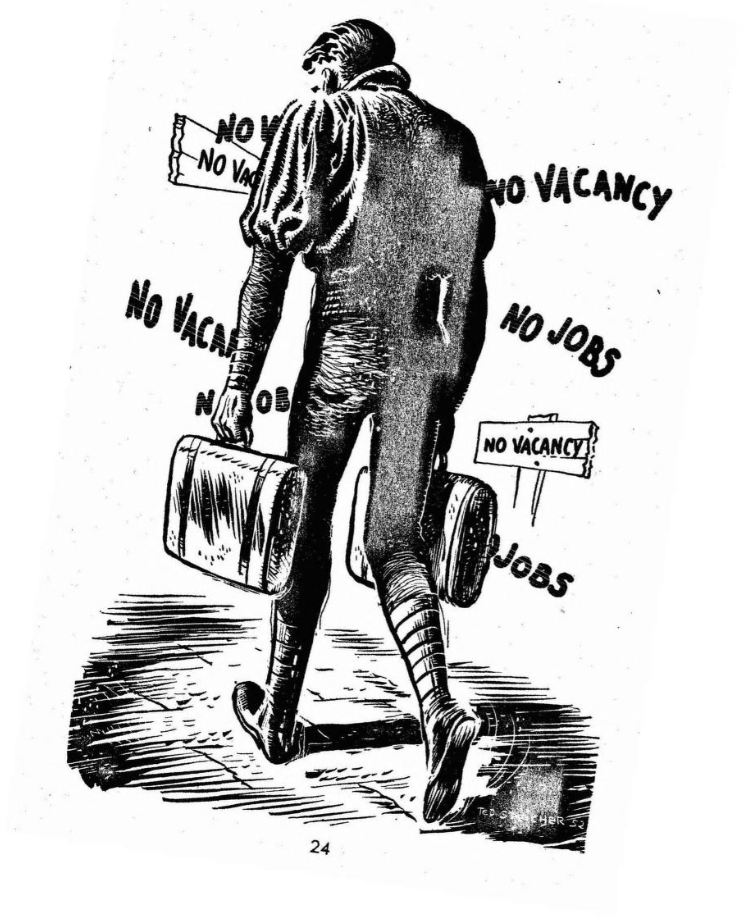
Ted Speicher’s interior art for Alan E. Nourse’s “Marley’s Chain” in If, ed. Paul W. Fairman (September 1952)
4/5 (Good)
Alan E. Nourse’s “Marley’s Chain” first appeared in If, ed. Paul W. Fairman (September 1952). You can read it online here.
Alan E. Nourse (1928-1992) re-entered my shortlist of authors I need to read as a result of my hunt for science fiction on the labor movement. Nourse might be best known for his many medical-themed stories (he was a practicing physician and wrote popular columns on medicine). He deviates from that interest with a classic illustration of 1950s anti-union sentiment in “Meeting of the Board” (1955), which I’ll cover eventually. While searching for further labor-related short stories, I came across a far different (and more perceptive) account of race and labor in America: “Marley’s Chain” (1952).2
Tam returns to Earth after eight “long years of hard work and bitterness” as an indentured servant in the outer Asteroid Rings (25). Whispers of radical transformation on Earth percolated though the distant reaches of the system. Tam, so far from home, dismissed them as hearsay and rumor. But the moment he disembarks, he notices the change — derisive comments, a cruel sneer, and an inability to find work despite the skills accumulated across the Solar System. He’d take any work. He even offers to labor in a mine on Mars, “I’ve worked on Mars before, and I can work six, seven hours, even, without a mask or equipment–” (28).
In a desperate attempt to find employment, Tam reaches out to an old friend David G. Hawke, now the Director of the United Continents Bureau of Employment (30). After a friendly reminisce, the pieces fall into place and fragments of meaning-making chronology emerge. After a violent Cold War confrontation between the US and the USSR severely weakened the superpowers, a race revolt, the product of generations of oppression and second-class citizenship, overthrew the American government (34). Men like Tam left Earth after the Revolt. Dave lays bare the hard reality of the past, behind all the friendly memories: “You tried, you did the best you could, I know. When it came to the pinch, to a real jam, you would have been just like the rest” (34). Despite Tam’s pretense at support, according to Hawke, racism “was built up in [him], drummed into you, until no amount of fighting could ever scour it out” (34). Tam refuses to return to the belt or take employment on inhospitable Mercury. He must find another way to survive.
“Marley’s Chain” takes aim at the ingrained, and corrosive, nature of racism in 50s America. His main target isn’t so much the overt Southern race baiters à la Senator Strom Thurmond and Senator Richard Russell Jr., the co-authors of the Southern Manifesto, but the middle class and/or college-attending 50s “liberal” who might be willing to interact cordially with African Americans without truly believing in the cause. The true ally must acknowledge the systemic nature of oppression and actually fight for change.
Dave and Tam were college buddies. Tam attempts to tap into his happy memories of brotherhood: “we were friends, you can’t forget that”” (33). Dave’s words slice to the bone: “You weren’t born like I was, you weren’t raised on the wrong side of the fence” (33). Tam claims he tried to fight for change. He tried to support men like Dave. Again, Dave’s words dispel the illusion: “You thought you tried, sure. It was the noble thing to do, the romantic thing, the good thing to do. But you didn’t really believe it” (34). Echoing President Truman’s Executive Order 9980 (1948) mandating fair employment practices within the federal government, Nourse also points out the gulf between law and enforcement of law.3 Nourse also acknowledges how the justice system is stacked against African Americans, who often received longer sentences for lesser crimes.4
Despite a few problematic moments, “Marley’s Chain” comes across as a radical genre work for the early 50s. Nourse attempts to delve beyond surface proclamations of racial justice and equality. Racism doesn’t come across as an easy to dispel stereotype or viewpoint brushed aside after brief interactions with someone from another race. Racism is a systemic problem. I can’t easily be solved by passing a law. It impacts how law is implemented, employment, daily interactions, and even the mindsets of those who might perfunctorily claim allyship.
Recommended.
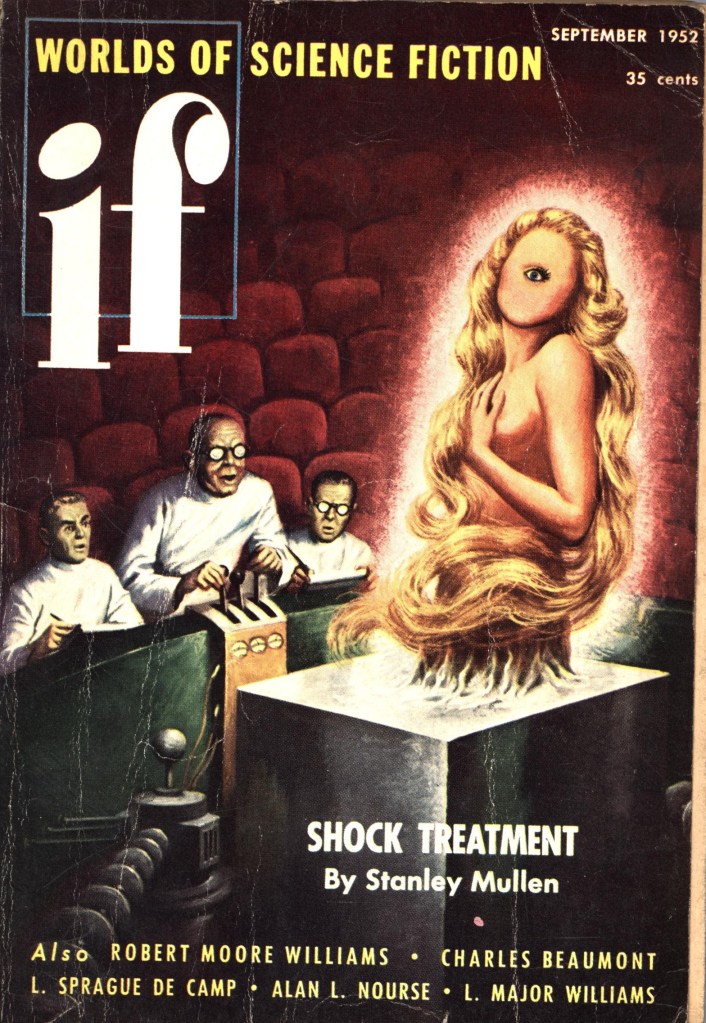
Ralph Joiner’s cover for If, ed. Paul W. Fairman (September 1952)
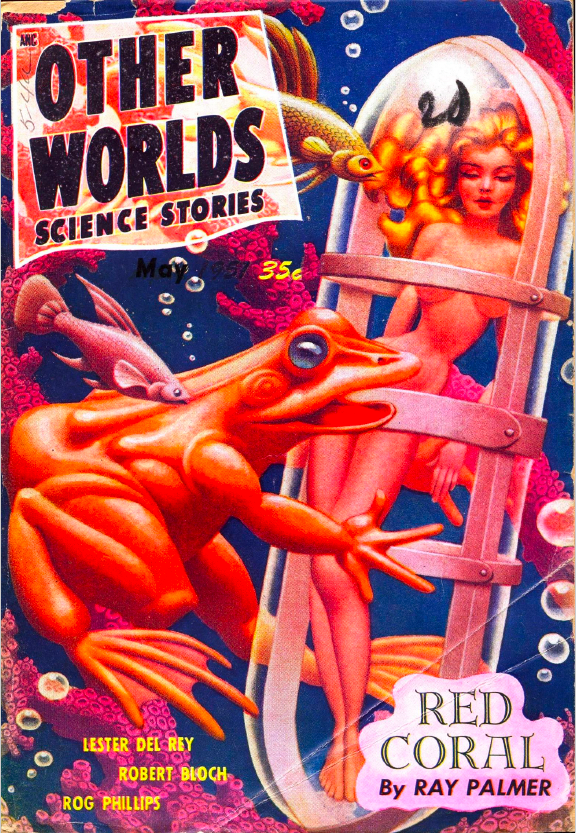
Hannes Bok’s cover for Other Worlds Science Fiction, ed. Raymond A. Palmer (May 1951)
3/5 (Average)
Edward W. Ludwig’s “The Rocket Man” first appeared in Other Worlds Science Fiction, ed. Raymond A. Palmer (May 1951). You can read it online here.
I cannot find much about the American science fiction author Edward W. Ludwig (1920-1990) online beyond some brief information from an author blurb in the magazine Gamma, 3, ed. Charles E. Fritch (1964): “A Coast Guard veteran of World War II, he served overseas in the Philippines. Now living in Stockton, California with his family, he works for the county by expects shortly to become a full time freelance writer. He has been a professional piano player and is married to a folk singer named Chris. Evenings around the Ludwig household are spent in ‘playing guitars, singing, and drinking beer.'” Fritch describes Ludwig’s stories as “neat” and “gentle,” which echoes my (limited) assessment. Ludwig published 27 shorter fictions (and one novel) across a range of magazines between 1950 and 1979 (two later stories were published in a 1983 small press collection). I first encountered his story “The Holes and John Smith” (1954) in my perpetual hunt for science fiction on the labor movement.
Bob Chandler dreams of becoming a spaceman. He imagines piloting a rocket called the Martian Queen and landing on the Red Planet. Like many kids, his parents see his play as play. He could be spending his time studying: “you’re at the bottom of your class” his father reminds him (142). His father wants Bobbie to devote his time to honing the skills necessary to take over his firm, not reading science fiction and playing with model rockets. In this near future, Spaceman Everson reached the Moon after five failed expeditions — and a hundred dead men. A successful flight to Mars? A fantasy! “they’ll never reach Mars, at least not in our lifetime” (142). Bobbie, the lowest-ranked kid in his class, hangs out with two fellow dreamers and outcasts: there’s the African American Sam White and Lloyd Davis. Bobbie’s dad parrots the racist viewpoints of many middle-class white Americans of the day: “he’s colored. I’ve nothing against colored people. Most of them are fine people. But, damn it, I want you to go around with white boys of your own age. I want you to have good friends” (142). Lloyd Davis has a rough family life. His dad’s a drunkard. He’s older than Bobbie and Sam. The three children find solace in each other’s company, and dream of triumph and escape. But Bobbie’s dad lays down the law. Or, at least, until a spaceman comes to town…
Ludwig’s “The Rocket Man” (1951) is a tender, if a bit predictable, science fiction story in the positivist mode with a delightful strand of progressive race politics. I love the trope of outcasts finding their own paths in the world. As with Nourse’s later story, Ludwig condemns the racist views of middle-class Americans: “I want you to have good friends” (142). If you’re in the mood for a breezy 50s short story suitable for younger readers about pursuing your passions with a positive rendering of an African American character, then this might be for you. While not a classic story by any means, it certainly falls into the unjustly forgotten territory — and illuminates a strand of 50s science fiction on race worth uncovering.
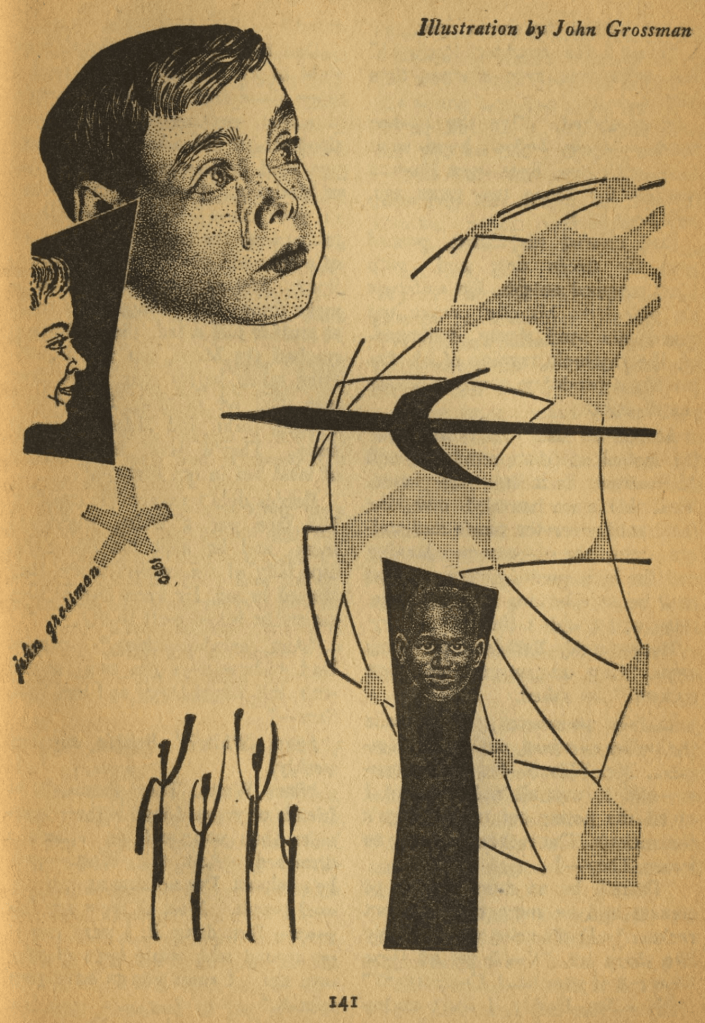
John Grossman’s interior art for Edward W. Ludwig’s “The Rocket Man” in Other Worlds Science Fiction, ed. Raymond A. Palmer (May 1951)
Notes
- I always love an excuse to cite one of my favorite books on the Civil Rights movement: Mary L. Dudziak ‘s Cold War Civil Rights: Race and the Image of American Democracy (2011). By looking at international news, Dudziak charts what became news abroad — and how that links to Civil Rights policies and actions on the federal level. Essentially the US government reacted to address what became international scandal in an effort to appeal to potential Cold War allies in the Third World. ↩︎
- I’d previously covered his functionalist medical thriller The Mercy Men (variant title: The Man Obsessed) (1955), ↩︎
- “I know the law of this system. There’s a fair-employment act on the books. It says that men are to be hired by any company in order of application when they qualify equally in experience.” “We don’t hire Sharkies, law or no law, get that?” (25). ↩︎
- “You know how the courts handle Sharkies, just a small offense, to get me a few years, then a couple attempts to break out, and I’d be in there for life” (35). ↩︎
For book reviews consult the INDEX
For cover art posts consult the INDEX
For TV and film reviews consult the INDEX


I’m keen to track down the Alan E. Nourse story (yes I’m reading SF again…). I haven’t read much of his stuff except the occasional short story like Brightside Crossing. He wrote a young adult novel called Raiders from the Rings (1962) that I read and re-read when I was around 12–yep, I sure loved that book though I’m not exactly sure why now.
I was not expecting this from Nourse! The ending doesn’t entirely work in my opinion. But it’s certainly a call to action for his fellow 50s Americans — there’s an imperative to act decisively now. Not later. Not a pretend stance at change. Real action.
I’d only read The Mercy Men (variant title: The Man Obsessed) (1955). It was a functionalist thriller with a pretense at social message that didn’t really go anywhere.
You mentioned that you stumbled upon it in your search for labour related SF stories. Was ‘Meeting of the Board’ the only other one you found?
By Nourse? I skimmed about 20 of his stories and didn’t find more overtly about unions. I’d call “Marley’s Chain” a more general labor-related story i.e. how systemic racism impacts employment.
As for other labor related SFF stories, I’ve contributed around 100 to Olav’s list on unions: https://hugoclub.blogspot.com/2018/12/organized-labour-in-science-fiction.html
I’m currently wading through all available digitized responses (positive and negative) to Bellamy’s socialist utopia Looking Backward: 2000–1887 (1888). I’ve sent a good 10 of those his way to add to the list. And there are sooooo many more…. I’m also writing a 30+ page article on Edward A. Johnson’s utopian Light Ahead for the Negro (1904). Johnson was an African American politician, professor, businessman, lawyer, and public intellectual in North Carolina. He imagines an active role for labor unions to improve the lot of African Americans in the south.
@sciencefictionruminations.com PKDick's Dr Futurity, published in 1960. May be just outside your 40s/50s criteria?
Remote Reply
Original Comment URL
Your Profile
Why do I need to enter my profile?
This site is part of the ⁂ open social web, a network of interconnected social platforms (like Mastodon, Pixelfed, Friendica, and others). Unlike centralized social media, your account lives on a platform of your choice, and you can interact with people across different platforms.
By entering your profile, we can send you to your account where you can complete this action.
Thanks for stopping by. I’ve already read and reviewed it — back in 2012. https://sciencefictionruminations.com/2012/08/19/book-review-dr-futurity-philip-k-dick-1960/
Looking back at my review, I can’t say I remember much about the book.
Here’s my general review index: https://sciencefictionruminations.com/science-fiction-book-reviews-by-author/