Book Review: The Bright Phoenix, Harold Mead (1955)

(Richard Powers’ cover for the 1956 edition)

3/5 (Average)

Harold Mead’s The Bright Phoenix is a readable future ultra-regulated “perfect” State themed science fiction novel with a time-worn but proven plot. Unfortunately, the end product, despite moments of intriguing characterization and oppressive gloom, sinks into forgettable melodrama and the conclusion resorts to frustratingly obvious references to a “second coming” (of sorts).  Mead is less interested in describing the mechanisms of the “perfect” state and more interested in the slow evolution of a character coming to grips with the deficiencies of the system.  This is an admirable program that falls woefully short in part due to the paltry descriptions of the before mentioned system.  This causes our hero’s evolution to occasionally ring hollow.  The primitive but somehow “truer” pseudo-Christian civilization contacted by our hero, the fulcrum of his transformation, lacks any seductive qualities that would facilitate Continue reading
Adventures in Science Fiction Cover Art: Through the View Screen, Through the Window

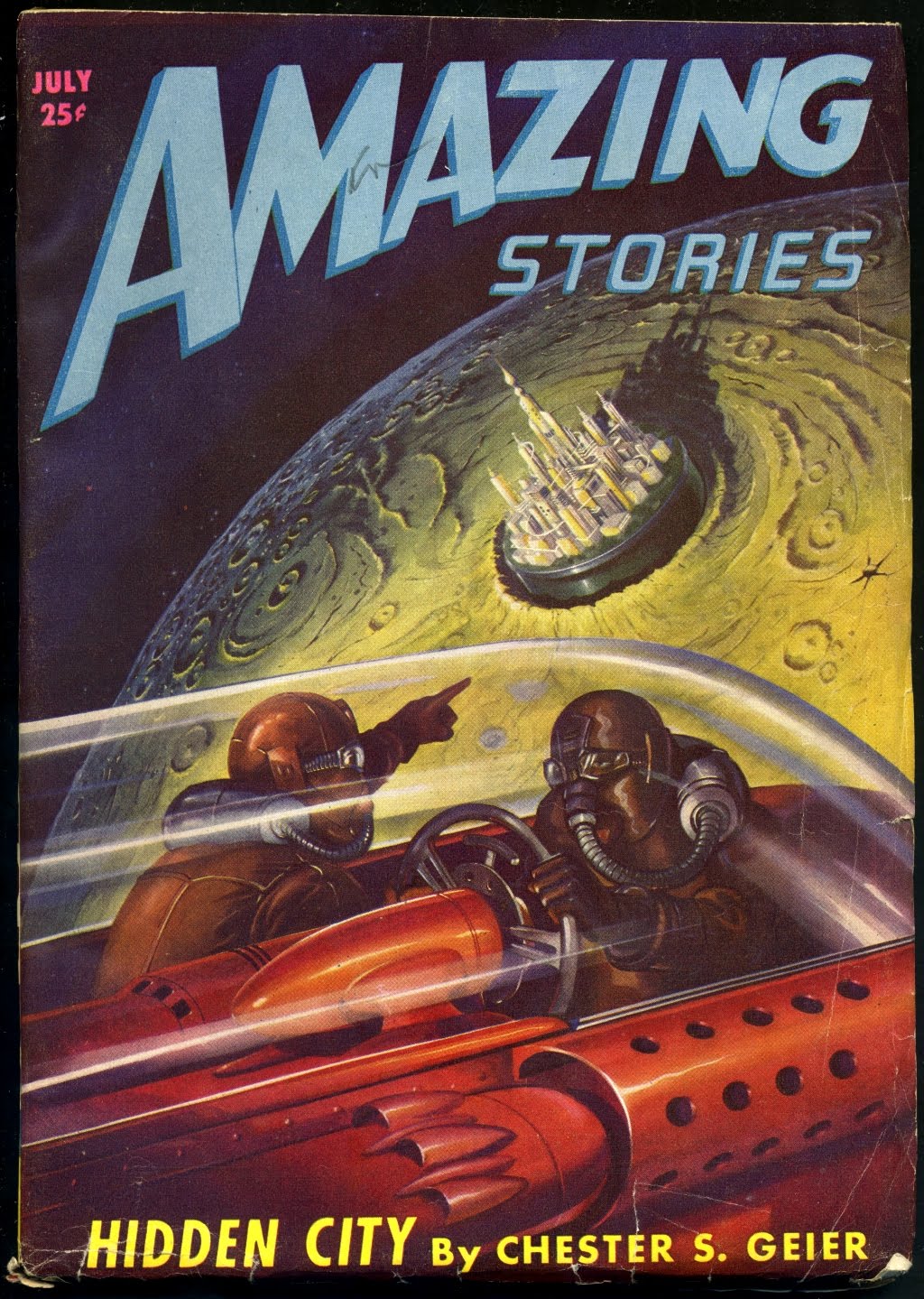
(Julian S. Krupa’s cover for the July 1947 issue of Amazing Stories)

Through the window, through the view screen cities are discovered, worlds end in searing flame,  vectors to unknown lands are plotted, the horrors of earth are left behind.  Alone in a space station an astronaut observes the fragile construction arrayed around him.  Through the window, through the view screen aliens observe our strife, loved ones watch in agony, and the culmination of our era’s scientific endeavors are arrayed in orderly rows.  

In short, the possibilities are endless.  The glass (or some scientifically advanced clear material) frames the story, we watch others watching or we see what they see while we stand among them… 

Definitely a delightful sci-fi cover art trope worth exploring.  Here are a broad selection of covers from juvenile science fiction novels, pulp magazines, edited Continue reading

Adventures in Science Fiction Cover Art: The Art of Robert Foster, Part II

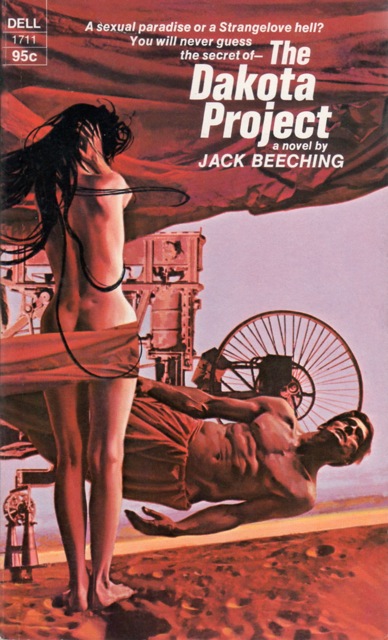
(Robert Foster’s cover for the 1971 edition of The Dakota Project (1968), Jack Beeching)

Unfortunately, science fiction covers from the 60s/70s are not always credited — Robert Foster’s covers are no exception.  Originally I assumed that Foster had only produced a handful (see my first post on his work, Part I), but after searching under Bob Foster and identifying covers by sight I’ve cobbled together another varied/intriguing/unusual collection of his work.

His work are often characterized by fascinating collaged, geared, industrial machinery paired with nudes and semi-nudes Continue reading

Updates: Recent Science Fiction Acquisitions N. XXIII (Farmer, Malzberg + et al.)

A while back I slogged through Philip José Farmer’s dismal To Your Scattered Bodies Go (1971) (the worst novel ever to win the Hugo Award?) and all the increasingly terrible sequels and made a solemn vow to wait a few years before I returned to his extensive oeuvre — so, against my better judgement I picked up a copy of  Traitor to the Living (1973).  I don’t have high hopes (but I love the cover!).  I hope my two dollars were well spent.

Malzberg is shaping into my “under read/unjustly forgotten author of the year” whom I’ll showcase.  Last year’s winner was the brilliant D. G. Compton (see INDEX for reviews).  Fresh off Conversations (1975) and In The Enclosure (1973) I picked up a copy of Guernica Night (1975).  I can’t wait!

Harold Mead’s The Bright Phoenix (1955) is yet another against the oppressive state à la Orwell’s 1984… But, I’ve found that the premise generally holds up despite frequent re-interpretations…

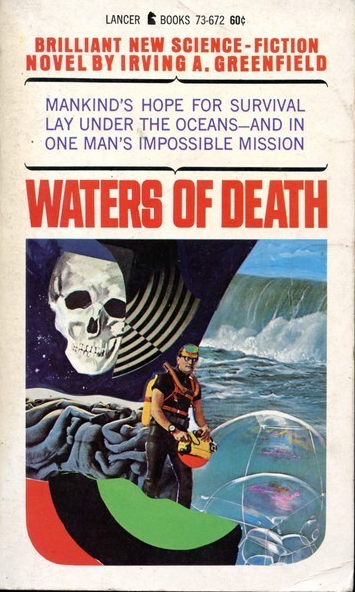
Greenfield’s Waters of Death (1967) should be avoided — at all cost.  I’ve already written a scathing review (rant).

1. Traitor to the Living (1973), Philip José Farmer (MY REVIEW)

(Hans Ulrich Osterwalder and Ute Continue reading

Book Review (rant): Waters of Death, Irving A. Greenfield (1967)

(Hoot von Zitzewitz’s cover for the 1967 edition)

1/5 (Terrible)

I apologize for the lack of deep philosophical insight into the nuances of the book in question. None can be dispensed/inferred/implied or even invented that would adequately embody the throbbing intellect that exudes forth from every word.  Instead, I shall wax nostalgic.

I loved underwater farms/cities/towns when I was a child.  I drew translucent housing domes in cross-section, replete with carefully delineated plots of seaweed stewarded by land dwelling turtle/dog/humans (flippers, tummy fur, soft shells and the like) and an array of mechanical contrivances to facilitate harvesting, processing, and oxygen production.

I picked up a copy of Irving A. Greenfield’s Waters of Continue reading

Book Review: In The Enclosure, Barry N. Malzberg (1973)

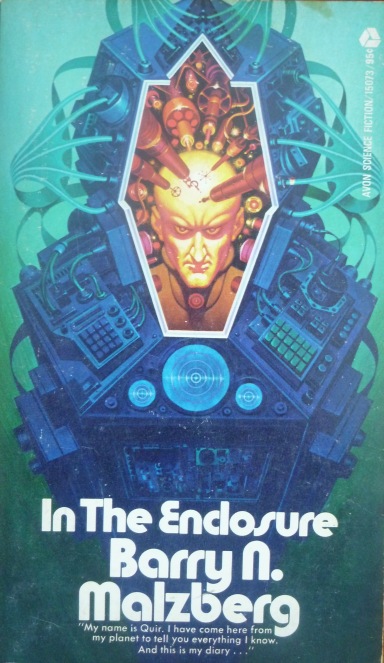
(Davis Meltzer’s cover for the 1973 edition)

4.5/5 (Very Good)

Fresh off Malzberg’s intriguing young adult novel, Conversations (1975), I picked up a copy of the altogether more disturbing, transfixing, unnervingly prescient, and at moments, brilliant In The Enclosure (1972).  As with many of Malzberg’s oeuvre, the work is infused with a steady dose of metafiction — our hero laments (and we writhe along with him in a malaise of unease), “I will never really know” (189).  Just as Quir is unsure of his own reality, his diaristic words — which the reader is desperate to hold on to — are admittedly, “an impression, a conception, nothing more” (190).

Combining the science fiction trope of implanted memories with the literary narrative mode of the unreliable narrator creates an overwhelmingly uncomfortable gulf between reality and constructed reality.  The result, the overpowering desire to pick up a piece of pulp science fiction where the future is rosy, technology = happiness, the kids smart, where rockets Continue reading

Book Review: Eight Keys to Eden, Mark Clifton (1960)

(Ralph Brillhart’s cover for the 1962 edition)

3.25/5 (Average)

Mark Clifton’s readable and thought-provoking Eight Keys to Eden (1960) has been unfortunately overshadowed by his dismal failure, They’d Rather Be Right (1955) (co-written with Frank Riley), which is generally considered the worst novel ever to win the Hugo Award.  Although I wouldn’t classify Eight Keys to Eden as a masterpiece, the novel does contains an original premise, good plotting, and sufficiently thought out “pseudo-intellectual” content that is only overbearing at the work’s climax.  The serious nature of the premise is weakened by a forced strain of unfunny “humor” that creeps in at the wrong moments.  Also, a complete lack of character development makes us care little for the challenges Continue reading

Updates: Recent Science Fiction Acquisitions N. XXII (Cooper + Wilhelm + Kornbluth + Merril)

I was so impressed with C. M. Kornbluth’s masterful collection The Explorers (1954) that I picked up a copy his 1958 collection A Mile Beyond the Moon (I own the hardback first edition but I prefer Powers’ cover below).  Also, recently inspired (again) to read more 1960s works by female authors I bought a collection of three novellas by Merril and a 1963 collection of shorts by Kate Wilhelm.  Wilhem and Merril aren’t always top-notch but worth a read (and in Wilhelm’s case, a second chance — I enjoyed Where Late the Sweet Birds Sang (1977) but I’m still not convinced it was Hugo/Nebula quality work).

Cooper’s Seed of Light (1958) is considered one of his more mature works — to the chagrin of some of his fans who prefer his more “pulpish” works — but my obsession with generation ships was my real motivation to add it to my collection.

One short story, a novel, and one of the novellas take place on generation ships!

A nice haul — a mixture of lesser known works by some famous figures.

Enjoy (the covers)!

1. Daughters of Earth (1968), Judith Merril (MY REVIEW)

(Robert Foster’s cover for Continue reading

Adventures in Science Fiction Cover Art: Rocket, Field, Figure Part I

(Rod Dunham’s cover for the 1953 edition of Planet of the Dreamers (1953), John D. MacDonald)

First (archetypal) incarnation: rocket, field, figure.  Second incarnation: rocket with extra fins, field with unusual terrain, human staring at alien figure (s).  Repeat with virtually infinite variation.

By far one of my favorite science fiction cover tropes, rocket/field/figure evokes covers spanning the entire history of science fiction.  Rod Dunham’s cover for the 1953 edition of John D. MacDonald’s Planet of the Dreamers (above) perfectly evokes the archetype in its pure unadulterated form.  Emswiller’s cover for the 1960 issue of The Magazine of Fantasy and Science Fiction (below) uses a more traditional perspective but manipulates the field with a Continue reading