Book Review: The Alley God, Philip José Farmer (1962)

TLLYGD19XX

(Richard Powers’ cover for the 1962 edition)

3.5/5 (Collated rating: Good)

The 1950s stories in Philip José Farmer’s collection Strange Relations (1960) rekindled my interest in in his earlier work.  Yes, I want odd stories about hard-shelled, hilltop living, female-only womb aliens who fertilize themselves via roving mobile “male” objects whom they capture and thrust into their womb-spaces. But, there is not an author whom I have more polarizing relationship with….  Outside of the 50s stories I’ve had no success with his work—readers of the site will know my views on Traitor to the Living (1972)To Your Scattered Bodies Go (1971), and the latter novel’s endlessly bland and bloated sequels.  I recently read the novel version of Night of Light (1966), based on the 1957 story by the same name, Continue reading

Book Review: The Dream Millennium, James White (serialized 1973, novel 1974)

THDRMMLLNN1974

( John Berkey’s cover for the 1974 edition)

4.75/5 (Very Good)

“The thought of the vast, utterly silent ship stretching away on all sides of his cubicle, guarded and guided by silent computers, was paralyzing his own ability to make sounds […]” (3)

The crew of a seed ship sent to find a new habitable planet dream the same dreams, dreams of unnatural clarity plagued by pain and death.  As a young woman lies dying in her cold cubicle, her final meal at her lips and unaware of her predicament, she whispers to our reluctant hero (Devlin), “All I seem to dream about is being a lady dinosaur” (32).  Devlin’s dreams follow some pseudo-evolutionary schema, first he dreams he’s a trilobite in some Silurian sea crushed by the tentacles of a cephalopod, “he went on feeding while the hot, constant flame of hunger was punctuated by explosions of pain as his appendages were twisted and crushed and torn away […]” (10).  Then he dreams he’s a brontosaurus, and then an early primate…

Periodically, the automated machines that tend the colonists in cold storage awake their charges, “BASIC INSTRUCTIONS. SPEAK. EXERCISE. REMEMBER” (2).  The Continue reading

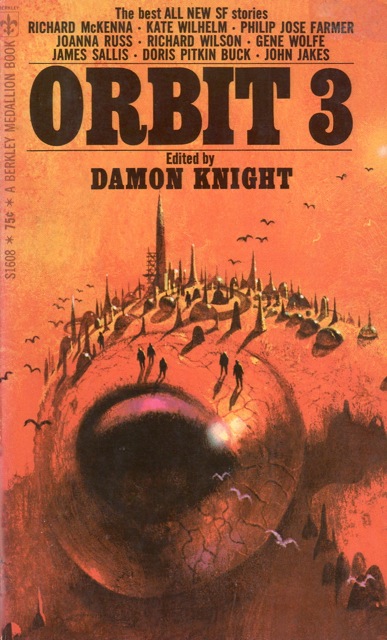
Book Review: Orbit 3, ed. Damon Knight (1968)

RBTFBJNLFG1968

(Paul Lehr’s cover for the 1968 edition)

3.5/5 (collated rating: Good)

Orbit 3 contains both masterpieces (by Gene Wolfe and Kate Wilhelm) and complete duds (by Doris Pitkin Buck and Philip José Farmer).  Damon Knight’s willingness to select a range of known and lesser known authors creates an enjoyable and unpredictable reading experience—but, most of the greats are on their game in this collection, other than Farmer who puts in a lazy shift…  Contains two Nebula award winners: Wilson’s problematic “Mother to the World” (novelette) and Kate Wilhem’s “The Planners” (short story).  The former was also nominated for a Hugo.

Recommended for fans of 60s SF of the experimental bent.  Do not let the collated rating sway you—there are some great stories behind the Paul Lehr Continue reading

Book Review: Three Worlds of Futurity, Margaret St. Clair (1964)

P1080582

(Jack Gaughan’s cover for the 1964 edition)

3/5 (collated rating: Average)

Margaret St. Clair (1911-1995) was a mainstay of the major pulp magazines and maintained a prolific career from 1946 to the late 60s (between the 70s and early 80s she  produced only one novel and a handful of stories).  Previously, I found myself disenchanted with her work as I struggled through the Wicca-inspired ramblings of Sign of the Labrys (1963).  However, I thought I would give her short fiction a try and snagged a copy of the 1964 Ace Double #M-105 that contained her collection Three Worlds of Futurity (1964) and her best known novel Message from the Eocene (1964) (which I might read sometime in the future).

Three Worlds of Futurity contains five stories from her most prolific period—the late 40s-early 60s.  Although the majority do not rise above their fellow pulp ilk, “The Rages” (variant title “The Rations of Tantalus” 1954, revised 1964) shows a measured and incisive feminist inspired vision and the unusual subject matter of “Roberta” (1962) suggests St. Clair’s willingness to tackle controversial subjects.  Most of the stories contain evocative imagery although the delivery rarely transfixes.  Also, although most of the main characters in St. Clair’s stories are men, women scientists and pilots (etc) populate the pages.  I suspect Continue reading

Book Review: Code Three, Rick Raphael (fix-up 1967)

raphaelr1911119111

(John Schoenherr’s cover for the 1963 magazine version)

3.25/5 (Above Average)

A discussion first about taglines…  The 1967 Berkley Medallion edition (with its murky Jerome Podwil cover: photo) reads: “A future world of gigantic expressways—and the men who patrol them.”  The 1985 Panther edition with its ubiquitous Chris Foss Textured Mass (CFTM for short) police car reads: “Before MAD MAX there was CODE THREE.”  Both are in error.  I proffer two edits.  “A future world of gigantic expressways—and the people who patrol them.”  And the latter should be rendered: ” Continue reading

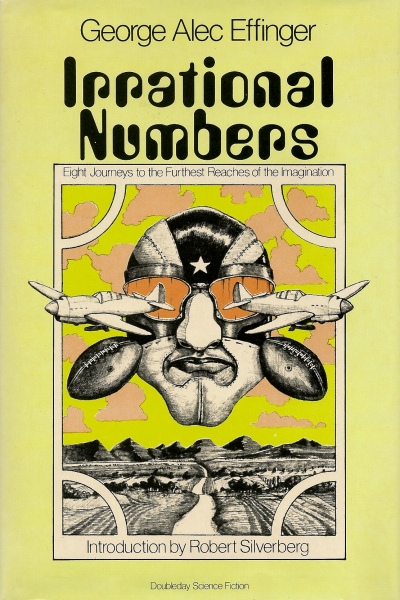
Book Review: Irrational Numbers, George Alec Effinger (1976)

IRRATNUM1976

(Michael Flanagan’s cover for the 1976 edition)

4.5/5 (collated rating: Very Good)

George Alec Effinger’s What Entropy Means to Me (1972) exemplifies the elements of the New Wave movement that continue to fascinate me, i.e. a fascination that compels my endless OrbitNebulaUniverse, etc. anthology purchases!  Effinger’s short fiction holds the same allure—he tackles a vast variety of subjects and themes: trauma, commercialization, sports, and biological apocalypse are paired with the daily experience, the mundane.  Interested in SF about a man obsessed with his fish tank confronting his disintegrating relationship and the end of the world?  A regimented cult, or psychological experiment (?), organized around Mithraic ritual and the memorization Continue reading

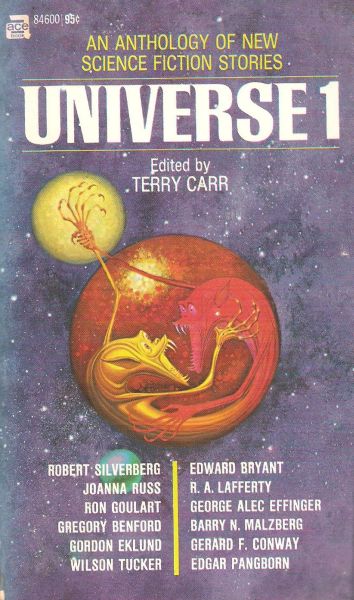
Book Review: Universe 1, ed. Terry Carr (1971)

UNVRS11971

(Davis Meltzer’s cover for the 1971 edition)

3.75/5 (Collated rating: Good)

Won the Locus 1972 Award for Best Original Anthology.

The Universe series of anthologies contained original SF that had not yet appeared in print.  And, the inaugural volume Universe 1 (1971) ed. by Terry Carr certainly hit critical pay dirt: Robert Silverberg’s minimalist the first robotic pope tale won the Nebula for Best Short Story, George Alec Effinger’s anti-war black comedy was nominated for the Hugo Award for Best Short Story, Joanna Russ’ alt-history (sort of) fable was nominated for the Nebula Award for Best Novelette, and Edgar Pangborn’s sentient “alien” animals look for a caretaker mood piece was nominated for the Nebula Award for Best Novelette.

On the whole the quality is fairly Continue reading

Short SF Book Reviews: Michaelmas, Algis Budrys (1976), The Machine in Shaft Ten, M. John Harrison (1975), and Catacomb Years, Michael Bishop (1979)

[The second of four review catch up posts.  The first — > here]

1. Catacomb Years, Michael Bishop (1979)

(Ron Walotsky’s cover for the 1979 edition)

5/5 (collated rating: Masterpiece)

Michael Bishop’s Catacomb Years (1979) takes the form of a complex and multi-layered future history of a single city, the Urban Nucleus of Atlanta, Georgia—entombed/reborn under a vast dome where even the sky is obscured.  Over the course of seven short SF works linked by recurring characters (and character references), theme, and chronology Bishop weaves one of the more spectacular future history canvases.  This is a future history of a profoundly human scope focusing on transformative junctures in the life of the city from the point of view of a range of the inhabitants—from the old to the young, from technicians to recluses obsessed with bonsai, from teachers to human caregivers of the alien visitors…  And most intriguing is Bishop’s willingness to Continue reading

Short SF Book Reviews: If All Else Fails…., Craig Strete (1980), My Petition for More Space, John Hersey (1974), and All Judgement Fled, James White (serialized 1967)

[Preliminary Note: This year saw a massive drop off in the number of reviews I’ve managed to put together due to professional pressures etc.  I wish I had been able to write fuller reviews–especially as much of the SF I read is lesser known and deserves a wider audience.  In some cases, I waited too long to write and thus loss the necessary momentum.  I have ten or so more waiting in the wings–hopefully they will allow me “to catch up” so to speak.]

1. If All Else Fails…, Craig Strete (1980)

FLLLSFLSDC1980

(Margo Herr’s cover for the 1980 edition)

4.75/5 (collated rating: Very Good)

Craig Strete, one of the few Native American SF authors, picked up three Nebula Award nominations for short SF over the 70s and early 80s (“The Bleeding Man” in 1976, “Time Deer” in 1976, and “A Sunday Visit With Great-Grandfather” in 1981 although it was withdrawn).  The first two are in If All Else Fails… (1980).   They are both far from the best of the collection.

Favorites: “All My Statues Have Stone Wings” (1980), “To See the City Sitting on Its Buildings” (1975), and “A Horse of a Different Technicolor” (1975).

The pages reek with despair at the loss of Native American culture ….  The narrator of the “All My Statues” is reminded of his “grandfather who died humming all the songs he had kept silent because there was no one left to sing them” (11).  In “To See the City” the dead try to escape the concrete prisons of the cities that desecrate the holy places: “Buried animal and ground Continue reading