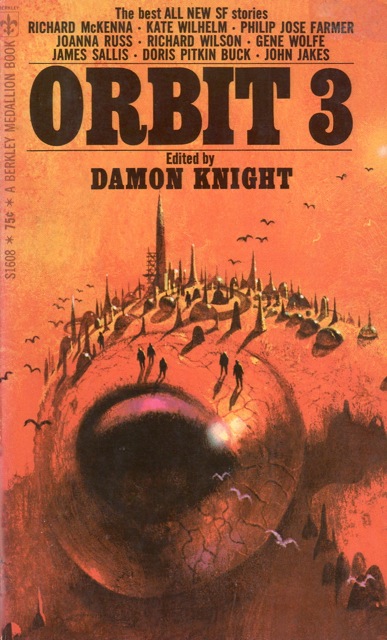
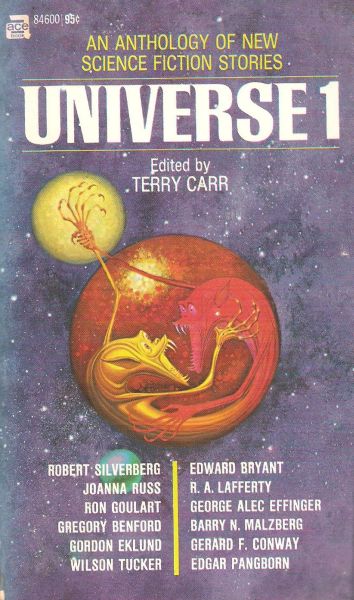
Short SF Book Reviews: Michaelmas, Algis Budrys (1976), The Machine in Shaft Ten, M. John Harrison (1975), and Catacomb Years, Michael Bishop (1979)

[The second of four review catch up posts.  The first — > here]

1. Catacomb Years, Michael Bishop (1979)

(Ron Walotsky’s cover for the 1979 edition)

5/5 (collated rating: Masterpiece)

Michael Bishop’s Catacomb Years (1979) takes the form of a complex and multi-layered future history of a single city, the Urban Nucleus of Atlanta, Georgia—entombed/reborn under a vast dome where even the sky is obscured.  Over the course of seven short SF works linked by recurring characters (and character references), theme, and chronology Bishop weaves one of the more spectacular future history canvases.  This is a future history of a profoundly human scope focusing on transformative junctures in the life of the city from the point of view of a range of the inhabitants—from the old to the young, from technicians to recluses obsessed with bonsai, from teachers to human caregivers of the alien visitors…  And most intriguing is Bishop’s willingness to Continue reading

Short SF Book Reviews: If All Else Fails…., Craig Strete (1980), My Petition for More Space, John Hersey (1974), and All Judgement Fled, James White (serialized 1967)

[Preliminary Note: This year saw a massive drop off in the number of reviews I’ve managed to put together due to professional pressures etc.  I wish I had been able to write fuller reviews–especially as much of the SF I read is lesser known and deserves a wider audience.  In some cases, I waited too long to write and thus loss the necessary momentum.  I have ten or so more waiting in the wings–hopefully they will allow me “to catch up” so to speak.]

1. If All Else Fails…, Craig Strete (1980)

FLLLSFLSDC1980

(Margo Herr’s cover for the 1980 edition)

4.75/5 (collated rating: Very Good)

Craig Strete, one of the few Native American SF authors, picked up three Nebula Award nominations for short SF over the 70s and early 80s (“The Bleeding Man” in 1976, “Time Deer” in 1976, and “A Sunday Visit With Great-Grandfather” in 1981 although it was withdrawn).  The first two are in If All Else Fails… (1980).   They are both far from the best of the collection.

Favorites: “All My Statues Have Stone Wings” (1980), “To See the City Sitting on Its Buildings” (1975), and “A Horse of a Different Technicolor” (1975).

The pages reek with despair at the loss of Native American culture ….  The narrator of the “All My Statues” is reminded of his “grandfather who died humming all the songs he had kept silent because there was no one left to sing them” (11).  In “To See the City” the dead try to escape the concrete prisons of the cities that desecrate the holy places: “Buried animal and ground Continue reading

Book Review: Interface, Mark Adlard (1971)

NTRFCKRGSP1977

(Paul Alexander’s cover for the 1977 edition)

3.25/5 (Vaguely Good)

“Stahlex! Stahlex!

I want it thick!

I want it quick!

I want something that’ll do the trick!

Use Stahlex! Use Stahlex!

A benevo-o-olent monopo-o-oly” (160).

Mark Adlard’s SF output consisted primarily of the Tcity trilogy: Interface (1971), Volteface (1972), and Multiface (1975).  The domed (and doomed) city is a powerful scenario to explore a cornucopia of future social issues such as conformity, Continue reading

Book Review: An Infinite Summer, Christopher Priest (1979)

NNFNTSMMR1981

(Don Puchatz’s cover for the 1981 edition)

4.75/5 (collated rating: Very Good)

With Christopher Priest’s second short story collection, An Infinite Summer (1979), he enters the pantheon of my favorite SF authors.  The thing is, I knew he would all along once I moved past the sour taste of his first novel Indoctrinaire (1970) and finally picked up one of his later endeavors.

Priest’s fiction appeals to my sensibilities: he is the consummate wordsmith; his worlds (especially the stories in the loose sequence of the Dream Archipelago) are evocative; the stories drip with a certain nostalgic longing and/or are populated with characters who cannot escape their memories; metafictional experimentation (a novel within a story, a novel that Priest himself would go on to write–perhaps with a different plot!) is rooted to the aims of each story (you cannot separate the two without Continue reading

Book Review: Scop, Barry N. Malzberg (1976)

SCPHBSVJZB1976

(Stephen Fabian’s cover for the 1976 edition)

3.5/5 (Good)

A TANTALIZING FRAGMENT/THE CONCEPTUAL CORE: “‘Don’t you understand what is going on here? [Scop] said, “Don’t you realize that we are living not in a present but in a dream of waste, an extension of all the terrors of the past; don’t you realize that we live awash in blood?” (105).

WHOSE BLOOD?/THE HISTORICAL JUNCTION: John F. Kennedy is assassinated on November 22nd, 1963 by Lee Harvey Oswald. Abraham Zapruder, a private citizen, films the death from the Grassy Knoll in Dealey Plaza, Dallas.  Jack Ruby kills Oswald, who was awaiting trial, on November 24th.  James Earl Ray assassinates Martin Luther Jing, Jr. on April 4th, 1968.  Robert F. Kennedy is assassinated by Sirhan Sirhan on June 5th, 1968.

Scop wants all three to never have Continue reading

Book Review: Garbage World, Charles Platt (serialized 1966)


NW_0168

(Keith Roberts’ cover for New Worlds SF, October 1966, ed. Michael Moorcock)

2/5 (Bad)

In 1980, 3,000 copies of Charles Platt’s SF novel The Gas (1968)—in which, the “eponymous gas, accidentally released over England, works as an irresistible aphrodisiac […]” and, according to John Clute at SF encyclopedia, contains “sex material” in “transgressively pornographic terms”—were seized by UK’s Director of Public Prosecutions in effect preventing a UK distribution [article].

Platt’s first novel, Garbage World (serialized 1966), feels like The Gas‘s SF juvenile little brother i.e. without the transgressive porn but all the intent to shock a 14 year old boy, although it’s never more than “the warmth of the mud mingled with the warmth of their lovemaking” (95).  So, what is this tidbit of effluvia all about?  First, the silliest part of the novel—the often scatalogical chapter titles: “Garbage Party” (21), “The Hole” ( 57), “The Yellow Rain” (81), “The Defecated Village” (100), “The Great Purgative Continue reading

Book Review: Walk to the End of the World, Suzy McKee Charnas (1974)

5/5 (Masterpiece)

“The men heard, and they rejoiced to find an enemy they could conquer at last.  One night, as planned, they pulled all the women from sleep, herded them together, and harangued them, saying, remember, you caused the Wasting” (3).

Suzy McKee Charnas’ Walk to the End of the World (1974) is the first of four novels in The Holdfast Chronicles sequence (1974-1999) that charts the slow forces of change in a post-apocalyptical future where women (“fems”) are chattel.  Kate Macdonald, in her wonderful review of Ammonite (1993) characterized Nicola Griffith’s novel as “instantly […] feminist: not stealth, or muted, or sub-conscious.”  Walk to the End of the World falls squarely, and powerfully into this category.  Told with intensity and vigor, Charnas brands the reader with her vision, a searing and festering landscape where white men have either exterminated the remaining “unmen” (the “Dirties”) or subjugated them (the “fems”) after a manmade cataclysm.  Complex societal institutions maintain control in a mostly illiterate world via appeals to collective memory, intensive drug facilitated indoctrination, and the deconstruction of the family unit in favor of exclusively homosocial relationships.

Continue reading

Book Review: The Custodians and Other Stories, Richard Cowper (1976)

IMG_0590

(Geoff Taylor’s cover for the 1978 edition)

3.25/5 (collated rating: Vaguely Good)

The Custodians and Other Stories contains Richard Cowper’s most famous short SF (both received Nebula nods): “The Custodians” (1975) and “Piper at the Gates of Dawn” (1976), later published side-by-side with his Nebula-nominated novel in the same sequence The Road to Corlay (1978).

My limited exposure to Cowper’s work so far—i.e. the hilarious post-apocalyptical black comedy on the British class system replete with intelligent dolphins and giant submarines,  Profundis (1979)—suggests an author who  can weave a solid story in a range of SF sub-genres from time travel Continue reading

Book Review: Out of Bounds, Judith Merril (1960)

OTFBNDS1960

(Art Sussman’s cover for the 1960 edition)

3.25/5 (collated rating: Vaguely Good)

I have long been a fan of both Judith Merril’s fiction and edited volumes.   The eponymous novella in the collection Daughters of Earth (1968) is one of more delightful visions from the 1950s I have encountered. Merril reframes biblical patrilineal genealogy as matrilineal–i.e. humankind’s conquest of space is traced via the female descendants of an august progenitor.  The story is brilliant in part due to a remarkable metafictional twist, the story itself is compiled from historical documents to serve as an instructional template for future generations of women.  Despite substantial editorial control that forced Merril to include a rather hokey plot on two hokey planets, the story remains memorable for the well crafted feminist Continue reading