Book Review: The Committed Men, M. John Harrison (1971)

THCMMTTDMB1971-1

(Chris Yates’ cover for the 1971 edition)

4.5/5 (Very Good)

Entropic visions of decay and despair inhabit M. John Harrison’s first novel The Committed Men (1971).  Possessed by destructive melancholy, the inhabitants of a post-apocalyptical UK–where political powers have sunk into oblivion–attempt to recreate a semblance of normalcy.  Clement St John Wendover, teeth long since rotted, still administers to the skin diseases and ailments of his one-time patients although he cannot cure them.  Halloway Pauce, decked out in his “gold lamé suit”, fastidiously coats his cancered face with a “layer of pancake make-up” (48).  Grocott Personnel and his hierarchically oriented fellows recreate the bureaucratic veneer Continue reading

Book Review: Tau Zero, Poul Anderson (1970)

TZRMHJZHWF1970

(Anita Siegel’s cover for the 1970 edition)

3/5 (Average)

Nominated for the 1971 Hugo Award for Best Novel

Poul Anderson’s Tau Zero (1970) exemplifies the type of SF I no longer enjoy.  A younger me would have gobbled up the magical phrases: A Bussard Interstellar Ramjet! Disaster in space! Einstein’s theory of Special Relativity!

At one point Anderson’s adventure-heavy SF formed my bread and butter.  Over the years I’ve reviewed thirteen of his novels and short story collections, most recently in 2013 — There Will Be Time (1972), Brain Wave (1953), and Time and Stars (1964).   I have sat on this review for months in a state of indecision debating whether or not to insert my sharpened awl into the novel’s brittle hide so repeatedly tattooed with the Continue reading

Book Review: The Best SF Stories from New Worlds 2, ed. Michael Moorcock (1968)

THBSTSFSTR1969

(Paul Lehr’s cover for the 1969 edition)

3.75/5 (Collated rating: Good)

As New Worlds issues tend to be expensive and hard to find (especially in the US), Michael Moorcock’s anthology series provides satiating morsels from the magazine’s best period.  New Worlds was instrumental in the so-called New Wave movement.  I am at home in  eclectic and genre-challenging/subversive madness.

New Worlds combined SF stories/poems with experimental art and layout that is, unfortunately, lost in the anthologies.  One of my favorite examples is Vivienne Young’s collage (below) illustrating James Sallis’ “Kazoo” (1967) Continue reading

Short Book Reviews: Robert Silverberg’s Dying Inside (1972), Universe 2, ed. Terry Carr (1972), and Avram Davidson’s The Enemy of My Enemy (1966)

Here are three short reviews.  Either I waited too long to review the work or in the case of the short story collection, the handful of poor stories (amongst the many gems) faded from memory and I couldn’t convince myself to reread them…

I apologize for the brevity and lack of analysis.  My longer reviews definitely try to get at the greater morass of things but hopefully these will still whet your palate if you haven’t read the works already.

1. Dying Inside, Richard Silverberg (1972)

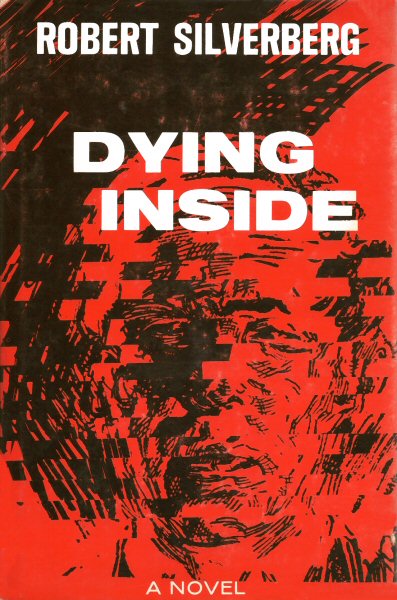
DYINGNSD1972

(Jerry Thorp’s cover for the 1972 ediiton)

5/5 (Masterpiece) Continue reading

Book Review: New Writings in SF 4, ed. John Carnell (1965) (Asimov + Roberts + Tenn + Kapp + Etchison + Morgan)

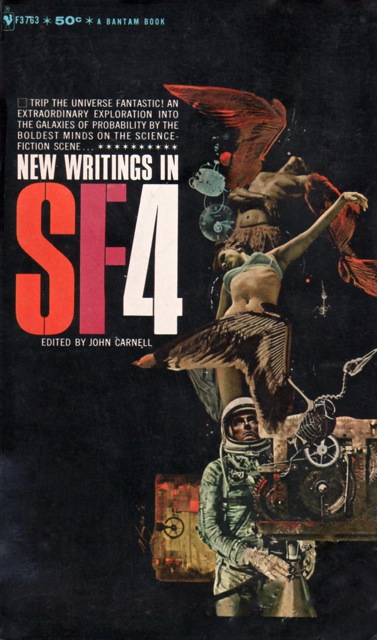
NWWRTNGSNF1968

(Robert Foster’s stunning cover for the 1968 edition)

2.75/5 (Collated rating: Vaguely Average)

Despite the presence of one of Robert Foster’s best covers (for more on his art: Part I, Part II), New Writings in SF 4, ed. John Carnell (1965) contains only a few glimmers of brilliance—concentrated in Keith Roberts’ short story “Sub-Lim” (1965), a dark tale of crooked people and subliminal stimuli.  Isaac Asimov regurgitates something about a SF heist he scribbled on a napkin, Dan Morgan mumbles about alternate universes and tricycles, and Colin Kapp lectures on the “unusual methods of cementation of electrolysis” (54) instead of telling a Continue reading

Book Review: The Long Loud Silence, Wilson Tucker (1952, revised 1969)

LNGLDS1952

(Richard Powers’ cover for the 1953 edition)

4.25/5 (Very Good)

Preliminary Note: I read the 1969 Lancer edition which was “specially revised and updated by the author.”  Other than many overt references to the Vietnam War which chronologically could not have been in the original 1952 edition, I am uncertain how much was subtracted, added, or re-conceived.  John Clute at SF Encyclopedia indicates that “early editions” deleted references to cannibalism.  Perhaps he means the pre-1969 editions as it is horrifyingly present in this edition.  I wish I read the first edition as comparisons to his contemporaries would be easier to make.  Anyone who has read both versions or knows of a resource which lays out the modifications, please let me know.  The idea of updating a radical 50s novel for a late 60s audience intrigues me!

The Long Loud Silence (1952, revised 1969) is a quiet novel that depends on the emotional impact of loneliness and trauma,  and the desire for intrahuman connection Continue reading

Book Review: The Eclipse of Dawn, Gordon Eklund (1971)

THCLPSFDWN1971

(Diane and Leo Dillon’s cover for the 1971 edition)

3.25/5 (Vaguely Good)

“I hadn’t even voted in the last election.  I knew nothing about it, except Robert Colonby, how he wanted to make America strong again, how he said we ought to exert ourselves” (15).

Gordon Eklund’s first novel Eclipse of Dawn (1971) tells of a future dystopic America (the year 1988) chaffing under foreign quarantine and suffering from a major race war which results in African-Americans creating an autonomous political entity in the American South.  The effects of limited nuclear war spawns a poisonous urban environment and microclimates across the state of California. A return to “Victorian morality” presents but a facade of “purity laid across a morass of fear and guilt” (94).

Robert F. Colonby sets out from his residence amidst the bombed-out remains of Disneyland, where he dines on exotic cuts of meat and “wines dated back to the glory days” Continue reading

Book Review: Heroics, George Alec Effinger (1979)

HEROICS1979

(Gary Friedman’s cover for the 1979 edition)

4.25/5 (Good)

George Alec Effinger’s What Entropy Means to Me (1972), a complex and intense homage to the act of literary creation, ranks among my favorite SF novels.  Heroics (1979), a deconstruction of myth and heroic quest,  treads similar ground but in a more light-hearted manner.  The sheer intensity elevates the former while the latter’s sincere examination of old age and loneliness still strikes with elegiac power.  Both are highly recommended but What Entropy Means to Me or his short story collection Irrational Numbers (1976) might be the place to Continue reading

Short Book Reviews: Theodore Sturgeon’s Venus Plus X (1960), Christopher Priest’s The Affirmation (1981), and Barry N. Malzberg’s Screen (1968)

Cycle: read a book, place it in the review pile, the immediacy of the novel fades slightly or the novel fights every moment of the review writing process (–> Priest’s masterpiece The Affirmation), never review it, feel bad that I never reviewed the novel, read less in order to catch up…

Result: less reading and more pouting.

Remedy: In order to catch up, here are short/less intensive reviews with links to in-depth analysis (if it exists).  Part I + II (books by Budrys, Strete, White, Bishop, etc).

1. Venus Plus X, Theodore Sturgeon (1960)

VNSPLSX1960

(Victor Kalin’s cover for the 1960 edition) Continue reading