Book Review: Time of the Great Freeze, Robert Silverberg (1964)

(Harry Schaare’s cover for the 1966 edition)

3/5 (Average)

Silverberg’s young adult (juvenile) science fiction novel Time of the Great Freeze (1964) is a by the numbers with few extra frills pulp adventure with a time-worn but still seductive premise: underground cities!  Unlike Heinlein’s best juvenile sci-fi works (Starman Jones, Citizen of the Galaxy, etc), Silverberg’s work fails to conjure the same wonder.  Silverberg’s portrayal of his youthful hero is dull even by 50s/60s juvenile standards — he fails to exude the biggest character trait of the genre, vibrant youthful vigor.  Yes he’s smart, does some judo moves, gets over friends’ deaths in a heartbeat, and is mentally tough but unfortunately is completely interchangeable with the other characters. Continue reading

Book Review: Ossian’s Ride, Fred Hoyle (1959)

SSNSRDSLDK1959.jpg

(Hoffman’s cover for the 1959 edition)

2.5/5 (Bad)

Fred Hoyle’s Ossian’s Ride (1959) is a disappointing sci-fi thriller which fails to live up to its intriguing premise: why is unusual technology flowing from unknown sources from far Western Ireland (a handy map is provided) beyond the Erin Curtain?  Get it, Ireland’s IRON CURTAIN…  This wobbly little thriller conjures but little thrill, the grand mystery is all too obvious/abrupt/giggle-inducing, and, most damaging, intended or not the political message is an endorsement of a police state as long as it encourages technological advancement.

The first edition cover proclaims Ossian’s Ride Continue reading

Book Review: Bright New Universe, Jack Williamson (1967)

(John Schoenherr’s cover for the 1967 edition)

3.25/5 (Average)

Jack Williamson’s Bright New Universe (1967) is one part juvenile (young man trekking into space against the wishes of his family), one part 1960s social commentary on race, and one part 30s/40s pulp (look at that beehive alien!  Look at that sexy Asian girl alien!).  The hybridity is jarring and unsuccessful but shows Williamson’s valiant attempt to modify his earlier writing styles to the increasingly prevalent social science fiction of the 60s.

Brief Plot Summary (limited spoilers)

In the middle of a gathering with his family and the family of his wealthy fiancée Kayren, Adam Cave (early 20s) calls off his wedding and declares that he will follow his father’s footsteps and Continue reading

Book Review: Planet of the Voles, Charles Platt (1971)

(Paul Lehr’s cover for the 1972 edition)

1/5 (Terrible)

Charles Platt’s Planet of the Voles (1971) has a similar feel to one of the more atrocious episodes of Stargate SG-1.  In place of all the horridly butchered Egyptian mythology is a weird pseudo-mythology about the inevitability of a battle between the sexes uneasily pasted on an archetypal military sci-fi plot.  The work is filled with alien landscapes which look like Earth, soldier/scientists who can do anything and everything with anything anywhere, random bits of hokey technology appear as if by magic to facilitate the pedestrian plot (this black box will make alien birds carry us into the fortress!) etc.

Platt’s prose is lacking all ability to convey human emotions.  After our Continue reading

Book Review: Marune: Alastor 933, Jack Vance (1975)

(Darrell Sweet’s cover for the 1975 edition)

3.75/5 (Good)

Even though I’ve previously read only three of Jack Vance’s lesser known works, The Showboat World (1975), The Blue World (1966) and City of the Chasch (1968) I’ve come to appreciate his world building and solid story telling abilities.  Marune: Alastor 933 (1975), although not the best of his Alastor trilogy, is no exception.  I recommend the work for all fans of space opera, “fantasy in space,” and fans of Vance’s more famous works who haven’t yet tracked down other works of his substantial catalogue.

Brief Plot Summary (limited spoilers)

This work of space opera takes place in the Alastor Cluster, a node Continue reading

Book Review: The Penultimate Truth, Philip K. Dick (1964)

(Uncredited cover for the 1964 edition)

4/5 (Good)

Although I’ve read a great majority of Philip K. Dick’s novels and short stories, I’ve only reviewed one of Philip K. Dick’s novels in the lifetime of this blog, The Man Who Japed (1956).  Despite not reaching the near perfection which characterizes his best works, The Penultimate Truth (1964) is worth the read.  The work’s premise is pure PKD.  As with his best, an uncanny sci-fi infused surrealism seeps from the pages….  However, the work is plagued by ramshackle editing, the unfortunate tendency to use words like “homeostatic” and “tropism” ever few pages, and an ungainly plethora of named characters who have little to no import in the novel creates unnecessary confusion.

Brief Plot Summary (limited spoilers)

Most of the inhabitants of Earth, due to worries about an approaching nuclear war with the Soviets, retreated to massive underground facilities (Tom Mix Continue reading

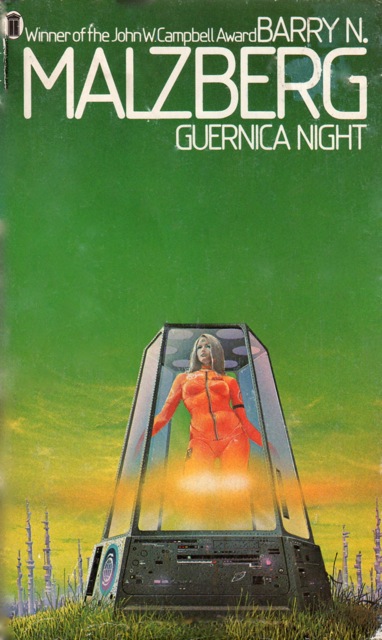
Book Review: Guernica Night, Barry N. Malzberg (1975)

(Tim White’s cover for the 1979 edition)

4.25/5 (Good)

Nominated for the 1976 Nebula Award for Best Novel

“Here we are in Disney Land/Disney World; clutching the strange hands of those with whom we came, we move slowly through the ropes under the chanting of the attendants, swatting insects of habitation, toward the exhibit of the martyred President.  The martyred President has become a manikin activated by machinery, tubes and wiring; he delivers selected portions of his famous addresses, stumbling back and forth […] (1)”

Guernica Night (1975) is the third of Barry N. Malzberg’s books I’ve read after Conversations (1975) and In the Enclosure (1973).  Although lacking the Continue reading

Book Review: The Long Winter, John Christopher (1962)

(Paul Lehr’s cover for the 1968 edition)

3.75/5 (Good)

Although known for his famous young adult Tripod Trilogy (The White Mountains, The City of Gold and Lead, The Pool of Fire), John Christopher produced a substantial corpus of science fiction works for older readers — most notably, the post-apocalyptical tale No Blade of Grass (1956).  The Long Winter (1961), one of Christopher’s lesser known works, is on the surface another post-apocalyptical novel (or sorts).  However, the post-apocalyptical elements are subsumed by a bitting satire on colonial and post-colonial British attitudes towards their colonies.  The publication date of 1962 is of vital importance in understanding the work.  Nigeria gained its independence from the British in 1960, Ghana in 1957, and South  Africa in 1961.

A large percentage of the reviews I’ve read complain that they Continue reading

Book Review: The Florians, Brian M. Stableford (1976)

(Michael Whelan’s cover for the 1976 edition)

2/5 (Bad)

Even after the underwhelming Journey to the Center (1982) I decided to give Brian M. Stableford a second chance.  Unfortunately, The Florians (1976), the first in a six novel series about the adventures of the starship Daedalus, is even less impressive.  Both works contain a potentially fascinating premise around which the barest framework of a story is cobbled.  At least Journey the Center maintained some sense of wonder and excitement despite its incredible brevity, poor prose, disappointing ending, and dull characters.  The Florians, on the other hand, fails to conjure Continue reading