Book Review: Marune: Alastor 933, Jack Vance (1975)

(Darrell Sweet’s cover for the 1975 edition)

3.75/5 (Good)

Even though I’ve previously read only three of Jack Vance’s lesser known works, The Showboat World (1975), The Blue World (1966) and City of the Chasch (1968) I’ve come to appreciate his world building and solid story telling abilities.  Marune: Alastor 933 (1975), although not the best of his Alastor trilogy, is no exception.  I recommend the work for all fans of space opera, “fantasy in space,” and fans of Vance’s more famous works who haven’t yet tracked down other works of his substantial catalogue.

Brief Plot Summary (limited spoilers)

This work of space opera takes place in the Alastor Cluster, a node Continue reading

Book Review: The Penultimate Truth, Philip K. Dick (1964)

(Uncredited cover for the 1964 edition)

4/5 (Good)

Although I’ve read a great majority of Philip K. Dick’s novels and short stories, I’ve only reviewed one of Philip K. Dick’s novels in the lifetime of this blog, The Man Who Japed (1956).  Despite not reaching the near perfection which characterizes his best works, The Penultimate Truth (1964) is worth the read.  The work’s premise is pure PKD.  As with his best, an uncanny sci-fi infused surrealism seeps from the pages….  However, the work is plagued by ramshackle editing, the unfortunate tendency to use words like “homeostatic” and “tropism” ever few pages, and an ungainly plethora of named characters who have little to no import in the novel creates unnecessary confusion.

Brief Plot Summary (limited spoilers)

Most of the inhabitants of Earth, due to worries about an approaching nuclear war with the Soviets, retreated to massive underground facilities (Tom Mix Continue reading

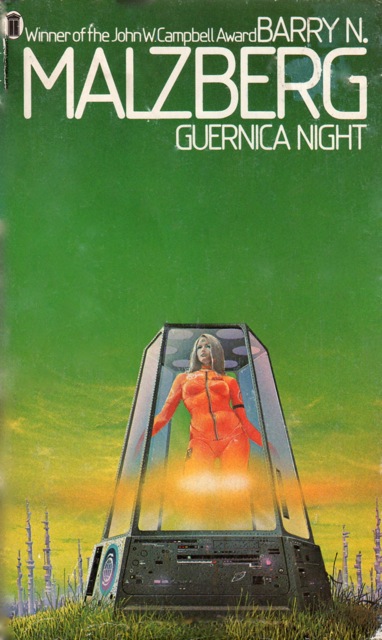
Book Review: Guernica Night, Barry N. Malzberg (1975)

(Tim White’s cover for the 1979 edition)

4.25/5 (Good)

Nominated for the 1976 Nebula Award for Best Novel

“Here we are in Disney Land/Disney World; clutching the strange hands of those with whom we came, we move slowly through the ropes under the chanting of the attendants, swatting insects of habitation, toward the exhibit of the martyred President.  The martyred President has become a manikin activated by machinery, tubes and wiring; he delivers selected portions of his famous addresses, stumbling back and forth […] (1)”

Guernica Night (1975) is the third of Barry N. Malzberg’s books I’ve read after Conversations (1975) and In the Enclosure (1973).  Although lacking the Continue reading

Book Review: The Long Winter, John Christopher (1962)

(Paul Lehr’s cover for the 1968 edition)

3.75/5 (Good)

Although known for his famous young adult Tripod Trilogy (The White Mountains, The City of Gold and Lead, The Pool of Fire), John Christopher produced a substantial corpus of science fiction works for older readers — most notably, the post-apocalyptical tale No Blade of Grass (1956).  The Long Winter (1961), one of Christopher’s lesser known works, is on the surface another post-apocalyptical novel (or sorts).  However, the post-apocalyptical elements are subsumed by a bitting satire on colonial and post-colonial British attitudes towards their colonies.  The publication date of 1962 is of vital importance in understanding the work.  Nigeria gained its independence from the British in 1960, Ghana in 1957, and South  Africa in 1961.

A large percentage of the reviews I’ve read complain that they Continue reading

Book Review: The Florians, Brian M. Stableford (1976)

(Michael Whelan’s cover for the 1976 edition)

2/5 (Bad)

Even after the underwhelming Journey to the Center (1982) I decided to give Brian M. Stableford a second chance.  Unfortunately, The Florians (1976), the first in a six novel series about the adventures of the starship Daedalus, is even less impressive.  Both works contain a potentially fascinating premise around which the barest framework of a story is cobbled.  At least Journey the Center maintained some sense of wonder and excitement despite its incredible brevity, poor prose, disappointing ending, and dull characters.  The Florians, on the other hand, fails to conjure Continue reading

Book Review: Station in Space, James Gunn (1958)

(Walter Murch and Jerry Powell’s cover for the 1958 edition)

collated rating: 3.75/5 (Good)

James Gunn’s Station in Space (1958) is an interconnected series of stories that form a cohesive chronologically organized whole tracking the development of human exploration into space (Earth –> first space flight –> first space station –> second space station –> Mars).  Because multiple characters reappear in later stories and the earlier events all have a direct bearing the work must be read in order.  The result is more a loose form novel than short story collection.

The most intriguing aspect of Gunn’s stories is the careful demystification of the glamor of space travel.  Many of the works begin like a juvenile à la Heinlein or Blish where space travel is fun and rosy and easy as picking corn before Gunn’s brutal realist streak seeps in and overwhelms the pages. I suspect that Continue reading

Book Review: The Outcasts of Heaven Belt, Joan D. Vinge (1978)

(Vincent Di Fate’s cover for the 1978 edition)

3.25/5 (Average)

The title of Joan D. Vinge’s first novel, The Outcasts of Heaven Belt (1978), is an homage to The Outcasts of Poker Flat (1869) by the turn of the century western writer and poet Bret Harte.  He is famous for his depictions of resourceful women in California pioneer settlements.  Vinge creates a resourceful female captain of a powerful but weaponless spaceship who finds herself beset–with only a depleted crew–by a series of challenges in the decadent, grasping, and fractured pioneer societies of Heaven Belt.  Although the often less than amicable conflict between the egalitarian society with powerful women and the male-focused pioneer cultures could be the focus of the novel, Vinge is less interested in exploring the social ramifications (à la Le Guin and other works of the previous decade — the 1960s).  Instead, this conflict provides a suitable world-building backdrop for a traditional space opera — a bedraggled but technologically Continue reading

Book Review: Traitor to the Living, Philip José Farmer (1973)

(Hans Ulrich Osterwalder and Ute Osterwalder’s cover for the 1973 edition)

2.5/5 (Bad)

In disappointing fashion, Traitor to the Living (1973) follows a similar pattern to Philip José Farmer’s famous Hugo winning To Your Scattered Bodies Go (1971) — the fascinating premise is bogged down by blank characters and repetitive action.  Despite my fervent conviction that To Your Scattered Bodies Go is one of the worst Best Novel Hugo winners (and I’ve read a majority of them) and that the endlessly laborious sequels are a complete waste of ink, paper, and time, I gave Farmer a second chance — albeit with one of his lesser known works.  Because some of the pieces are in place in Traitor to the Living for a worthwhile novel, I hold out hope that he produced a readable work that I might be compelled to acquire (queue question: what is your favorite novel/short story/novella by Farmer?).

If you’re a Farmer completest, Traitor to the Living might be Continue reading

Book Review: Daughters of Earth, Judith Merril (1968)

daughters of earth

(Robert Foster’s cover for the 1970 edition)

4/5 (Good)

Judith Merril was not only an important early science fiction author of novels and short stories but a political activist and a member of the influential 1940s sci-fi group known as the Futurians (members included her husband Frederik Pohl, James Blish, Damon Knight, David A. Wollheim, C. M. Kornbluth, et al.).  Her fascinating collection, Daughters of Earth (1968), contains three novellas from the 1950s: ‘Project Nursemaid’ (1955), the highlight of the collection — ‘Daughters of Earth’ (1952), and the underwhelming ‘Homecalling’ (1956).  

All three contain a plethora of female characters Continue reading