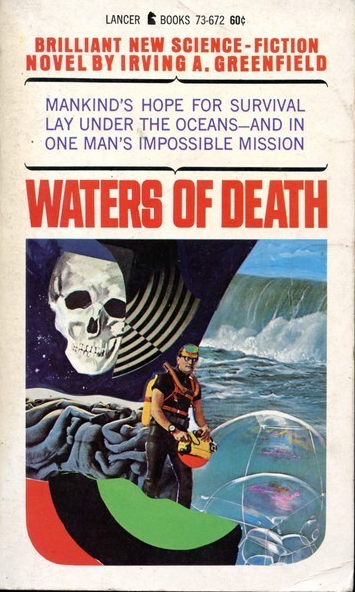
Book Review (rant): Waters of Death, Irving A. Greenfield (1967)

(Hoot von Zitzewitz’s cover for the 1967 edition)

1/5 (Terrible)

I apologize for the lack of deep philosophical insight into the nuances of the book in question. None can be dispensed/inferred/implied or even invented that would adequately embody the throbbing intellect that exudes forth from every word.  Instead, I shall wax nostalgic.

I loved underwater farms/cities/towns when I was a child.  I drew translucent housing domes in cross-section, replete with carefully delineated plots of seaweed stewarded by land dwelling turtle/dog/humans (flippers, tummy fur, soft shells and the like) and an array of mechanical contrivances to facilitate harvesting, processing, and oxygen production.

I picked up a copy of Irving A. Greenfield’s Waters of Continue reading
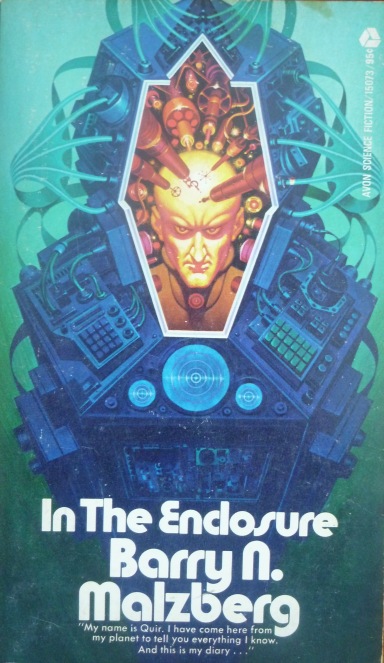
Book Review: In The Enclosure, Barry N. Malzberg (1973)

(Davis Meltzer’s cover for the 1973 edition)

4.5/5 (Very Good)

Fresh off Malzberg’s intriguing young adult novel, Conversations (1975), I picked up a copy of the altogether more disturbing, transfixing, unnervingly prescient, and at moments, brilliant In The Enclosure (1972).  As with many of Malzberg’s oeuvre, the work is infused with a steady dose of metafiction — our hero laments (and we writhe along with him in a malaise of unease), “I will never really know” (189).  Just as Quir is unsure of his own reality, his diaristic words — which the reader is desperate to hold on to — are admittedly, “an impression, a conception, nothing more” (190).

Combining the science fiction trope of implanted memories with the literary narrative mode of the unreliable narrator creates an overwhelmingly uncomfortable gulf between reality and constructed reality.  The result, the overpowering desire to pick up a piece of pulp science fiction where the future is rosy, technology = happiness, the kids smart, where rockets Continue reading

Book Review: Eight Keys to Eden, Mark Clifton (1960)

(Ralph Brillhart’s cover for the 1962 edition)

3.25/5 (Average)

Mark Clifton’s readable and thought-provoking Eight Keys to Eden (1960) has been unfortunately overshadowed by his dismal failure, They’d Rather Be Right (1955) (co-written with Frank Riley), which is generally considered the worst novel ever to win the Hugo Award.  Although I wouldn’t classify Eight Keys to Eden as a masterpiece, the novel does contains an original premise, good plotting, and sufficiently thought out “pseudo-intellectual” content that is only overbearing at the work’s climax.  The serious nature of the premise is weakened by a forced strain of unfunny “humor” that creeps in at the wrong moments.  Also, a complete lack of character development makes us care little for the challenges Continue reading

Book Review: The Man in the Maze, Robert Silverberg (1969)

(Ron Walotsky’s cover for the 1978 edition)

4.5/5 (Very Good)

The Man in the Maze (1969) is yet another glorious novel from Silverberg’s best period (1967-1975).  Silverberg adeptly recasts Sophocles’ play Philoctetes (perhaps more of a loose inspiration) in an inventive and fully realized science fiction future where man has newly come into contact with interstellar beings.  As with some of his more serious works (The World Inside, Downward to the EarthHawksbill Station, etc.) the tone is that of a dark and brooding rumination.  The setting, a massive and unexplained ancient maze/city on the planet of Lemnos, is the perfect backdrop for the thought-provoking human drama that unfolds.

Plot Summary

Our hero, Richard Muller, is a one-time diplomat famous Continue reading

Book Review: Conversations, Barry N. Malzberg (1975)

(Uncredited cover for the 1975 edition)

3.25/5 (Average)

“Here I live.  Twenty up, twenty down, me in the middle with the Group.  Twenty up, broken gray and movement to the distance, twenty down to the landing, farther out the arena.  Gray up, landing down, me forever in the middle (1).”

Malzberg’s novella (89 pages), Conversations (1975), distills the common future dystopia tropes into an occasionally poignant but unremarkable young adult novel.  By young adult I mean completely suitable for young readers interested in science fiction (Malzberg fans know his usual relentlessly dark fare often verges on crass/risque).  I was unable to glean any information from the web on the work — only two or three of Malzberg’s extensive canon (late 60s-early 80s) receive any attention — so I had no idea that it was for younger readers.  A shot in the dark…

The main downfall of the work is the overly simplistic setting Continue reading

Book Review: Beyond the Sealed World, Rena Vale (1965*)

(Uncredited cover for the 1965 edition)

2/5 (Bad)

*Concerning the publication date: Rena Vale’s Beyond the Sealed World was written in the 50s and sold to Shasta press.  However, the press went bankrupt and the novel remained unpublished until 1965.  No wonder it took forever for another press to pick it up….

Before Rena Vale became a science fiction author she was a secretary for the California State Assembly Committee on Un-American activities.  In an affidavit she detailed her own experiences as a member of the Communist party and implicated famous individuals she worked with including Lucille Ball (of I Love Lucy fame), novelist John Steinbeck, actress Gale Sodergaard, and various others!  Wonderful.

I’m not going to lie but this piqued Continue reading

Book Review: The Explorers, C. M. Kornbluth (1954)

(Richard Powers’ cover for the 1954 edition)

collated rating: 4/5 (Good)

I’ve stayed away from C. M. Kornbluth for far too long.  I read Kornbluth and Pohl’s The Space Merchants (1953) when I was quite young and was put off for some unexplainable reason.  What a shame!  This collection of short stories and novelettes contains some of the best short works I’ve ever read from the 50s (a few of Philip K. Dick’s early works are just as good).  As with The Space Merchants, Kornbluth exposes (in an often satirical manner) the dark underbelly of the usually glamourous 50s accounts of space travel, interplanetary trade, and the devastating social ramifications of technology on astronauts, new cultures, etc.  Kornbluth is equally adept at infusing his work with devastating commentary on American society.

This collection is brilliant throughout — only the annoying silly Continue reading

Book Review: The City Machine, Louis Trimble (1972)

THCTMCHNGH1972

(Kelly Freas’ cover for the 1972 edition)

3.75/5 (Good)

First, a snarky comment about Kelly Freas’ unfortunate cover art — I can’t help but giggle at the imposing sci-fi behemoth cityscape which accidentally wandered onto a Thomas Kinkade, “Painter of Light” (or, as I call him, “The Painter of Kitsch”) Christmas tableau.  Kelly Freas’ fuzzy light, happy-budget-hotel-color-scheme art seldom impresses me.  Perhaps I’m too harsh….

On the other less caustic hand, Louis Trimble’s The City Machine is a surprisingly intriguing blend of allegory and sci-fi tale.  In line with my previous Continue reading

Book Review: Magellan, Colin Anderson (1970)

(Uncredited cover for the 1970 first edition)

3.5/5 (Good)

Magellan (1970), Colin Anderson’s only science fiction publication, is an inventive but emotionally hollow novel, overly brief, and lacking in sufficient prose to adequately convey the lengthy allegorical sequences.  It is a shame that Colin Anderson didn’t write other science fiction works because this one holds great potential.  The future evolution of mankind — waiting to be subsumed into a computer of their own making — is a fascinating premise.  The tepid  and unadventurous prose conflicts with the grand and audacious subject matter.

Brief Plot Summary (limited Continue reading