Book Review: Conversations, Barry N. Malzberg (1975)

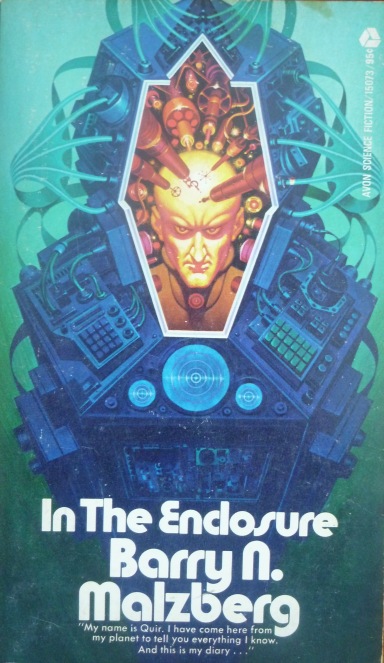
(Uncredited cover for the 1975 edition)

3.25/5 (Average)

“Here I live.  Twenty up, twenty down, me in the middle with the Group.  Twenty up, broken gray and movement to the distance, twenty down to the landing, farther out the arena.  Gray up, landing down, me forever in the middle (1).”

Malzberg’s novella (89 pages), Conversations (1975), distills the common future dystopia tropes into an occasionally poignant but unremarkable young adult novel.  By young adult I mean completely suitable for young readers interested in science fiction (Malzberg fans know his usual relentlessly dark fare often verges on crass/risque).  I was unable to glean any information from the web on the work — only two or three of Malzberg’s extensive canon (late 60s-early 80s) receive any attention — so I had no idea that it was for younger readers.  A shot in the dark…

The main downfall of the work is the overly simplistic setting Continue reading

Book Review: Beyond the Sealed World, Rena Vale (1965*)

(Uncredited cover for the 1965 edition)

2/5 (Bad)

*Concerning the publication date: Rena Vale’s Beyond the Sealed World was written in the 50s and sold to Shasta press.  However, the press went bankrupt and the novel remained unpublished until 1965.  No wonder it took forever for another press to pick it up….

Before Rena Vale became a science fiction author she was a secretary for the California State Assembly Committee on Un-American activities.  In an affidavit she detailed her own experiences as a member of the Communist party and implicated famous individuals she worked with including Lucille Ball (of I Love Lucy fame), novelist John Steinbeck, actress Gale Sodergaard, and various others!  Wonderful.

I’m not going to lie but this piqued Continue reading

Book Review: The Explorers, C. M. Kornbluth (1954)

(Richard Powers’ cover for the 1954 edition)

collated rating: 4/5 (Good)

I’ve stayed away from C. M. Kornbluth for far too long.  I read Kornbluth and Pohl’s The Space Merchants (1953) when I was quite young and was put off for some unexplainable reason.  What a shame!  This collection of short stories and novelettes contains some of the best short works I’ve ever read from the 50s (a few of Philip K. Dick’s early works are just as good).  As with The Space Merchants, Kornbluth exposes (in an often satirical manner) the dark underbelly of the usually glamourous 50s accounts of space travel, interplanetary trade, and the devastating social ramifications of technology on astronauts, new cultures, etc.  Kornbluth is equally adept at infusing his work with devastating commentary on American society.

This collection is brilliant throughout — only the annoying silly Continue reading

Book Review: The City Machine, Louis Trimble (1972)

THCTMCHNGH1972

(Kelly Freas’ cover for the 1972 edition)

3.75/5 (Good)

First, a snarky comment about Kelly Freas’ unfortunate cover art — I can’t help but giggle at the imposing sci-fi behemoth cityscape which accidentally wandered onto a Thomas Kinkade, “Painter of Light” (or, as I call him, “The Painter of Kitsch”) Christmas tableau.  Kelly Freas’ fuzzy light, happy-budget-hotel-color-scheme art seldom impresses me.  Perhaps I’m too harsh….

On the other less caustic hand, Louis Trimble’s The City Machine is a surprisingly intriguing blend of allegory and sci-fi tale.  In line with my previous Continue reading

Book Review: Magellan, Colin Anderson (1970)

(Uncredited cover for the 1970 first edition)

3.5/5 (Good)

Magellan (1970), Colin Anderson’s only science fiction publication, is an inventive but emotionally hollow novel, overly brief, and lacking in sufficient prose to adequately convey the lengthy allegorical sequences.  It is a shame that Colin Anderson didn’t write other science fiction works because this one holds great potential.  The future evolution of mankind — waiting to be subsumed into a computer of their own making — is a fascinating premise.  The tepid  and unadventurous prose conflicts with the grand and audacious subject matter.

Brief Plot Summary (limited Continue reading

Book Review: The Watch Below, James White (1966)

(George Ziel’s cover for 1966 Ballantine edition)

4/5 (Good)

James White, famous for his Sector General series, spins a disturbing tale of two isolated and decaying societies — one alien, one human.  Without doubt the work demands a certain suspension of disbelief.  The isolated human society half of the premise comes off as highly artificial/improbably/impossible (and, well, bluntly put, hokey).  I found the alien half of the story line a more “realistic” situation but less emotionally involving as the human half.  White has difficultly meshing the trans-generational nature of both story lines — and the inevitable intersection at the end is predictable, anti-climactic, and dents the great appeal of the central portion of the work.

Lest this dissuade you, White’s dark vision is a transfixing take on the generation ship (literally) — how would a society descended from five individuals evolve for a hundred years trapped Continue reading

Book Review: Future City, ed. Roger Elwood (1973)

3.25/5 (Average)

According to Future City, the cities of the future are to be avoided at all costs.  There are no utopias here — only overpopulation, pollution, racial warfare, natural disasters, robot takeovers, and eventual reversion to primitivism!  But there’s a trajectory!  In fact, Roger Elwood, the editor of the volume, asked for new stories that fit along this arc.  Elwood claims that there are twenty-two leading science-fiction writers who contributed to the volume.  Unfortunately, three of these leading authors don’t submit stories: Tom Disch contributes a one page poem, Clifford D. Simak a brief introduction, and Frederick Pohl a short afterword.  Also, two of the twenty-two are monikers for Barry N. Malzberg.  Famous authors like Frank Herbert and Ellison contribute substandard short stories.  Many of the other leading figures are not “leading figures” in any sense of the word!

As with most collections there are gems AND complete blunders.  Robert Silverberg, R. A. Lafferty, Ben Bova (and others) all contribute thought-provoking stories making this collection Continue reading

Book Review: One Million Tomorrows (variant title: 1 Million Tomorrows), Bob Shaw (1971)

(Diane and Leon Dillon’s cover for the 1971 edition of One Million Tomorrows (1971), Bob Shaw)

3/5 (Average)

One Million Tomorrows (1971) is the second of Bob Shaw’s science fiction novels I’ve read.  The first, Ground Zero Man (1971), suffered from an extreme case of grating melodrama which weakened the insightful central message — the ever evolving danger (and nature) of nuclear war.

One Million Tomorrows attempts, in a dubious manner, to tackle another standard trope — immortality.  That is, immortality with a catch, the sterilization and complete loss of sexual drive of all men who take the drug.  Women, on the other-hand, become ageless and maintain whatever level of sexual desire they had when they took the Continue reading

Book Review: The Lifeship, Harry Harrison and Gordon R. Dickson (1976)

3.5/5 (Good)

Harry Harrison and Gordon R. Dickson’s The Lifeship (1976) is two parts tense and exciting adventure in the expanse of space and one part half-hearted “key differences between individuals are overcome in the end” attempts at social commentary.  I found the first two-thirds of the work riveting.  Sadly, the final third devolves into a ramshackle and unpleasant mixture of save the world formulae and endless exposition at gunpoint about all the nefarious nooks and crannies of each and every plan, counter-plan, potential plan, half-realized plan, and unrealized plan soon to be fomented in the liminal realm of coalescing Continue reading