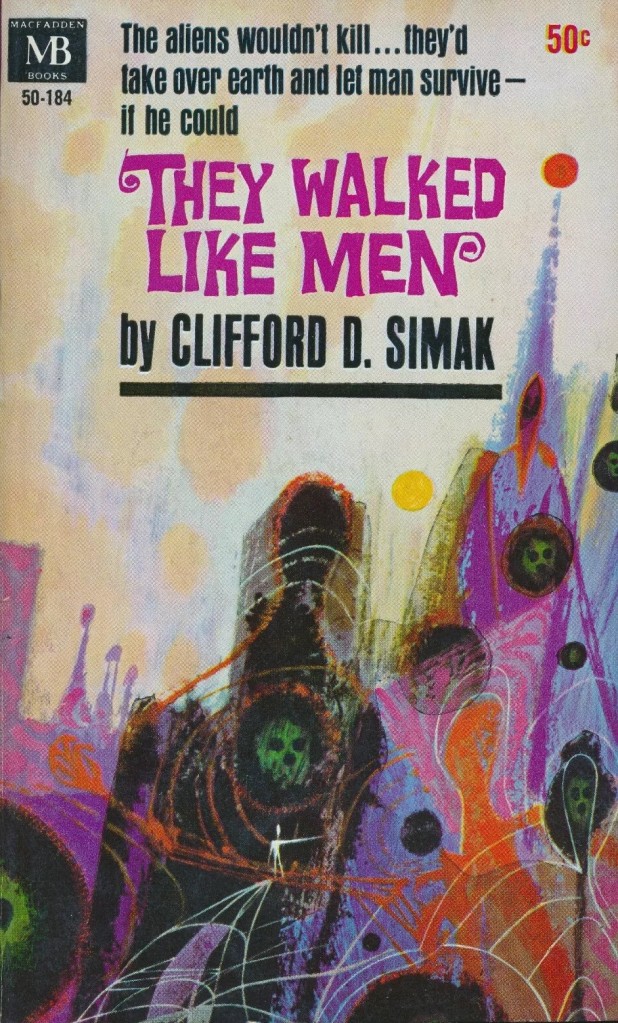
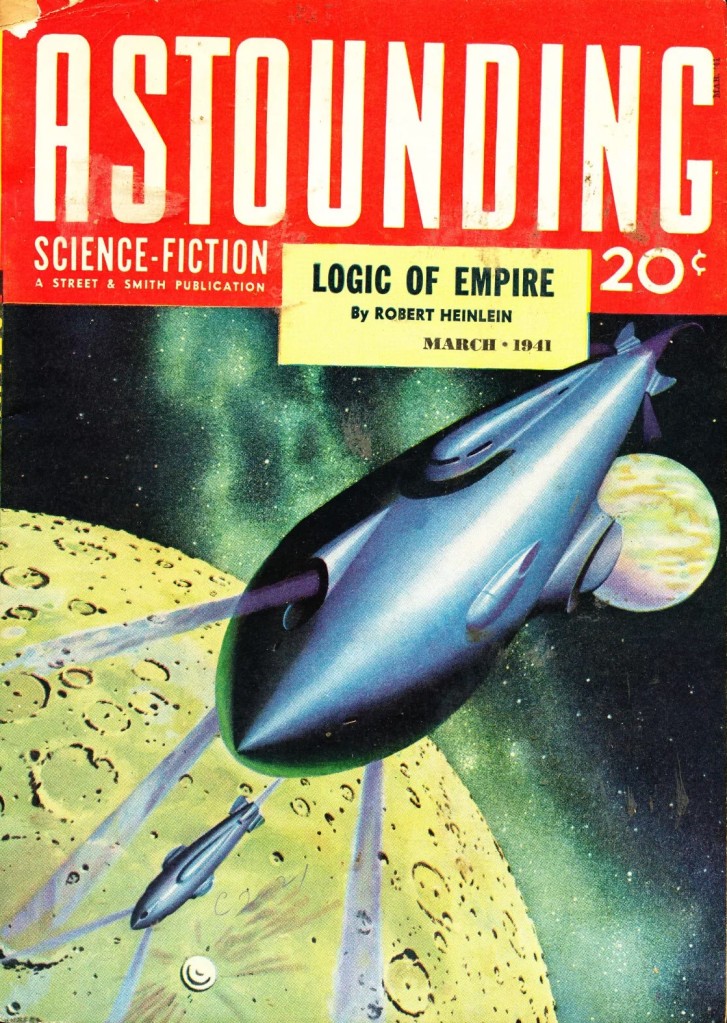
Short Story Reviews: Clifford D. Simak’s “Masquerade” (1941) and “Tools” (1942)

Today I’ve selected two early Clifford D. Simak “apprentice” stories–“Masquerade” (1941) and “Tools” (1942)–deeply critical of the American business ethic.1 Collectively they posit a future in which colonization goes hand-in-hand with the exploitation of resources, workers, and threatens the alien intelligences they encounter.2

Welcome to a future of capitalistic vastation!


3/5 (Average)

“Masquerade” first appeared in Astounding, ed. John W. Campbell, Jr. (March 1941). You can read it online here.

In the surprisingly bleak “Masquerade” (1941), metamorphic aliens on Mercury’s radiation-blasted surface parrot human actions. Beneath their clownish behavior is a plot, a plot to takedown an Earth corporation. The story begins with a disquieting sequence in the bleak expanse outside a sunlight harvesting power station on the surface of Mercury: “the Roman candles, snatching their shapes from Creepy’s mind, had assumed the form of Terrestrial hillbillies and were cavorting the measures of a square dance” (57). The Candles, “kicking up the dust, shuffling and hopping and flapping their arms” (58), are the mysterious natives of Mercury. In classic Simak fashion, there’s a method to their apparent comic madness.3

Continue reading

Generation Ship Short Story Review: Fred Saberhagen’s “Birthdays” (1976)

This is the 19th post in my series of vintage generation ship short fiction reviews. I am not entirely sure Fred Saberhagen’s vision exactly fits the definition of a generation ship but it’s so fascinating that I had to share it with you all!

As a reminder for anyone stopping by, all of the stories I’ll review in the series are available online via the link below in the review. And, if you want to work through the reviews from the series from the beginning, here’s my first post from 2019 on Chad Oliver’s “The Wind Blows Free” (1957).

You are welcome to read and discuss along with me as I explore humanity’s visions of generational voyage. And thanks go out to all who have joined already. I also have compiled an extensive index of generation ship SF if you wish to track down my earlier reviews on the topic and any that you might want to read on your own.

Previously: Barrington J. Bayley’s “Exit from City 5” (1971).

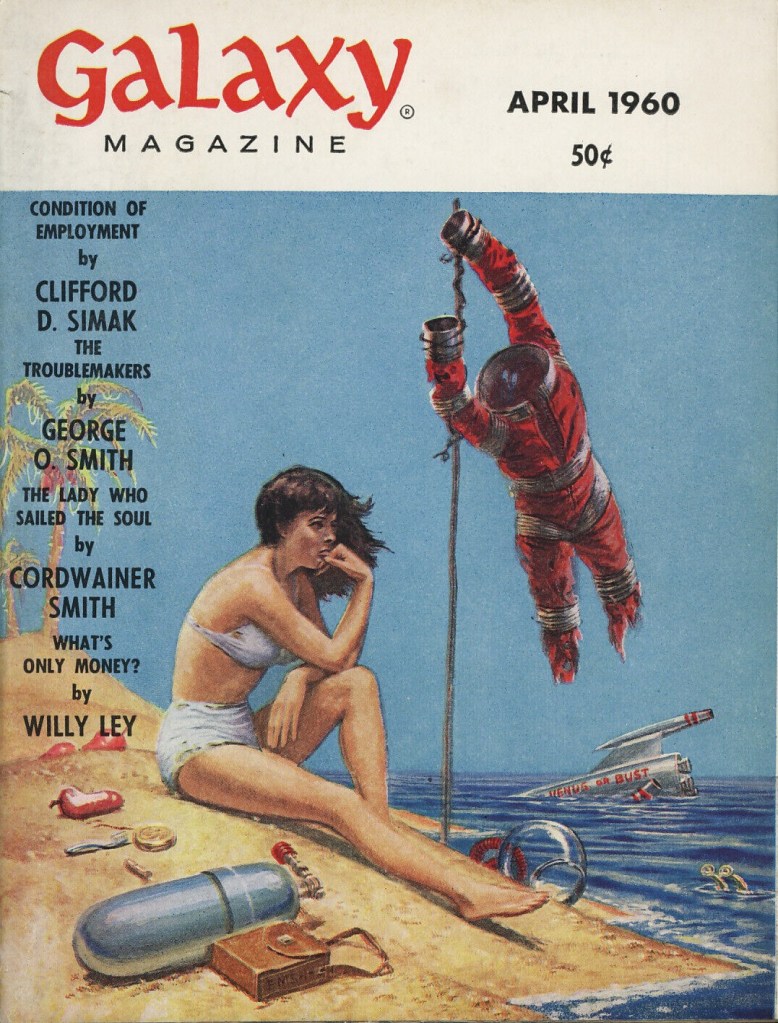
Next Up: Poul Anderson’s “The Troublemakers” (1953)

4.25/5 (Very Good)

Continue reading

Short Story Reviews: Robert Bloch’s “Daybroke” (1958) and “The Head” (1976)

After watching the first episode of the new Fallout (2024) adaptation a few nights ago (I like it!), I impulsively decided to push aside all my unfinished reviews and write about two more nuclear gloom tales. I selected two by Robert Bloch (1917-1994), best known as the author of Psycho (1959), whose SF output I’ve only recently started to explore. Both stories are slick satires that use the nuclear scenario to poke holes in the stories we weave about American exceptionalism and progress.

Let’s get to the nightmares!


3.25/5 (Above Average)

“Daybroke” first appeared in the only issue of Star, ed. Frederik Pohl (1958). You can read it online here.

Robert Bloch’s “Daybroke” attempts to convey an encyclopedic glimpse of post-apocalyptic destruction in order to satirize an America that allowed the usage of a nuclear weapon. Despite its appealing structure, the story lacks the prose necessary to sear and burn–the last sentence, well, that you’ll remember.

Continue reading

Short Story Review: Vladimir Colin’s “The Contact” (1966, trans. 1970)

Today I’m joined again by Rachel S. Cordasco, the creator of the indispensable website and resource Speculative Fiction in Translation, for the second installment of our series exploring non-English language SF worlds. Last time we covered Kōbō Abe’s allegory of Marxist transformation, “The Flood” (1950, trans. 1989).

This time we journey east of the Iron Curtain to 1960s Romania with Vladimir Colin’s “The Contact.” It first appeared in his collection of short stories Viitorul al doilea (1966). We read it in Other Worlds, Other Seas: Science-Fiction Stories from Socialist Countries, ed. Darko Suvin (1970). The story was translated into English by the author. I cannot find a copy online. Reach out if you want to read it!

Make sure to check out Rachel’s website Speculative Fiction in Translation. Not only does she review the global phenomena of speculative fiction but gathers lists of translated fiction by language. Also check out her reference monograph Out of This World: Speculative Fiction in Translation from the Cold War to the New Millennium (2021).

Now let’s get to our reviews!

Continue reading

Book Review: Clash by Night and Other Stories, Henry Kuttner and C. L. Moore (1980)

3.5/5 (collated rating: Good)

From 1937 to 1958, the dynamic writing duo of Henry Kuttner (1915-1958) and his wife C. L. Moore (1911-1987) wrote countless stories together. As SF Encyclopedia puts it, “much of [Kuttner’s] later work is inextricably entwined” with that of Moore–often to the point of being unable to entangle who wrote what. While the cover of Clash by Night and Other Stories (1980) does not mention Moore, all the stories in the collection were co-written with her.1

Continue reading

Short Story Review: Kōbō Abe’s “The Flood” (1950, trans. 1989)

Today I’m joined by Rachel S. Cordasco, the creator of the indispensable website and resource Speculative Fiction in Translation, for something a bit different!

We will both offer our reviews of one of Kōbō Abe’s first published speculative short stories, “The Flood” (1950). Over the next few months, we’ll post reviews of speculative fiction in translation from Romania, Chile, Austria, Poland, France, and the Netherlands. Depending on the story and our thoughts, I might also include our responses to each other’s review.

Also if you haven’t checked out Rachel’s website, you must. Not only does she review the global phenomena of speculative fiction but gathers lists of translated fiction by language. Also check out her reference monograph Out of This World: Speculative Fiction in Translation from the Cold War to the New Millennium (2021). In 2016, she contributed to my site reviews of three French SF stories in translation.

We read Kōbō Abe’s “The Flood” (1950) in The Best Japanese Science Fiction Stories, ed. John L. Apostolou and Martin H. Greenberg (1989). Translated by Lane Dunlop. You can read it online here.

Now let’s get to our reviews!

Continue reading

Short Fiction Reviews: Alice Eleanor Jones’ “Life, Incorporated” (1955), “Miss Quatro” (1955), and “Recruiting Officer” (1955)

I ranked Alice Eleanor Jones’ apocalyptic slice-of-life nightmare “Created He Them” (1955) as my favorite SF short story of 2022. I also found Jones’ “The Happy Clown” (1955) a bleakly effective satire of television and consumerism. Unfortunately, Jones only published five short stories in 1955 before leaving science fiction altogether. It’s a shame she did not continue writing SF. With this post, I’ve covered her entire SF output.

Alice Eleanor Jones (1916-1981) received a PhD in English from University of Pennsylvania in 1944 on the seventeenth-century dramatist Shakerly Marmion. In the first year of her writing career, Jones “published five SF stories and two slick romance narratives.” Despite Anthony Boucher’s prediction that she’d be successful in both fields, Jones never returned to science fiction but continued to publish in the leading women’s magazines of the day and wrote a column for the trade magazine The Writer “well into the 1960s.”1 Lisa Yaszek argues that Jones’ “stories about housewife heroines and other domestic figures” do not reiterate conservative ideologues of the day but rather, through the construction of “offbeat” situations, examine how new scientific and social relations would impact women.2 Her two stories from the male perspective, “The Happy Clown” (1955) and “Life, Incorporated” (1955) are anti-consumerist satires.

This post fits–in conjunction with my earlier “Created He Them” (1955) review—in my series on the first three published short stories by female authors. So far I’ve featured Phyllis Gotlieb (1926-2009), Sydney J. Van Scyoc (1939-2023), Josephine Saxton (1935-), Carol Emshwiller (1921-2019), Wilmar H. Shiras (1908-1990), Nancy Kress (1948-), Melisa Michaels (1946-2019), Lee Killough (1942-), Betsy Curtis (1917-2002), and Eleanor Arnason (1942-).

Now let’s get to the stories!


Continue reading

Book Review: The Squares of the City, John Brunner (1965)

4/5 (Good)

Nominated for the 1966 Hugo Award for Best Novel

John Brunner’s The Squares of the City (1965) transposes the moves of a 1892 chess game between Wilhelm Steinitz (1836-1900) and Mikhail Chigorin (1850-1905) onto a near future landscape of political intrigue. Inspired by Brazil’s planned capital Brasília (founded in 1960), the action takes place in Ciudad de Vados, the capital city of the imaginary Latin American nation of Aguazul.1 Conjured out of a “barren, rocky stretch of land,” Ciudad de Vados contains all the homogenized trappings of an ultra-modern metropolis (170). It’s sterile. Planned. Mechanized. Quickly the monumental urban regularity fades into the background and the intricate game across its squares takes over.

Continue reading

Book Review: Worlds Without End, Clifford D. Simak (1964)

3.5/5 (collated rating: Good)

I’m a compulsive list maker. In the past few years I’ve gathered and submitted older science fiction short stories that depict worker unions–from Robert Silverberg’s “Guardian Devil” (1959) to Mari Wolf’s “Robots of the World! Arise!” (1952)–to the Hugo Book Club’s fantastic index. It’s about time I finally get around to reviewing a few of my submissions!1

Clifford D. Simak’s collection Worlds Without End (1964) contains two novellas and one short story that appeared in Robert W. Lowndes’ magazines (second/third tier SF markets in the 50s). Two of three–“Worlds Without End” (1956) and “Full Cycle” (1955)–speculate on evolution of the trade union after the breakdown of the state.

Continue reading