Book Review: A Billion Days of Earth, Doris Piserchia (1976)

4.25/5 (Very Good)

Doris Piserchia’s A Billion Days of Earth (1976) is a whimsical, disturbing, and stunningly inventive science fiction novel.  This is the second and by far the best of her novels I’ve read (A Billion Days of Earth surpasses Doomtime (1981) in virtually every regard).  Not only are the characters better drawn but the plot isn’t as easily derailed by repetitious actions.  That said, she isn’t always the best at plotting but her imaginative worldscapes and bizarre creatures more than compensate.   Continue reading

Book Review: Master of Life and Death, Robert Silverberg (1957)

0.25/5 (Terrible)

First, a few words to describe the tattered novel (I hurled it on the ground at one point) in front of me.

Politically dangerous: Master of Life and Death (1957) presents dictatorship (well, so-called “benevolent” dictatorship), propaganda, extreme distrust of the common person, fratricide, surveillance, torture, government control of the press, political assassination, euthanasia of children, among other equally dubious activities as occasionally necessary for the good of humanity.

I understand that Silverberg himself does not endorse these positions BUT he in NO WAY presents the actions of his main character as anything other than exemplarily and a necessary result of the tough position he finds himself Continue reading

Book Review: The Quality of Mercy, D. G. Compton (1965)

4/5 (Good)

D. G. Compton’s first science fiction novel, The Quality of Mercy (1965), is a forgotten work which deserves to be read along with the rest of his canon.  I’ve found Compton’s lesser known works to be on the whole quite solid — with the dismal The Missionaries (1972) the lone exception so far.  Both Synthajoy (1968) and The Steel Crocodile (1970) are among my top reads of this year.  I’m keeping his acknowledged masterpiece Continue reading

Book Review: Vault of the Ages, Poul Anderson (1952)

3.75/5 (Good)

Vault of the Ages (1952), one of Poul Anderson’s earliest novels, should not be missed.  Although Vault of the Ages is at its core a simplistic juvenile (50s sci-fi for younger readers), Anderson’s budding storytelling skills make it engaging and a joy to read.  If only I had read it when I was younger!  Suggested for any fans of 50s sci-fi, early post-apocalyptical Continue reading

Book Review: The Star Dwellers, James Blish (1961)

3/5 (Average)

James Blish’s The Star Dwellers (1961) is a quality sci-fi novel (for younger readers) easily comparable to some of Heinlein’s juveniles.  The plot is straightforward/predictable yet still engaging.  Of course, Jack, our seventeen year old hero, saves the day!  Unlike the best “alien encounter” sci-fi novels which convey a certain sense of convincing “reality,” The Star Dwellers demands Continue reading

Book Review: Ground Zero Man (variant title: The Peace Machine), Bob Shaw (1971)

3.5/5 (Good)

Bob Shaw’s Ground Zero Man (1971) is a well-told take on a common 50s/60s/70s sci-fi trope — the discovery of technology which could potentially end the omnipresent danger of all out nuclear war.  Although the premise is straightforward and simplistic, the main character (Lucas Hutchman) and his motivations are drawn in a convincing manner, the ending is somewhat surprising and dark, and the novel is on the whole characterized by solid Continue reading

Book Review: And Chaos Died, Joanna Russ (1970)

4.5/5 (Very Good)

Nominated for the 1970 Nebula Award for Best Novel

“The ground was covered with old names…” (76)

Joanna Russ, famous for her feminist sci-fi novel The Female Man (1975), weaves together a bizarre (and difficult) novel filled with strange images, peculiar characters, and a fragmented/layered/bewildering narrative structure.  And Chaos Died (1970) is a startlingly original take on the staple sci-fi Continue reading

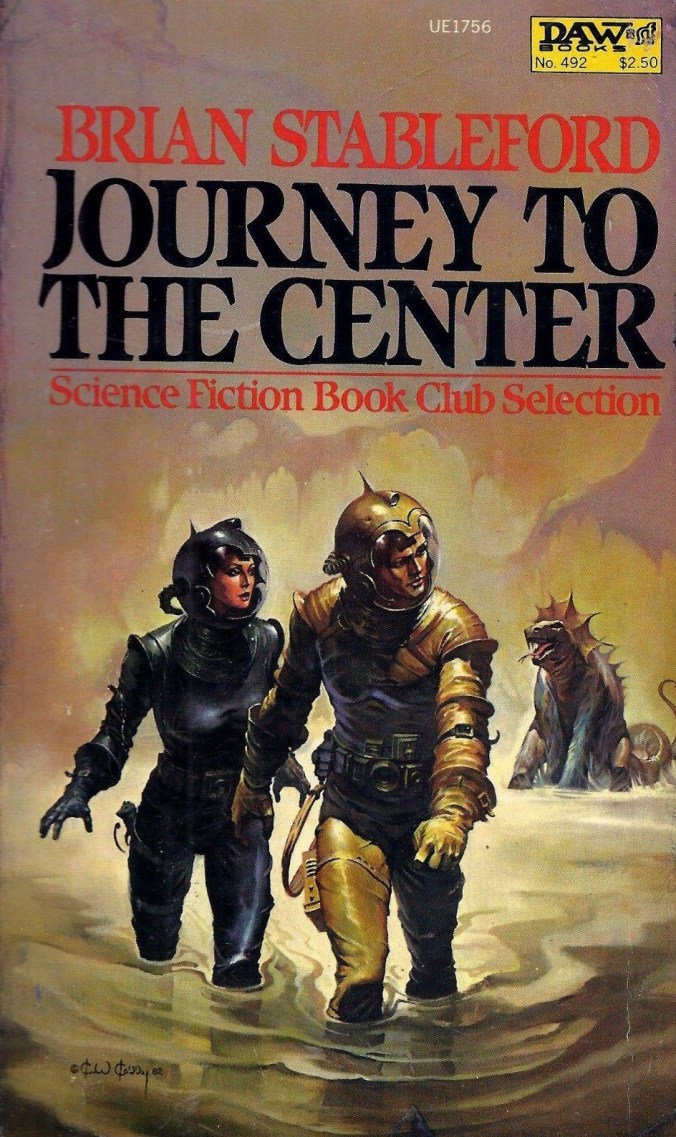
Book Review: Journey to the Center, Brian M. Stableford (1982)

journey to the center.jpg

3/5 (Average)

Brian M. Stableford’s Journey to the Center (1982) is a poor man’s Ringworld (1970) mixed with a light dose of Pohl’s Gateway (1977).  The combination is pleasantly surprising in parts but also downright dull.  Stableford’s alien species are interchangeable and uninteresting and his descriptions of the world — although a fantastic idea — fail to encapsulate the awe Asgard should inspire. Continue reading