Which books/covers/authors intrigue you? Which have you read? Disliked? Enjoyed?
1. Father to the Stars, Philip José Farmer (1981)
Janny Wurtz’ cover for the 1st edition
From the back cover: “John Carmody has no ethics, no morals and no conscience. Until he takes the Chance on Dante’s Joy, living through seven nights of wildest fantasies come true, he can’t even imagine why anyone would want a conscience. But Dante’s Joy is a truly strange place–and the phone calls from his murdered wife are only the beginning of his strange experiences.
In 1968, the moody Canadian psychedelic pop group The Poppy Family released “Of Cities and Escapes,” a haunting song of urban emptiness. The song’s narrator intones: “I live in a one-room apartment, with windows on one side / I stare through the glass ‘cross the water, to where the big, ugly city lies.” In the second verse, later sampled by Deltron 3030 on “Madness” (2000), the narrator cannot escape the death spiral: “I’m caught in the grip of the city, madness and smog.” Twilight City (1974, trans. Joan Tate, 1993), by Norwegian novelist Knut Faldbakken (1941-), delves into a similar dystopian urban gloom. The refugees of a decaying city dust off the entangling membranes of lost paths and the weight of melancholy souls and attempt to chart a new beginning in the city dump.
Brief Plot Summary/Analysis
In an unnamed country, the metropolis of Sweetwater–“an eruption of urban geography” (2) possessed by an “ever-growing urban sprawl” (23)–suffers under the effects of global warming, industrialization, and malignant societal decay.
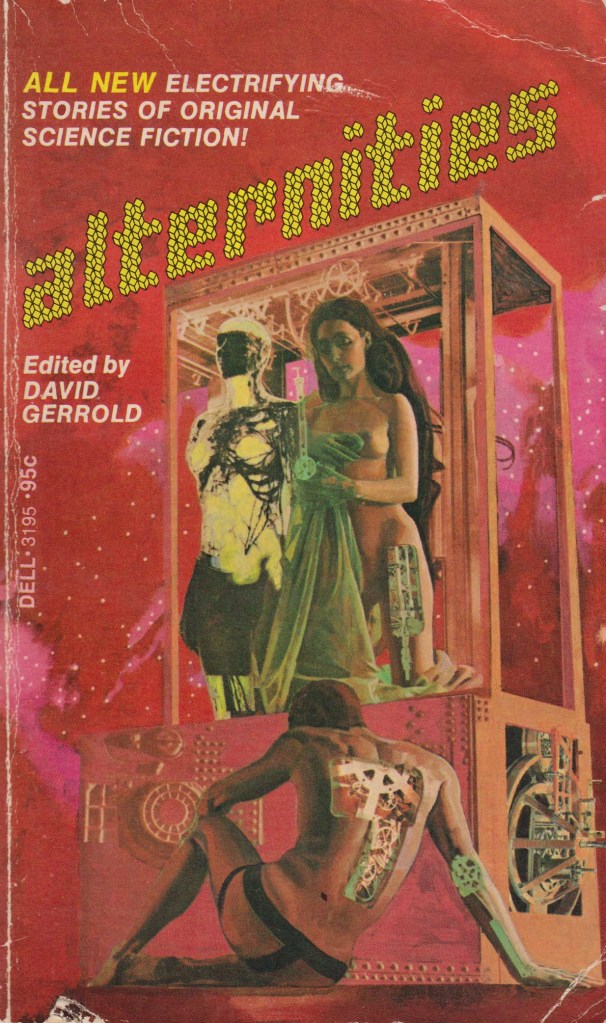
David Gerrold and his associate editor Stephen Goldin collect a bizarre range of SF oddities including an epistolary nightmare from Vonda N. McIntyre’s pen and a one-sentence “sign” by Duane Ackerman. Gerrold argues that he wants “science fiction to be fun again” without “literary inbreeding and incestuous navel-studying” (8). With a more than pungent hint of hypocrisy, he spouts “I’m tired of the kind of bullshitting that creates false images in the readers’ minds” (8). Alternities (1974) reads like the cast off stories from a New Wave (i.e. deliberately literary) Judith Merril or Harlan Ellison anthology with heavy dose of erotic comedy and shock value. A few–including E. Michael Blake’s “The Legend of Lonnie and the Seven-Ten Split,” Vonda N. McIntyre’s “Recourse, Inc.,” and Edward Bryant’s “Cowboys, Indians”–rise above the dross.
To be clear, I enjoy devouring anthologies like Alternities. The stories are originals and few are anthologized elsewhere. I adore reading authors I wouldn’t otherwise encounter (Robert Wissner, E. Michael Blake, et al.). Gerrold’s nonsense of an introduction aside, the anthology with its deliberate attempts at the “literary” (Greg Bear’s “Webster” and James Sallis’ “The First Few Kinds of Truth”) and “edgy” (Steven Utley’s “Womb, with a View”) firmly fit in the passing mid-70s foam of the New Wave movement.
As always, which books/covers/authors intrigue you? Which have you read? Disliked? Enjoyed?
1. Ambient, Jack Womack (1987)
Peter Jones’ cover for the 1989 edition
From the back cover: “Twenty-first century New York. It’s a nightmare. Reaganomics has gone mad: there’s murder and mutilation on the bombed-out streets, and in the corporate conference rooms. Manhattan is a zoo. There’s guerilla war on Long Island. You’ll need to be rich to survive at all, and it’s easier to be dead than poor.
Seamus O’Malley is a bodyguard and assassin in the outrageously powerful Dryco organization, and he’s in deep trouble. Taking the job sounded like a good idea at the time.
Falling in love with his employer’s mistress Avalon, probably wasn’t so bright. Getting caught up in the Dryden family’s crazy, lethal rivalries didn’t help. Agreeing to murder the Old man was plain stupid. And being involved with the Ambient only complicated matters further. Before long O’Malley’s on the run, and there’s nowhere safe to hide. ‘Ready to kill, Shameless?’ Avalon said. ‘Ready to die.’
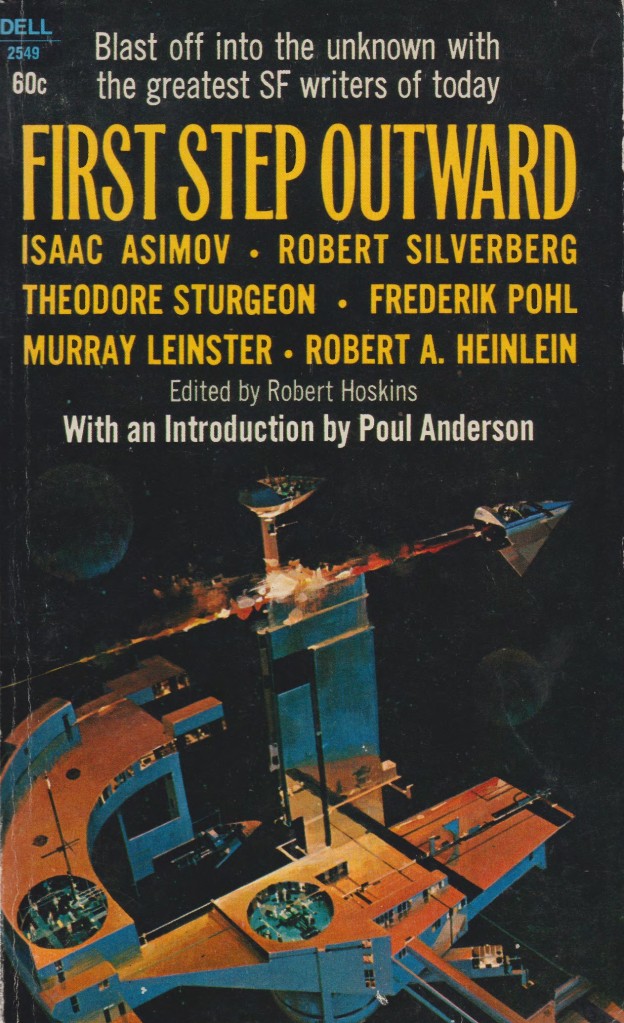
Published a few months before the Apollo 11 mission to the moon, Robert Hoskins’ anthology First Step Outward (1969) charts an imagined future history of humanity’s exploration of the galaxy. The stories, gathered from some of the big names of the day (Robert Heinlein, Robert Silverberg, Theodore Sturgeon, Isaac Asimov, Poul Anderson, etc.), are grouped as if part of the same future with headings such as “To the Planets” and “To the Stars.” As with most anthologies, this contains a range of gems (such as Sturgeon’s “The Man Who Lost the Sea”) and duds (Ross Rocklynne’s “Jaywalker”).
I’ve previously reviewed five of the thirteen stories in their own posts–linked for easy consultation.
Brief Plot Summary/Analysis
“Cold War” (1949), Kris Neville, 3/5 (Average): Previously reviewed in its own post here.
“Third Stage” (1963), Poul Anderson, 3.5/5 (Good): Previously reviewed in its own post here.
“Gentlemen, Be Seated!” (1948), Robert A. Heinlein, 2.75/5 (Vaguely Average): My first return to Robert A. Heinlein in around a decade is exactly like I thought it would be–thoroughly disappointing. Yes, yes, yes, I know this is far from what he was capable of. The number of reprints this misfire of a story receives mystifies (it appeared in the regularly reprinted The Green Hills of Earth and The Past Through Tomorrow).
Here is another post in my series exploring Carol Emshwiller’s science fiction and fantasy–published between 1955-1979 in genre magazines–in chronological order. And if you missed earlier installments, check out Part I and II.
I found Emshwiller’s next three science fiction stories, including the first in her new long-term home The Magazine of Fantasy and Science Fiction, polished fables utilizing standard genre tropes (alien mating rituals, a mysterious stranger, etc.) to highlight humanity’s encounter with itself in idiosyncratic and grim ways.
However, this batch presents a bit of a lull in overall quality. These are probably only recommended for Emshwiller completists like myself or fans of off-kilter 50s parables. The next post will contain one of her best known works of the 50s–“Pelt” (1958). I look forward to Part IV.
For those curious why I am conducting this series, check out my review of the intense power that is “Animal” (1968) (the best story of hers I’ve read so far).
Frank Kelly Freas’ cover for The Magazine of Fantasy and Science Fiction (May 1957)
“The Coming” in The Magazine of Fantasy and Science Fiction (May 1957), ed. Anthony Boucher. 3.5/5 (Good). You can read it online here.
A mysterious stranger, “stick thin, and he walked as as scarecrow might walk” (102), comes into town like someone in a trance, his “lips parted, eyes half closed, head thrown back” (102). On cue, a young girl named Nina with her homework spread before her, slips into the same trance-like state. Her mom threatens “if you don’t keep your mind on your work you’ll be set back again this year” (103). But something about the stranger, the unknown, and the other world in which he seems to inhabit free from all care or obligation beckons.
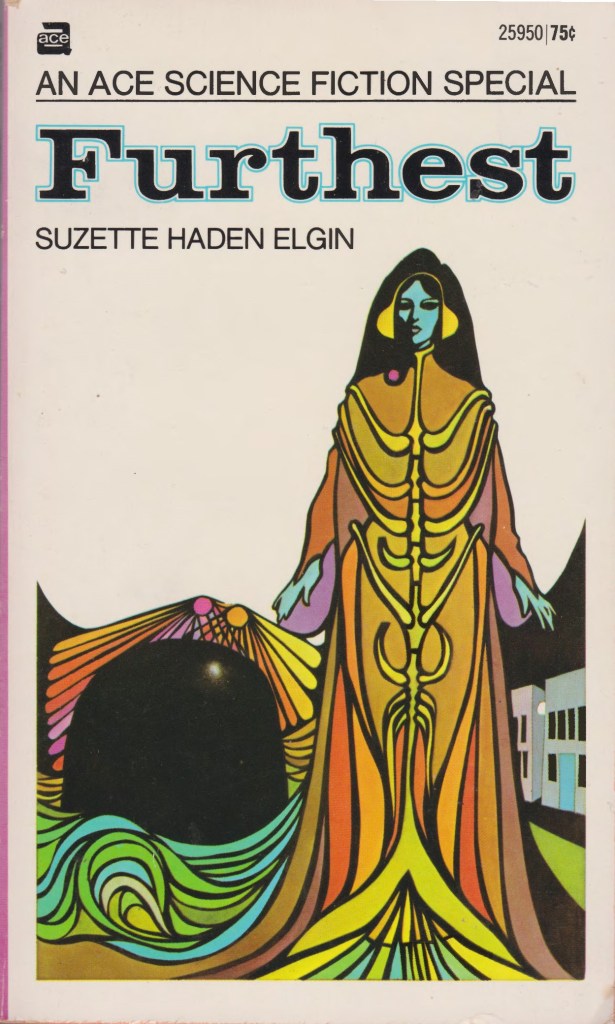
From the back cover: “Coyote Jones, agent for the Tri-Galactic Intelligence Service, had been sent to a planet so unimaginably distant from the rest of the Federation that it bore the descriptive name Furthest. His mission: to find out why the total body of data about Furthest showed the world’s inhabitants to be absolutely average down to the last decimal place. That data had to be false.
Jones was permitted to live on the planet, but the natives were so wary of him that he could uncover nothing—until he chanced into a personal crisis faced by his young Furthest assistant. The boy’s sister had been sentenced to Erasure, and he wanted Coyote Jones to take the fugitive girl in and hide her.
The following review is the 14th installment of my series searching for “SF short stories that are critical in some capacity of space agencies, astronauts, and the culture which produced them.” Some stories I’ll review in this series might not fit. And that is okay. I relish the act of literary archaeology.
Up Next: Walter M. Miller, Jr.’s “The Hoofer” (1955)
Alex Schomburg’s cover for the February 1962 issue of Amazing Stories, ed. Cele Goldsmith
3.5/5 (Good)
Poul Anderson’s “Third Stage” first appeared in the February 1962 issue of Amazing Stories, ed. Cele Goldsmith. You can read it online here.
At first glance Poul Anderson’s “Third Stage” (1962) reads as an archetypal disaster-in-space tale of intrepid spacemen making courageous decisions under great duress. Around that central core, Anderson delves into far more sinister reaches–the media’s role in televising and manipulating grief. Anderson’s astronauts maintain their heroism despite the machinations of nefarious media men in pursuit of ratings.
The following review is the 13th installment of my series searching for “SF short stories that are critical in some capacity of space agencies, astronauts, and the culture which produced them.” Some stories I’ll review in this series might not fit. And that is okay. I relish the act of literary archaeology.
Uncredited cover for the December 1951 issue of Thrilling Wonder Stories
2/5 (Bad)
“Star Bride” (1951) first appeared in the December 1951 issue of Thrilling Wonder Stories, ed. Samuel Mines. You can read it online here.
Anthony Boucher’s short “Star Bride” is a tepid condemnation of colonialism written in the immediate post-WWII stages of decolonization (the Philippines gained its independence from the United States in 1946 and India from the British Empire in 1947). While a deeply problematic and forgettable story, a handful of Boucher’s themes and observations are worth teasing out due to later SF formulations I’ll be exploring in this series.