Updates: Recent Science Fiction Acquisitions No. CXLIV (Farmer + Anderson + Two Anthologies including Aldiss, Wilhelm, Priest, Disch, etc.)

I have been on a short story kick as of late! Three of the following volumes are short story collections (two anthologies).  I want to complete the Orbit series, ed. Damon Knight….

And, well, I have a soft spot for Philip José Farmer’s 50s/60s SF after Strange Relations (1960).

Thoughts? Comments?

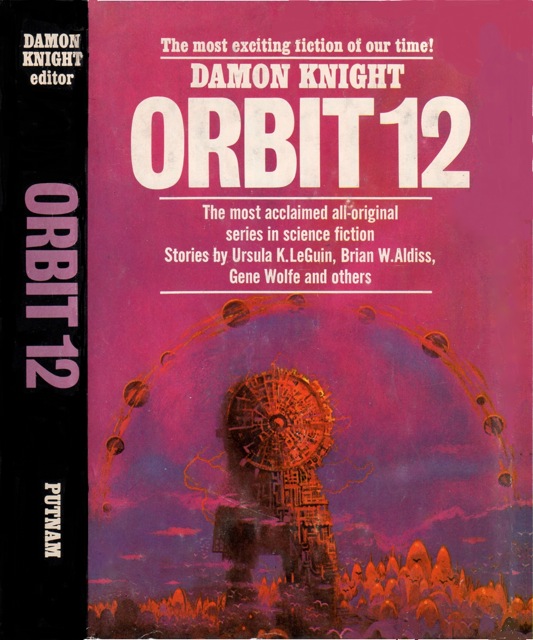
  1. Orbit 12, ed. Damon Knight (1973)

RBTDBDGFSX1973

(Paul Lehr’s cover for the 1973 edition) Continue reading

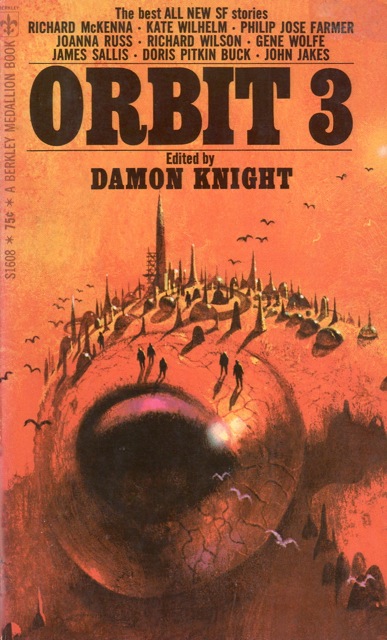
Book Review: Orbit 3, ed. Damon Knight (1968)

RBTFBJNLFG1968

(Paul Lehr’s cover for the 1968 edition)

3.5/5 (collated rating: Good)

Orbit 3 contains both masterpieces (by Gene Wolfe and Kate Wilhelm) and complete duds (by Doris Pitkin Buck and Philip José Farmer).  Damon Knight’s willingness to select a range of known and lesser known authors creates an enjoyable and unpredictable reading experience—but, most of the greats are on their game in this collection, other than Farmer who puts in a lazy shift…  Contains two Nebula award winners: Wilson’s problematic “Mother to the World” (novelette) and Kate Wilhem’s “The Planners” (short story).  The former was also nominated for a Hugo.

Recommended for fans of 60s SF of the experimental bent.  Do not let the collated rating sway you—there are some great stories behind the Paul Lehr Continue reading

Updates: Recent Science Fiction Acquisitions No. CXLIII (Two themed anthologies: Election Day 2084 and TV: 2000 + Harrison + Gary)

Two themed anthologies—one in “honor” of the election [*cough* I mean, well, I won’t go all political] year cycle…  Another on one of my favorite SF themes, television of the future!

That said, both Asimov edited collections (from the 80s but with stories from only earlier decades) have a serious fault: out of the combined 35 stories there is not a single story by a woman author.  I’ve read a vast number of 60s/70s collections which do not fall into this trap…. Orbit 1 (1966) almost manages gender parity!  I can think of numerous stories by women authors that fit both themes.  For example, Kit Reed’s wonderful “At Central” (1967) fits the TV anthology!

A hard to find for cheap early M. John Harrison novel…. Unfortunately I only found a much uglier edition that the one I show below as the rest were out of my price range….

And, a complete shot in the dark—a SF novel by the mainstream French/Lithuanian novelist/screenwriter Romain Gary, the author of White Dog (1970)..

As always, I’d love to hear your thoughts + comments.

1. The Committed Men, M. John Harrison (1971)

THCMMTTDMB1971-1

(Chris Yates’ cover for the 1971 edition) Continue reading

Book Review: Three Worlds of Futurity, Margaret St. Clair (1964)

P1080582

(Jack Gaughan’s cover for the 1964 edition)

3/5 (collated rating: Average)

Margaret St. Clair (1911-1995) was a mainstay of the major pulp magazines and maintained a prolific career from 1946 to the late 60s (between the 70s and early 80s she  produced only one novel and a handful of stories).  Previously, I found myself disenchanted with her work as I struggled through the Wicca-inspired ramblings of Sign of the Labrys (1963).  However, I thought I would give her short fiction a try and snagged a copy of the 1964 Ace Double #M-105 that contained her collection Three Worlds of Futurity (1964) and her best known novel Message from the Eocene (1964) (which I might read sometime in the future).

Three Worlds of Futurity contains five stories from her most prolific period—the late 40s-early 60s.  Although the majority do not rise above their fellow pulp ilk, “The Rages” (variant title “The Rations of Tantalus” 1954, revised 1964) shows a measured and incisive feminist inspired vision and the unusual subject matter of “Roberta” (1962) suggests St. Clair’s willingness to tackle controversial subjects.  Most of the stories contain evocative imagery although the delivery rarely transfixes.  Also, although most of the main characters in St. Clair’s stories are men, women scientists and pilots (etc) populate the pages.  I suspect Continue reading

Updates: Recent Science Fiction Acquisitions No. CXLII (The Soviet SF special: Strugatsky + Shefner + Bilenkin +Savchenko)

In the late 70s and early 80s a wide range of Soviet SF—from the famous Strugatsky brothers to lesser known authors—was translated and introduced to the American market.  As I have decided to start collecting the Best of Soviet Science Fiction Collier Books series of paperbacks (hardbacks were published by Macmillan), my dad gave me three for my birthday.  My first collecting experiment!  I want to read more SF from outside of the USA and the UK…  This batch is in addition to the only other one I have acquired so far: Half a Life, Kirill Bulychev (USSR 1975, USA 1977).  Unfortunately, the vast majority of the series fetch hefty prices (especially those by the two Strugatsky brothers) online.  And, other than The Ugly Swans (below), I have never encountered them in used book stores… and The Ugly Swans was not cheap (I have my wife to thank!).

The back cover of The Unman/Kovrigin’s Chronicles provides a blurb about the series that I thought I would reproduce: “In the Soviet Union, as in the U.S.A., the fascination with the possibilities of science and technology has led to a rich and long tradition of science fiction.  Macmillan’s BEST OF SOVIET SCIENCE FICTION is now presenting the major works in lively, readable translations, allowing the American reader to explore—for the first time—the wide range of visions of space, time and man’s future in the other major SF tradition.”

As always, thoughts?

1. The Ugly Swans, Arkady and Boris Strugatsky (USSR 1972, USA 1979)

The Ugly Swans

(Richard Powers’ cover for the 1979 edition) Continue reading

Updates: Recent Science Fiction Acquisitions No. CXLI (Lessing + Zelazny + Engh + Priest)

Fresh off reading Christopher Priest’s An Infinite Summer (1979) and his even more amazing novel The Affirmation (1981) (which I’ve been unable to review for a variety of reasons), I acquired yet another one of his challenging gems….

And M.J. Engh’s Arslan (1975), which appears to polarize audiences—for example, Ian Sales’ negative review of her novel [here].  One of the odder and lesser known Golancz SF Masterwork inclusions for sure….  I.e. normally my cup of tea.  Seriously problematic seems to be Arslan‘s operating word.

And more Zelazny novels! I’m close to owning everything he wrote, other than the Amber sequence, up to the 1980s.

And there’s nothing wrong with more Lessing! (I wish MPorcius would stop writing such intriguing reviews of her work—haha.  Here’s his review of Briefing for a Descent Into Hell).

As always, thoughts?

1. Arslan, M. J. Engh (1975)

arslan

(Vincent Di Fate’s cover for the 1975 edition) Continue reading

Book Review: Code Three, Rick Raphael (fix-up 1967)

raphaelr1911119111

(John Schoenherr’s cover for the 1963 magazine version)

3.25/5 (Above Average)

A discussion first about taglines…  The 1967 Berkley Medallion edition (with its murky Jerome Podwil cover: photo) reads: “A future world of gigantic expressways—and the men who patrol them.”  The 1985 Panther edition with its ubiquitous Chris Foss Textured Mass (CFTM for short) police car reads: “Before MAD MAX there was CODE THREE.”  Both are in error.  I proffer two edits.  “A future world of gigantic expressways—and the people who patrol them.”  And the latter should be rendered: ” Continue reading

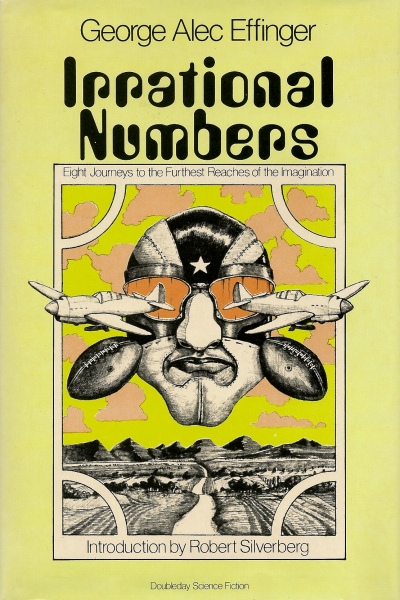
Book Review: Irrational Numbers, George Alec Effinger (1976)

IRRATNUM1976

(Michael Flanagan’s cover for the 1976 edition)

4.5/5 (collated rating: Very Good)

George Alec Effinger’s What Entropy Means to Me (1972) exemplifies the elements of the New Wave movement that continue to fascinate me, i.e. a fascination that compels my endless OrbitNebulaUniverse, etc. anthology purchases!  Effinger’s short fiction holds the same allure—he tackles a vast variety of subjects and themes: trauma, commercialization, sports, and biological apocalypse are paired with the daily experience, the mundane.  Interested in SF about a man obsessed with his fish tank confronting his disintegrating relationship and the end of the world?  A regimented cult, or psychological experiment (?), organized around Mithraic ritual and the memorization Continue reading

Updates: Recent Science Fiction Acquisitions No. CXL (Vance + Pournelle + Sucharitkul + Crowley)

A more disparate series of SF novels would be hard to come by…. John Crowley has long impressed—The Deep (1975) and Beasts (1976) are highly recommended works of literary SF.  And finally, I have the last one of his 70s novels!

A new author in Somtow Sucharitkul (sometimes known by S. P. Somtow)…

Vance’s most famous work and one of only a handful of supposedly top-tier “classics” I have yet to read…

Pournelle anyone? First work by him as well… Baen book picked up a number of his novels so I don’t have high hopes.

Thoughts?

1. Engine Summer, John Crowley (1979)

NGNSMMRSLD1979

(Gary Friedman’s cover for the 1979 edition) Continue reading