As always, which books/covers/authors intrigue you? Which have you read? Disliked? Enjoyed?
1. The Island Under the Earth, Avram Davidson (1969)
Diane and Leo Dillon’s cover for the 1st edition
From the inside page: “In THE ISLAND UNDER THE EARTH, a master fantasist has created his most fabulous land of imagination, peopled with humans and not-humans who speak with characteristically different voices and pursue goals and philosophies that set them inevitably against one another.
Note: My read but “waiting to be reviewed pile” is growing. Short rumination/tangents are a way to get through the stack before my memory and will fades. Stay tuned for more detailed and analytical reviews.
1. The Chrysalids (variant title: Re-Birth), John Wyndham (1955)
Richard Powers’ cover for the 1st edition
3/5 (Average)
John Wyndham’s The Chrysalids (1955), my first exposure to his science fiction, transpires in a standard post-apocalyptic cozy catastrophe scenario with a deeply emotional core. The narrative follows David’s childhood in the backwater territories of Labrador, Canada hundreds of years after a nuclear war. The Church, inspired by Nicholson’s Repentances—which along with the Bible are only surviving books–imposes a draconian theology that “only God produces perfection” (51). Mutations, a visual sign of diabolical influence, must be destroyed. David, the son of the local strongman and preacher, discovers a young girl with a terrifying secret–she has six toes. David starts to accumulate secrets including his own mysterious telepathic abilities and recurrent dreams of a city in a world without cities. He shares them with his sympathetic Uncle Axel, who attempts to protect him from the forces narrowing in.
There are some nice touches throughout. Uncle Axel recounts his travels and knowledge of the world as a seaman and the effects is that of a medieval map, filled with pseudo-legendary beings, historical fragments, and “real” flora and fauna that, at first glance, seems too fantastic to exist (54-57).
As always, which books/covers/authors intrigue you? Which have you read? Disliked? Enjoyed?
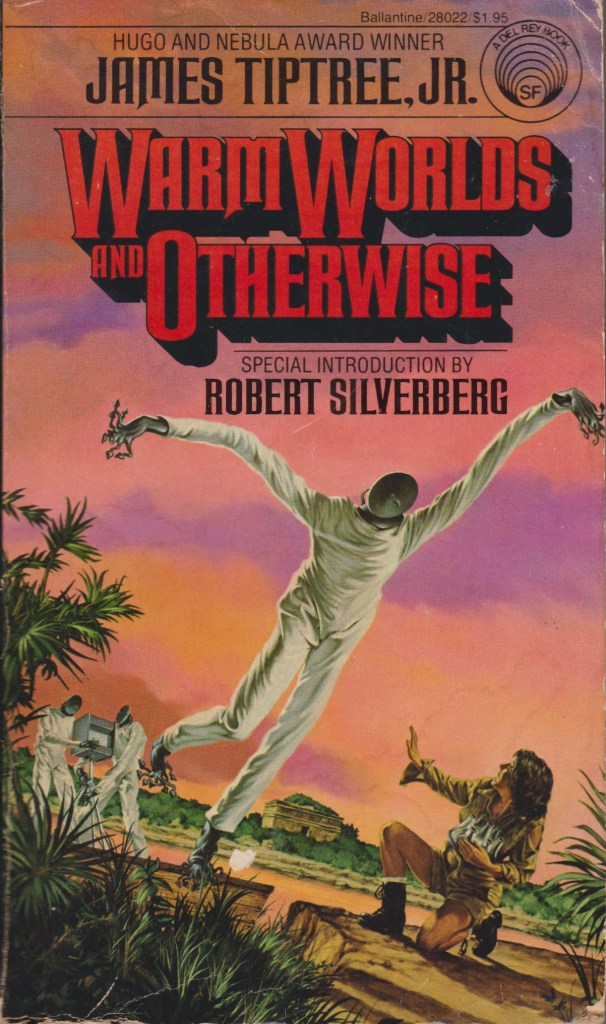
1. Warm Worlds and Otherwise, James Tiptree, Jr. (1975)
Michael Herrin’s cover for the 1979 edition
From the back cover: “A DOZEN FABULOUS TALES OF INNER VISIONS AND OUTER SPACE…
LOVE IS THE PLAN, THE PLAN IS DEATH (Nebula-Award Winner—Best Short Story 1973)
Courtship rites can easily run amok, especially when that’s what’s supposed to happen… especially when the creatures are color-coded for passion as well as for death!
Bill Botton’s cover for the 1970 edition of Project Barrier (1968)
3/5 (collated rating: Average)
In the early days of my site, I reviewed Daniel F. Galouye’s best-known novel Dark Universe (1961) and A Scourge of Screamers(1966). Since then I’ve attempted to read Simulacron-3 (1964), adapted into a fantastic German mini-series World on a Wire (1973) and The Thirteenth Floor (1999), three times without success. What can I say, I’m a reader of whim and in each instance I wasn’t in the mood. Maybe it was Bill Botton’s compelling/bizarre psychedelic cover for Project Barrier (1968) or perhaps Rich Horton’s comments on twitter about the title story but I decided to give Galouye’s short fiction a go.
Project Barrier (1968) contains four uneven tales with one notable standout–“Rub-a-Dub” (variant title: “Descent Into the Maestrom”) (1961)–which I highly recommend if disturbing psychological SF is up your alley. The others in the collection exude a more run-of-the-mill feel. I found it refreshing that Galouye, a veteran greatly impacted by war injuries, tends to eschew violent conflict for peaceful resolution.
Ever since I read Judith Merril’s “Daughters of Earth” (1952), I’ve been fascinated by her subversive takes 1950s-60s gender roles and classic SF tropes. Survival Ship and Other Stories (1974) contains twelve short stories and a never-before-published poem selected by the author.
In addition to the merits of the tales within, I found Merril’s brief reflections on her early work fascinating. For example, she ruminates on the failure of her planned novel based on the generation ship launched by The Matriarchy in “Survival Ship” (1951), “Wish Upon a Star” (1958), and “The Lonely” (1963). She also describes a magazine “cover story” commission. The author would be provided with the cover art and asked to write a story containing its elements! The following three in this Continue reading →
Detail from Darrel K. Sweet’s cover for the 1st paperback edition of The Best from Cordwainer Smith (1975)
Today’s installment of my occasional Monday Maps and Diagrams series is a self-reminder that I must get over the poor taste left in my mouth by two forgettable Cordwainer Smith short stories and dive into the meat of his Instrumentality of Mankind sequence. Which should I have read?
I’m a sucker for future history timelines (Olaf Stapledon, Robert A. Heinlein, and Isaac Asimov come to mind). They add a sense of time and scope to what, at first glance, might seem like disparate pieces. I often wonder how much an author plans out a timeline. This one, scanned from The Best of Cordwainer Smith (1975), places each of the Instrumentality of Mankind stories into a functional timeline. I’m assuming it adds to the series’ sense of historical development and societal evolution?
Let me know what you think of the series and the timeline in the comments!
John J. Pierce’s timeline (he wrote the intro article) in the 1975 Ballantine Paperback edition
Isfdb.org note on the timeline’s publication history: “There are (at least) 2 variants of this timeline. A table version titled The Instrumentality of Mankind appears in the original July 1975 Nelson Doubleday hardcover. A reformatted graphical version titled Timeline from THE INSTRUMENTALITY OF MANKIND appears in Continue reading →
As always, which books/covers/authors intrigue you? Which have you read? Disliked? Enjoyed?
1. Windhaven, George R. R. Martin and Lisa Tuttle (1981)
Vincent Di Fate’s cover for the 1st edition
From the inside flap: “The planet Windhaven was settled by humans after the crash of a colony starship. Survivors discovered that people could actually fly on this world, aided by the light gravity and dense atmosphere, and using wings made from a virtually indestructible metal fabric that had once been part of the starship. On this planet of small islands, monster-infected seas Continue reading →
As always, which books/covers/authors intrigue you? Which have you read? Disliked? Enjoyed?
1. Millennium: A Novel About People and Politics in the Year 1999, Ben Bova (1976)
Fred Marcellino’s cover for the 1st edition
From the inside flap: “We are thrust into the terrifying world of the future in this chilling novel about people and politics in the year 1999. The Earth’s population has soared to eight billion. The two major powers are on the brink of nuclear war as they vie for control of the planet’s dwindling supply of natural resources.
Meanwhile, a few hundred kilometers above the Earth’s surface, on their respective Moon colonies, the United States Continue reading →
As always, which books/covers/authors intrigue you? Which have you read? Disliked? Enjoyed?
Preliminary Note: I’ve made two big changes to the site. My revamped review index now contains every single short story and novel I’ve reviewed on the site listed by author. In the past, you had to sift through the anthologies to find short stories. Hopefully this is easier to navigate [you better say yes — it took me more than eight hours — hah]. Let me know if it is a useful change.
I’ve also updated the site template to make it easier to navigate on a mobile device. I still like my old template but this seems functionally identical and visually similar.
Now to the science fiction!
1. Deep Space, ed. Robert Silverberg (1973)
John Berkey’s cover for the 1976 edition
From the back cover: “Beyond the rim of the solar system, past the orbit of Pluto, far into uncharted space, a man in a life hutch is held prisoner by a deranged robot. A galactic agent learns that there is a cosmic reason for his distasteful, dangerous job. A man discovers he is the only human being not controlled by an analogue—an invisible guardian. And the planet Centaurus holds Continue reading →




 Science Fiction and Other Suspect Ruminations